An approaching storm system will make for quite the interesting Thursday across New England.
The low pressure system that will generate severe weather across parts of the Mississippi and Ohio Valleys this afternoon and evening will head northeastward tonight, and pass right over New England on Thursday. It will produce a variety of weather across our six-state region, depending on where you’re located. Across southern New England, we’ll have heavy rain, possibly some thunderstorms, and strong winds. Across northern New England, this could turn out to be quite a snowstorm.
The High-Resolution NAM model shows the progression of the system over the next couple of days. Loop provided by Tropical Tidbits.
Starting with southern New England, we’ll see showes developing during the morning, becoming a steady rain during the afternoon. With warmer air moving at the surface, thunderstorms may develop as the system moves in. Some of these storms may produce gusty winds, and hail, as there will be plenty of cold air aloft with an upper-level low pressure system moving into the Northeast.
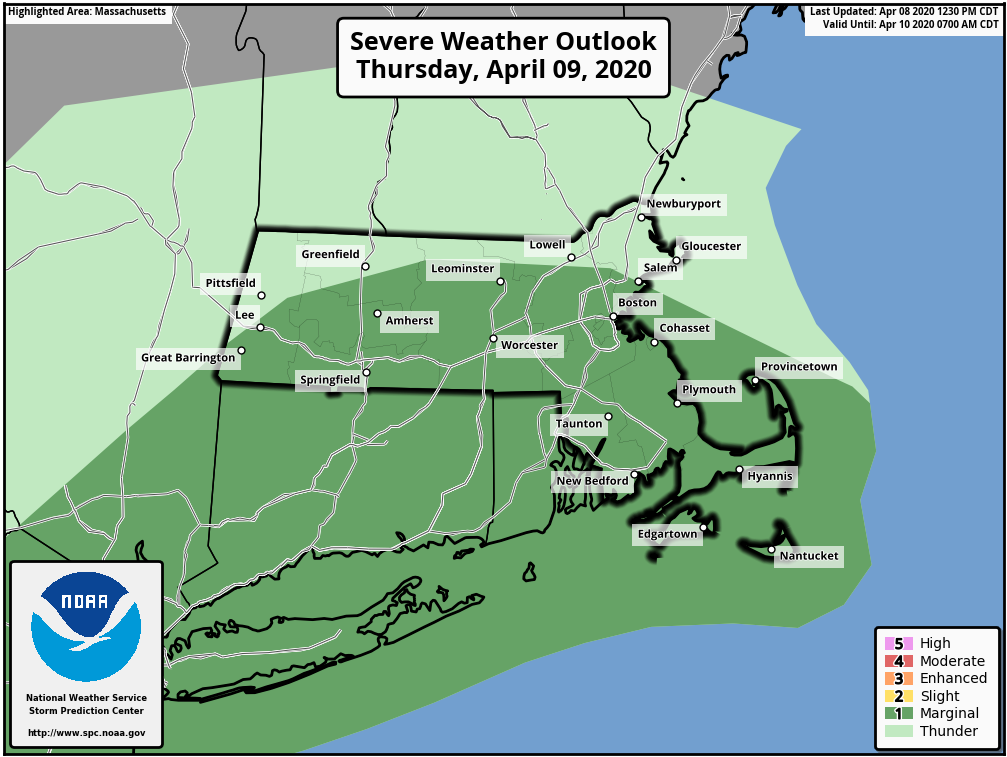
The Storm Prediction Center has placed most of Southern New England under a marginal risk for severe weather on Thursday. Image provided by the Storm Prediction Center.
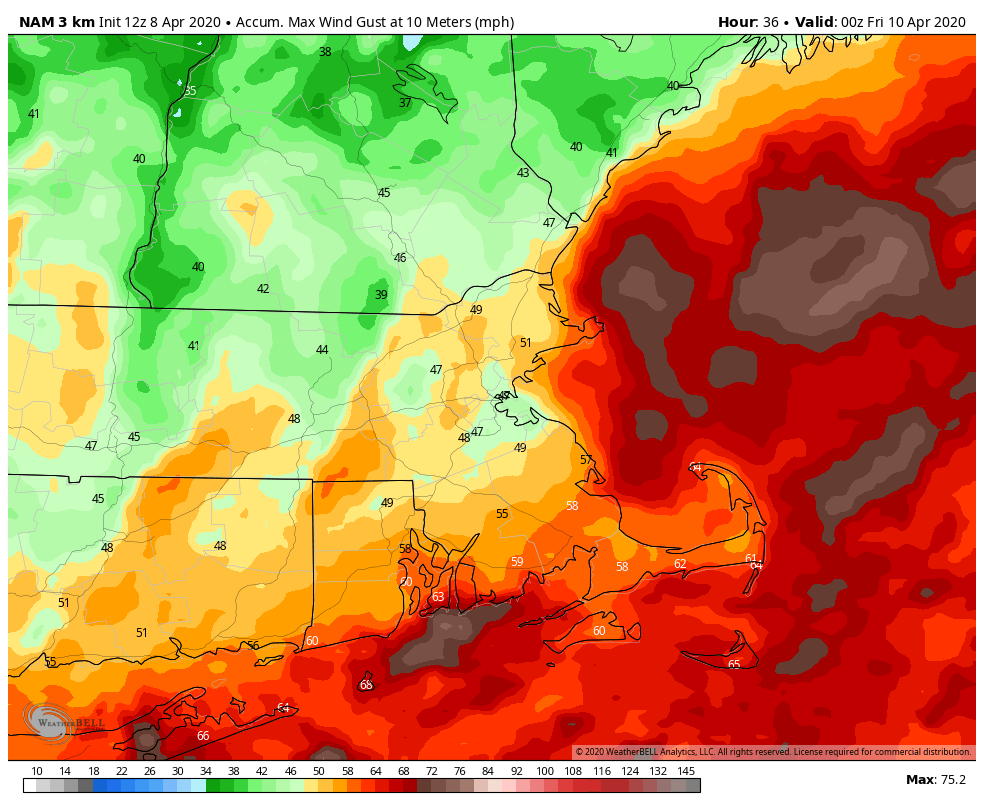
The rain and thunderstorms should come to an end by late afternoon, but that’s only half of the threat. A cold front will cross the region, with strong winds likely behind it. Sustained winds of 20-30 mph, with gusts of 40-50 mph or higher are likely. These winds may diminish a bit overnight, but will likely pick back up on Friday as the storm continues to intensify across eastern Canada. That upper-level low pressure area will also be overhead, so we’ll have plenty of clouds and a few showers popping up. With the cold air aloft, some of those showers could produce some small hail or graupel.
Wind gusts could exceed 50 mph in places Friday afternoon. Image provided by WeatherBell.
While we are dealing with strong winds and thunderstorms, it’ll be a completely different story across northern New England. Temperatures will be much cooler across Maine, New Hampshire, and Vermont, with much of the precipitation falling in the form of snow, especially in the mountains. Some of the snow will be quite heavy, with a foot or more possible, especially across Maine and northern New Hampshire. Winter Storm Watches are in effect for parts of the region. The snow will also be accompanied by strong winds, gusts to 40 mph or more, which may create blizzard conditions at times. There’s already little travel going on due to the pandemic, but there should be even less over the next few days.
Parts of northern New England, especially Maine and northern New Hampshire, could pick up more than a foot of snow Thursday into Friday. Image provided by WeatherBell.
The snow should wind down on Friday, but with the upper-level low in place, snow showers may continue. Some of those snow showers may spread into the Berkshires as colder air works its way in. Some wet snow is even possible into the Worcester Hills and Monadnocks.
High pressure will build in for the weekend with drier weather, but our next system looks to move in on Monday. That one looks like a rain-maker right now, and it might produce a decent amount of rainfall. We’ve been a bit dry this winter, so we need all the rain we can get right now to avoid slipping into a drought.
The warm and humid conditions we’ve had for much of the region over the past several days are going to continue today, but changes are coming, and the change may not be that quiet.
There is a slight risk of severe weather across much of the region today. Image provided by the Storm Prediction Center.
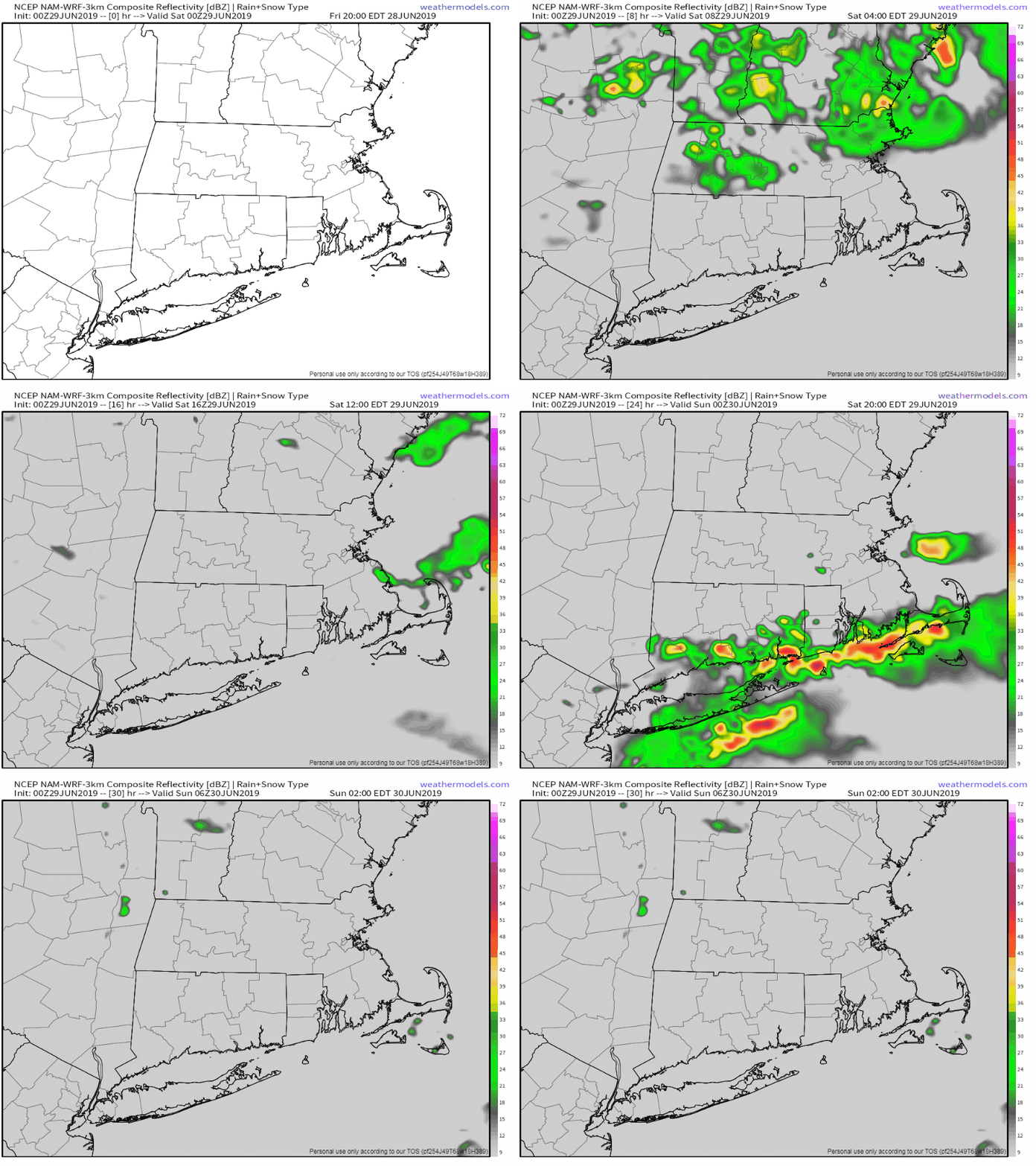
A weak cold front is going to approach the region today. The front may never make it across the area before it washes out, but it will help to trigger some strong to severe thunderstorms across parts of the region today. Right now, it looks like the most likely area for strong storms is from southeastern Connecticut into Rhode Island and southeastern Massachusetts. The most likely time for the storms in this area is from 11am to 3pm,, though some storms may continue through about 7pm.
The high-resolution NAM model shows the progression of storms across the region this morning and afternoon. Loop provided by weathermodels.com
The ingredients appear to be in place for some strong to severe thunderstorms to develop across the region. There are several different indices that meteorologists look at to help determine the risk for severe weather. We won’t confuse you with most of them, nor will we bore you with how they are derived. Most of these indices are indicating that the risk for today is real and significant. One of the parameters that we will share you you is called CAPE. That stands for Convective Available Potential Energy. It’s a measure of how unstable the atmosphere is, and how much “juice” is available to fuel the storms. It’s measured in joules per kilogram, and a value over 1000 means that the atmosphere is moderately unstable. If the values reach 2500 there is strong instability, and values over 4000 are indicative of extreme instability. as you can see in the map below, values of 2000-4000 (or more) are expected early this afternoon.
The High Resolution NAM model is showing CAPE values of 2000-4000 early this afternoon across New England. Image provided by WeatherBell.
Any storms that do develop this afternoon will likely contain heavy downpours, strong winds, and hail. There is even a risk for an isolated tornado. With the heavy rain, flash flooding is also a risk. So, if you’ve got plans that involve outdoor activities, make sure you keep an eye to the sky.
So, things will be better on Sunday, right? Not so fast my friends. We’ll have an upper-level low pressure area dropping southward from Canada. So, not only will it be cooler, we’ll have some more showers and thunderstorms developing. We don’t expect most of these to become severe, but with cold air aloft, we’ll have some of these storms produce small hail across the area. This is similar to what happened last Saturday, when another upper-level low moved through. There were numerous reports of small hail across the region. So again, if you’ve got outdoor plans on Sunday, keep an eye to the sky.
For the third year in a row, the “M” storm in the Atlantic is prepared to wreak havoc on a populated area, but Michael isn’t the only headline maker in the weather at the moment.
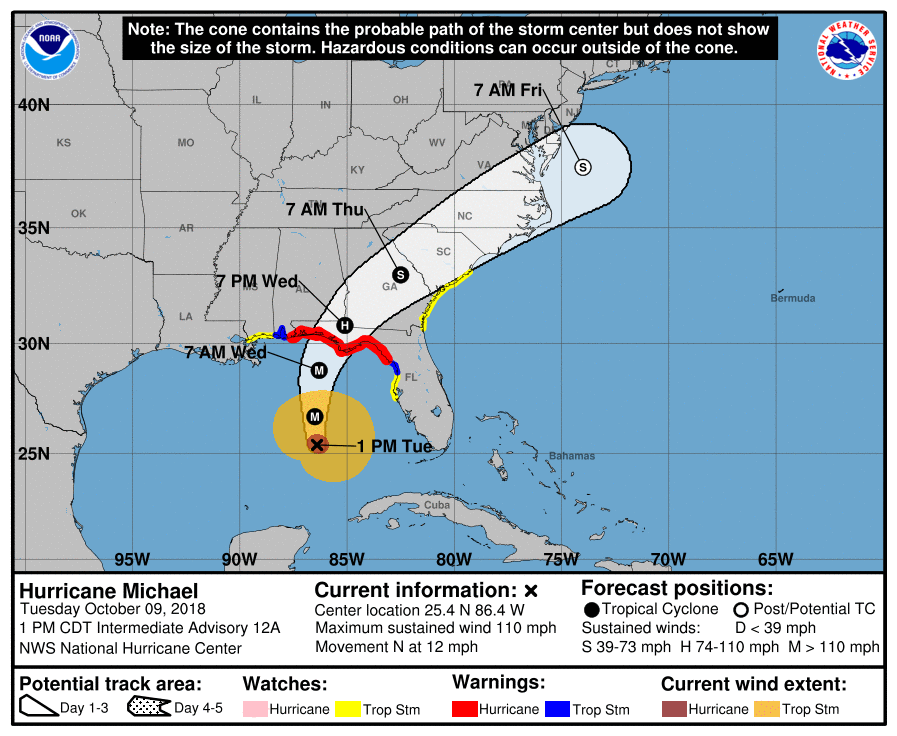
Hurricane Michael isn’t the only storm in the news, but it is the biggest threat at the moment. As of early Tuesday afternoon, Michael was centered about 335 miles south of Panama City, Florida, moving toward the north at 12 mph. Maximum sustained winds are near 110 mph, making Michael a Category 2 Hurricane. Additional strengthening is expected over the next 12-18 hours as the storm moves over the warm waters of the eastern Gulf of Mexico. Hurricane and Storm Surge Warnings are in effect for the Florida Panhandle and the Big Bend area of Florida, with Tropical Storm Warnings and Watches surrounding the Hurricane Warnings. Tropical Storm Watches are also in effect for the Atlantic coast from northeastern Florida into South Carolina.
Michael is going to pack quite a wallop when it slams into the Florida Panhandle Wednesday afternoon. Image provided by the National Hurricane Center.
Michael is expected to make landfall in the Florida Panhandle Wednesday afternoon, likely as a Category 3 storm. Strong winds, torrential rainfall, storm surge, and some tornadoes are all possible with this storm. Unlike Florence, which hung around the Carolinas for days and dumped incredible amounts of rainfall on the region, Michael is expected to keep moving at a steady pace, emerging off the Mid-Atlantic coast by Friday morning. Rainfall totals of 5-10 inches are still expected in parts of the region, which will produce flooding in some areas, especially in Carolinas, where many areas are still recovering from Florence. Right along the coast, a storm surge of 6-12 feet is possible, especially in the Big Bend area of Florida. Fortunately, this area is not heavily populated, but for the residents that do live in this area, storm surge flooding is a significant threat.
Once it moves back into the Atlantic early Friday, it should pass well south of our area. The northern edge of the rainfall from the system could reach the South Coast, but the bulk of the heavy rain should remain well to the south.
This is the 3rd year in a row that the “M” storm is expected to result in significant damage to a populated area. In 2014, Category 5 Hurricane Matthew left a path of death and destruction across parts of Haiti, Cuba, the Bahamas, and eventually parts of the southeastern United States. Last year, Category 5 Hurricane Maria devastated the northeastern Caribbean, including Puerto Rico and the US Virgin Islands. While Michael is not expected to become a Category 5 storm, it is still expected to result in significant damage to parts of Florida and the Southeast.
Tropical Storm Leslie has been around for near 2 weeks and still looks rather healthy. Loop provided by NOAA.
Meanwhile, in the eastern Atlantic, Tropical Storm Leslie refuses to go away. As of midday Tuesday, Leslie was centered a little more than 1000 miles west-southwest of the Azores, moving toward the south-southeast at 13 mph. Maximum sustained winds are near 65 mph. The forecast for Leslie calls for a turn more toward the east over the next few days while it strengthens back into a hurricane. Leslie is expected to remain over open waters for the next few days, and could become an extratropical storm this weekend while continuing on a general easterly track.
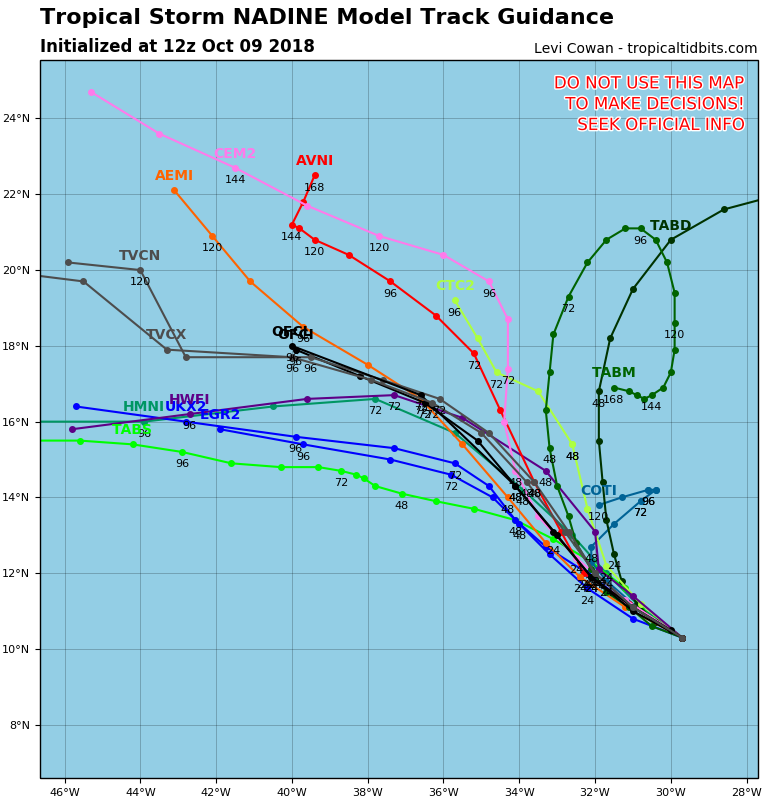
Nadine is a fish storm. Nothing to worry about here. Image provided by Tropical Tidbits.
To the south, Tropical Storm Nadine as formed nearly 500 miles southwest of the Cabo Verde Islands. Nadine has maximum sustained winds near 40 mph, and is moving toward the west-northwest at 9 mph. Nadine is expected to remain fairly weak over open waters for the next several days while turning more toward the northwest. As it moves over colder water late this week and this weekend, it should weaken and eventually dissipate.
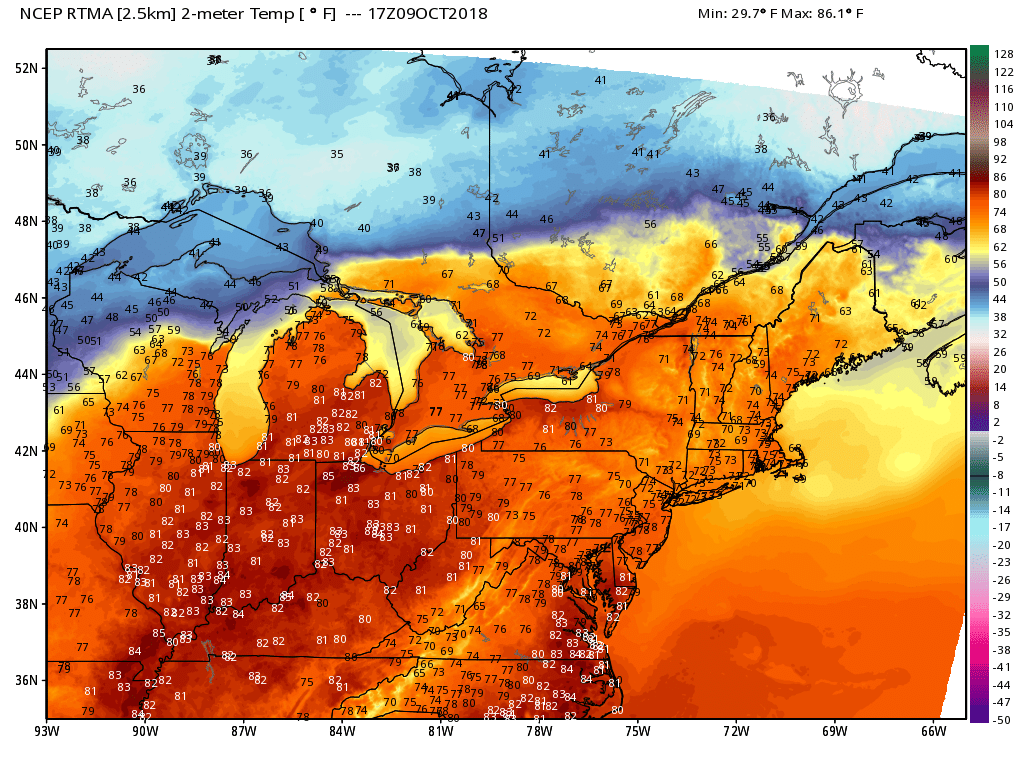
What month is it again? 70s and 80s early in the afternoon on October 9th? Image provided by WeatherBell.
Back in the United States, unseasonably warm conditions remain in place across much of the eastern half of the nation. Temperatures are in the 70s and 80s across much of the region, which is 15 to 25 degrees above normal. A strong frontal system is located in the Plains states this afternoon, separating the warm air in the East, from much cooler weather behind it in the Plains and the Rockies. Right along this front, which hasn’t moved much for the past 24 hours, severe weather and heavy rainfall are common this afternoon.
That’s snow in Colorado, and heavy rain along with severe weather from Texas into the Central Plains this afternoon. Loop provided by WeatherTAP.
Several tornadoes have been reported already today, including a few in the Oklahoma City area, and more are expected later today and tonight. Heavy rainfall is also expected from Texas into the Central Plains and parts of the Upper Midwest. Rainfall totals of 1-3 inches and locally heavier may produce flash flooding in some areas. Flash flood watches are in effect for much of the region.
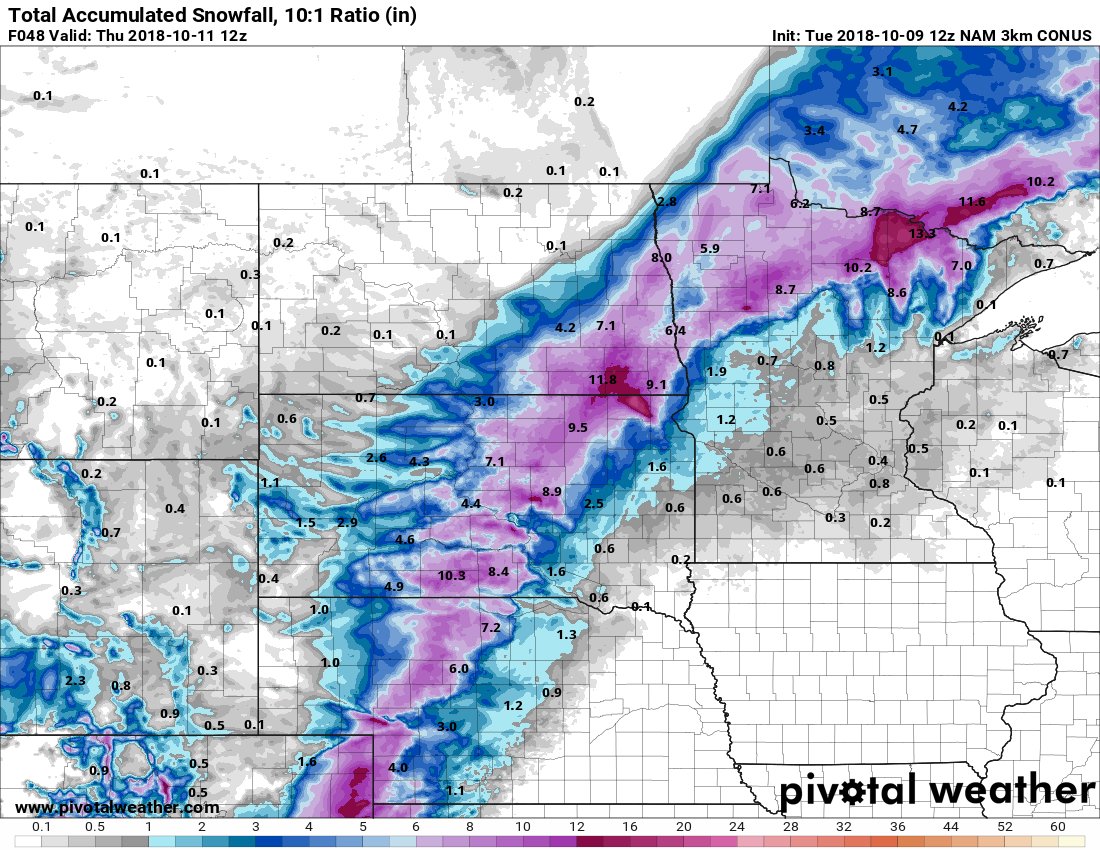
Several inches of snow is expected form the Plains into the Upper Midwest over the next few days. Image provided by Pivotal Weather.
On the other side of the front, where much cooler weather is in place, rain is expected to change over to snow as low pressure rides along the front and into the Midwest. Winter weather advisories have already been posted for parts of the region. Snow is already falling in parts of Colorado this afternoon, and several inches may fall over the next 36-48 hours from western portions of Kansas and Nebraska into the Dakotas and northern Minnesota.
Some heavy rain is possible across our area on Thursday as a strong cold front approaches the region. Image provided by WeatherBell.
As the system moves eastward, it will spread some heavy rain and thunderstorms into our area on Thursday. We’re not expecting any severe weather, but some heavy downpours are possible, especially from western Massachusetts into southern New Hampshire. Some localized flooding may result. Once this front pushes offshore, much cooler weather will settle in for the Friday and the weekend.
You know that dry weather we’ve had for much of the Spring and Summer? How about those warm days with low humidity? Well, both will be a distant memory by this time next week.
A weather pattern that is both typical and atypical of summer at the same time is going to settle into the nation over the next several days. The typical part is that we’ll have a ridge of high pressure off the East Coast, and another one in the Southwest. The ridge off the East Coast will result in heat and humidity up and down the coastline for the next several days. The ridge in the Southwest will bring very hot conditions to the Southwest and especially the Southern Plains, where record highs are expected over the next several days. The Atypical part is across the Midwest. Normally, in between the two ridges of high pressure you’d have a trough of low pressure, but in this case, we actually have a closed upper-level low pressure system. While these are common in the fall, winter, and spring, they usually don’t occur much in the summer. This will bring cooler than normal conditions into the Midwest for the next few days.
What is this, April? The upper-level pattern features ridges of high pressure in the Southwest and off the East Coast, and an upper-level low pressure system in the Great Lakes. Image provided by Pivotal Weather.
With high pressure anchored off the East Coast, a warm and humid pattern will set up for much of next week (and possibly longer). Notice that we said “warm”, and not “hot”. While temperatures will still be a little above normal this weekend into much of next week, highs will only be in the 80s to lower 90s for most of the Eastern US. While the temperatures won’t be that bad, humidity levels will. With high pressure anchored off the East Coast, a southerly flow will help moisture stream northward from the tropics right up the East Coast this weekend and into much of next week. Dewpoints will be in the upper 60s and 70s across the region, so even though temperatures may not be hot, it will feel oppressive across much of the region.
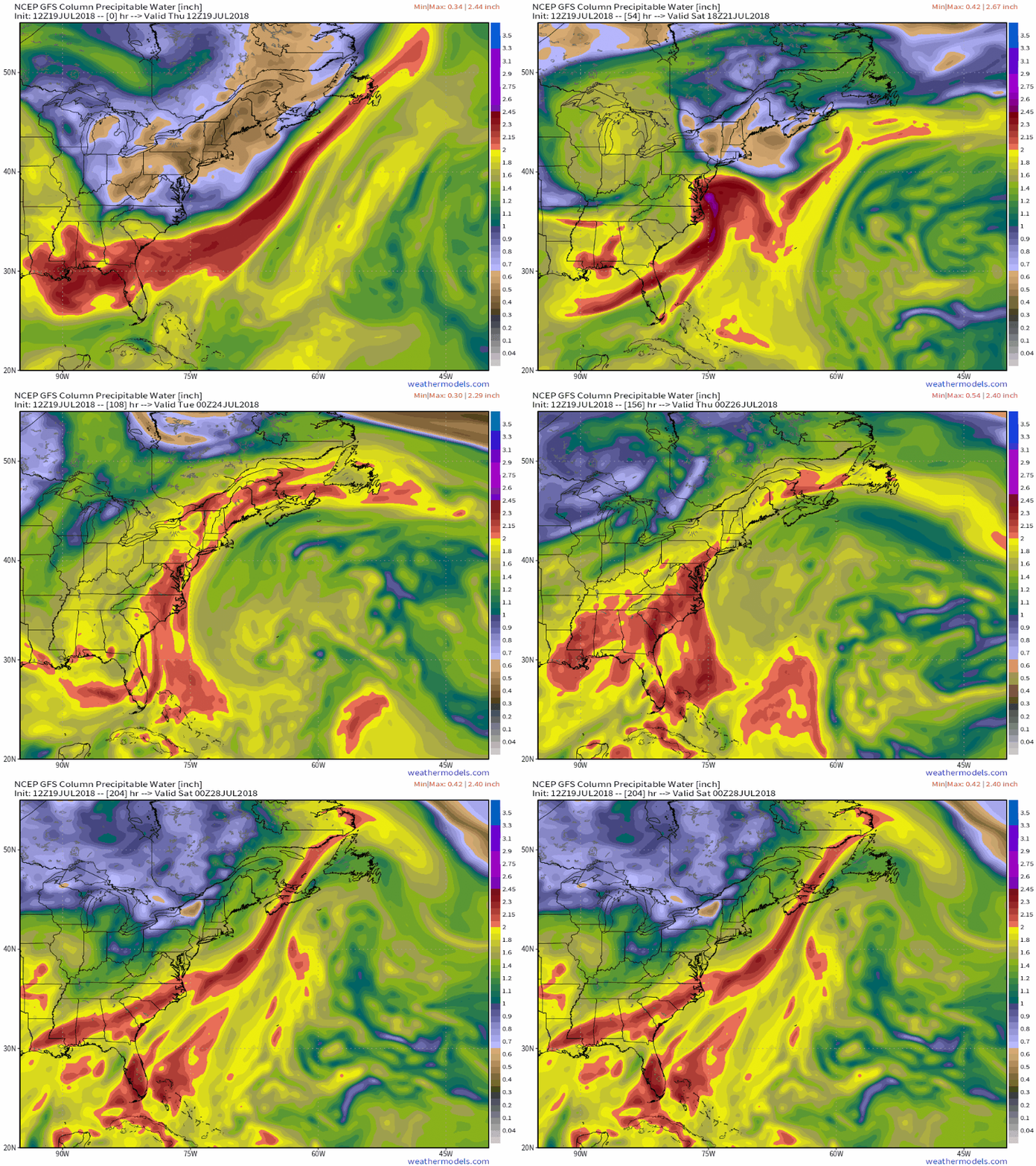
Moisture will stream northward from the tropics into much of the East Coast over the next several days. Loop provided by WeatherModels.com
With a warm and humid airmass in place for much of the week, it won’t take much for showers and thunderstorms to develop each day. With plenty of available moisture, some of these storms will end up producing very heavy rainfall. While the map above is a forecast that shows widespread coverage of heavy rain, in many cases, the storms will be very localized. Some locations could get hit by slow-moving thunderstorms over and over, while other spots a few miles away get little to no rainfall. Across the Mid-Atlantic States, where heavy rain led to flooding during the Spring, similar conditions are possible again for the next week. Across the Northeast, things are a little different.
That’s a lot of rain from the Carolinas northward over the next week or so. Image provided by College of DuPage.
Here in New England, and in New York too, much of the Spring and early summer has been very dry. Localized thunderstorms have brought heavy rain to a few spots, especially earlier this week, but overall, rainfall has been well below normal across the area. Some relief will come this weekend. A weak low pressure system will move across the region late Saturday into Sunday as an upper-level low pressure system moves into the Midwest. The surface low will bring heavy rain and some gusty winds to parts of Southern New England and southeastern New York. The heaviest rain is expected late Saturday night into early Sunday morning, so neither day should be a complete washout. Once that system moves by, a warm and humid airmass will settle in, with a daily chance for showers and thunderstorms this week. Again, some places could get drenched, and some might get missed completely. Some could see off-and-on showers and storms for 6 hours, some could get a shower that lasts 6 minutes. Basically, it’ll be like living in Florida for a week, without having to worry about looking outside and finding an alligator in your swimming pool.
It’s been very dry across New England and New York for a few months now, with drought conditions developing. Image provided by the National Drought Monitor.
Think warm and humid conditions with a daily chance of thunderstorms isn’t fun? It could be worse. Normally, it’s hot across Texas and the Southwest during the summer. This week though, the ridge of high pressure that is currently setting up across the Southern Plains and Southwest will bring in temperatures that are well above normal. In fact, record highs are expected for the next several days across much of Texas, as temperatures soar past 100 across much of the state, with some locations possibly exceeding 110 degrees. Unlike when the models were forecasting those temperatures here a few weeks ago, this time it’s going to happen. The heat won’t be confined to the Lone Star State either, with triple-digit highs also expected from parts of the Lower Mississippi Valley into the Southern Plains as well as parts of Colorado and New Mexico. There won’t be much, if any, relief at night either, as low temperatures will stay in the 70s, with many locations, especially urban areas like the Dallas-Fort Worth Metroplex likely not dropping below 80 degrees for low temperatures.
Friday looks to be the hottest day across the Southern Plains and Texas, with many record highs expected to be broken. Image provided by WeatherModels.com
As we head into next week, the heat will ease a bit across Texas and the Southern Plains, but the core of the intense heat will shift westward into the Desert Southwest. High temperatures will top 110 degrees across much of the area for the first half of next week, with the usual hot spots such as Lake Havasu City, Arizona; Laughlin, Nevada; and Death Valley, California likely exceed 120 degrees during some of the afternoons. Highs will also top 100 across much of interior California once again. Anyone wanna place a bet as to whether Death Valley reaches 125? Better yet, will they have a night where the temperature doesn’t drop below 100 (it’s happened before)?
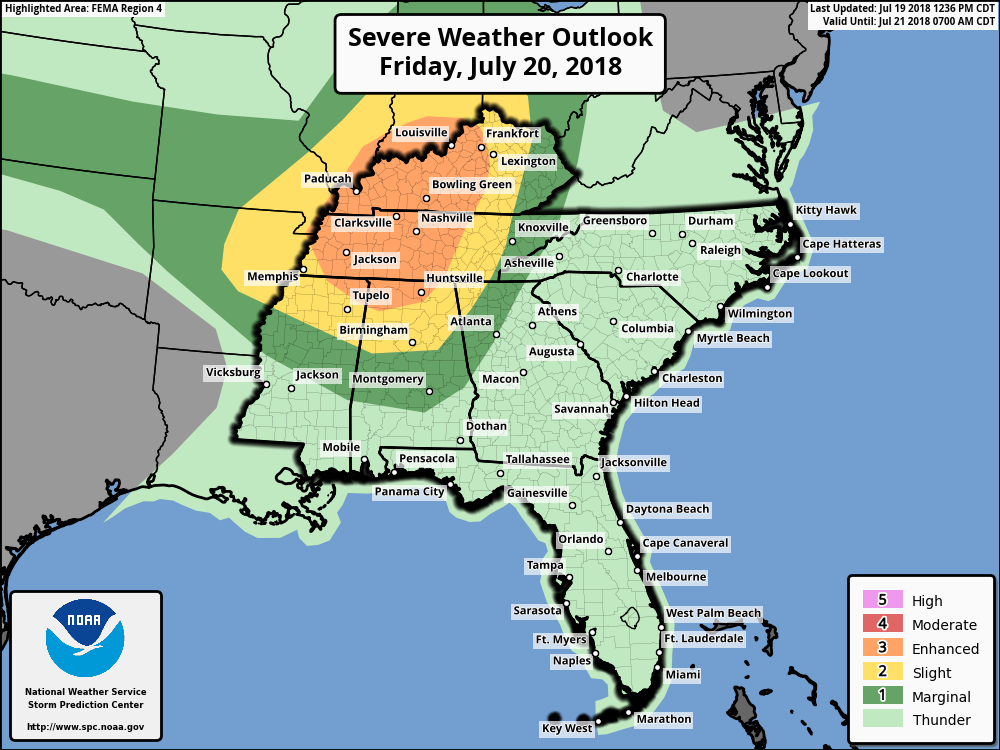
A severe weather outbreak is possible on Friday across the Ohio and Tennessee Valleys. Image provided by the Storm Prediction Center.
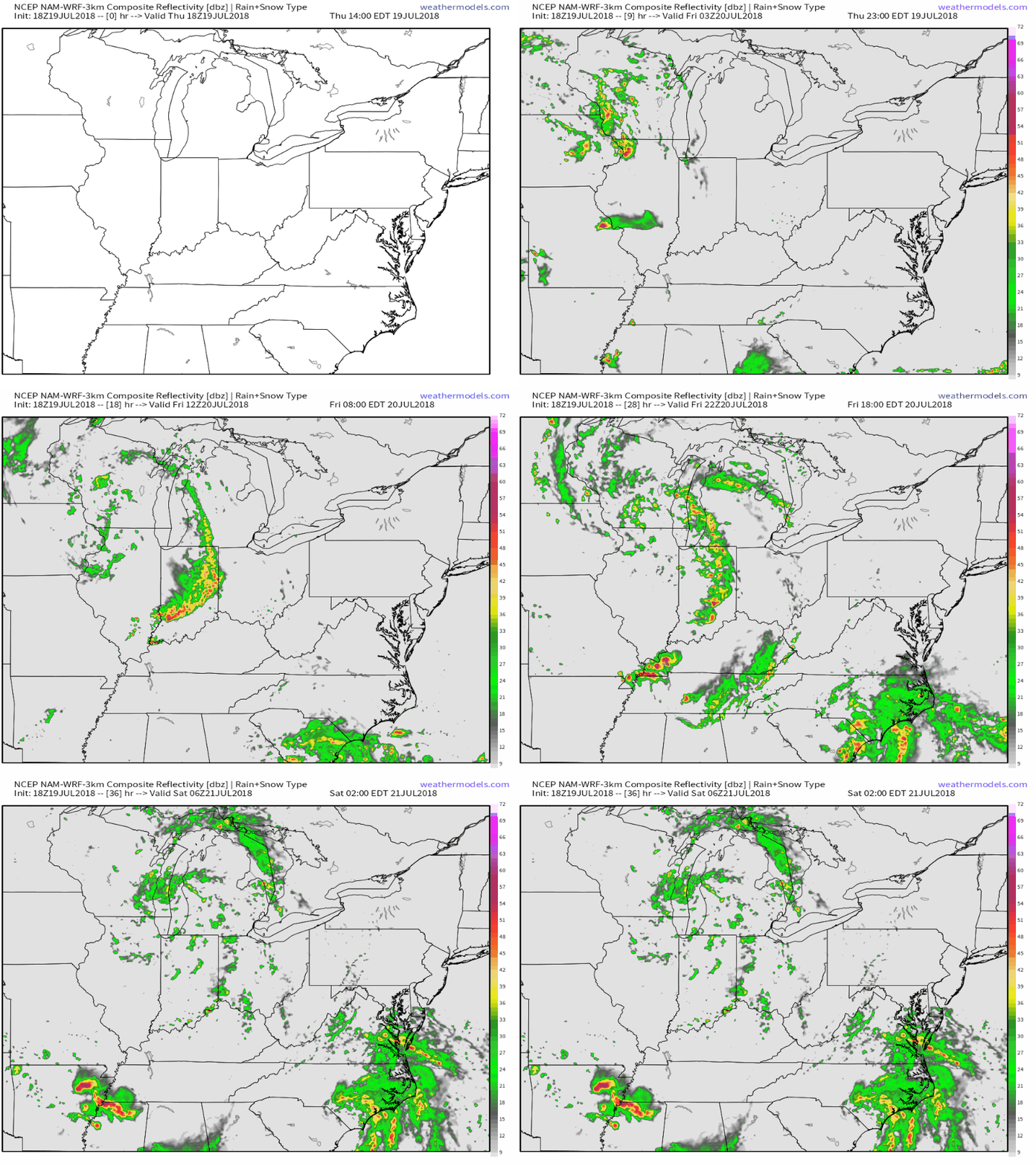
Meanwhile, an upper-level low pressure area will settle into the Midwest. With the clash in airmasses along a cold front, showers and thunderstorms will develop. Some of these storms will become strong to severe on Friday, especially across the Ohio and Tennessee Valleys. The main threats with any storms that develop will be strong winds, large hail, and torrential rainfall that could trigger flash flooding. Some tornadoes are also possible. The storms may start during the morning closer to the Great Lakes, with the afternoon and evening seeing the most widespread activity across the region. While activity should weaken at night, the threat of severe weather will continue across southern and eastern parts of the region.
Strong to severe thunderstorms are expected across the Midwest on Friday. Loop provided by WeatherModels.com
As these storms crossed the Midwest today, they produced wind gusts to 90 mph and more than 30 tornadoes across Iowa. The town of Marhsalltown was devastated by a tornado earlier today. How bad was it? We’ll end this post with the Storm Report from the National Weather Service Office in Des Moines with the description of what happened in Marshalltown:
REPORTS OF CATASTROPHIC DAMAGE, INCLUDING
VEHICLES MISSING, VEHICLES OVERTURNED, TOPS
OF BUILDINGS GONE, TREES DOWN, POWER LINES,
GAS LINES, ETC...
No, we’re not expecting anything like that across the region this afternoon, but if you’ve got outdoor plans, you may want to keep an eye to the sky – we’ve got thunderstorms coming, and some of them could be strong to severe.
It’s a little humid for mid-May, but temperatures in the 70s to lower 80s at midday are pretty nice. Image provided by NOAA.
We’ve got a rather nice day in progress across the region, but changes are coming. At midday, temperatures are generally in the 70s to lower 80s away from the coastline, where seabreezes are keeping temperatures in the 50s to lower 60s. Dewpoints are creeping up, generally in the 60s now, which is humid by mid-May standards. We’ve also got plenty of sunshine, so temperatures should continue to climb into the afternoon. However, a cold front is starting to approach from the west. An area of showers and thunderstorms is moving into western Massachusetts at midday, and though these should weaken, they will spread cloud cover in, with some rain possible across northern Massachusetts and southern New Hampshire early this afternoon.
The HRRR simulates what the radar should look like as we head through the afternoon and evening. Loop provided by WeatherModels.com
As that cold front approaches, a stronger line of thunderstorms is expected ahead of it. As you can see in the radar simulation above, this line should enter our region during the 5-8pm time frame, also known as the evening rush hour. Some of these storms will contain strong winds, heavy downpours, and frequent lightning. That will likely make the commute home for many people even worse than normal.
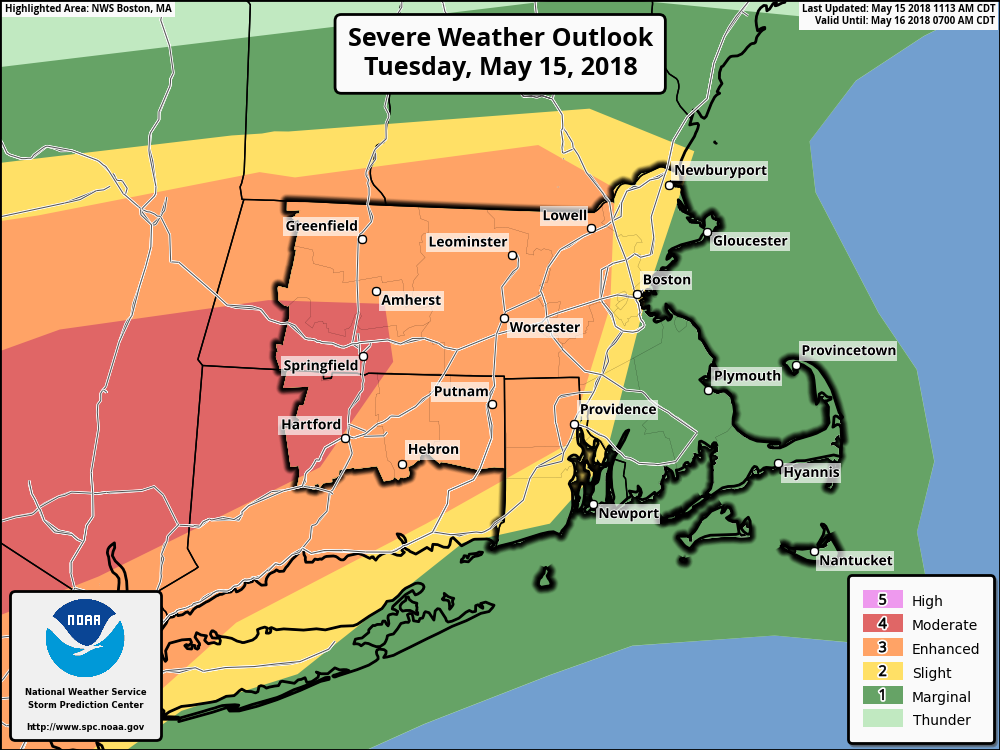
There is a moderate risk of severe weather across much of interior Southern New England this afternoon. Image provided by the Storm Prediction Center.
If it were just rain, wind, and lightning, it wouldn’t be a big deal. The problem is, it might be more than “just rain wind, and lightning.” Well away from the coastline, conditions will be favorable for severe thunderstorms to develop ahead of the front. As we mentioned in our Weekly Outlook, we still think the best odds for severe weather are from the Mid-Atlantic states into southeastern New York and western New England, but some severe storms could survive into eastern New England late this afternoon and evening. These storms should start to weaken quickly as they approach the coastal plain, but from interior Rhode Island into Central Massachusetts, the I-495 Belt of eastern Massachusetts, and Southern New Hampshire, we could see some fairly strong thunderstorms. We’ve already mentioned the frequent lightning and heavy downpours, but in the places we just mentioned, winds could gust to 60 mph or more with some of the stronger storms, which could result in more damage to places that already had lots of tree damage earlier this month.
There is a low chance for a tornado or two this afternoon with some of the stronger storms. Image provided by the National Weather Service.
In addition to the threats we listed in the last paragraph, there is also a low (but non-zero) threat for am isolated tornado or two this afternoon. No, we’re not expecting a tornado outbreak, but a brief tornado or two could spin up, especially across central and western portions of New England. In fact, if we do get one, it wouldn’t even be the first one this year in New England. Just last night, we found out that on May 4, a tornado tracked 35 miles through mostly (but not all) rural western and central New Hampshire.
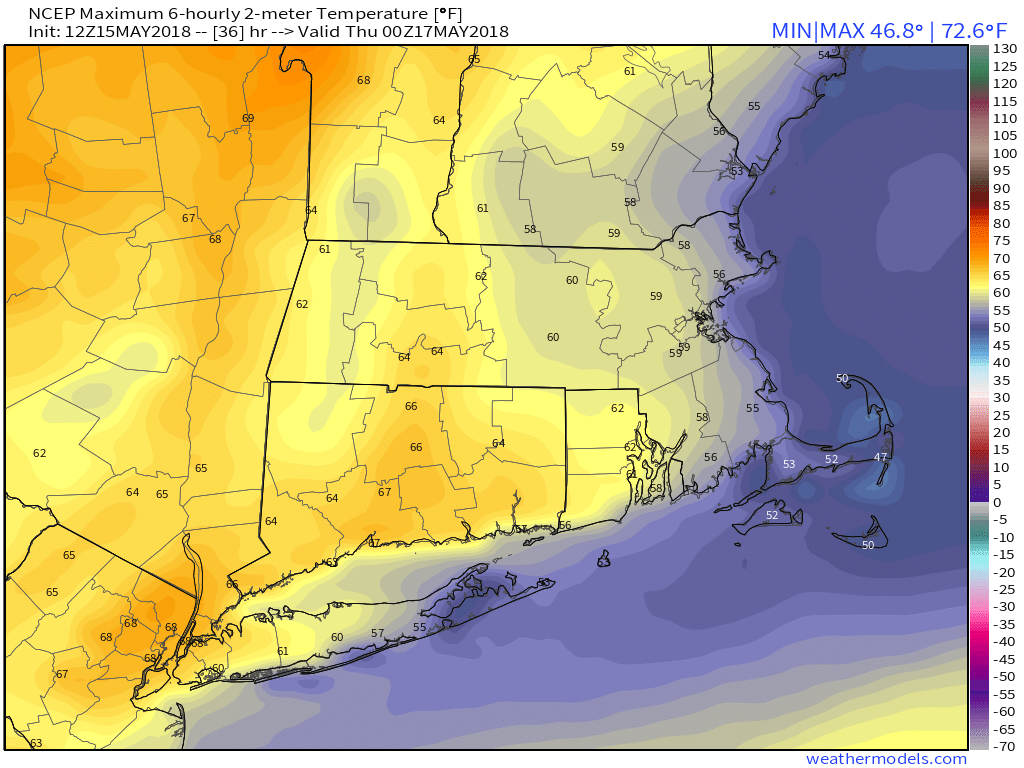
Temperatures on Wednesday will be 20-30 degrees cooler than today. Image provided by WeatherModels.com
Behind the front, Wednesday will be a much cooler day. Easterly winds and some cloud cover will keep temperatures in the 50s along the coast, lower 60s inland. Sunshine and warmer temperatures will return on Thursday, so you’ll only have one day to complain about.
As we start a new week all eyes will literally be looking at the sky. As you may have heard, there’s an eclipse today. The weather will cooperate, as high pressure provides us with sunshine, so viewing it shouldn’t be a problem. You’ve probably also heard plenty of people warning you not to look directly at the sun during the eclipse. Since you’ve heard it enough already, we won’t say it. Besides, if you want to look at the sun, we won’t stop you. Eyesight is overrated anyways. Plenty of people live without it. If that’s what you want, who are we to stop you? You’ll still be alive and free to go golfing in the middle of the thunderstorms we’re expecting on Tuesday. Don’t worry, they’ll likely be coming at night, so even if you were golfing, you wouldn’t be able to find the ball if you had eyesight.
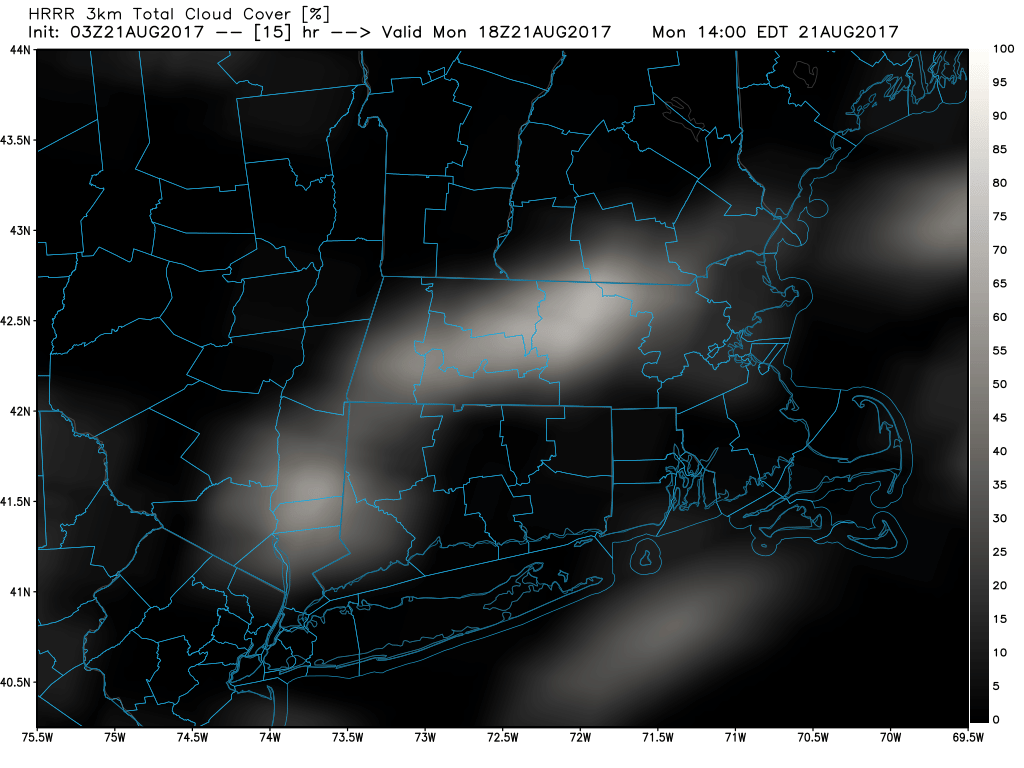
Cloud cover forecast from the HRRR model for 2pm Monday. Just a few clouds around, which shouldn’t impact eclipse viewing much. Image provided by WeatherBell.
Now that we’ve given you the teaser and the sarcasm, let’s get to the details. We start the week off with high pressure, giving us a fantastic Monday. A cold front approaches on Tuesday, producing showers and thunderstorms, mainly at night. A few of these storms could be quite strong, but with the activity mostly expected at night, that should limit the potential for severe weather. Of course, that doesn’t mean you should let your guard down. These storms still could produce heavy downpours, but severe weather is still possible at night. In fact, Tuesday marks the one year anniversary of the tornado that impacted Concord, MA at 3:20 in the morning.
A rare overnight tornado impacted Concord, MA one year ago tomorrow. Image provided by the National Weather Service office in Taunton, MA.
The showers and thunderstorms will taper off and end early Wednesday as a cold front crosses the region, then things get quiet again. We’ll dry out Wednesday afternoon but it will remain warm. We’ll cool off a little more on Thursday as an upper-level trough of low pressure settles into the Northeast while high pressure does at the surface, which will result in some cool days for Friday and the weekend.
Monday: Sunshine and a few afternoon clouds, dimmed for a while by a passing moon in the afternoon. High 82-89.
Monday night: High clouds overspread the region. Low 64-71.
Tuesday: Clouds thicken up, with some showers and thunderstorms possible late in the day. High 85-92.
Tuesday night: Showers and thunderstorms likely, some of which could contain heavy downpours and gusty winds. Low 68-75.
Wednesday: Showers and thunderstorms end in the morning, then skies clear out in the afternoon. High 78-85.
Thursday: Sunshine and some afternoon clouds. High 74-81.
Friday: A sunny start, then clouds start to pop up with a slight chance for a spot shower in the afternoon. High 71-78.
Saturday: A mix of sunshine and clouds. High 70-77.
Sunday: Partly to mostly sunny. High 70-77.
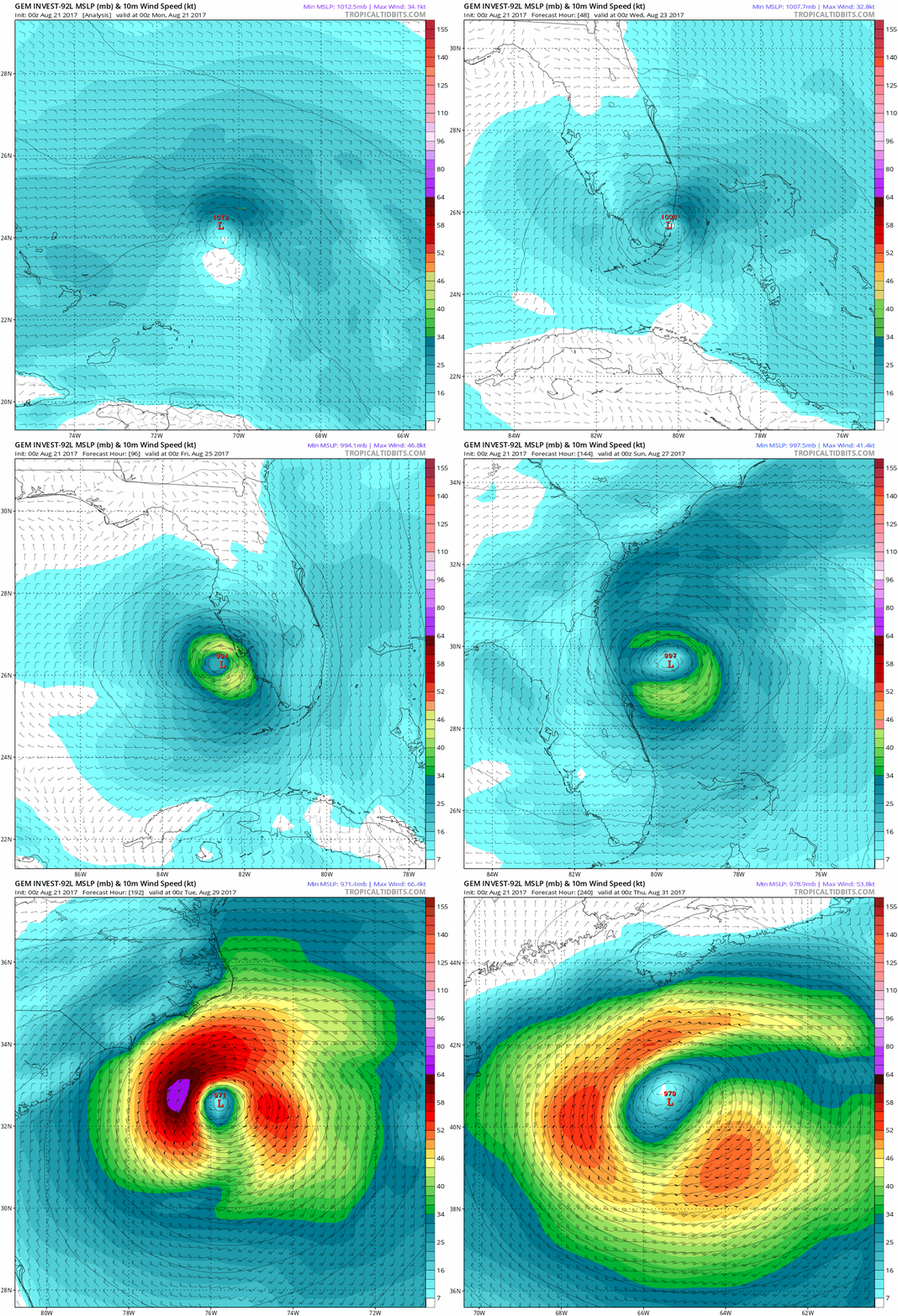
Finally, we get to a topic that doesn’t impact this week’s forecast, but could have an impact early next week. For several days now, the Canadian model has been extremely insistent on a tropical disturbance developing near the Bahamas and eventually moving northward, up the East Coast early next week. There have been a few reasons to ignore this for the past few days:
This was the only model showing this feature.
The Canadian model always seems to take every little ripple in the tropics and blow it up into a hurricane.
So, why are we mentioning it now? There are a few reasons.
Other models are starting to show the potential for something to develop near the Bahamas or Florida late this week or early next week.
The Canadian model has been slightly better than many of the other models in regards to the tropics so far this season.
It’s had this feature with very little variation for at least 6 consecutive model runs.
That last point is the main reason why we at least feel the need to mention it. This model has not really wavered much at all, and consistency is one of the things we look for in a model before we start to trust its solution. Add in the fact that other models are starting to come around, and well, it’s something we need to keep an eye on. This does not mean that a massive hurricane is going to wipe out the East Coast just before Labor Day. If anything does materialize, we’ll obviously keep you informed, but for now, it’s just something to keep in the back of your mind. (Of course, now that we’ve mentioned it, the next run of the Canadian model will likely change its tune completely)
Forecast for Atlantic Disturbance 92L based on the Canadian GEM model initialized Sunday evening. Loop provided by Tropical Tidbits.
We’ll have perfect weather for fireworks displays on the Fourth of July.
We’ve made it to July, and the stubborn pattern we had for much of the Spring and well into June is finally gone.
We’ll start right off with the forecast for Tuesday, since that’s the day people are most interested in. Planning a barbecue? Perfect weather for it. Heading into the pool or to the beach? Bring the sunscreen. Watching fireworks in the evening? No problems expected. Stuck working because your chosen profession doesn’t take holidays? Sucks to be you, but don’t expect anyone to feel bad for you.
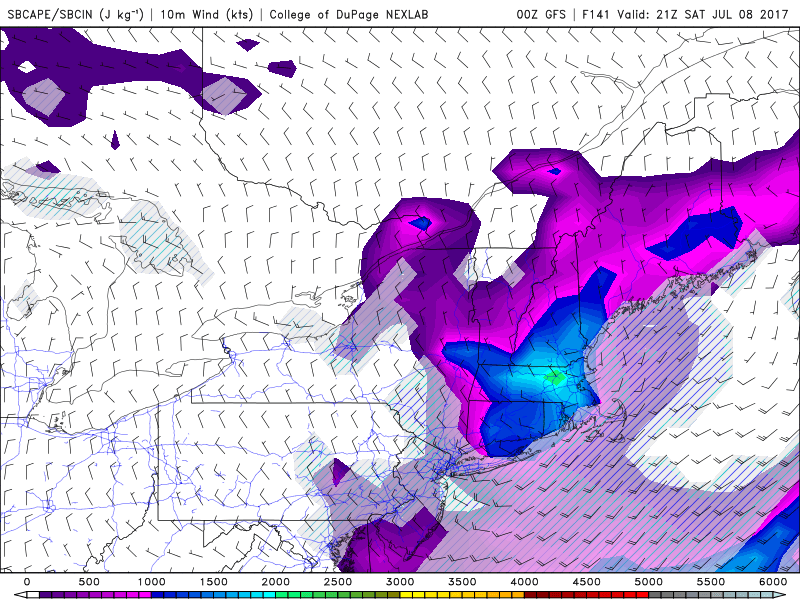
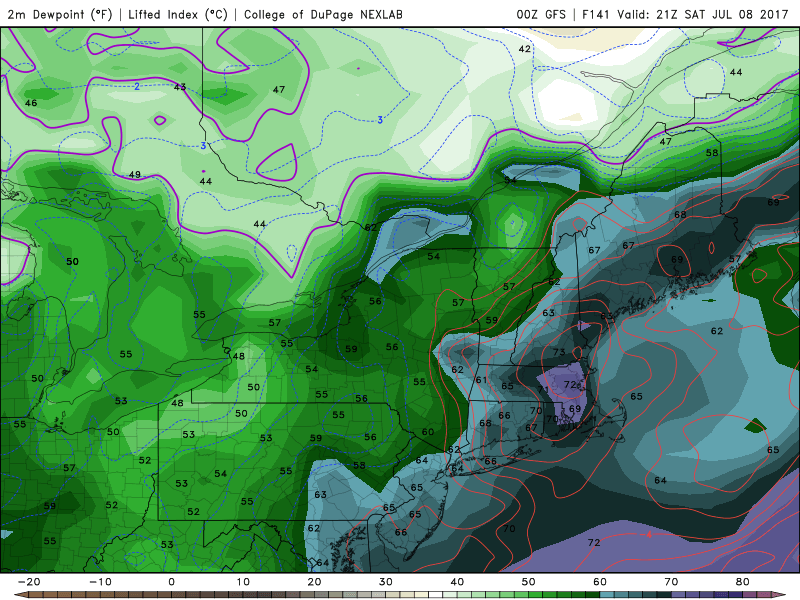
As for the rest of the week, sunshine and warm temperatures will be here for the next few days, along with low humidity, as high pressure builds in across northern New England. There is a slight chance for a shower or thunderstorm this afternoon as a weak upper-level disturbance moves through, mainly along the South Coast. However, the bulk of the activity looks like it should remain well to our south and west. As the high slides offshore later this week, humidity will start to creep back into the region. With humidity comes the risk for afternoon showers and thunderstorms. That risk looks to be the greatest Friday and Saturday as another cold front starts to approach the region. While it’s still a bit early, and the timing of the front will play a critical role, we wouldn’t be surprised to see some severe storms develop on Saturday, if everything comes together. We’ll monitor this as the week progresses. High pressure will build in behind the front with drier conditions for next Sunday.
A moist and unstable airmass may be in place ahead of a cold front next Saturday, which could help to produce strong to severe thunderstorms. Image provided by the College of Dupage.
A moist and unstable airmass may be in place ahead of a cold front next Saturday, which could help to produce strong to severe thunderstorms. Image provided by the College of Dupage.
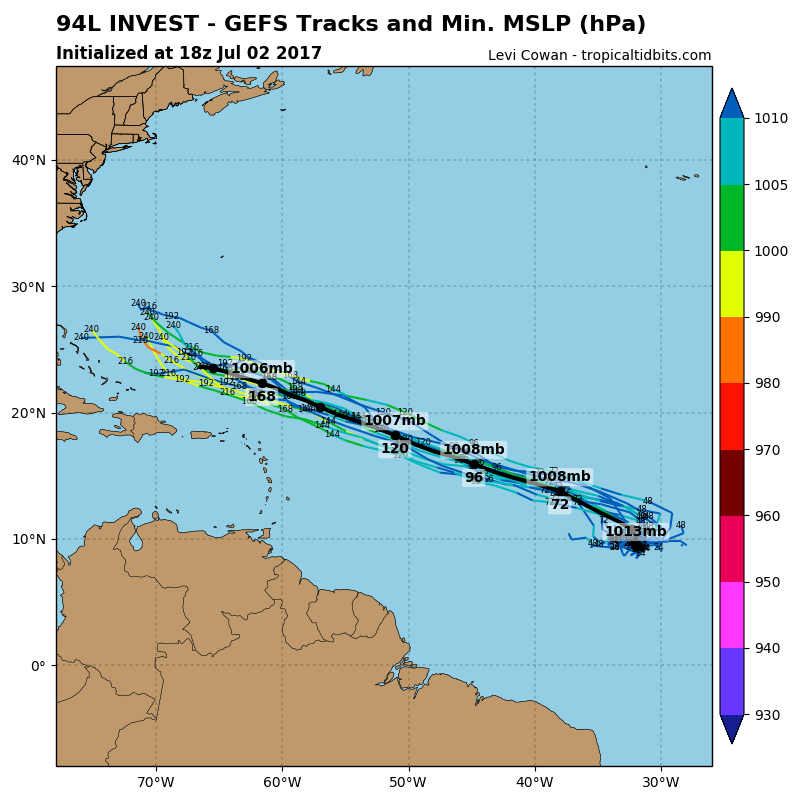
While we’ve got a fairly simple forecast here for most of the week, things are starting to cook out in the Atlantic. A tropical disturbance located well east of the Lesser Antilles has the potential to develop into a tropical depression later this week. There’s nothing to worry about now, but some of the models (not all), try to develop the system into a hurricane at some point, and possibly become a threat to the East Coast or Bermuda about 2 weeks from now. The odds of this happening are still pretty low, so we wouldn’t worry about it too much, but we’ll certainly keep our eyes on this system, as well as the rest of the tropics.
GFS Ensemble forecasts for the track of a tropical disturbance in the Central Atlantic. Image provided by Tropical Tidbits.
Monday: A mix of sun and clouds, just a slight chance for an afternoon shower or thunderstorm near the South Coast. High 81-88.
Monday night: Clear to partly cloudy. Low 58-65.
Tuesday: Sunshine and a few clouds. High 77-84.
Tuesday night: Clear skies. Perfect weather for fireworks in the evening. Low 55-62.
Wednesday: Mostly sunny. High 78-85.
Thursday: A sunny start, then clouds develop along with the chance for some afternoon showers and thunderstorms, becoming humid. High 77-84.
Friday: A mix of sun and clouds, humid, chance for some afternoon showers and thunderstorms. High 80-87.
Saturday: Partly sunny, more showers and thunderstorms are possible. Some of the storms could be strong to severe in the afternoon. High 83-90.
Sunday: Mostly sunny with a few afternoon clouds, drier. High 75-82.
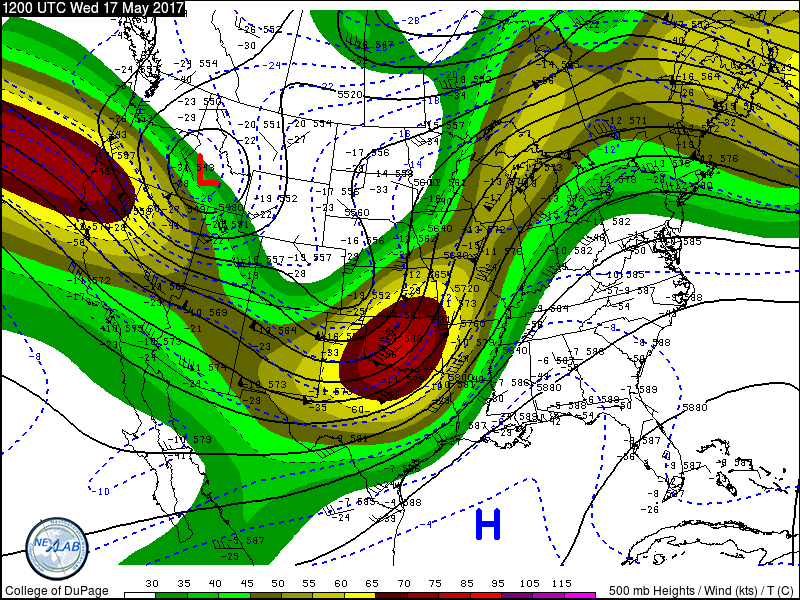
The current weather pattern across the country is one that is fairly typical of Spring. However, the results of that pattern are Winter in the Rockies and Summer in the East. In between, there is plenty of severe weather, which is fairly typical of Spring.
A ridge in the East, a trough in the West. Not that uncommon of a pattern. Image provided by College of DuPage.
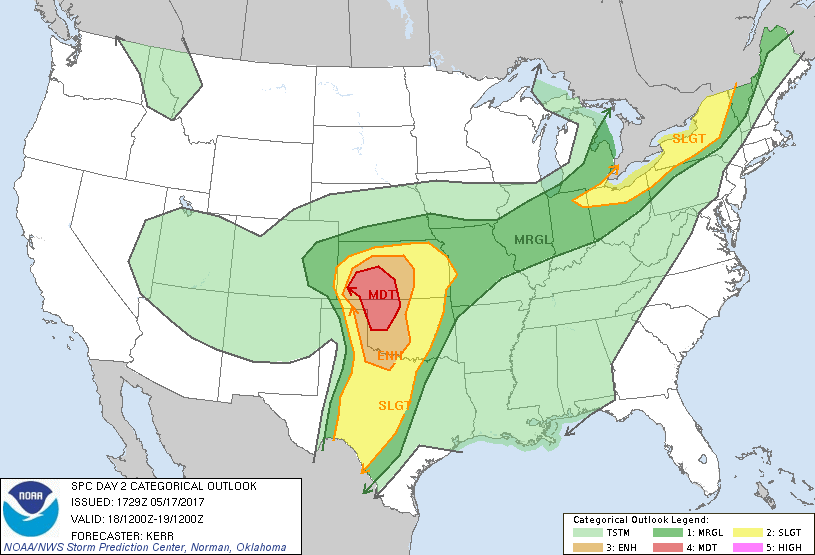
An upper-level low pressure area will move out of the Pacific Northwest and into the nation’s midsection over the next few days. While one storm system moves into the Upper Midwest today, a second one will develop east of the Rockies and move into the Plains states on Thursday. With cold air moving in behind these systems, and warm, moist air flowing northward from the Gulf of Mexico ahead of them, strong to severe thunderstorms are likely again for the next few days across the Plains states.
Thursday could be a very active day for severe weather in the Central and Southern Plains. Image provided by the Storm Prediction Center.
Severe weather has plagued the Plains states and Great Lakes for the past few days, with over 500 reports of severe weather between Monday and Tuesday. Nearly 30 tornadoes were reported, along with hail as large as softballs, and hundreds of reports of wind damage from gusts as high as 85 mph.
85 mph wind gust here at the office in Valley NE #newx
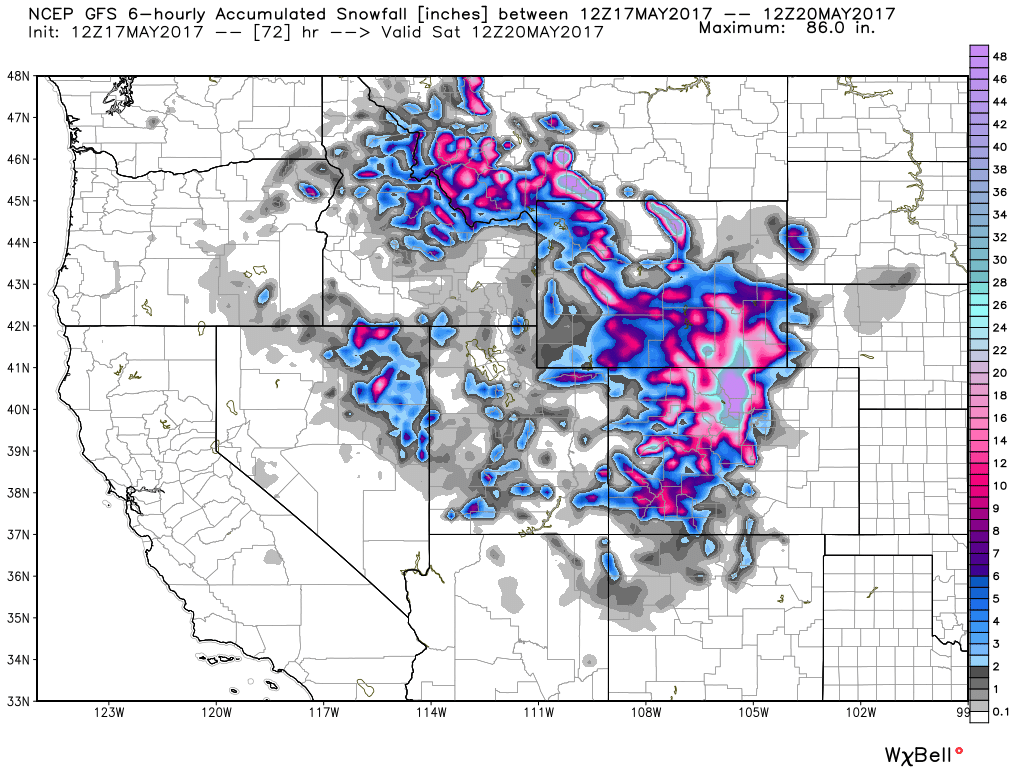
Behind the low pressure area, a late-season snowstorm is expected across the Rocky Mountains. Heavy snow will continue across portions of Montana and Idaho today, spreading into Wyoming and Colorado for Thursday into Friday. Across the higher elevations, totals of 1-3 feet are expected, which will keep the ski season going for a while longer. Snow may also spread into the High Plains of eastern Colorado and western Nebraska, with some minor accumulations possible. In Denver, it looks a couple of slushy inches may fall, though at least 1 model is forecasting much heavier amounts. In a normal year, Denver averages 1.7″ of snow, and the city has seen measurable snow during the month of May in 11 out of the last 16 years, so snow in May is not uncommon, though a heavy snowstorm, if it materializes, would be. Denver has only received 10 or more inches of snow in the month of May 6 times in a 135 years of records, with a record total of 15.5″ set back in May of 1898.
A late-season snowstorm may drop up to 3 feet of snow in the higher elevations of the Rockies. Image provided by WeatherBell.
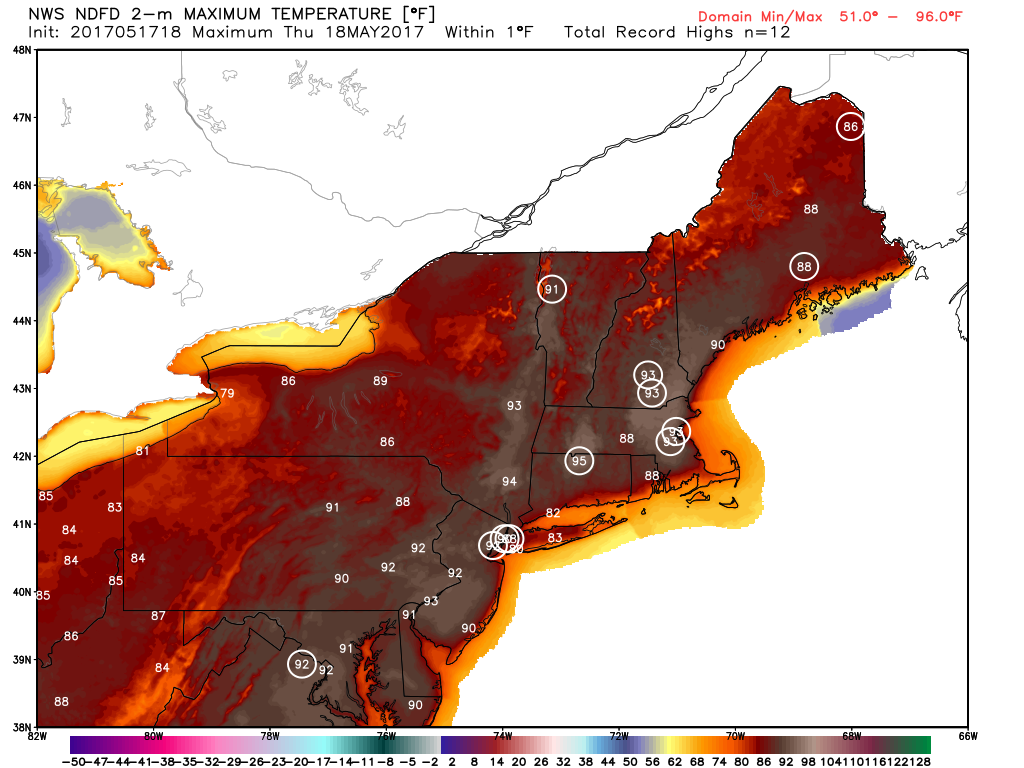
Meanwhile, in the East, an early taste of summer is ongoing, thanks to a ridge of high pressure aloft, and a surface high pressure area off the East Coast. Temperatures soared into the 80s and lower 90s on Wednesday, setting several records, but the hottest day for many locations will be Thursday. High temperatures will climb into the lower to middle 90s in many locations, likely breaking records across much of the region. When you combine the heat with dewpoints well into the 60s, it will definitely feel like a mid-summer afternoon across the region. A cold front will move through the area of Friday, possibly triggering a few showers and thunderstorms, but also sending temperatures back to where they should be in the middle of May.
A lot of record high temperatures may be broken across the Northeast on Thursday. Image provided by WeatherBell.
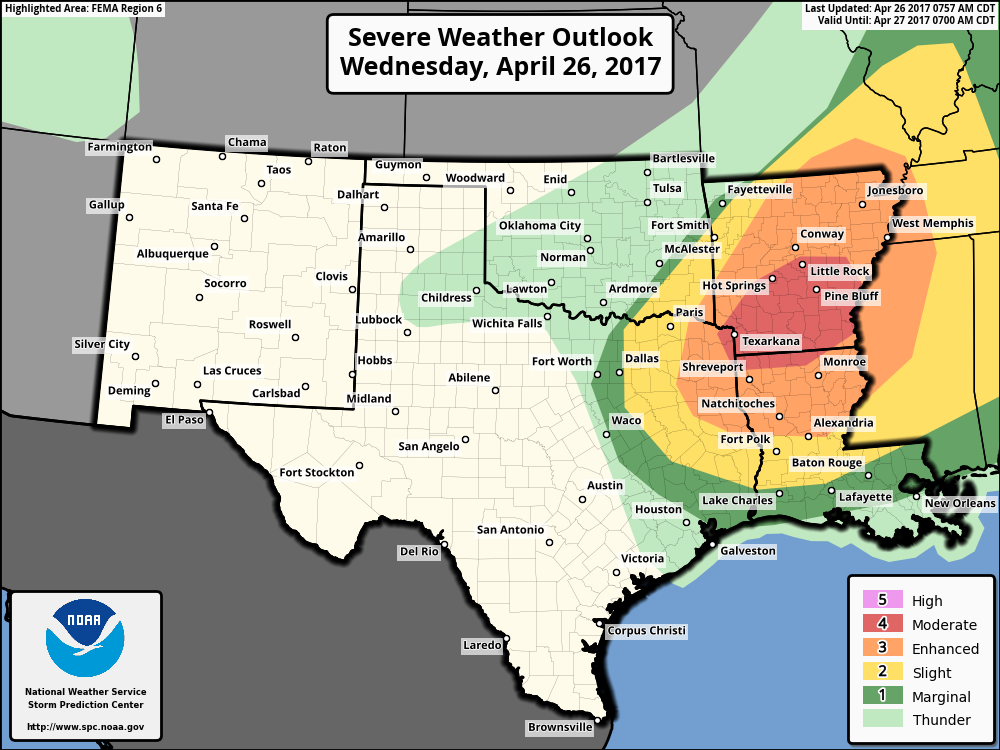
Severe weather is likely across portions of the Gulf Coast and Mississippi Valley today, but another, perhaps more widespread, outbreak is possible at the end of the week. While that is happening, a snowstorm might also be brewing in the Rockies. Spring can feature a little bit of everything across the nation.
Severe weather is expected across portions of the Mississippi Valley today. Image provided by NOAA.
A strong cold front is moving into the Mississippi Valley and Texas this afternoon, and it is helping to trigger strong to severe thunderstorms across portions of the region. Ahead of the front, temperatures are into the 70s and lower 80s, with dewpoints in the upper 60s and 70s, so there’s plenty of warm, moist air in place. Behind the front, temperatures quickly drop into the 40s and 50s. Thunderstorms will continue to develop in the unstable airmass ahead of the front, with some of the storms containing large hail, heavy downpours, damaging winds, and possibly some tornadoes. Earlier this morning, some storms produced baseball-sized hail and wind gusts in excess of 70 mph in portions of Missouri, Arkansas, and Oklahoma. The threat should start to diminish across the region as we head into the overnight hours.
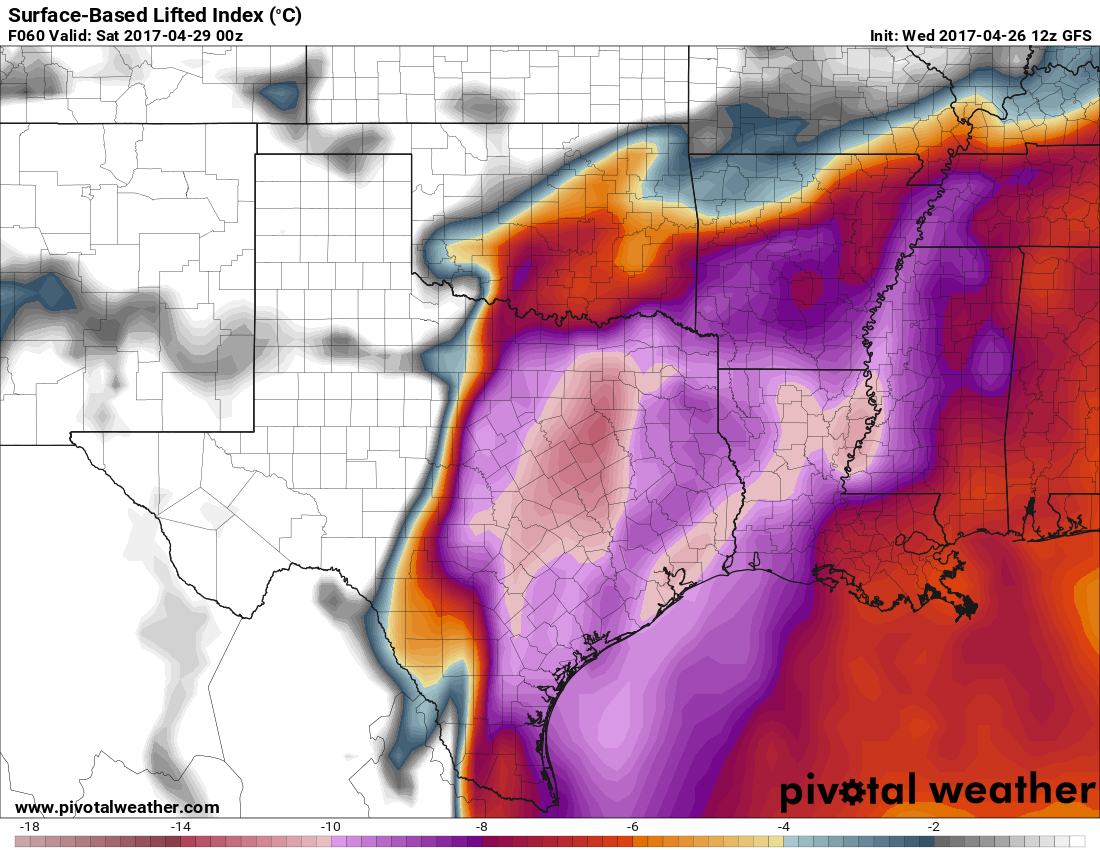
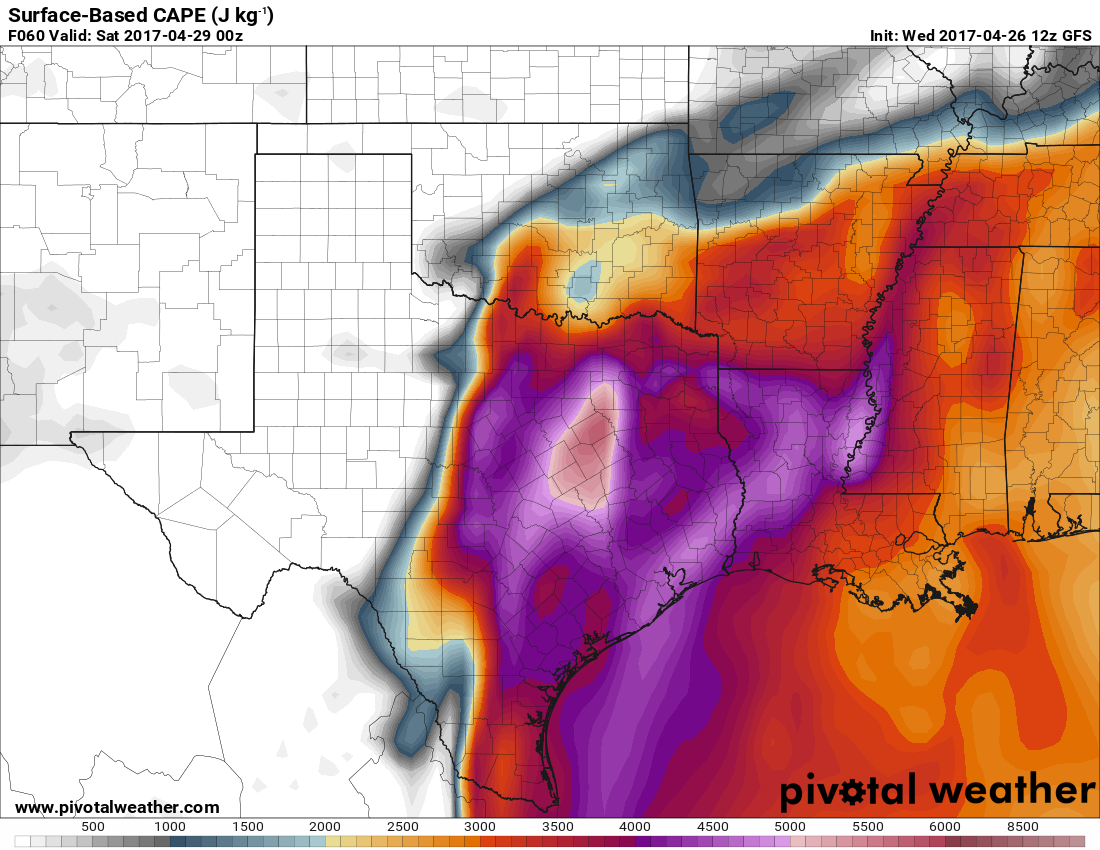
A more significant severe weather outbreak is possible later Friday into Saturday from the Southern Plains and Texas into portions of the Mississippi and Tennessee Valleys. Low pressure will move out of Texas and head northeastward, drawing warm, moist air northward from the Gulf of Mexico once again. North and west of the system, much cooler air will be in place (more on that in a moment).
Lifted index values of -10 and lower across Texas and the Lower Mississippi Valley show that the airmass will be very unstable on Friday. Image provided by Pivotal Weather.
CAPE values of 4000 J/kg and higher across Texas and the Lower Mississippi Valley show that the airmass will be very unstable on Friday. Image provided by Pivotal Weather.
As low pressure rides along the boundary between the two airmasses, it will help to trigger strong to severe thunderstorms across the region. The threat will continue into the overnight hours Friday night, shifting into the Mississippi and Tennessee Valleys on Saturday as the system continues to progress northeastward. Some of the storms may produce torrential downpours that could trigger flash flooding, large hail, damaging winds, and tornadoes.
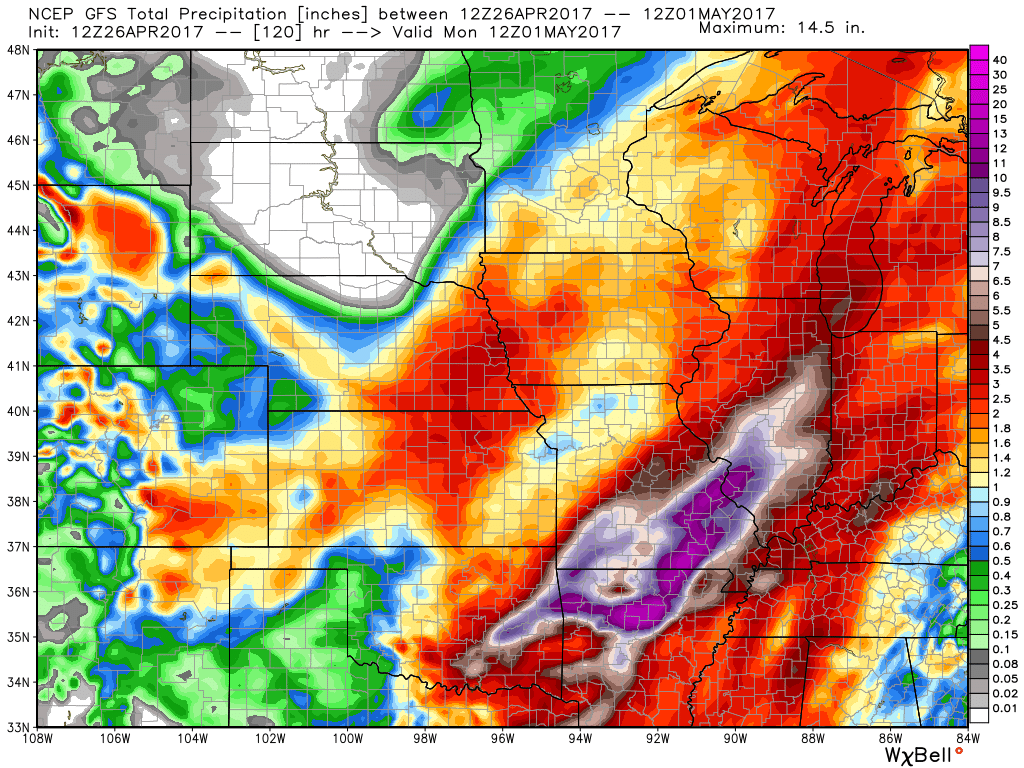
The GFS model shows the potential for 5-10 inches of rain (or more) in parts of the Mississippi Valley through Sunday. Flooding is likely. Image provided by WeatherBell.
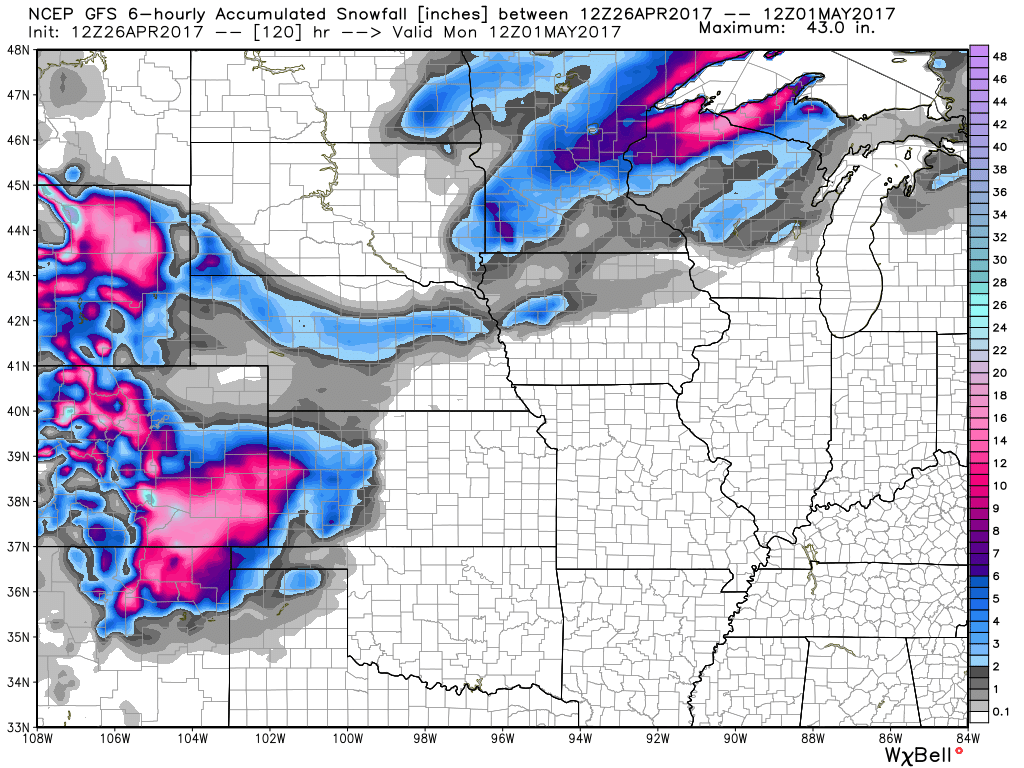
Behind the storm, as colder air settles into the region, a different threat is evolving – heavy snow. While it’s getting late in the season, heavy snow is not uncommon in the Central and Southern Rockies at this time of year. Some of the higher elevations in Colorado and New Mexico could receive 1-2 feet of snow Friday into Saturday. East of the Continental Divide, especially in the High Plains, snow is also possible, especially from eastern Colorado and western Kansas into portions of the Oklahoma and Texas Panhandles. In Denver, there is still a big question as to whether to precipitation falls mainly as rain, snow, or a wintry mix. Some snow accumulation seems likely at this point, but it’s still a little too early to tell whether there will be heavy snow in the city itself. The heavy snow threat will expand into the portions of the Upper Midwest and southern Canada Sunday into Monday as the storm moves into that region.
GFS model forecast for snowfall in the Rockies and High Plains through Sunday. Winter is definitely not over there. Image provided by WeatherBell.
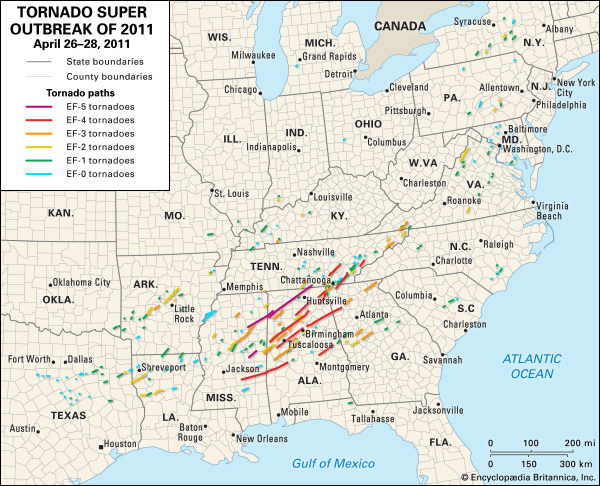
Severe weather outbreaks are not uncommon at this time of year. In fact, from late March into early May is when they are most likely. The largest tornado outbreak on record occurred 6 years ago this week. Between April 25 and 28, 2011, a total of 362 tornadoes were observed from Texas to New York and portions of southern Canada, resulting in 324 fatalities, 317 of them on April 27, the most active day.
Map showing tracks of all 362 tornadoes from the April 2011 “Super Outbreak”. Image provided by Encyclopedia Brittanica.
As for our part of the country – the clouds and rain and cool temperatures will eventually move out. Things will start to improve on Thursday with some sunny breaks possible and temperatures into the 60s. By Friday, there will be more sunshine and temperatures getting into the 70s. Saturday looks like the best day, as temperatures could get into the lower 80s in some spots. We will have to watch out for some late-day showers and maybe a thunderstorm. Sunday looks to be significantly cooler thanks to a northeast wind off of the still-chilly Atlantic.
The old saying is that March comes in like a lion and goes out like a lamb. We’ll see about how it goes out, but it certainly looks like it’s going to come in like a lion this year, but not in the usual way.
We’ve got some unseasonably mild air already in place, but it’s going to get even warmer as a warm front moves across the region tonight. It’ll be accompanied by some showers, and maybe even a rumble of thunder when it moves through. Some of the rain overnight may be locally heavy, but since most of you will be sleeping when it comes through, you won’t even notice. Also, with the warm front coming through, we’ll have our low temperatures this evening instead of in the morning, as temperatures will slowly rise overnight.
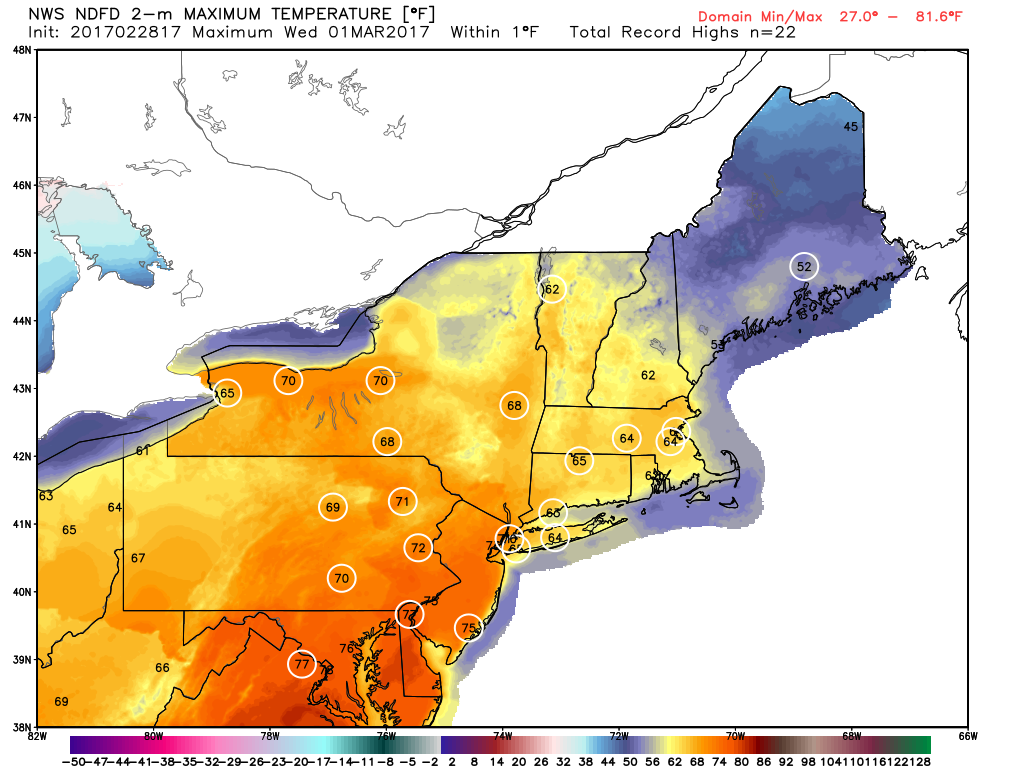
Plenty of record highs are expected across the Northeast on Wednesday. Image provided by WeatherBell.
This brings us to Wednesday. Once that warm front moves across the area, even warmer air will flood into the region, with highs again soaring well into the 60s. The only limiting factor for tomorrow will be cloud cover, which there will likely be plenty of. If we can get some breaks of sunshine, it wouldn’t be a surprise if temperatures made a run at 70 in spots.
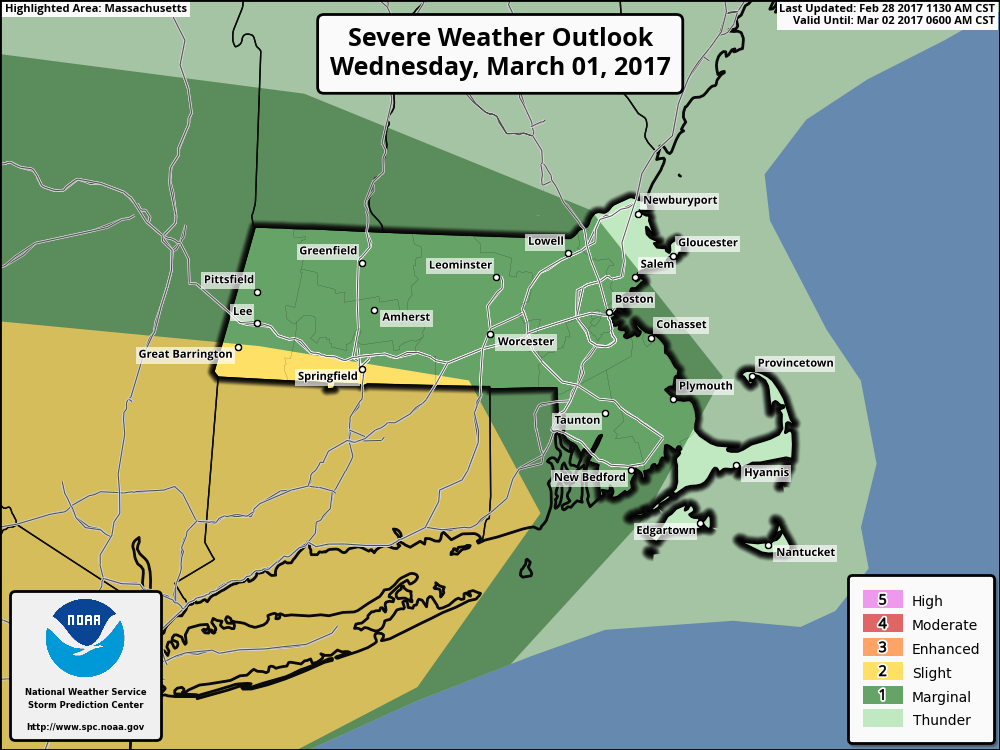
Warm temperatures aren’t the only story for Wednesday though. A strong cold front will be approaching from the west. While this front will bring an end to our warmth Thursday morning, it’s what happens ahead of it that is a bigger concern.
A slight risk for severe weather exists across parts of southwestern New England on Wednesday, with a marginal risk for most of the remainder of Southern New England. Image provided by the Storm Prediction Center.
As is usually the case during the warmer months, with a warm and relatively humid airmass in place, the atmosphere will become unstable. Add in some lift ahead of the front and you get showers and thunderstorms. The bigger the clash in airmasses, but stronger the storms. That’s what will happen tomorrow. Thunderstorms will develop ahead of the front during the afternoon and evening hours and may even continue into the nighttime ahead of the front. Some of the storms could become quite strong, with heavy downpours, frequent lightning, and damaging winds. There is even the chance for an isolated tornado. Just last week, a tornado touched down in Goshen and Conway, Massachusetts – the first confirmed tornado ever during the month of February in the Commonwealth.
A severe weather outbreak is possible across the Ohio and Mississippi Valleys today. Image provided by the Storm Prediction Center.
The severe weather threat shifts eastward on Wednesday. Image provided by the Storm Prediction Center.
New England isn’t the only place where severe weather is expected though. In fact, what’s expected up here is minor compared to the Ohio and Mississippi Valleys. As that cold front moves into those areas later today into early Wednesday, widespread severe weather is expected to develop. Large hail, heavy downpours, damaging winds and several tornadoes are expected. This is more typical of April than the last day of February.
After this front moves offshore, things quiet down a bit, and we get back into weather that is more typical of early March, especially here in the Northeast. We do need to keep an eye on Friday though. An Alberta Clipper will be diving southeastward from the Great Lakes. It will pass south of New England during the day on Friday and into Friday morning. While the majority of the forecast models keep the system far enough south of have little to no impact on us, not all of them do. So, there is the chance for some light snow, especially south of the Mass Pike, on Friday. We’ll have more on this later in the week if the threat materializes.