Here Comes the Heat (Except for You New England)

A large ridge of high pressure will shift from the West Coast into the Nation’s midsection over the next few days, bringing with it some of the hottest weather so far this year to the Plains states.

ncep_cfsv2_120_t2anom_usa
Temperature anomalies for the past 30 days across the nation. Image provided by WeatherBell.

A persistent ridge of high pressure has been anchored across the West for the past few weeks, keeping temperatures well above normal for much of May and early June. Numerous records were set across the region, even in normally hot locations like the Desert Southwest, where temperatures exceeded 110 degrees several times. In Death Valley, California, which is frequently the nation’s hotspot, the first 8 days of June have averaged 10.6 degrees above normal, with high temperatures exceeding 115 degrees each day.

While the West has been baking, temperatures across the Plains states have been 1 to 3 degrees below normal for the past month. That is about to change as the ridge slides eastward. By the end of the week and the weekend, the ridge will be centered across the Plains and doesn’t look to move that much right through next week.

500hv.conus (1)
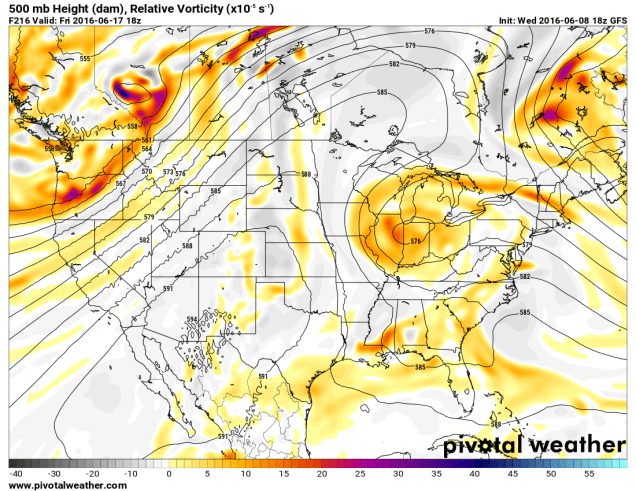
Map showing heights at the 500mb level across the United states on Sunday June 12. Image provided by Pivotal Weather.

500hv.conus (2)

With the ridge of high pressure in place, temperatures will soar well into the 90s across the Plains states and adjacent portions of the Mississippi Valley for much of the remainder of the week, with some triple-digit heat possible across parts of the Dakotas, especially Friday and Saturday.

Some relief will settle into the Northern Plains in the form of a cold front early next week, but the heat will continue from the Southern Plains and Texas eastward into the Southeast. Across these areas, humidity levels will be higher, with dewpoints rising into the 60s and 70s. The result will be heat index values well over 100 degrees across parts of these areas.

gfs_t2max_mw_14
High temperature forecast based off of the GFS model for Saturday June 11. Image provided by WeatherBell

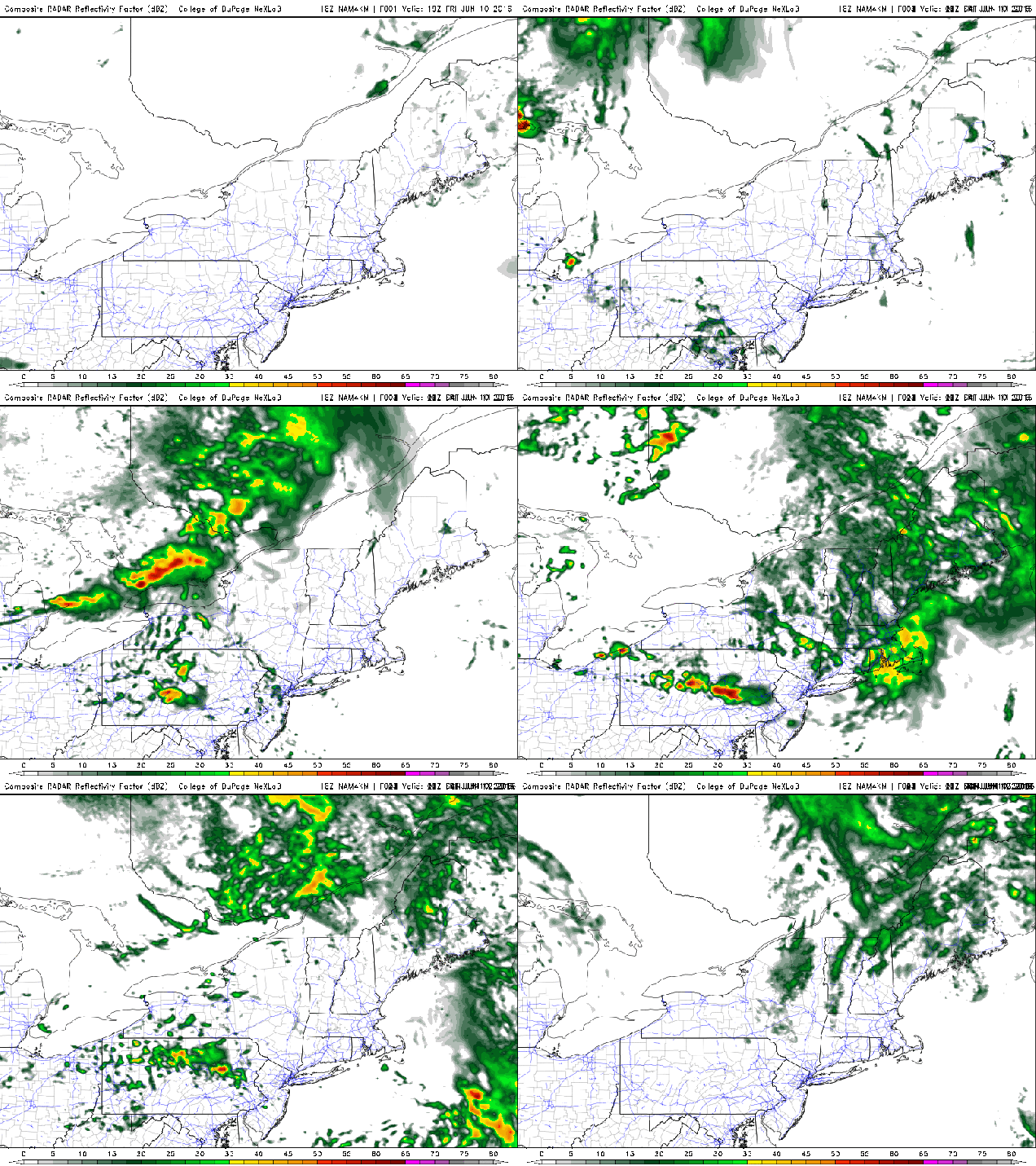
The ridge will also act to suppress thunderstorm activity across the Plains states for much of the remainder of the week. Cluster of thunderstorms may develop across the Northern Rockies and ride over the Ridge and into the Great Lakes and eventually the Northeast later in the week. One of these clusters could produce some severe weather across the Eastern Great Lakes and Mid-Atlantic states on Saturday.

While the heat settles in across the Plains temperatures will remain cool across the Northeast. An upper-level low pressure system will only slowly move eastward across southern Canada over the next few days, moving into the Gulf of Maine by early next week. While temperatures surge into the 90s and lower 100s across the Dakotas on Friday, temperatures will only be in the 60s to lower 70s across the Northeast, with parts of Northern New England staying in the 50s. A few showers may pop up during the afternoon, and across some of the higher peaks of the region, some wet snowflakes could mix in with the rain.

There are signs that things could change in New England, but not until the end of next week. Some of the forecast models are indicating the possibility that the upper-level low finally moves out, allowing the heat to finally spread eastward. The latter half of June could feature much warmer conditions if this does come to pass.

gefs_t2ma_5d_noram_63
Temperature anomalies forecast by the GFS Ensemble for the period June 19 through June 24. Image provided by WeatherBell.

Colin (or what’s left of it) is Hitting Florida, Severe Weather on Tuesday in New England?

Often, you’ll hear meteorologists say not to focus on the center of a tropical system, because its effects can be felt far from the center. Tropical Storm Colin is a terrific example of this.

vis_lalo-animated
Satellite loop of Tropical Storm Colin from Monday afternoon. Loop provided by NOAA.

The “center” of Tropical Storm Colin is about to cross the coast of the Big Bend of Florida this evening. As of 11pm, the center was about 70 miles east of Apalachicola, Florida, moving northeast at 22 mph. Maximum sustained winds are near 50 mph. While the center is about to cross the coast, most of the thunderstorm activity is located east and northeast of the center. Heavy rain has been falling for most of the day across much of Florida as well as parts of Georgia and the Carolinas, but there have only been a few reports of tropical-storm force winds.

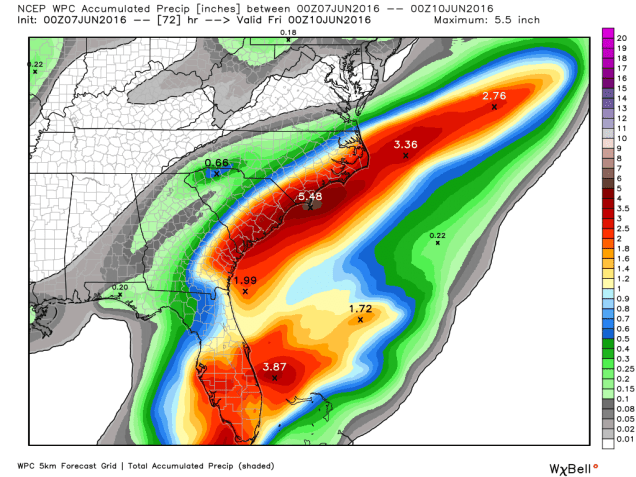
Tropical Storm Warnings remain in effect for the Gulf Coast of Florida from Indian Pass to Englewood, and along the Atlantic coast from Sebastian Inlet, Florida northward to Oregon Inlet, North Carolina. The current forecast from the National Hurricane Center calls for Colin to cross northern Florida and southern Georgia overnight, then move back into the Atlantic on Tuesday. Colin will likely have lost tropical characteristics by then (some would that it is already doing that), but it may still strengthen a bit as it passes offshore of the Carolinas. The main impact will be heavy rain and flooding near the coast. Flood watches are in effect for much of the region.

wpc_total_precip_se_12
Expected rainfall between Monday evening and Thursday evening. Image provided by WeatherBell.

Once Colin or its remains pull away from the Carolinas it will head out into the open Atlantic. Aside from impacting the fish and marine traffic, the system could pass close enough to Newfoundland to bring some gusty winds and rainfall to the island later this week.

Meanwhile, the first tropical depression of the season has formed in the Eastern Pacific Ocean. As of 11pm EDT, Tropical Depression One-E was centered about 125 miles south-southwest of Salina Cruz, Mexico, heading towards the northeast at 7 mph. A Tropical Storm Watch has been posted for the coast of Mexico from Puerto Escondido to Boca De Pijijiapan.

01E_intensity_latest
Computer model forecasts for the intensity of Tropical Depression One-E. Image provided by Tropical Tidbits.
01E_tracks_latest
Computer model forecasts for the track of Tropical Depression One-E. Image provided by Tropical Tidbits.

The system is expected to remain weak while drifting towards the northeast over the next day or two. The system could dissipate before making landfall. One thing it will do is produce very heavy rainfall across southern Mexico and adjacent Central America. Rainfall totals of 5-10 inches are expected with heavier amounts possible. This will lead to flash flooding and mudslides across the region.

qpf_acc_mm.mx
GFS model forecast for rainfall across Mexico for the next 4 days. Image provided by Pivotal Weather.

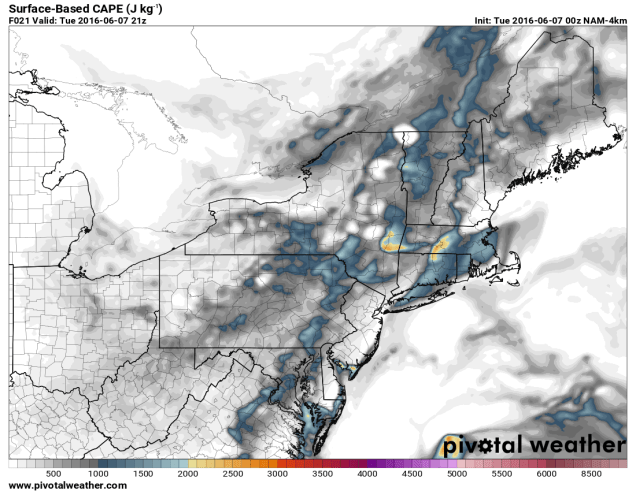
Closer to home, we have a possibility of severe weather around here on Tuesday. A cold front will cross the region during the afternoon, likely producing some showers and thunderstorms. Before that, we’ll have some cloud cover and showers around in the morning. If we can get enough sunshine to develop during the afternoon, it could help produce instability for another round of showers and thunderstorms, some of which could be strong to severe. Right now, it looks like the best chance for and strong storms will be from western and central Massachusetts into southern Vermont and southern New Hampshire, but again, this is dependent on how much sunshine we get. Any storms that do form may contain heavy downpours, gusty winds, and hail.

sbcape.us_ne (1)
NAM model forecast of CAPE values for 4pm Tuesday. Notice that the higher values are across central and western Massachusetts. Image provided by Pivotal Weather.
sbli.us_ne (1)
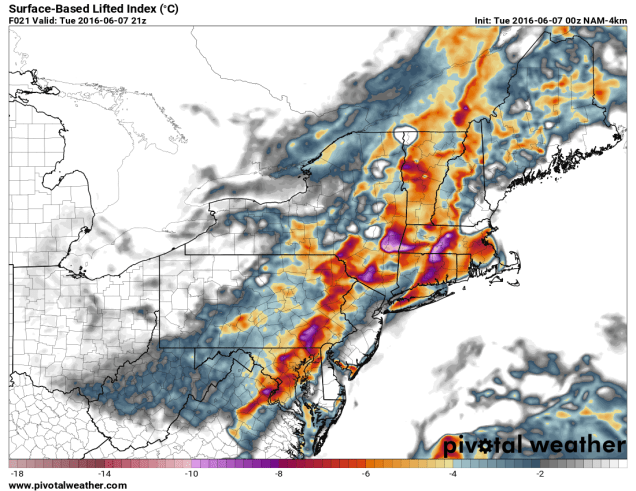
NAM model forecast of Lifted Index values for 4pm Tuesday. Notice that the higher values are across central and western Massachusetts. Image provided by Pivotal Weather.

After the front moves through, cooler weather will settle in for Wednesday, but a secondary cold front may produce another round of showers and thunderstorms Wednesday afternoon. With much cooler air aloft, there’s a better chance that any storms that form on Wednesday may contain small hail, but widespread severe weather isn’t expected.

A Classic “Good News/Bad News” Weekend is Coming Up

Sunday isn’t looking that great around here, but things could be worse. Severe weather is likely across the Mid-Atlantic states on Sunday. Meanwhile, Tropical Storm Bonnie will head out into the open Atlantic this weekend, but another area is being watched for development near the Yucatan Peninsula.

We’re starting the weekend off with a fantastic Saturday here in New England, but big changes are coming. High pressure builds in today, so after some morning fog burns off we’ll have a mix of sunshine and clouds this afternoon. High temperatures will get into the upper 60s and 70s near the coastline, but away from the water, highs will be in the lower to middle 80s, with a few spots possibly reaching the upper 80s. Make sure you get outside and enjoy it because clouds will stream in late in the day ahead of a cold front moving across the Midwest.

Ahead of that front, with a warm, humid airmass in place, showers and thunderstorms will develop, some of which will become strong to severe. Widespread severe weather isn’t expected on Saturday, but there is a risk for some strong to severe storms from the Great Lakes into the Ohio Valley.  Sunday will be a different story. The ingredients will be in place for a severe weather outbreak from the Mid-Atlantic states into the Carolinas.

sbli.us_ma
GFS forecast of Lifted Index values for Sunday afternoon. Image provided by Pivotal Weather
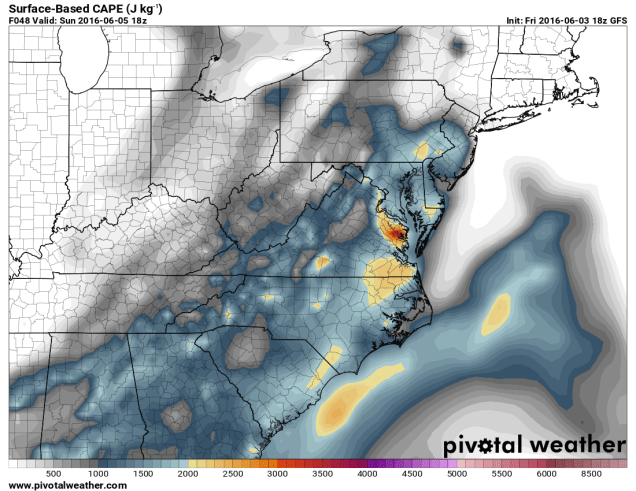
sbcape.us_ma
GFS forecast of CAPE values for Sunday afternoon. Image provided by Pivotal Weather

As temperatures rise into the 80s to lower 90s, the airmass will become increasingly unstable. CAPE, which is short for Convective Available Potential Energy, is a measure of instability through the atmosphere. CAPE values of 1000-3000 J/kg are expected from the Delmarva Peninsula into the Carolinas Sunday afternoon. These values are indicative of moderate instability in the atmosphere. The “Lifted Index” is the difference in temperature between the atmosphere at 500mb (about 18,000 feet up) and a parcel of air from the surface that is lifted to 500mb. A negative value is indicative of unstable conditions. On Sunday, forecast models are showing values between -4 and -9 across the Mid-Atlantic states.

While Sunday may start off cloudy with showers across parts of the region, breaks of sunshine should develop by early afternoon, with showers and thunderstorms developing along the eastern slopes of the Appalachians. Thunderstorm activity will likely organize into a line that will march eastward, reaching the Washington/Baltimore area by late afternoon, and the Richmond/Norfolk area towards evening. The main threats with any storms that do develop are strong winds, hail, and heavy downpours, with a few tornadoes also possible.

Up here in New England, we won’t have to worry too much about severe weather. That doesn’t mean we’ll have a great day. Rain will likely develop Sunday morning and continue for much of the day, ending late Sunday night or early Monday morning. We’re looking at an inch to an inch and a half of rain across the region, which we really need, as it’s been dry for the past few months. If you’ve got outdoor plans for Sunday, we’d start looking for alternate ideas. While the day may not be a complete washout, it’ll be cloudy, relatively cool (60s to lower 70s), and raining off and on for much of the day.

20160531_northeast_trd
Most recent update on drought conditions across the Northeast. Image provided by NOAA.

Meanwhile, Tropical Storm Bonnie has redeveloped east of North Carolina this evening. As of 5pm Friday, Bonnie was centered about 285 miles east of Cape Hatteras, NC, moving towards the east at 13 mph. Maximum sustained winds are near 40 mph. Bonnie is expected to head out into the open waters of the Atlantic over the weekend while steadily weakening.

vis_lalo-animated
Satellite loop of Tropical Storm Bonnie from Friday afternoon. Loop provided by NOAA.

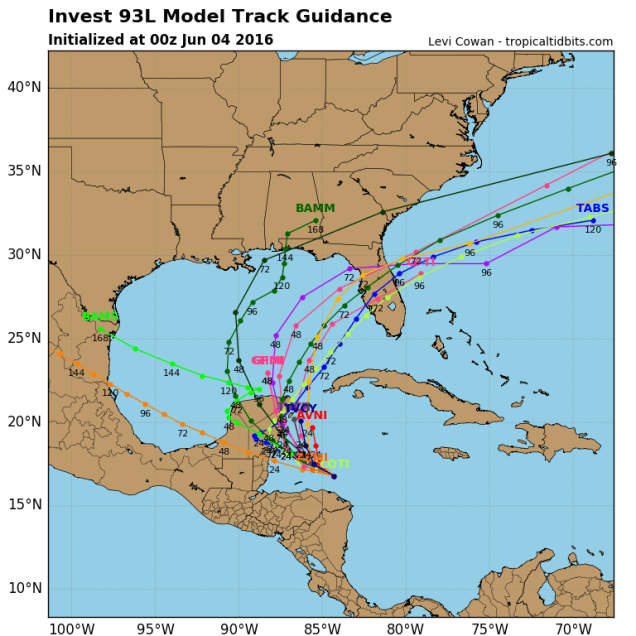
While June is usually quiet in the tropics, another area of disturbed weather in the western Caribbean is being monitored for development this weekend. A cluster of showers and thunderstorms will head towards the Yucatan Peninsula this weekend and then turn more towards the north and head into the Gulf of Mexico. For several days now, forecast models have been indicating that this system could become a tropical depression or tropical storm over the Gulf early next week.

93L_intensity_latest
Computer model forecasts for the strength of a potential tropical system in the Gulf of Mexico. Image provided by Tropical Tidbits
93L_tracks_latest
Computer model forecasts for the track of a potential tropical system in the Gulf of Mexico. Image provided by Tropical Tidbits

Most forecasts are for the storm to turn more toward the northeast early next week and cross the Florida Peninsula as a tropical depression or weak tropical storm. While winds aren’t expected to be strong, the main impact will be heavy rainfall. The storm could drop as much as 4-8 inches of rain on the Sunshine State next week, especially the southern half of the state. Heavy rain fell on portions of the region during May, so additional heavy rain could lead to flooding in parts of the area.

After all that, we didn’t even talk about the potential tropical system in the Eastern Pacific, the record heat in the West, the flooding in Paris and parts of western Europe, or the powerful storm impacting southeastern Australia. Yup, things are pretty busy in the weather office.