Weekly Outlook: September 10-16, 2018

We’ve got a little bit of everything in the forecast this week – cool weather, warm and humid weather, heavy rain, thunderstorms, and sunshine. What about a hurricane? Not likely in this neck of the woods, but we’ll get to Florence in this outlook.

hires_t2min_maine_13
While we’re looking at a cool start to the day, up north, skies are clear and low temperatures will dip into the 20s and 30s this morning in parts of Northern Maine. That’ll be coming here soon enough. Image provided by WeatherBell.

The week starts off on a cool note with high pressure trying to hang on, but it will lose its grip on the region quickly. A warm front will start to move up from the south while low pressure also starts to approach from the west. That low pressure area contains the remains of Tropical Storm Gordon, and thus is very juicy. It dropped several inches of rain on the Ohio valley and Mid-Atlantic states over the weekend. Rain should spread across our area today from south to north. Some of the rain could be locally heavy, especially today and tonight. We’ll also have some gusty winds, especially along the coastline. These winds, combined with astronomical high tides, could result in a little bit of coastal flooding, especially along east-facing shorelines around high tide. Keep that in mind if your travels bring you along the coast around midday today. Rough surf from Florence will start impacting the coast, especially the south coast over the next day or two, and will likely build through the week.

The rain continues tonight as a warm front moves across the area. Temperatures will actually go up overnight as the warm and humid air moves in. Tuesday will not be a washout, but we’ll have occasional showers and thunderstorms with the warm and humid air in place. Low pressure passes north of the region later Tuesday, bringing a cold front in. The front will likely dissipate as it tries to cross the area, but will provide just enough instability for more showers and thunderstorms on Wednesday.
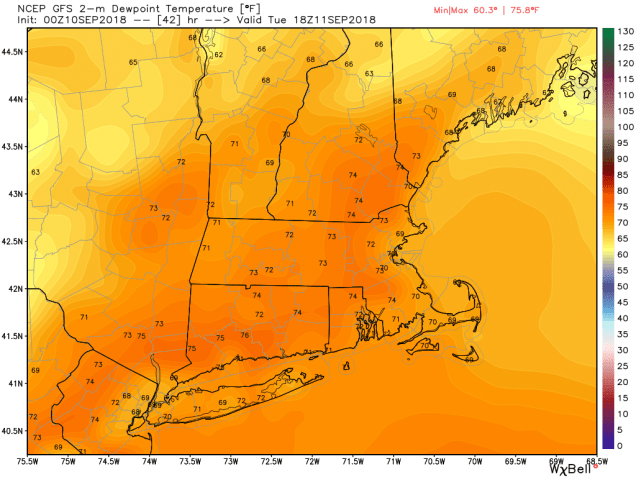
gfs_dew2m_boston_8
Dewpoints will jump back into the 70s across the area on Tuesday. Image provided by WeatherBell.

High pressure builds in on Thursday, with sunshine and less humid conditions expected. This high will remain in place right through the weekend, with partly to mostly sunny skies, warm conditions and comfortable humidity. It will also serve to block Hurricane Florence from coming up here. It could also make things that much worse for the Mid-Atlantic states and the Southeast.

GOES16-TAW-13-900x540
The Atlantic remains quite active with Florence, Isaac, Helene and a potential system in the western Caribbean. Loop provided by NOAA.

The exact track of Florence is still a question, that it seems fairly certain that it will at least come close to the Carolinas. Whether or not it makes landfall is still not certain. One thing that does seem more likely is that Florence is going to stall out somewhere near the Carolinas as it gets blocked by the high sitting over the Northeast. Whether it stalls just off the coast or inland will make a difference in terms of how much wind and storm surge damage and how quickly the system starts to wind down. What it won’t make a difference with is the fact that it’s going to produce a lot of rain across the area, with widespread flooding. Determining exactly what area will get what conditions will be something that we’ll narrow down in the next few days as we get a better of idea what the track that Florence will take.


Monday: Cloudy, breezy, and cool with showers developing from south to north, becoming a steady rain late in the day. High 60-67.

Monday night: Periods of rain, heavy at times in the evening, tapering off to showers overnight, maybe a rumble of thunder or two as well. Temperatures slowly rise overnight.

Tuesday: Plenty of clouds, breezy, humid, occasional showers and thunderstorms. High 76-83.

Tuesday night: Mostly cloudy with a few showers and some patchy fog possible. Low 63-70.

Wednesday: More clouds than sunshine chance for a few showers or thunderstorms. High 76-83.

Thursday: Becoming partly to mostly sunny. High 74-81.

Friday: Plenty of sunshine. High 73-80.

Saturday: Sunshine continues. High 75-82.

Sunday: Sunshine and some high clouds. High 76-83.

We wrote an extensive post about the tropics Saturday night, and not much has changed since then. Hurricane Helene is pulling away from the Cabo Verde Islands and destined to be a fish storm. Hurricane Isaac will become an increasing threat to the Lesser Antilles in the next few days. Hurricane Olivia will weaken before crossing the Hawaiian Islands tomorrow. Tropical Storm Warnings are in effect for much of the island chain. Tropical Storm Paul will remain weak over open water in the Eastern Pacific. Typhoon Mangkhut is crossing the Northern Mariana Islands this morning. A new tropical depression has also formed near Taiwan. We may also have another system to watch in the Gulf of Mexico later this week. We’ll have another special blog post about the tropics tomorrow, where we’ll go into a little more detail, especially about Florence, Isaac, Olivia, and the potential system in the Gulf, since those are the ones that will be the biggest threats to land.

Multiple Tropical Systems Threaten Land

It seems like just a week or two ago we were saying how quiet that the Atlantic had been. Now, Mr. Dolby is right, it’s hyperactive – and so is the Pacific.

Right now, all of the media hype is centered on Tropical Storm Florence. As of 5pm EDT Saturday, Florence was centered about 800 miles southeast of Bermuda, moving toward the west at 5 mph. After reaching Category 4 strength a few days ago, Florence has weakened to a tropical storm with maximum sustained winds near 70 mph. Over the next day or two, Florence will be moving into an area where conditions will be favorable for development, plus there is plenty of warm water ahead, so the system will likely become a hurricane again. Rapid strengthening is possible over the next few days, and Florence could become a Major Hurricane (Category 3 or stronger) again over the next few days.

tcheat_atlantic_2018090112
There is plenty of warm water in the western Atlantic to help fuel a strong hurricane. Image provided by Weathermodels.com

The future track of Florence still has plenty of questions that can’t be answered yet, but have significant implications. A ridge of high pressure will build in to the north of Florence, sending it on a general westward track, towards the southeastern United States for the next couple of days. The questions are – How strong is that ridge to the north of Florence? How will it be oriented? If it’s strong enough, it will continue to drive the system west or west-northwestward, sending it into the Carolinas, Georgia, or possibly even northern Florida. If the high is weaker, or centered a little more to the east, it could allow the system to turn more northward as it gets close to the coastline, which could allow it to recurve out to sea without making landfall, or it could stall close to the coastline. This will obviously determine what impacts Florence may or may not have on the Southeast (as well as the Mid-Atlantic and possibly even the Northeast) later in the week. People with interests along the East Coast, especially the Mid-Atlantic states and the Southeast, should keep a close eye on the future of Florence. Rough surf ahead of Florence will impact most of the East Coast beginning on Sunday, and continuing through the week.

While Florence is gathering all of the attention (and the hype), it is far from the only system that is a threat to land right now. Newly-formed Tropical Storm Isaac was centered about 1640 miles east of the Windward Islands as of 5pm EDT Saturday, moving toward the west at 7 mph. Isaac had maximum sustained winds near 40 mph, and is expected to steadily strengthen over the next few days while crossing the Atlantic. The current forecast calls for Isaac to become a hurricane by early in the week. As we get toward midweek, if it continues on its current westward track, it could become an increasing threat to the Lesser Antilles. Many parts of this area are still recovering from getting battered by Irma and Maria last summer, and were hoping for a quiet hurricane season. This is not the news that anybody in that region wants to hear.

al092018
A hurricane heading for the Caribbean? No, that’s not what anybody wants to hear, not after last season. Image provided by the University of Wisconsin.

To the east, Tropical Storm Helene is a threat to the Cabo Verde Islands tonight and Sunday. Tropical Storm Warnings and Hurricane Watches are in effect for the islands of Santiago, Fogo, and Brava. As of 8pm EDT Saturday, Helene was centered about 125 miles southeast of Praia in the Cabo Verde Islands, moving towards the west at 13 mph. Maximum sustained winds are near 60 mph, and additional strengthening is expected. Helene could become a hurricane on Sunday. It will bring gusty winds and heavy rainfall to parts of the Cabo Verde Islands for the next 24-36 hours. Rainfall totals of 4-8 inches could result in flooding and mudslides across the islands. Once it pulls away from the islands later on Sunday, it should continue off toward the west-northwest while strengthening a bit more. By mid-week, a turn more towards the northwest is expected, with a weakening trend ensuing as Helene moves over colder waters.

233955_5day_cone_no_line_and_wind
Forecast track for Tropical Storm Helene. Image provided by the National Hurricane Center.

Think all the action is in the Atlantic? Think again – the Pacific remains active as well. Hurricane Olivia was centered about 1000 miles east of Hilo, Hawaii Saturday evening, moving towards the west at 15 mph. We know that we were more focused on Norman earlier in the week, but Norman is out of the picture, and Olivia is now the bigger threat. Olivia has maximum sustained winds near 85 mph right now. The forecast for Olivia is for a general west to west-southwest motion over the next few days, with a gradual weakening trend expected. By mid-week, Olivia should have weakened to a tropical storm as it approaches and then moves across the Hawaiian Islands. Rough surf is expected across Hawaii over the next few days, with gusty winds likely as the system approaches later on Tuesday and into Wednesday. The main threat with this system will be heavy rain, leading to flooding across the area. Hurricane Lane brought torrential rainfall and flooding to the area a few weeks ago, and this will likely renew flooding in some of the same areas that have not cleaned up yet. We’re not expecting 20-40 or more inches of rain like Lane produced, but 8 to 15 inches and locally heavier is possible, especially in the normally favored upslope locations.

17E_tracks_latest
Just what Hawaii needs – more rain! Model forecasts for the track of Hurricane Olivia. Image provided by Tropical Tidbits.

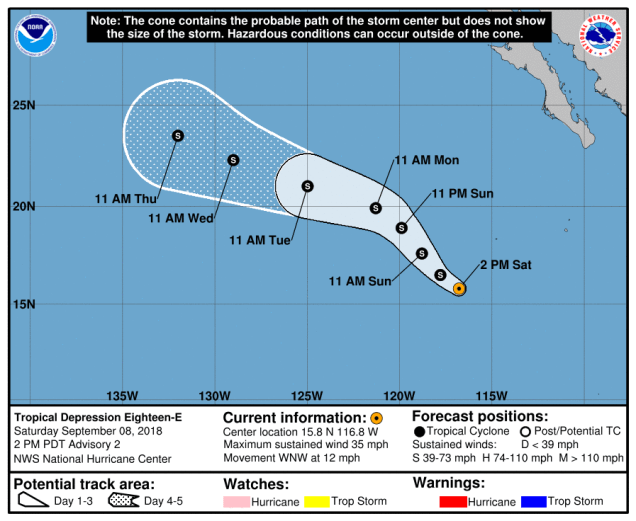
Back to the east a bit, Tropical Depression 18-E has formed off the west coast of Mexico. As of Saturday evening, the system was centered about 665 miles southwest of Cabo San Lucas, Mexico, moving toward the west-northwest at 12 mph. Maximum sustained winds are near 35 mph, and strengthening is expected. The system should become a tropical storm on Sunday. The storm should head northwestward for the next 24-36 hours, before turning back towards the west-northwest. It should remain over open water, with no threat to any land areas. At this time, the system is not expected to become a hurricane before it starts to weaken over colder waters towards midweek.

EP182018_5day_cone_no_line
Forecast track for Tropical Depression 18-E. Finally, a fish storm that is no threat to land. Image provided by the National Hurricane Center.

We’re not done yet! Heading much farther to the west, Tropical Storm Mangkhut (not King Tut) continues to strengthen in the Western Pacific Ocean. As of Saturday evening, Mangkhut was centered a little more than 800 miles east of Guam, moving toward the west at 23 mph. It has maximum sustained winds near 65 mph, and is expected to steadily strengthen while heading westward over the next few days. It should become a typhoon on Sunday. The system is expected to move across the Northern Mariana Islands on Monday as a strengthening typhoon. Strong winds, torrential rainfall and storm surge are all threats to the islands, including the large US military presence on Guam. Considering that it’s a small island in the middle of the vast Pacific Ocean, Guam actually gets hit by typhoons quite a bit. Mangkhut should continue on a general west or west-northwest course beyond that, possibly becoming a Super Typhoon (equivalent to a Category 4 or 5 Hurricane in the Atlantic/Eastern Pacific) by midweek. Its too early to determine where it goes beyond that, but it could become a threat to the northern Philippines, Taiwan, or southeastern China late in the week.

wp2618 (1)
Forecast track for Tropical Storm Mangkhut. Image provided by the Joint Typhoon Warning Center.

Believe it or not, that’s not all. It looks like another tropical system could be developing closer to the northern Philippines. We’ll worry about that one once it actually forms. we’ve got our hands full already.

By the way, we didn’t even get to what’s left of Tropical Storm Gordon. Yeah, we’re focusing on active tropical systems in this post, but Gordon is going to bring heavy rain to the Ohio Valley into Sunday, and parts of the Mid-Atlantic and Northeast later Sunday into Monday. Several inches of rain are possible in parts of this area, with flooding expected. We’ve lost count of how many times this has happened in the Mid-Atlantic states this year. Somehow, we have a hunch that this isn’t the last time it’ll happen this year either.

Gordon Flashes Toward the Gulf Coast

The peak of hurricane season in the Atlantic occurs around September 10 on average. As we rapidly approach that date, the Atlantic is heating up. We’ve got two named storms right now, and possibly another on the way. Things aren’t quiet in the Pacific either.

GOES16-TAW-GEOCOLOR-900x540 (1)
The Atlantic is getting active again. We’ve got Gordon in the Gulf, and Florence for the fishes. Loop provided by NOAA.

The biggest threat right now is Tropical Storm Gordon. As of midday Tuesday, Gordon was centered about 130 miles south-southeast of Mobile, Alabama, moving towards the northwest at 15 mph. Maximum sustained winds were near 65 mph, and some additional strengthening is possible. Gordon doesn’t look like a classic tropical system just yet, but there are signs that it is getting its act together, and it could become a hurricane before making landfall along the Mississippi or Alabama coastline tonight. Hurricane and Tropical Storm Warnings are in effect for much of the north-central Gulf Coast, with a Storm Surge Warning also in effect for parts of the area.

GFS 50-STATES USA Alabama & Miss Total Precipitation 72
There’s a lot of rain heading for the Gulf Coast and the Deep South over the next few days. Image provided by Weathermodels.com

While storm surge flooding and strong winds are threats with Gordon, heavy rain will be a more prolonged threat to the region. Once it makes landfall it will slow down, which is not good news at all. This will keep the heavy rain threat going for a few days. Rainfall totals of 3-6 inches, with localized totals to 10 inches or more, could result in flooding across much of the region. By Friday, as the system continues to drift northward, an approaching cold front will pick it up, and send it off towards the Ohio Valley and Great Lakes.

Meanwhile, in the Central Atlantic Ocean, Florence has become the third hurricane of the season. As of midday Tuesday, Florence was about halfway between the Lesser Antilles and Cape Verde Islands, moving toward the west-northwest at 12 mph. Florence has maximum sustained winds near 75 mph, but the current forecast calls for Florence to weaken a bit over the next few days before regaining a little strength. Florence should continue in a general northwestward track through the week, remaining over open water. After that, things may get a little complicated.

atcf_AL06_current
Florence will head towards the northwest for the next few days. After that? That’s a really good question. Image provided by WeatherBell.

The steering currents in the central Atlantic Ocean are forecast to weaken later this week, making the future track of Florence a lot more uncertain once we get into the weekend. Right now, the more likely scenario is the usual one – an approaching trough of low pressure picks up Florence and it curves northward and eventually harmlessly out to sea. However, if that trough is not strong enough to grab Florence, it could meander around for a while or start to drift westward as a ridge of high pressure builds back in to the north. While Florence would still likely head out to sea eventually, this scenario would imply a potential threat to the East Coast later next week. We won’t know which scenario is more likely until we get to this weekend at the earliest. There are a few models, as well as members of some of the Ensembles that do show that threat. As we mentioned in our Weekly Outlook, we think that the odds of an East Coast impact are fairly low at this point (despite the internet hype), but they are certainly not zero, so we’ll keep an eye on it.

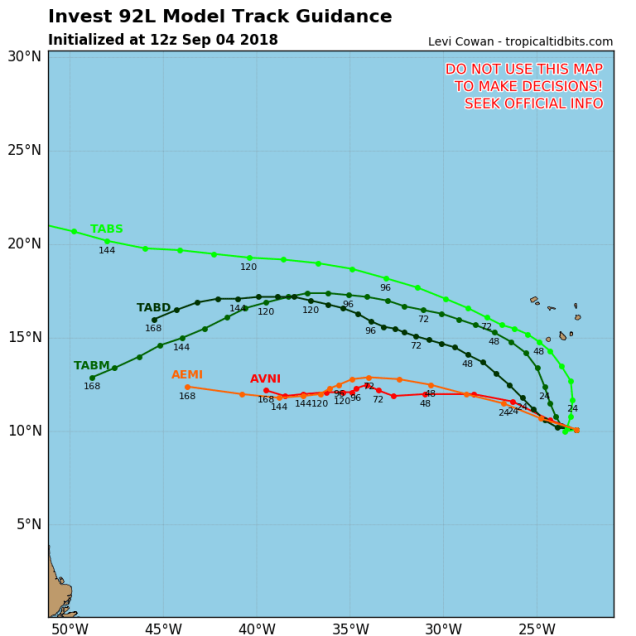
But wait, there’s more! A developing low pressure system is passing south of the Cape Verde Islands today. It is expected to continue on a general west to west-northwest track over open waters for the next several days. Conditions are favorable for development, and the system could become a tropical depression later this week. It is still a week away from impacting any land areas, if it were to even get that far.

92L_tracks_latest
We may have yet another Atlantic system to deal with later this week. Image provided by Tropical Tidbits.

In the Pacific, Hurricane Olivia will strengthen a bit more over the next day or two as it continues to move away from Mexico and into the open waters of the Eastern Pacific, so we won’t spend much time on it. Hurricane Norman, however, is the system getting attention in that part of the world.

EP162018_5day_cone_with_line
Hawaii isn’t going to get hit again (at least not yet). Norman should turn well before getting near the Islands. Image provided by the Central Pacific Hurricane Center.

As of Tuesday morning, Norman was centered about 750 miles east of Hilo, Hawaii, moving toward the west at 17 mph. Maximum sustained winds were near 85 mph. Norman is expected to maintain its current strength for another day or two before a weakening trend begins. The system is expected to turn more toward the northwest later this week, passing safely east and north of Hawaii towards the end of the week. It will send some rough surf towards the islands, but that should be the only impact as the region continues to recover from Hurricane Lane.

What about the Western Pacific? Anyone care? Anyone? Bueller? Typhoon Jebi made landfall on Japan’s main island of Honshu early this morning. It’s weakened to a tropical storm, and has moved into the Sea of Japan. It should weaken and dissipate as it moves into far eastern Russia over the next day or so.

Weekly Outlook: September 3-9, 2018

We’re into September, which means that meteorological fall has started. Time for cooler weather, leaves changing colors, pumpkin-flavored everything, and football. So naturally, we’re starting the week off with hot and humid conditions.

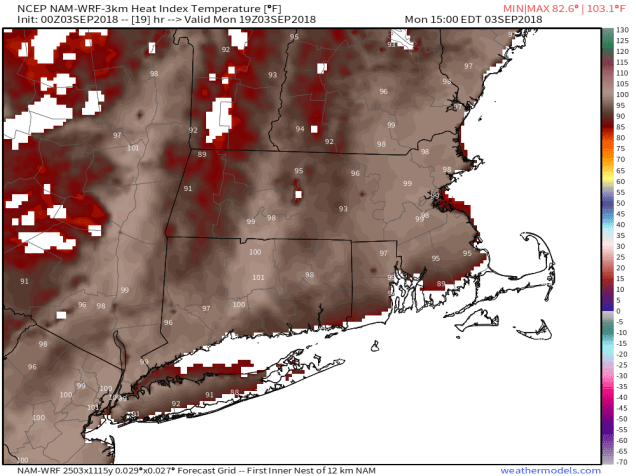
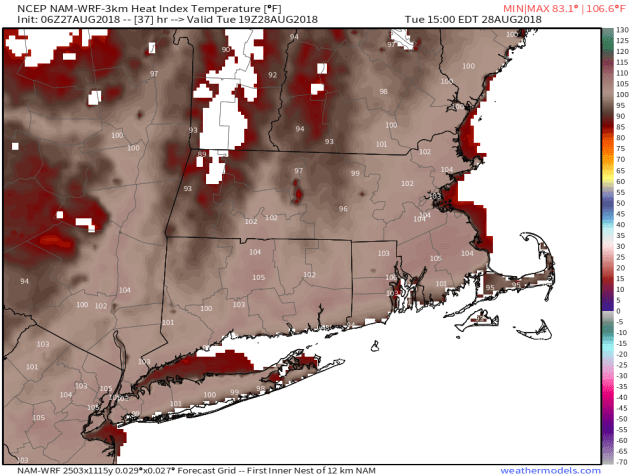
A ridge of high pressure remains in place off the East Coast, so the hot and humid weather that we’ve dealt with for much of the summer has returned. Heat Advisories are in effect for much of the region, as temperatures should get well into the 80s and lower 90s both today and Tuesday. However, with dewpoints in the upper 60s and 70s, the heat index will be in the middle to upper 90s, hence the heat advisories.

NAM-WRF 3-km Mass & CT & RI Heat Index 19
Heat indices will be well into the 90s across the region this afternoon. Image provided by Weathermodels.com

Later on Tuesday, a backdoor cold front will drop southward, bringing some cooler air into eastern parts of the area for Tuesday night and Wednesday. “Cooler” is a relative term. In April or May, a backdoor front results in easterly or northeasterly winds off of water that is only in the 40s and 50s, so coastal areas get quite chill while it stays relatively mild well inland. In this case, we’ll have northeast or east winds blowing off of water that is in the lower 70s, so it’s not going to cool off that much at the coast.
The front lifts back northward Wednesday night, resulting in another hot and humid day on Thursday. However, a cold front will be approaching from the northwest. This front may kick off some showers and thunderstorms late in the day and into Thursday night and early Friday. This is where things get more questionable. That front will likely stall out near the South Coast. Exactly where it stalls out is not clear though. If it stalls right along the South Coast, then Friday and Saturday could be cool and damp with periods of showers at times. If it stalls much farther offshore, then the clouds may hang around, especially from Boston southward, but the showers would likely stay offshore. For now, we’re leaning towards the drier scenario. Sunday is an even bigger question mark. One model has high pressure build in with partial sunshine and temperatures only in the 60s, while another model has low pressure move into the Great Lakes, likely the remains of what is currently Potential Tropical Cyclone Seven (more on that in a moment), with cool conditions, but also some rain in the afternoon. Since that’s the Patriots home opener, we’ll be keeping an eye on that forecast as the week goes on.

gillette_580
Here’s hoping that Sunday looks more like this than damp at Gillette Stadium. Image provided by ESPN.

Labor Day: Some patchy fog early, otherwise partly to mostly sunny. High 86-93, a little cooler along the South Coast.

Monday night: Clear to partly cloudy. Low 68-75.

Tuesday: A mix of sun and clouds, chance for a few showers. High 85-92, turning cooler along the east coast in the afternoon.

Tuesday night: Partly to mostly cloudy. Low 64-71.

Wednesday: Early clouds, then becoming partly to mostly sunny. High 81-88, coolest along the coast.

Thursday: Sunshine fades behind increasing clouds, showers and thunderstorms are possible late in the day and at night. High 87-94.

Friday: Mostly cloudy, a few more showers are possible. High 72-79.

Saturday: Intervals of clouds and sunshine.  High 68-75.

Sunday: More clouds than sun, chance for showers in the afternoon.  High 65-72.

GOES16-TAW-GEOCOLOR-900x540
Satellite loop showing a tropical disturbance near the Bahamas and South Florida and Tropical Storm Florence in the Central Atlantic Ocean. Loop provided by NOAA.

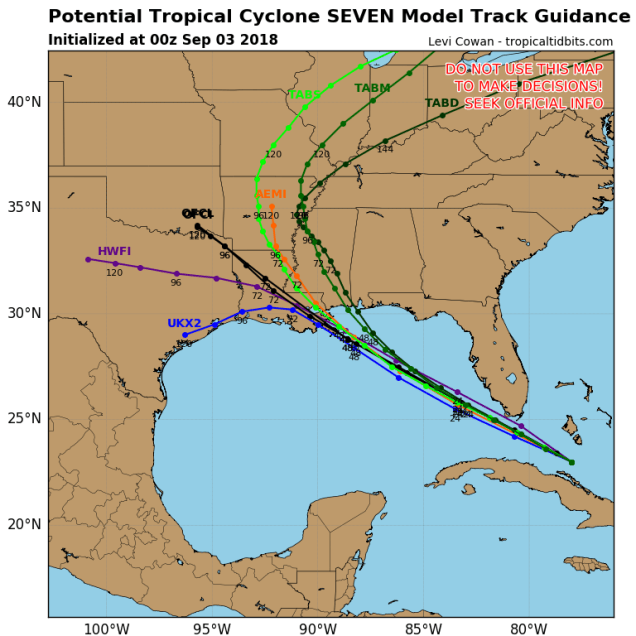
Now that we’re into September, we’re approaching the peak on tropical season in the Atlantic, and we have 2 systems to keep an eye on. The more immediate threat is a system that at the time this blog was written was still labelled Potential Tropical Cyclone Seven”. It is expected to become a tropical depression at some point on Monday as it crosses the Florida Keys. It will then turn northwestward while strengthening over the Gulf of Mexico. The current track calls for landfall in southeastern Louisiana Tuesday night as a tropical storm. Storm surge flooding and gusty winds will be threats with this system, but the main threat is heavy rain that could lead to flooding across much of the Gulf Coast.

07L_tracks_latest
A tropical system in the Gulf always needs to be monitored. This one is no exception. Image provided by Tropical Tidbits.

Well out into the Atlantic we have Tropical Storm Florence. Florence is expected to remain fairly weak as it crosses the Atlantic over the next several days, with only some minor fluctuations in intensity. You may have read on the internet over the weekend that Florence is a threat to the East Coast. Yes, a couple of the models do show that potential, but many others don’t. At this point, it’s more hype than anything else. If it were to become a threat, that would still be a good 10 days or so from now. We’re not worried about it right now. We’d put the odds of an East Coast threat fairly low right now, but not zero, not yet. If it were to become a threat, we’d let you know well in advance.

Weekly Outlook: August 27-September 3, 2018

Labor Day Weekend is coming up? Summer is definitely fading, except that you won’t notice that for the next few days. That’s right, a late-summer heat wave is settling in.

A ridge of high pressure will settle into the East Coast for the next few days while at the surface high pressure remains in place off the East Coast. That means hot and humid conditions through the middle of the week. Heat Advisories and Excessive Heat Watches are in effect across much of the Northeast. High temperatures will get well into the 90s for much of the area, but when you factor in the dewpoints well into the 70s, the heat index will be well over 100.

NAM-WRF 3-km undefined undefined 37
The heat index will likely be over 100 across much of the area Tuesday afternoon. Image provided by Weathermodels.com

A cold front comes through on Thursday, triggering some showers and thunderstorms, and bringing cooler and drier air in. Behind that front, high pressure settles into eastern Canada. Labor Day Weekend might start off quite cool, but as the high slides off to the East, temperatures will start to warm up for the latter half of the holiday weekend. There is one potential fly in the ointment. That front that is coming through on Thursday is likely going to stall out south of New England. Depending on how close it stalls, it may keep clouds and possibly some showers in place, especially along the South Coast. We’ll see how that plays out as we get later on the week.
Monday: Sunshine and a few clouds. High 85-92.

Monday night: Clear to partly cloudy. Low 67-74.

Tuesday: Mostly sunny, hot, and humid. High 90-97.

Tuesday night: Clear skies. Low 71-78.

Wednesday: Mostly sunny, hot, and humid again. High 90-97.

Thursday: A mix of sun and clouds, chance for some showers and thunderstorms. High 86-93.

Friday: Partly sunny and less humid. High 70-77.

Saturday: Partly to mostly sunny. High 68-75.

Sunday: A mix of sun and clouds. High 75-82.

Labor Day: Intervals of clouds and sunshine, chance for a few showers. High 80-87.

hires_snow_nw_61
Need more proof that summer is almost over? How about 1-2 feet of snow in the mountains of Idaho, Montana, and Wyoming over the next few days? Image provided by WeatherBell.

Triple Tropical Trouble in the Pacific

We’re heading towards the peak of hurricane season in the Atlantic, but it’s the Pacific where the problems are right now. In fact, we’ve got not one, not two, but three storms that may impact land later this week.

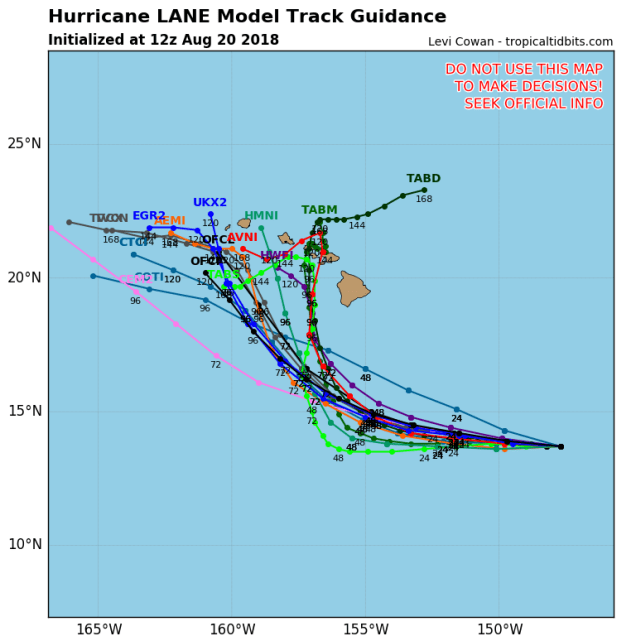
Hurricane Lane has been steadily moving across the Eastern and Central Pacific Ocean for the past week while strengthening. As of midday Monday. Lane was centered about 615 miles southeast of Hilo, Hawaii, moving towards the west at 14 mph.  Lane’s maximum sustained winds peaked at 140 mph on Saturday, and have since dropped to 125 mph, meaning it is still a Category 3 Hurricane. It is expected to maintain its current intensity through Tuesday before a more pronounced weakening trend develops.

14E_tracks_latest (1)
Hurricane Lane is a threat to Hawaii later this week. Will it be a direct hit or another miss? Too early to tell. Image provided by Tropical Tidbits.

The forecast track for Lane is a bit problematic. Lane is expected to continue westward for another day or two before turning more towards the northwest or north. Where it makes that turn is very important, as it will determine what, if any, impact Lane may have on Hawaii. At the very least, we’re looking some rough surf, rainfall, and gusty winds for parts of the island chain. However, a closer pass brings stronger winds and heavy rain in, especially to some of the northwestern islands.

image011
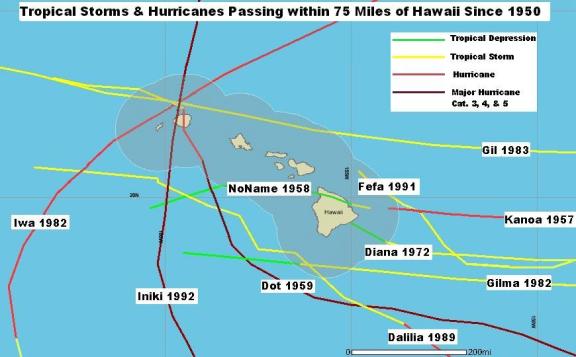
Map showing all tropical storms and hurricanes that have passed with 75 miles of the Hawaiian Islands. Image provided by the Central Pacific Hurricane Center.

As we mentioned in our Weekly Outlook, Hawaii doesn’t get direct hits from hurricanes very often. In fact, since their tropical cyclone records began in 1950, only 3 hurricanes have made direct hits on Hawaii – Hurricane Dot in 1959, Hurricane Iwa in 1982, and Hurricane Iniki in 1992 – all of which hit the island of Kauai . Dot and Iwa were both Category 1 storms when they hit, while Iniki was a Category 4 storm. There have been a lot more tropical storms that have hit the islands, and hurricanes that passed close enough to impact part of the island chain, but only those 3 have had direct impacts.

rbtop_lalo-animated
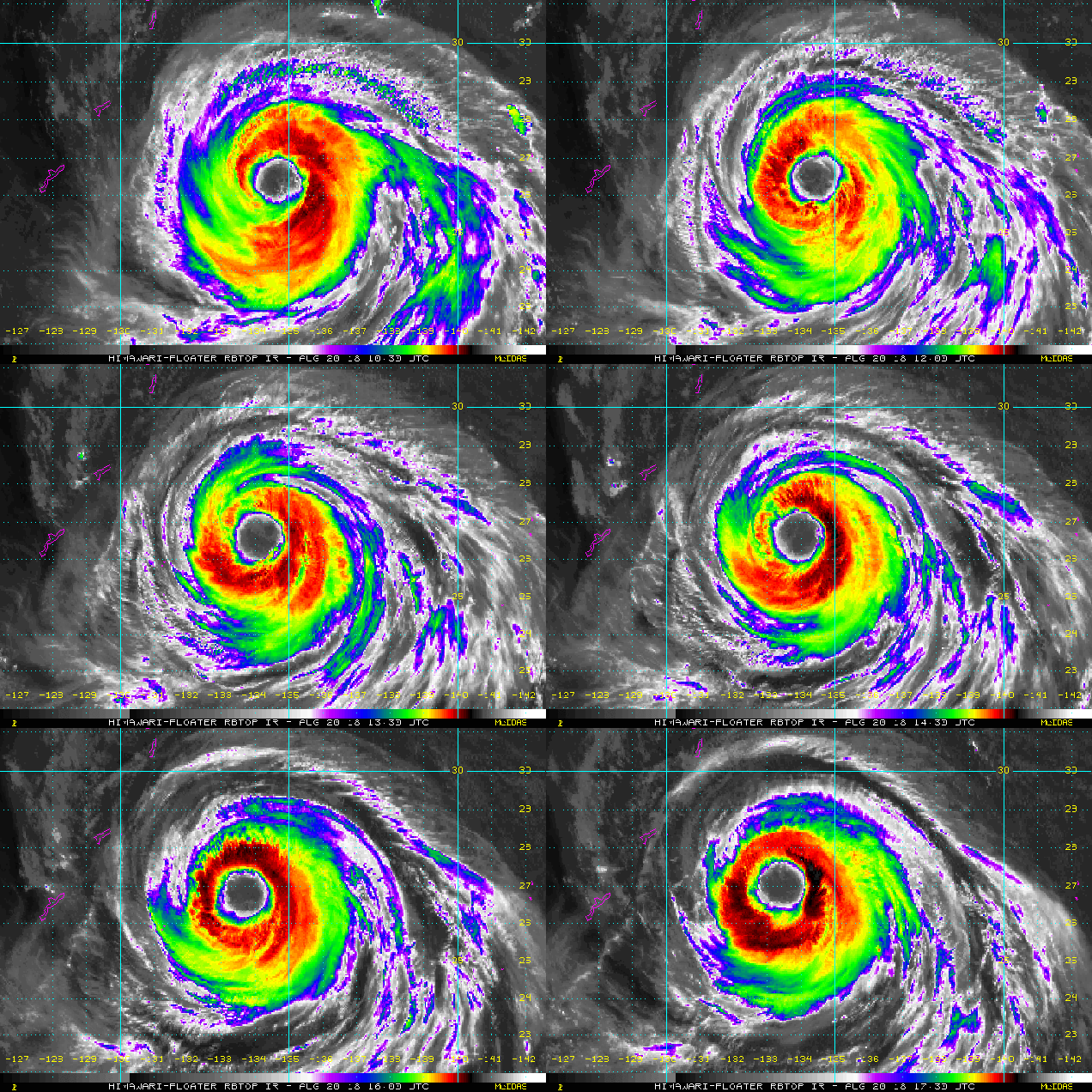
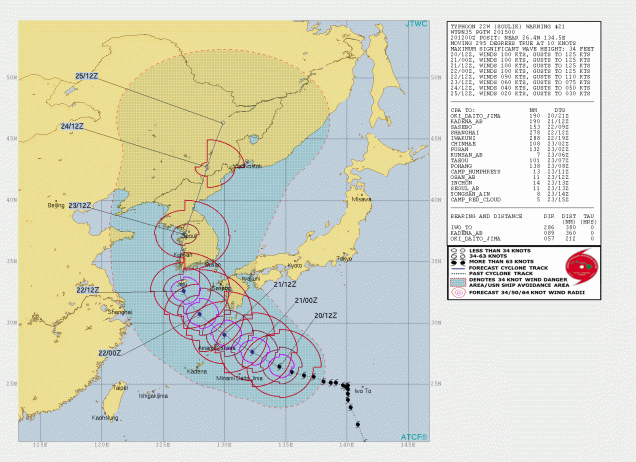
Typhoon Soulik has a rather large eye at the moment. Loop provided by NOAA.

Heading much farther to the west, Typhoon Soulik is threatening parts of Japan and South Korea. As of midday Monday, Soulik was centered about 415 miles east of Okinawa, moving toward the west-northwest at 12 mph. Soulik has maximum sustained winds near 115 mph, and is expected to maintain that intensity for the next 24-36 hours. After that it should start to weaken a bit while turning more toward the northwest as it crosses the Ryukyu islands southwest of Japan. After that, a turn more towards the north and steady weakening are expected as Soulik heads for the coast of South Korea. If the storm makes the northerly turn a little later than currently anticipated, it could remain over the Yellow Sea a little longer, and make landfall in North Korea instead, likely in a somewhat weaker state. Either way, strong winds, heavy rainfall, and flooding are likely across the Korean Peninsula towards midweek.

wp2218
Typhoon Soulik is expected to hit Korea later this week. Image provided by the Joint Typhoon Warning Center.

A little southeast of Soulik is Typhoon Cimaron, which is pulling away from the Northern Mariana Islands. Cimaron is a minimal typhoon with maximum sustained winds near 75 mph, but steady strengthening is expected over the next 24-36 hours. Cimaron is expected to take a northwest track, passing close to Iwo Jima before turning more towards the north by midweek. After that it will likely head towards Japan, with landfall expected later this week as a minimal typhoon, likely around the same time that Soulik is impacting Korea. Cimaron will bring strong winds, and heavy rain to an area that was already recovering from deadly flooding earlier this summer.

1820-00
Forecast track for Typhoon Cimaron. Image provided by the Japanese Meteorological Agency.

While the Pacific remains somewhat active, the Atlantic is still quiet. While the forecast models show this continuing for the remainder of August, climatology says that the trend won’t continue into September, as the peak of hurricane season is mid-September climatologically. The pattern remains unfavorable for storms to form now, but it remains to be seen if that pattern will continue into September.

Bob
Yesterday was the 27th anniversary of Hurricane Bob’s landfall in Southern New England. Image provided by the National Weather Service office in Norton, MA.

While talking about the Atlantic and climatology, we’d be remiss if we didn’t mention that yesterday was the 27th anniversary of Hurricane Bob slamming into Southern New England. If 27 years seems like a long time, you’d be correct. Using data back to 1851, a tropical storm makes landfall in Southern New England or Long Island once every 4 years, while a hurricane makes landfall once every 8 years. The last tropical storm to make landfall was Irene, which passed right over New York City in 2011, so we’re about due for another one. As for hurricanes, while we’ve been threatened several times in the past few years, that 27-year gap since Bob is the 2nd longest on record, second only to the 28 year gap between 1896 and 1924. In other words, we are very overdue. There are a lot of people that live around here that have never experienced a hurricane. We saw storms wreak havoc and create lots of damage around here last winter. If a full-fledged hurricane were to make landfall, especially one that’s a Category 2 or 3, we’d be in real trouble. Only 3 Major Hurricanes (Category 3 or higher) have made landfall in New England, and the last was Carol in 1954. The other 2 were a storm in September of 1869, and another one you have heard about before that hit the area in September of 1938. If one of those comes along again, the damage Sandy brought to this area would probably look minor in comparison.
Weekly Outlook: August 20-26, 2018

The heat and humidity have finally departed. Don’t worry, the humidity will be coming back again this week, but only briefly. Then, once it leaves again, the heat might come back. Yup, we’ve got an interesting week coming up.

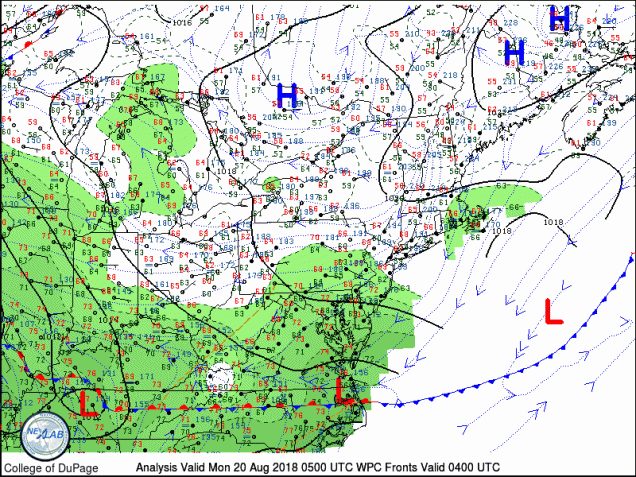
NEsf.fronts
High pressure is moving into New Brunswick this morning while a cold front is stalled out across North Carolina. Image provided by the College of DuPage

The week starts off with a frontal system stalled out south of New England and high pressure over New Brunswick. When you combine those two, you get a northeasterly flow, bringing in relatively cool and drier conditions. In the Spring, when water temperatures are only in the 40s or 50s this would result in temperatures in the 40s or 50s along the coast, while areas well inland might get into the 70s (or warmer). However, since it’s mid-August, water temperatures are in the lower to middle 70s, so a northeast wind means temperatures will be in the lower to middle 70s along the coast, and upper 70s to lower 80s inland.

MonthTDeptNRCC
It has been a VERY warm August thus far, which makes days like yesterday, today, and tomorrow feel even more refreshing. Image provided by the Northeast Regional Climate Center.

Another cold front will start to move towards the area on Tuesday. We’ll have another relatively cool day, but clouds will start to move in. Tuesday night into Wednesday is when we notice bigger changes. A warm front moves through, bringing heat and humidity back into the area. With the warm and humid conditions will also be some thunderstorms. Much like many days over the past month or so, we’re not expecting any widespread severe weather, but a few places could get hit with a nasty storm that contains gusty winds and heavy downpours.

By Thursday, high pressure builds into the region, with seasonably warm conditions for the end of the week and into the weekend. Humidity levels will be fairly low to start, but should rise a bit for the weekend. While most of the region should remain dry as well, a few showers and thunderstorms are possible, mainly on Thursday as an upper-level low pressure area moves across the Northeast.

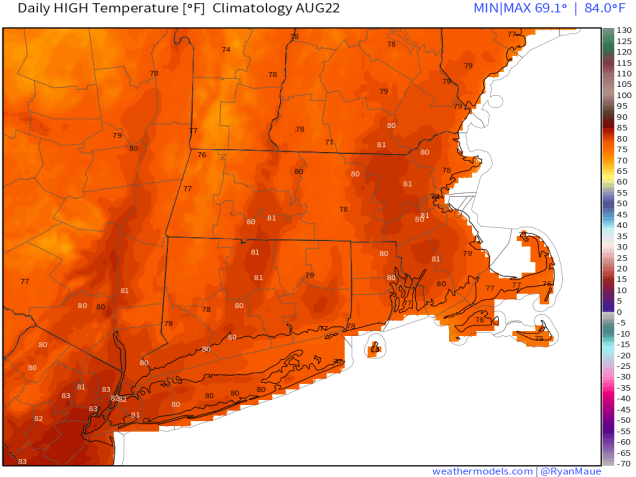
t2max_massachusetts_AUG22
On average, high temperatures should be in the upper 70s to lower 80s during the latter half of August around here. Image provided by Weathermodels.com

Monday: A few showers or some drizzle are possible in the morning, mainly south of Boston. Otherwise, intervals of clouds and sunshine, a little breezy, especially along the coast. High 71-78, coolest along the coast.

Monday night: Partly cloudy. Low 56-63.

Tuesday: Partly sunny. High 70-77.

Tuesday night: Mostly cloudy, showers and thunderstorms developing, mainly after midnight. Low 63-70.

Wednesday: Breezy with occasional showers and thunderstorms, some of which could be heavy at times. High 77-84.

Thursday: Partly to mostly sunny, slight chance for a pop-up shower or thunderstorm.  High 73-80.

Friday: Sunshine and a few clouds. High 77-84.

Saturday: A mix of sun and clouds. High 78-85.

Sunday: Partly to mostly sunny. High 79-86.

14E_tracks_latest
Hurricane Lane could be a threat to Hawaii later this week. Image provided by Tropical Tidbits.

Meanwhile, in the tropics, the Atlantic remains fairly quiet, but in the Pacific, we could have some trouble in paradise. As of early this morning, Hurricane Lane was centered a little more than 700 miles east-southeast of Hilo, Hawaii, moving towards the west at about 14 mph. Lane had maximum sustained winds around 120 mph. It is expected to gradually weaken over the next several days, while heading westward, before turning more toward the northwest. Where it makes that northwest turn is very important, as it will determine what, if any, impact Lane may have on Hawaii. At the very least, we’re looking some rough surf and some gusty winds, especially across the Big Island. However, a closer pass brings stronger winds and heavy rain in, possibly to more than just the Big Island. Hawaii doesn’t get direct hits very often. In fact, since their tropical cyclone records began in 1950, only 3 hurricanes have made direct hits on Hawaii – Hurricane Dot in 1959, Hurricane Iwa in 1982, and Hurricane Iniki in 1992 – all of which hit the island of Kauai . Dot and Iwa were both Category 1 storms when they hit, while Iniki was a Category 4 storm. There have been a lot more tropical storms that have hit the islands, and hurricanes that passed close enough to impact part of the island chain, but only those 3 have had direct impacts.

Weekly Outlook: August 13-19, 2018

The forecast for the upcoming week is both simple, and not-so-simple at the same time. If it feels like you’ve heard this before, it’s because you have. The pattern has remained fairly persistent for a while now, but the subtle details make all the difference.

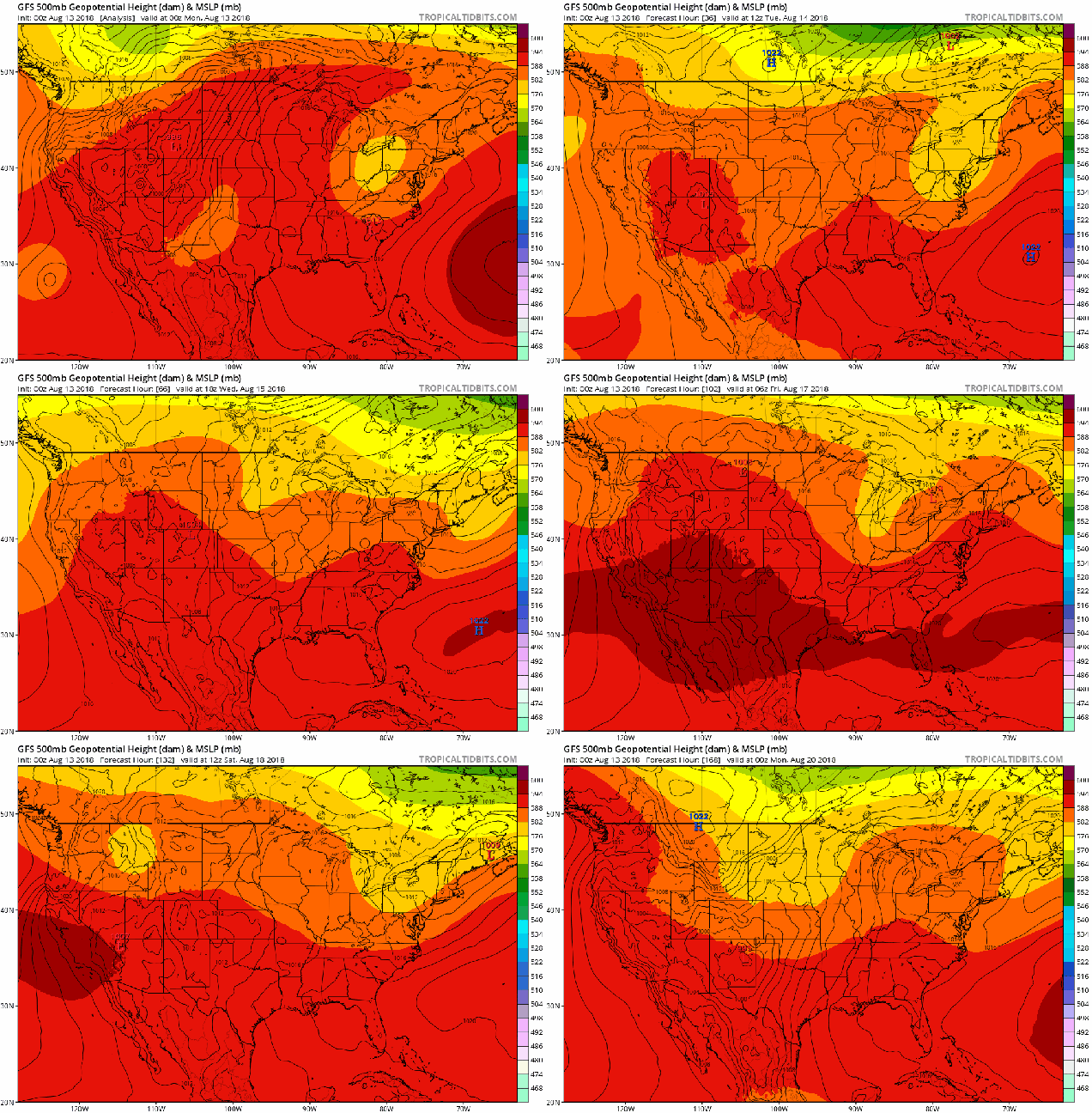
gfs_z500_mslp_us_fh0-168 (1)
High pressure remains off the East Coast, keeping warm and humid air in place for much of the week. Loop provided by Tropical Tidbits.


That stubborn Bermuda High remains in place off the East Coast for much of the week, which means the warm and humid pattern that we’ve been in for a while will continue. However, there are some differences in the pattern that will have other impacts. A frontal system remains stalled out near the East Coast. With an upper-level low pressure system across the Northeast, we’ll have little impulses of energy move through, bringing in some rounds of showers and thunderstorms over the next few days. None of these days will be a washout, and some of the rain will be very localized, but anything that does form could produce some heavy rainfall. This was the case over the weekend, when localized totals of 4 to as much as 8 inches produce flash flooding in a few spots.

SNERain
Many locations received between 1 and 4 inches of rain over the weekend. Some localized totals in excess of 8 inches were reported near Lynn, Massachusetts. Image provided by NOAA.


The upper-level low moves out by mid-week, resulting in less showers and thunderstorm activity, and an increase in temperatures once again. Don’t worry, humidity levels will remain moderate to high right through the week. We could be looking at some places topping 90 again during the latter half of the week. By the weekend, another cold front (an another upper-level trough of low pressure) will approach the region. That means that we could be looking at more showers and thunderstorms. Again, we’re not expecting either day to be a washout right now, so don’t go cancelling any plans just yet. However, we’d have a backup plan ready, just to be safe. With the airmass remaining quite humid, we’d expect any showers and storms next weekend to again  produce some locally heavy rainfall.

So, how much longer will this pattern last? We usually don’t delve into forecasts beyond 7 days, as the models don’t show a lot of skill beyond that, but for now, it looks like we’re locked in for at least a couple more weeks. Beyond that? There are some signs that we could shift into a cooler pattern as we get into early September. Obviously, this is not written in stone, and the cool weather may not even last too long. However, it can’t stay warm and humid forever. The days are getting shorter, meteorological autumn starts in less than 3 weeks, astronomical autumn starts in less than 6 weeks, and most importantly, the Patriots open the regular season 4 weeks from yesterday. Before you know it, we’ll be talking about that 4-letter word that begins with “s” that so many of you hate.

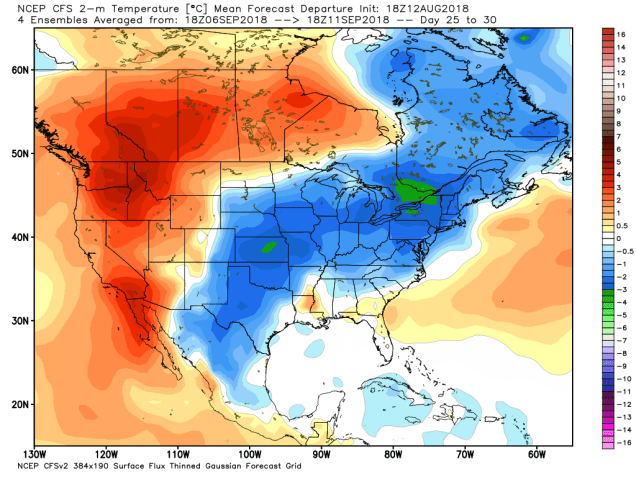
cfs_anom_t2m_conus_2018081218_121
The CFS model shows some much cooler air settling into the eastern half of the nation during early September. Will it actually happen? We’ll see. Image provided by WeatherBell.


Monday: Intervals of clouds and sunshine, chance for some showers, maybe a rumble of thunder. High 73-80.

Monday night: Partly to mostly cloudy, maybe a lingering shower or two. Low 65-72.

Tuesday: Partly sunny, some showers and thunderstorms are possible, mainly in the afternoon. High 78-85.

Tuesday night: Partly cloudy, a few lingering showers are possible. Low 64-71.

Wednesday: A mix of sun and clouds, slight chance for a shower. High 81-88.

Thursday: Partly to mostly sunny, a pop-up shower or thunderstorm may develop in the afternoon. High 83-90.

Friday: Sunshine and some afternoon clouds, a few showers or thunderstorms can’t be ruled out. High 83-90.

Saturday: Partly sunny, chance for some showers and thunderstorms. High 79-86.

Sunday:  More clouds than sunshine, more showers and thunderstorms are possible. High 74-81.

Weekly Outlook: August 6-12, 2018

Another week gone by filled with heat and humidity, as well as some thunderstorms. Can we expect more of the same this week? Yes, at least for part of the week, though some subtle changes are coming.

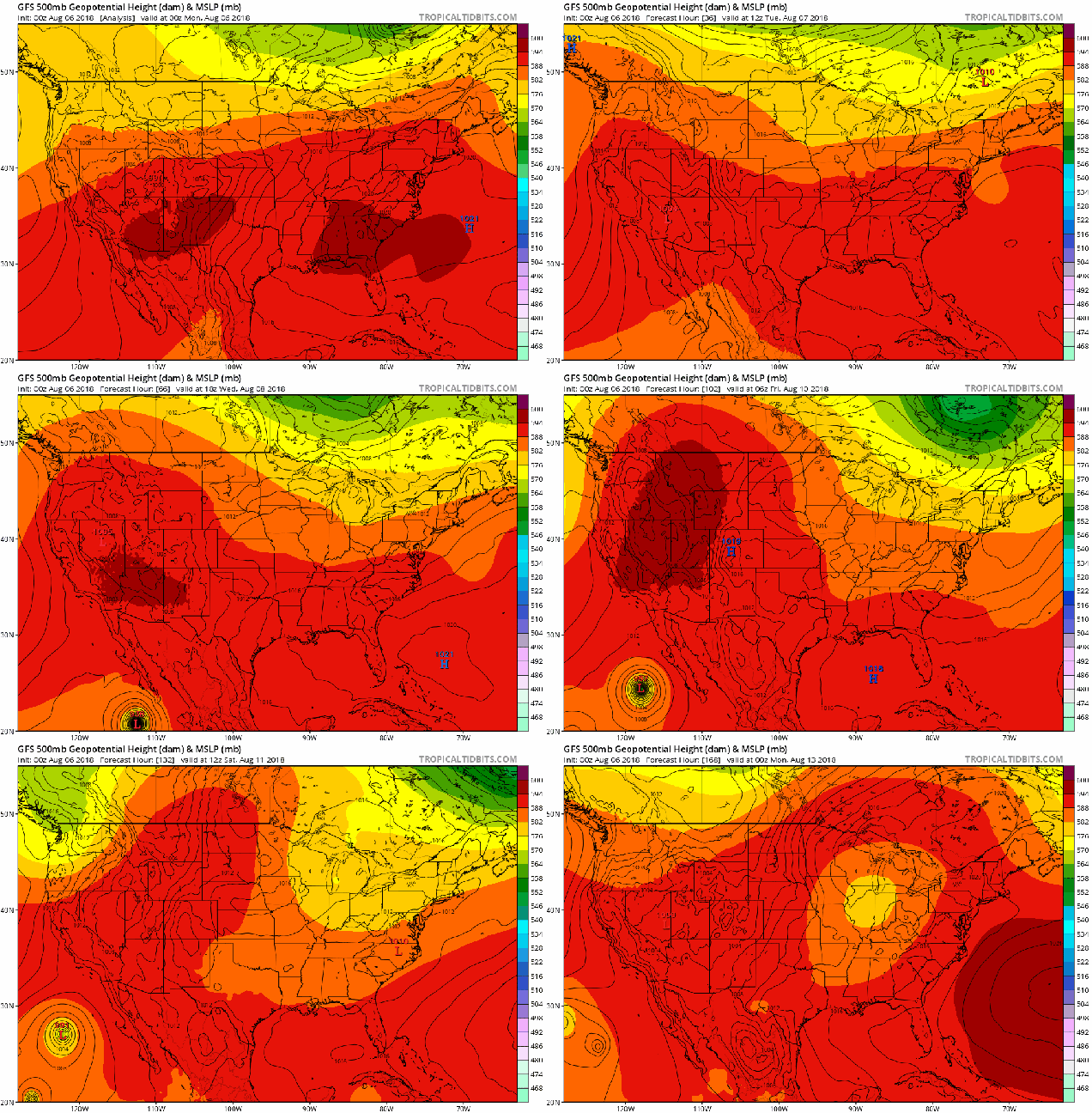
gfs_z500_mslp_us_fh0-168
Changes in the upper-level pattern will mean changes in our weather later this week. Loop provided by Tropical Tidbits.

The reason for heat and humidity has been a persistent ridge of high pressure in the Eastern US for most of the past few weeks. As you can see in the loop above, that ridge is forecast to shift into the Western US later this week, while a trough of low pressure settles into the Northeast. What does that mean in terms of actual weather? We’ll explain.

NAM-WRF 3-km undefined undefined 20
The combination of heat and humidity will result in heat indices int he upper 90s across most of the region this afternoon. Image provided by Weathermodels.com

With the ridge of high pressure in place aloft, we’ve also had high pressure at the surface, pumping warm and humid air into the region. That will continue today, and likely on Tuesday as well, though a frontal system approaching the region may produce a few showers and thunderstorms later Tuesday. That front will draw closer on Wednesday, likely moving through the region early Thursday. Ahead of it, more showers and thunderstorms are expected, some of which could be locally heavy. Depending on the timing of the front, severe weather is not out of the question. We’ll keep an eye on that as it gets closer.

We’ve had several fronts attempt to move through the region over the past few weeks, but as they run into that high pressure area at the surface and aloft, they end up stalling out and dissipating. With the ridge shifting westward and a trough of low pressure moving into the region, it will help provide enough impetus to help this front move offshore. Now, it’s not much of a “cold” front, as temperatures will still be warm to hot for the end of the week and into the weekend, but the most noticeable effect will be on the humidity. Humidity levels will drop on Thursday, with dewpoints in the upper 60s and 70s replace by dewpoints in the 50s to lower 60s for Thursday and Friday. Another frontal system may approach over the weekend, possibly bringing in some additional showers and thunderstorms, but also raising humidity levels a little.

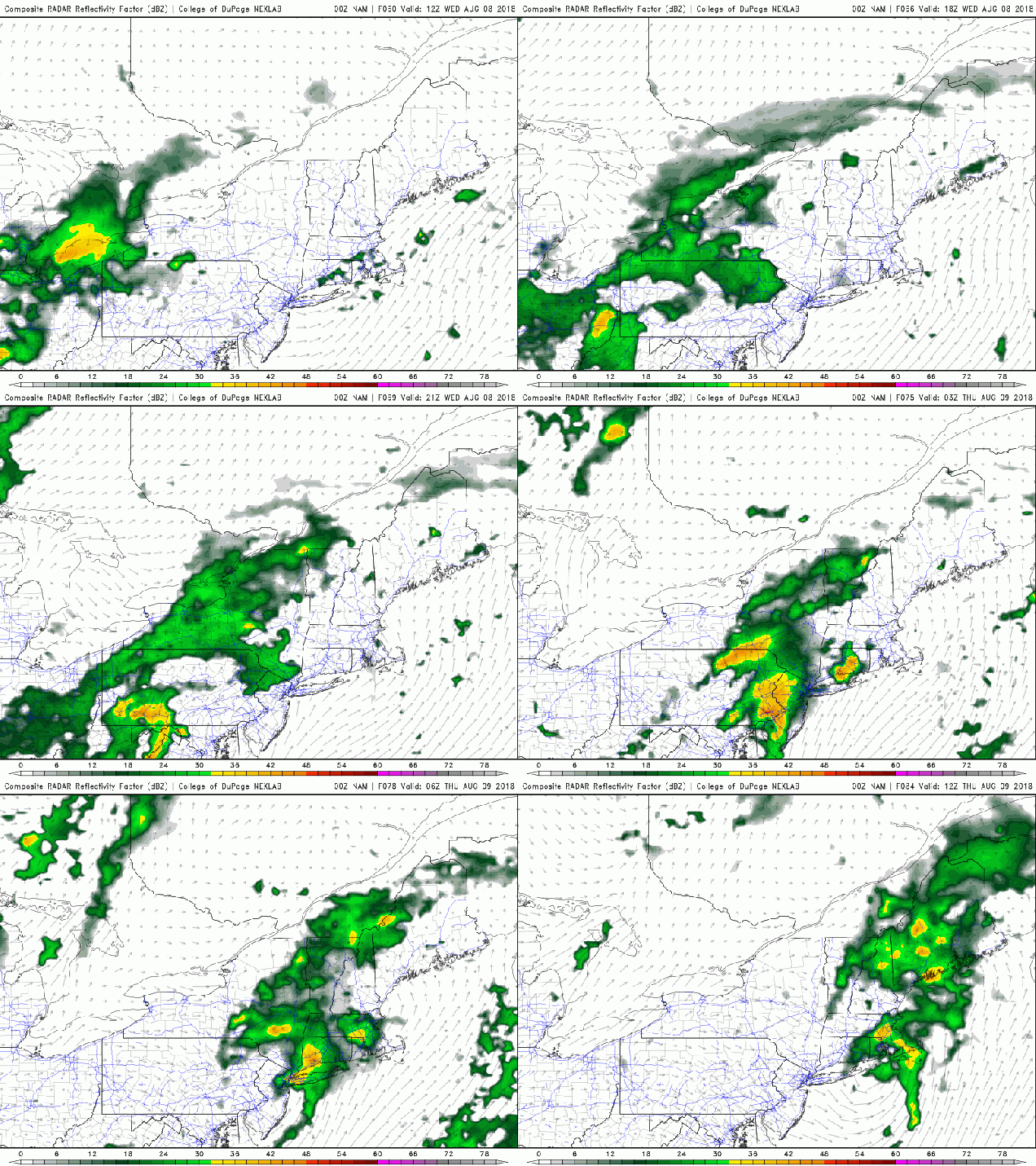
00Z-20180806_NAMNE_prec_radar-60-84-10-100
We don’t normally get a lot of thunderstorms overnight around here, especially severe ones, but it has happened a few times already this summer. At least one model shows the potential for more activity Wednesday night into Thursday morning. Loop provided by the College of DuPage.

Monday: Some patchy fog early, otherwise sunshine and some high clouds, humid. High 89-96.

Monday night: Mostly clear. Low 68-75.

Tuesday: Sunshine and some afternoon clouds, slight chance for a late-day shower or thunderstorm, humid. High 88-95.

Tuesday night: Partly cloudy, a few showers or thunderstorms are possible, mainly during the evening. Low 68-75.

Wednesday: Partly sunny, with scattered showers and thunderstorms developing late in the day, with more possible overnight. High 84-91.

Thursday: Early showers and thunderstorms, then skies clear out in the afternoon. High 81-88.

Friday: A mix of sun and clouds, slight chance for a shower or thunderstorm. High 82-89.

Saturday: Partly sunny with some showers and thunderstorms possible. High 79-86.

Sunday: A mix of sun and clouds. High 79-86.

Weekly Outlook: July 30 – August 5, 2018

Did you enjoy the past few weeks with the heat and humidity, or were you more happy with the lower humidity that we enjoyed on Sunday? No matter which you prefer, we’ve got both in the forecast for this week, but a lot more of one than the other (Hint: you’re gonna sweat a lot).

gfs_z500_mslp_eus_fh0-180
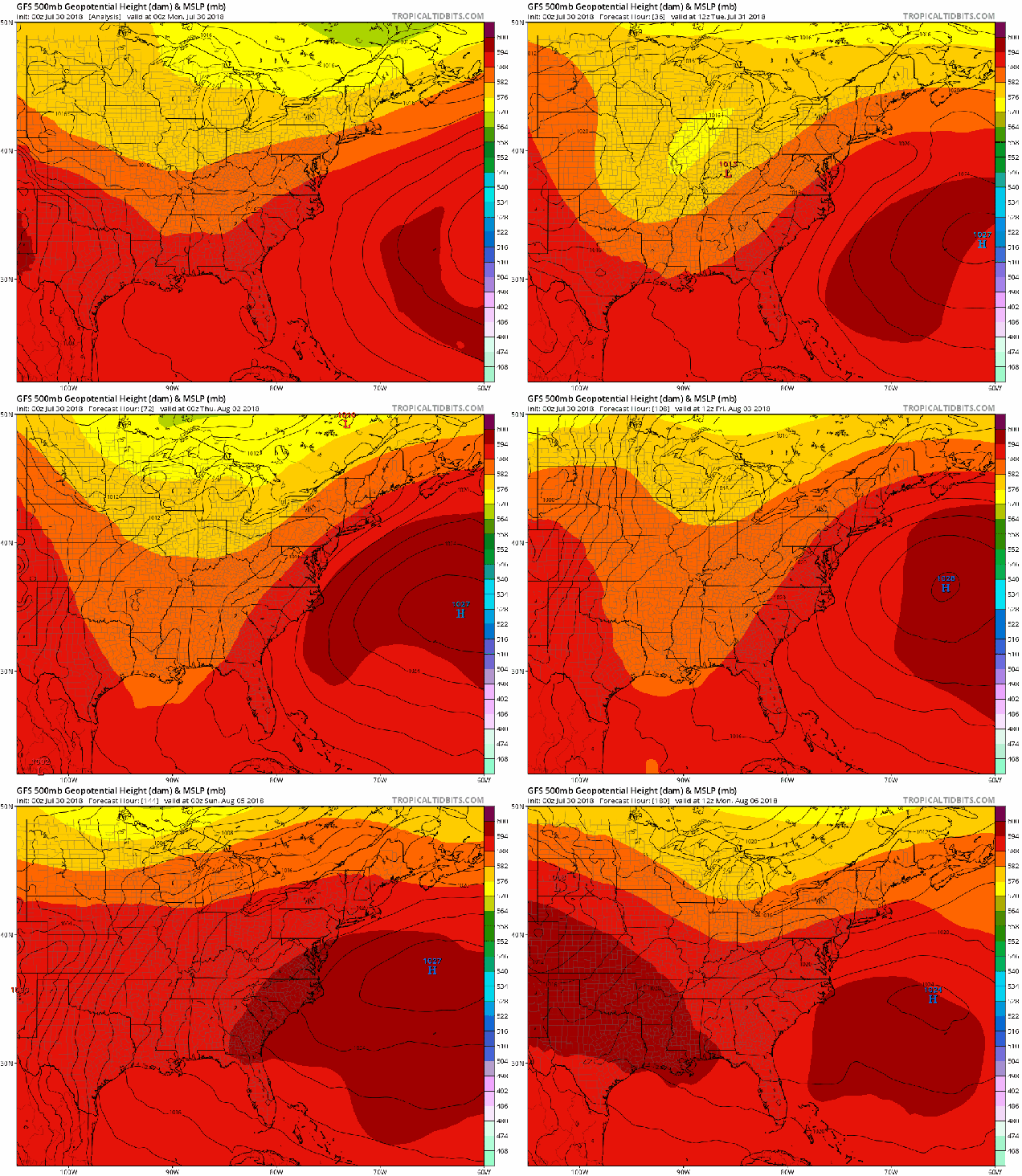
High pressure will be centered off the East Coast this week and really won’t move that much. Loop provided by Tropical Tidbits.

Once again, as is typical of summer, the general forecast is fairly simple. A “Bermuda High” will be anchored off the East Coast for most of the upcoming week. As a result, we get southwest winds pumping warm and humid air into the region. The high will actually start the week centered right over New England, which is why humidity levels will remain fairly low today. As the high slides offshore on Tuesday, a warm front will lift northward. That front may produce a few showers and thunderstorms late in the day, but once it moves through, it allows the humidity to come back in on Wednesday, and remain in place for the rest of the week.

hires_dew2m_boston_19
Dewpoints will be in the upper 50s to lower 60s this afternoon, which is very comfortable for late July. It’s not going to last too long though. Image provided by WeatherBell.

With that warm and humid air in place, we can expect some showers and thunderstorms to pop up each afternoon. Some of these storms may produce heavy downpours and gusty winds in a few spots, but for the most part, we’re not looking at any widespread severe weather outbreaks. A few of the storms each day could become severe, but for the most part, we’re just looking at your typical garden-variety thunderstorms each afternoon. There are a couple of days where they could be a little stronger and a little more numerous. The first day is Wednesday. Low pressure will move across the Great Lakes, and try to bring a cold front into the region. The front will likely dissipate before it is able to move through, but it will create enough instability to help trigger more thunderstorms. The other day is Friday, when we have a similar setup. A frontal system will likely dissipate before it can get across the region, but will help to trigger more widespread showers and thunderstorms.

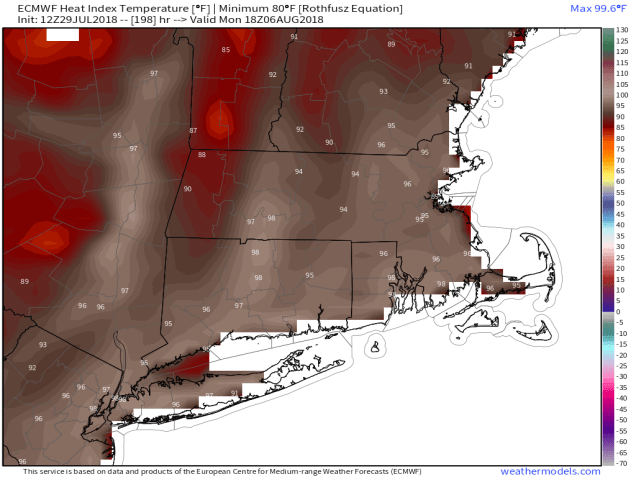
By next weekend, it looks like the heat will make a comeback as well. There are some indications that next week could end up being quite hot across the area for much of the week, but it’s still a little early to make that call, plus, not all of the models are showing this possibility.

9-km ECMWF USA Cities undefined undefined 198
Next Monday looks to be hot and humid with heat indices well into the 90s across much of the area, Image provided by Weathermodels.com

Monday: Sunshine and some high clouds. High 79-86.

Monday night: Thickening clouds. Low 61-68.

Tuesday: Partly to mostly cloudy, more humid, chance for a few showers. High 79-86.

Tuesday night: Mostly cloudy, chance of a shower. Low 64-71.

Wednesday: Intervals of clouds and sunshine with scattered showers and thunderstorms possible. High 81-88.

Thursday: Partly sunny, chance for afternoon showers and thunderstorms. High 83-90.

Friday: More clouds than sun with scattered showers and thunderstorms.  High 81-88.

Saturday: Partly to mostly sunny, chance for some showers and thunderstorms, especially early in the day. High 81-88.

Sunday: Sunshine and a few clouds. High 86-93.