We’ll tell you right now – the best day of the week is going to be Wednesday, and not because it’s Halloween. It’s going to be an absolutely glorious day. Why? That’s when the parade is.
As for the weather itself, well, a good chunk of the week should be nice, and believe it or not…..mild! The week starts off on a damp note though, as a little system comes rolling in from the west, giving us some rain showers this morning, ending by early afternoon. We’re not looking at a lot of rain, certainly nothing compared to what we had on Saturday, but it will fall during the morning commute, so, be prepared for that.
It’ll be wet out this morning, so bring an umbrella to work or school. Things will improve this afternoon. Loop provided by Tropical Tidbits.
After that, high pressure builds in with dry and warmer conditions for Tuesday and Wednesday. If you’re heading to the parade on Wednesday, expect plenty of sunshine with temperatures in the 50s. For trick-or-treaters that evening, expect it to be dry abd possibly a little breezy with temperatures generally in the middle to upper 50s. By Thursday, we’ll really start to warm up with temperatures getting into the 60s, but it will come with clouds as a storm system starts to approach the area. That storm passes to our north and west Thursday night into Friday, with some rain likely along with the mild temperatures. A cold front brings an end to the rain and the mild weather late Friday.
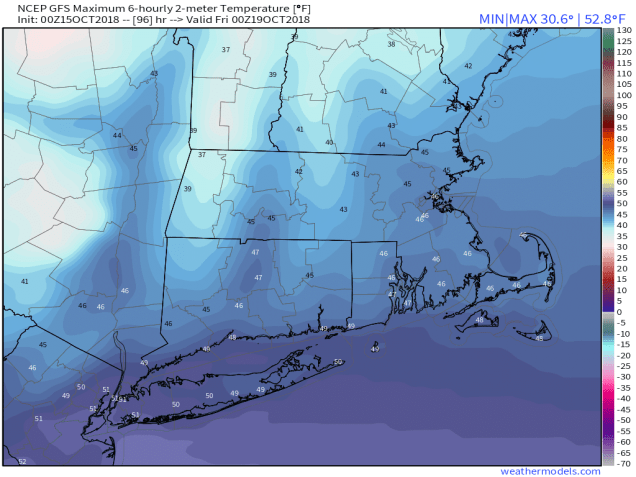
Despite the cloudcover, Thursday is looking like a very mild day. Image provided by Weathermodels.com
We’ll have a brief break on Friday night, but another system will start to head up the coast early Saturday, with a chilly rain expected for much of Saturday and Saturday night. This system may produce a little bit of snow in the mountains, but we shouldn’t have much to worry about around here. High pressure builds in on Sunday with dry and cooler conditions.
Also, don’t forget, Daylight Saving Time ends Sunday morning at 2am. If you have any clocks that don’t automatically update, then you’ll need to change them back an hour Saturday night. The good news is that you’ll get an extra hour of sleep. It’ll help make up for all the sleep you lost staying up for the Red Sox games.
Turn your clocks back an hour Saturday night before bed. We don’t want to know what you’re doing with your hoe for that extra hour. Image provided by Wikipedia.
Monday: Showers ending by early afternoon, some clearing develops late in the day. High 50-57.
Monday night: Clear to partly cloudy. Low 34-41.
Tuesday: A mix of sun and clouds. High 44-51.
Tuesday night: Clear skies. Low 30-37.
Wednesday: Sunshine and a few clouds, becoming breezy. High 55-62.
Thursday: Becoming partly to mostly cloudy and breezy. High 62-69.
Friday: Cloudy and breezy with showers likely. High 59-66.
Saturday: Mostly cloudy with more rain likely. High 50-57.
The forecast for this week is fairly straightforward for most of the work week. Next weekend? Well, there could be some issues.
We’re starting the week off on a very chilly note. Image provided by Weathermodels.com
The week starts off on a chilly, but dry note with high pressure in control. If you’re up early enough, you may need to find the scraper for your windshield before you head out. Either that, or turn the defroster on and let in run for a but before you get in the car.Yup, it’s that time of year again. Clouds will start to stream in late in the day as a fast-moving storm system approaches from the Great Lakes. That system will bring us some rain showers on Tuesday. If the rain moves in early enough, we could see some snowflakes mixing in, mainly across the higher terrain from central Massachusetts into southwestern New Hampshire.
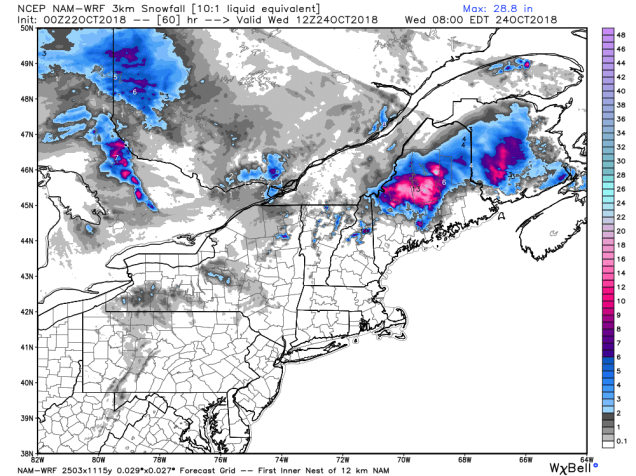
The storm on Tuesday and Wednesday could drop a decent amount of snow from parts of Northern New England into New Brunswick. Image provided by WeatherBell.
As that system departs, it will start to strengthen as it moves into the Gulf of Maine and Atlantic Canada. It may drop a decent a mount of snow from the mountains of northern New England into parts of northern Maine and New Brunswick, but around here, we can expect breezy and cooler conditions for Wednesday and Thursday. High pressure builds in on Thursday, allowing the winds to die down, with dry and cool conditions continuing into Saturday.
Later Saturday and into Sunday is where things start to get complicated. Hurricane Willa will make landfall in southwestern Mexico on Tuesday, then move into Texas, and then the Gulf of Mexico (but not as a tropical system any more). From there, it will start to head up the East Coast, while becoming a strong storm system once again. High pressure to the north should block in from getting in here on Saturday, though the clouds ahead of the system will move in. It’s Sunday that could be a problem. As the high continues to retreat to the north and east, we’ll still have plenty of cold air in place Saturday night into Sunday. As the storm starts to move up the coast, it will spread some moisture into the region. If you have cold air trapped at the surface while moisture and milder air move in aloft, you have the potential for problems. While coastal areas will just see a gusty winds and a cold rain, across interior areas, we have the potential for some sleet or freezing rain on Sunday. Milder air should eventually win out, with a change to all rain even across the interior. There are other models that have the storm pass to our west, which would just mean a wind-swept mild rain. Obviously, there’s a lot of uncertainty with future of this system. For now, we’re leaning towards the colder scenario, but it’s low confidence. As we get later in the week, if this scenario becomes more likely, we’ll keep you updated.
The GFS model is showing the potential for some sleet or freezing rain across the interior next Sunday. Other models have a wind-swept warmer rain. It’s too early to tell which scenario is more likely. Loop provided by Tropical Tidbits.
Monday: Sunny and chilly to start, clouds start to move in during the afternoon. High 45-52.
Monday night: Becoming mostly cloudy, showers developing towards daybreak, possibly mixed with some wet snowflakes across the interior. Low 35-42.
Tuesday: Cloudy with scattered showers. High 45-52 north and west of I-495, 53-60 elsewhere.
Tuesday night: Showers ending in the evening, then some clearing late at night. Low 34-41.
Wednesday: Becoming partly to mostly sunny and breezy. High 46-53.
Thursday: Sunshine and a few clouds, still breezy. High 40-47.
Friday: Partly to mostly sunny. High 41-48.
Saturday: Some early sun, otherwise thickening clouds throughout the day. Breezy again. High 44-51.
Sunday: Cloudy and breezy with rain likely , possibly starting as a period of freezing rain and/or sleet across the interior. High 39-46 north and west of I-495, 47-54 elsewhere.
Fall has finally arrived, and you’ll know it for sure this week. If you’re playing the game of trying to avoid turning on the heat before November 1, there’s a good chance you’ll lose before this week is out.
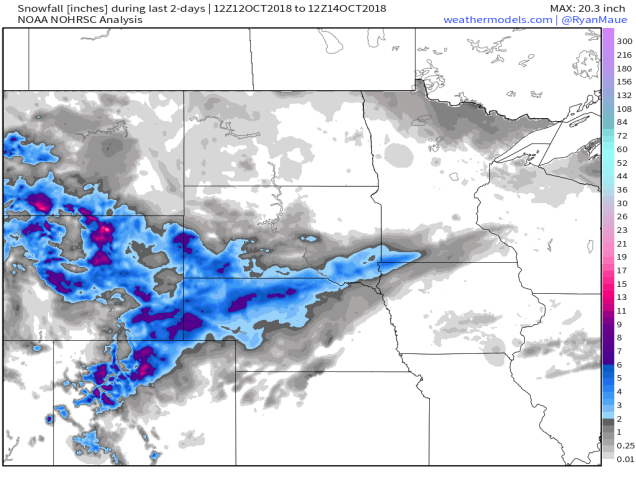
The storm moving into our area today brought snowfall to the Rockies and Plains over the weekend. We’re not going to see any snow around here from it. Image provided by Weathermodels.com
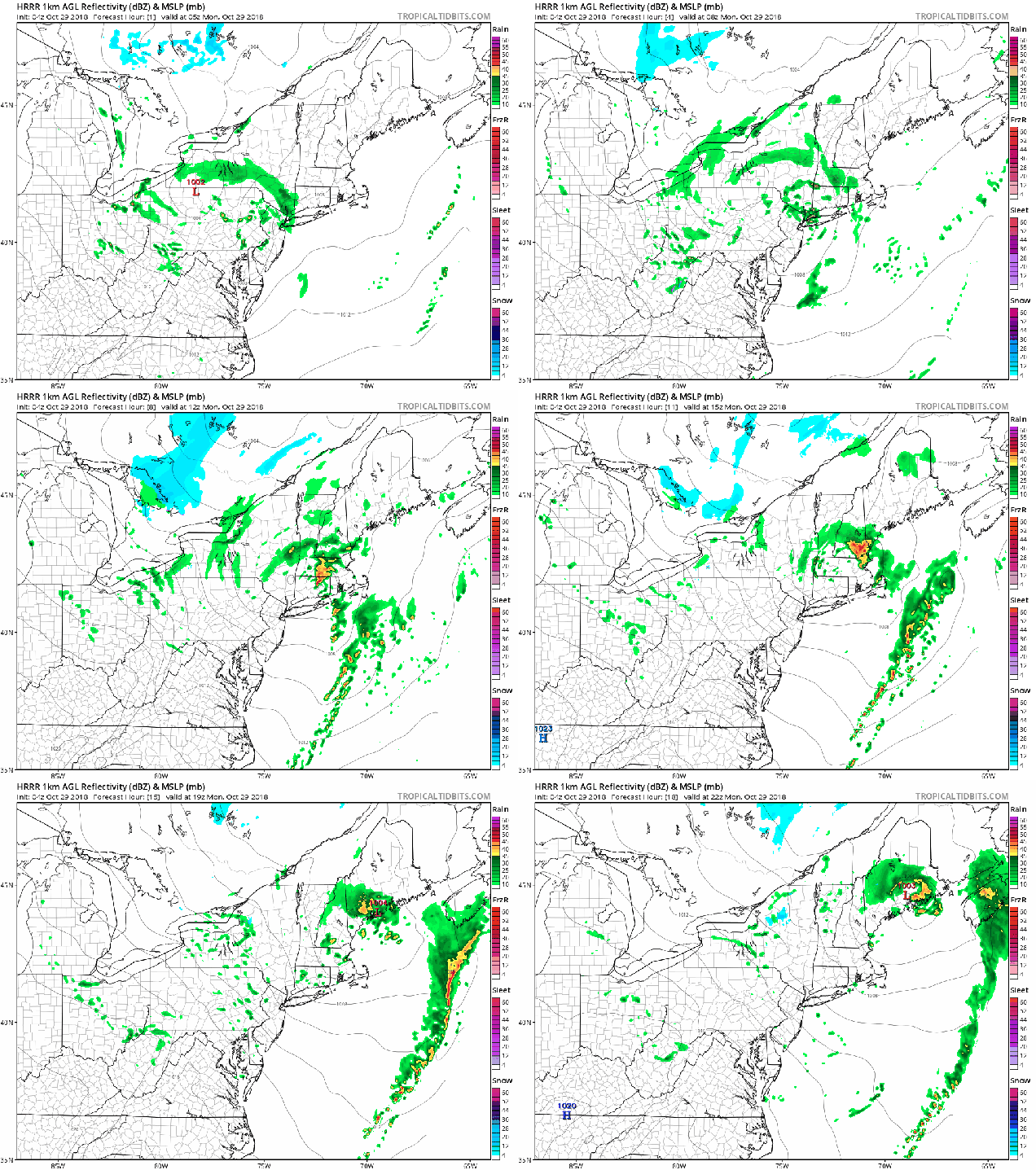
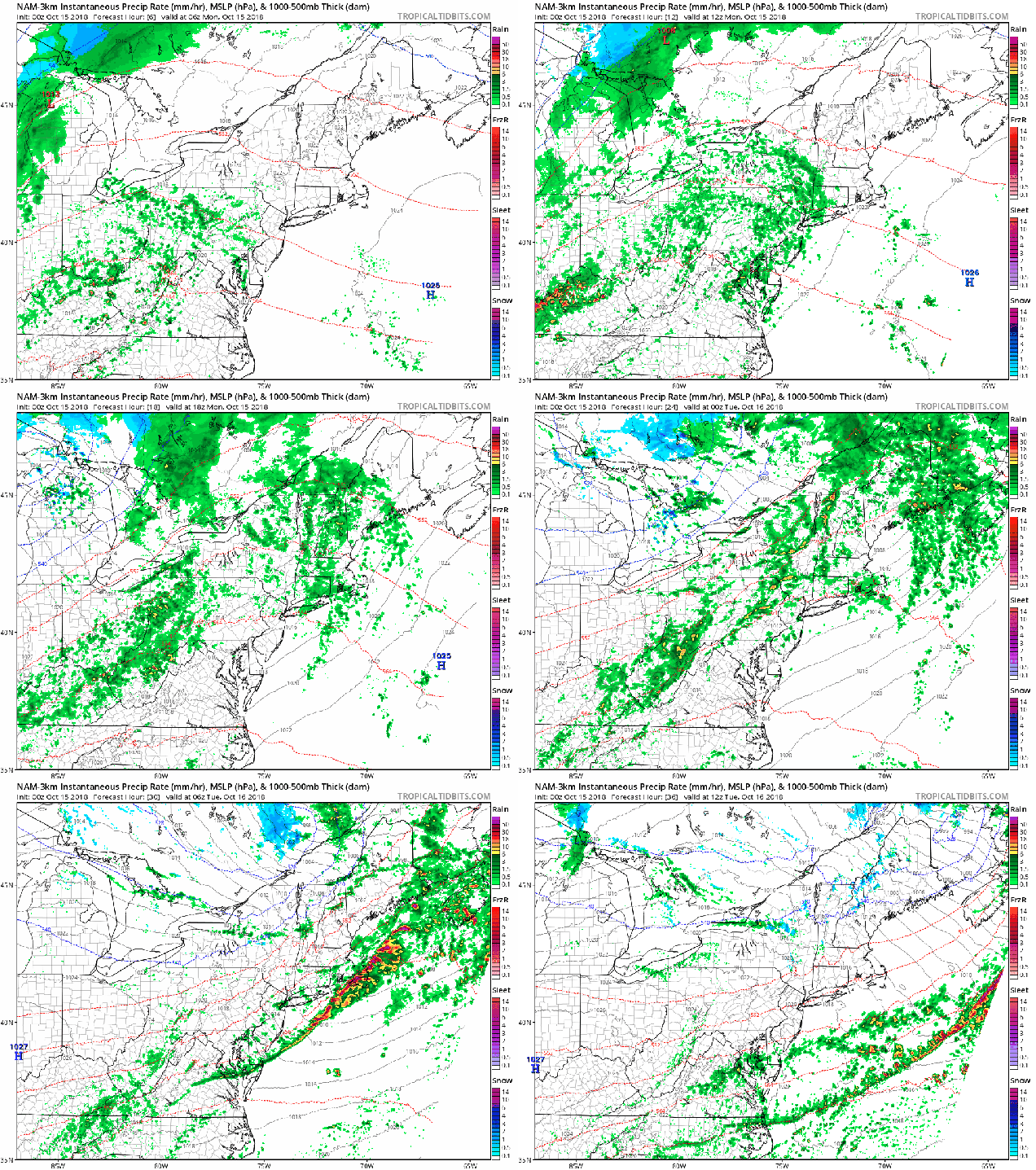
We start the week off with low pressure passing well north of our area. This low used to be Hurricane Sergio in the Pacific Ocean. As it moved across the nation’s mid-section, it produced severe weather in the Mississippi Valley and heavy snow from the Rockies into parts of the Plains. Nothing like that is expected here, but it will bring in some milder air today, along with some showers, mainly during the afternoon an evening. A cold front trailing the system pushes through in the evening which produce some heavier showers, maybe even a thunderstorm, and some gusty winds.
Showers are likely during the afternoon today, but some thunderstorms may accompany the actual cold front this evening, as the high-resolution NAM model shows. Loop provided by Tropical Tidbits.
High pressure builds in on Tuesday with sunshine and breezy conditions, but it’ll turn cooler. The high slides offshore on Wednesday, allowing slightly milder air to move back in, but it’ll be short-lived. Another cold front approaches. This one won’t contain a lot of moisture, so only a few showers are expected. Behind it, windy and much cooler conditions are expected on Thursday. In fact, Thursday will likely be the coolest day we’ve had since the end of April, with high temperatures likely staying below 50 across much of the region.
Those are the high temperatures Thursday afternoon, not the lows Thursday morning. Image provided by Weathermodels.com
The cool shot doesn’t last long though, as high pressure moves offshore, allowing temperatures to moderate again. However, another cold front moves through on Saturday, bringing some more showers to the region. Once again, the front moves through, and windy and cooler conditions return on Sunday.
Monday: Mostly cloudy and breezy with showers likely, especially during the afternoon. High 59-66.
Monday night: Showers end in the evening, possibly with some thunder, then skies clear out by daybreak. Low 40-47.
Tuesday: Sunshine and a few clouds, breezy. High 50-57.
Tuesday night: Clear to partly cloudy. Low 39-46.
Wednesday: A mix of sun and clouds, breezy, slight chance for a late-day shower. High 53-60.
Thursday: Partly to mostly sunny, breezy, and cooler. High 41-48.
Friday: Sunshine dimmed by afternoon high clouds. High 53-60.
Saturday: Cloudy with some showers possible. High 54-61.
Sunday: A mix of sun and clouds, breezy. High 44-51.
For the third year in a row, the “M” storm in the Atlantic is prepared to wreak havoc on a populated area, but Michael isn’t the only headline maker in the weather at the moment.
Hurricane Michael isn’t the only storm in the news, but it is the biggest threat at the moment. As of early Tuesday afternoon, Michael was centered about 335 miles south of Panama City, Florida, moving toward the north at 12 mph. Maximum sustained winds are near 110 mph, making Michael a Category 2 Hurricane. Additional strengthening is expected over the next 12-18 hours as the storm moves over the warm waters of the eastern Gulf of Mexico. Hurricane and Storm Surge Warnings are in effect for the Florida Panhandle and the Big Bend area of Florida, with Tropical Storm Warnings and Watches surrounding the Hurricane Warnings. Tropical Storm Watches are also in effect for the Atlantic coast from northeastern Florida into South Carolina.
Michael is going to pack quite a wallop when it slams into the Florida Panhandle Wednesday afternoon. Image provided by the National Hurricane Center.
Michael is expected to make landfall in the Florida Panhandle Wednesday afternoon, likely as a Category 3 storm. Strong winds, torrential rainfall, storm surge, and some tornadoes are all possible with this storm. Unlike Florence, which hung around the Carolinas for days and dumped incredible amounts of rainfall on the region, Michael is expected to keep moving at a steady pace, emerging off the Mid-Atlantic coast by Friday morning. Rainfall totals of 5-10 inches are still expected in parts of the region, which will produce flooding in some areas, especially in Carolinas, where many areas are still recovering from Florence. Right along the coast, a storm surge of 6-12 feet is possible, especially in the Big Bend area of Florida. Fortunately, this area is not heavily populated, but for the residents that do live in this area, storm surge flooding is a significant threat.
Once it moves back into the Atlantic early Friday, it should pass well south of our area. The northern edge of the rainfall from the system could reach the South Coast, but the bulk of the heavy rain should remain well to the south.
This is the 3rd year in a row that the “M” storm is expected to result in significant damage to a populated area. In 2014, Category 5 Hurricane Matthew left a path of death and destruction across parts of Haiti, Cuba, the Bahamas, and eventually parts of the southeastern United States. Last year, Category 5 Hurricane Maria devastated the northeastern Caribbean, including Puerto Rico and the US Virgin Islands. While Michael is not expected to become a Category 5 storm, it is still expected to result in significant damage to parts of Florida and the Southeast.
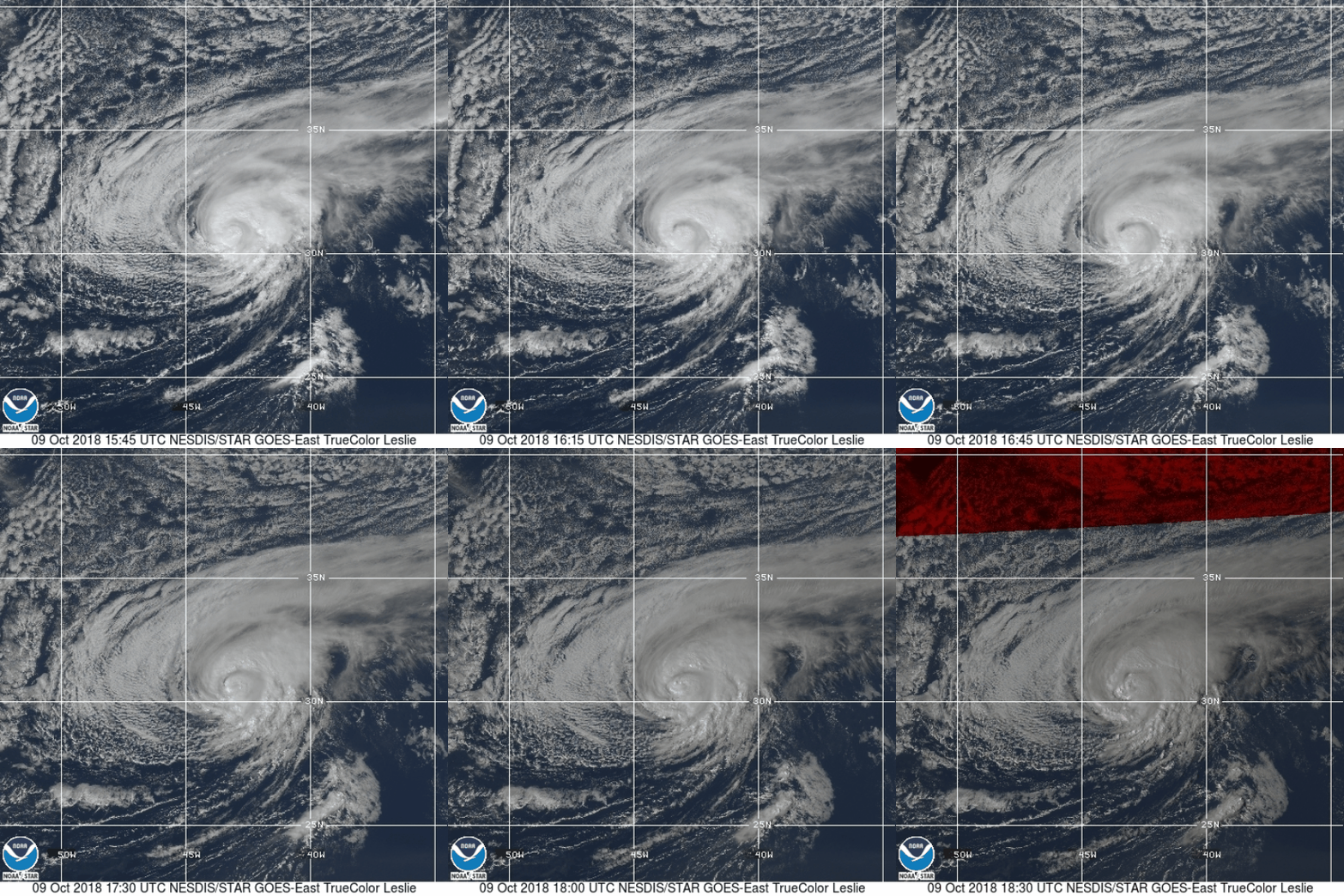
Tropical Storm Leslie has been around for near 2 weeks and still looks rather healthy. Loop provided by NOAA.
Meanwhile, in the eastern Atlantic, Tropical Storm Leslie refuses to go away. As of midday Tuesday, Leslie was centered a little more than 1000 miles west-southwest of the Azores, moving toward the south-southeast at 13 mph. Maximum sustained winds are near 65 mph. The forecast for Leslie calls for a turn more toward the east over the next few days while it strengthens back into a hurricane. Leslie is expected to remain over open waters for the next few days, and could become an extratropical storm this weekend while continuing on a general easterly track.
Nadine is a fish storm. Nothing to worry about here. Image provided by Tropical Tidbits.
To the south, Tropical Storm Nadine as formed nearly 500 miles southwest of the Cabo Verde Islands. Nadine has maximum sustained winds near 40 mph, and is moving toward the west-northwest at 9 mph. Nadine is expected to remain fairly weak over open waters for the next several days while turning more toward the northwest. As it moves over colder water late this week and this weekend, it should weaken and eventually dissipate.
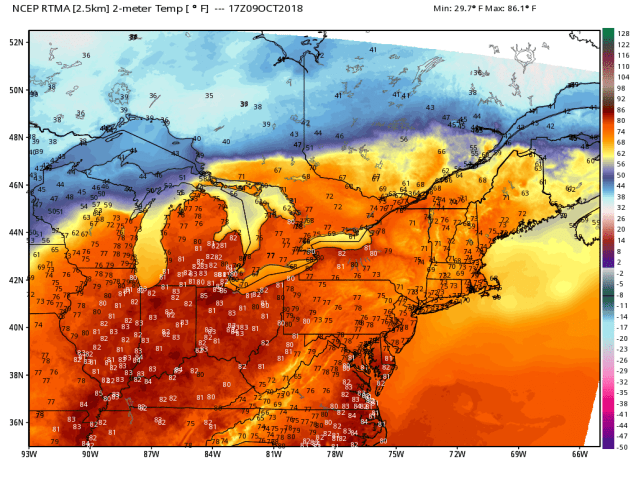
What month is it again? 70s and 80s early in the afternoon on October 9th? Image provided by WeatherBell.
Back in the United States, unseasonably warm conditions remain in place across much of the eastern half of the nation. Temperatures are in the 70s and 80s across much of the region, which is 15 to 25 degrees above normal. A strong frontal system is located in the Plains states this afternoon, separating the warm air in the East, from much cooler weather behind it in the Plains and the Rockies. Right along this front, which hasn’t moved much for the past 24 hours, severe weather and heavy rainfall are common this afternoon.
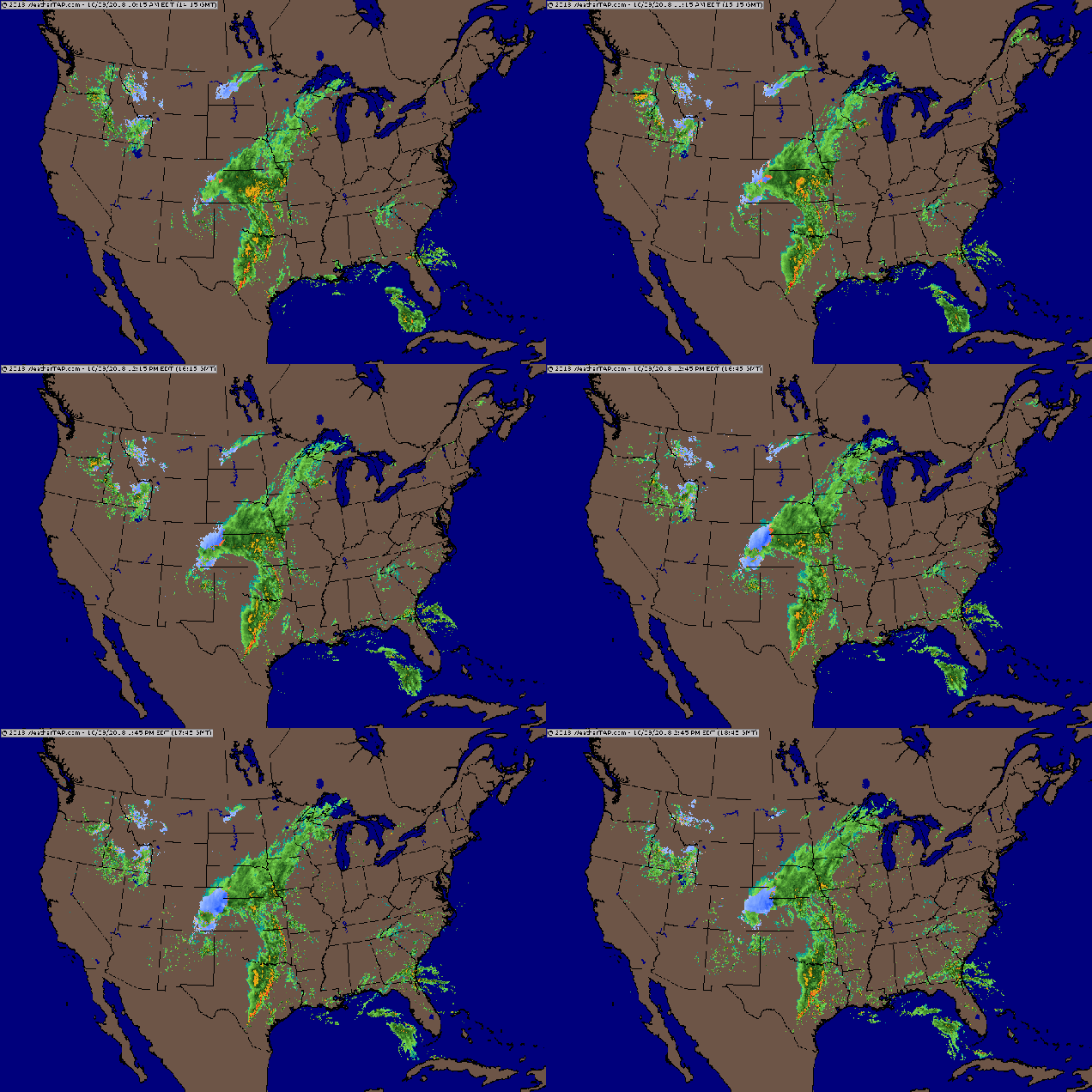
That’s snow in Colorado, and heavy rain along with severe weather from Texas into the Central Plains this afternoon. Loop provided by WeatherTAP.
Several tornadoes have been reported already today, including a few in the Oklahoma City area, and more are expected later today and tonight. Heavy rainfall is also expected from Texas into the Central Plains and parts of the Upper Midwest. Rainfall totals of 1-3 inches and locally heavier may produce flash flooding in some areas. Flash flood watches are in effect for much of the region.
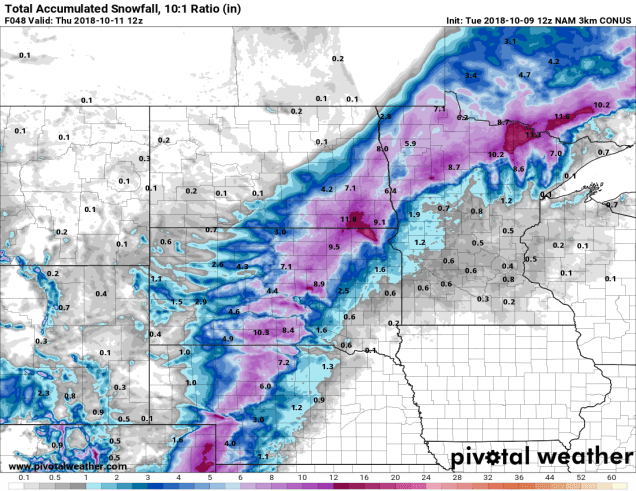
Several inches of snow is expected form the Plains into the Upper Midwest over the next few days. Image provided by Pivotal Weather.
On the other side of the front, where much cooler weather is in place, rain is expected to change over to snow as low pressure rides along the front and into the Midwest. Winter weather advisories have already been posted for parts of the region. Snow is already falling in parts of Colorado this afternoon, and several inches may fall over the next 36-48 hours from western portions of Kansas and Nebraska into the Dakotas and northern Minnesota.
Some heavy rain is possible across our area on Thursday as a strong cold front approaches the region. Image provided by WeatherBell.
As the system moves eastward, it will spread some heavy rain and thunderstorms into our area on Thursday. We’re not expecting any severe weather, but some heavy downpours are possible, especially from western Massachusetts into southern New Hampshire. Some localized flooding may result. Once this front pushes offshore, much cooler weather will settle in for the Friday and the weekend.
Much of the week will not feel like October once again, but changes are coming. Enjoy the warm weather we’ll have this week, it might not be back for a while.
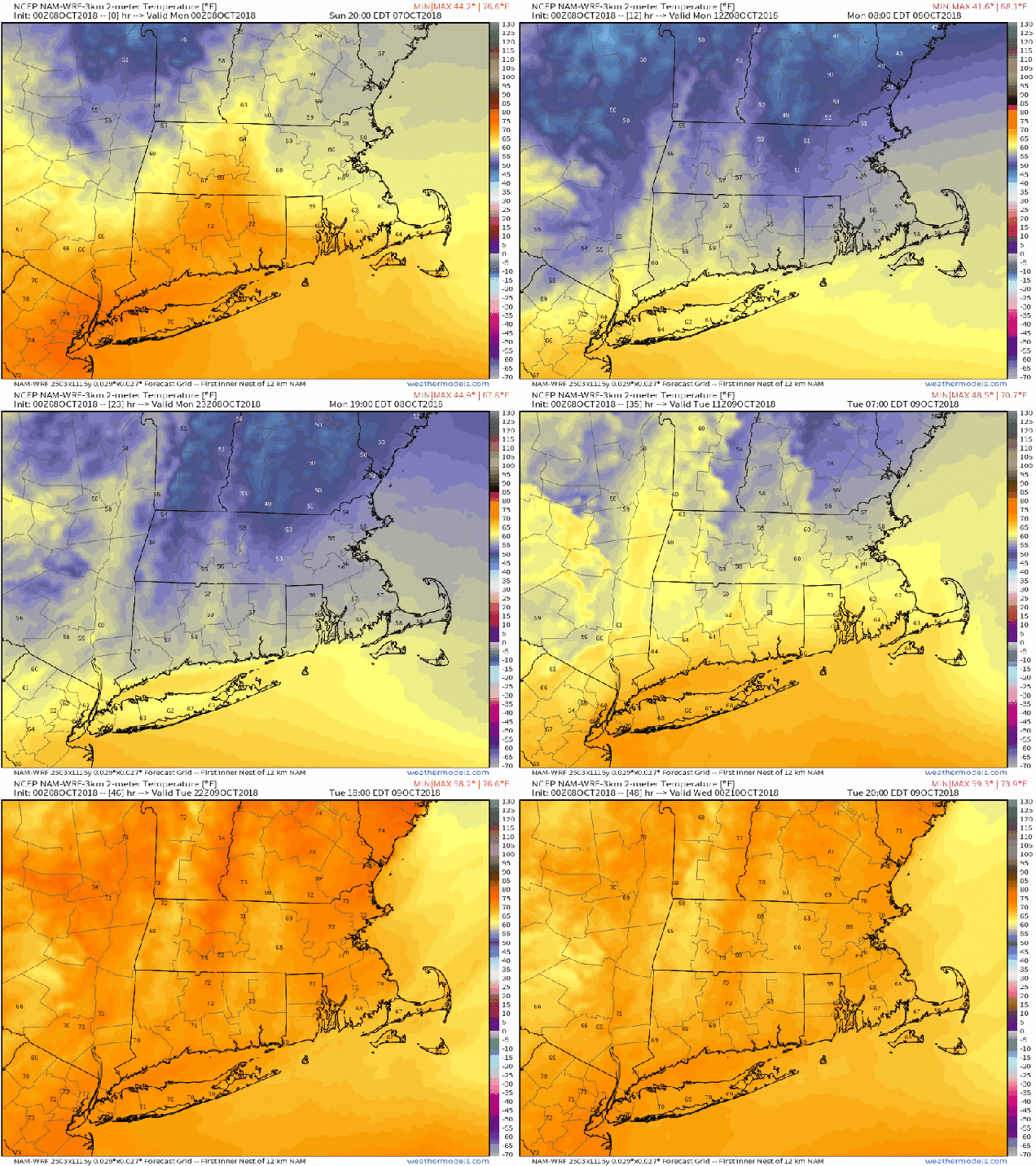
We’re going to be riding that temperature roller coast again between today and tomorrow. Loop provided by Weathermodels.com
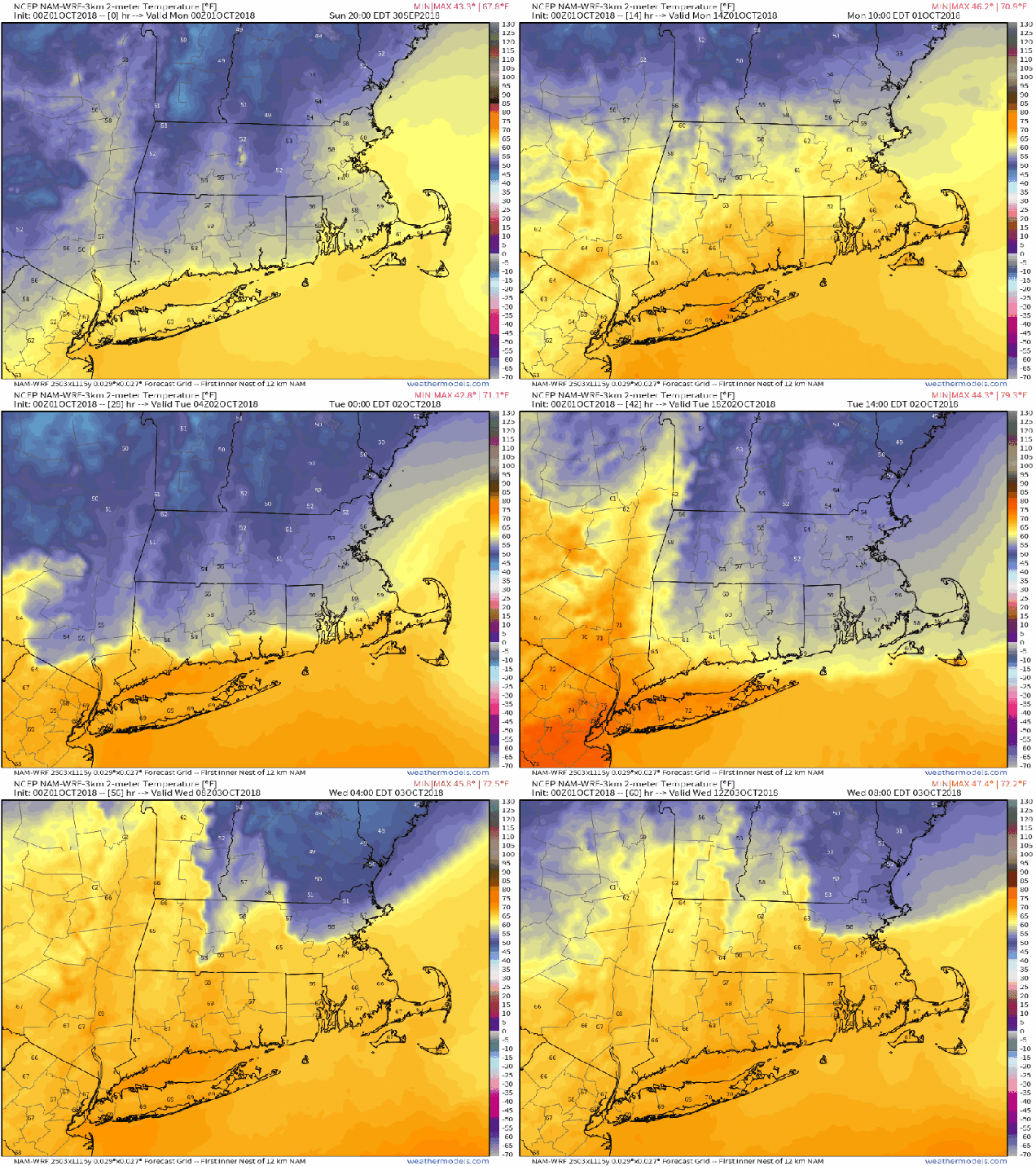
The week starts out on a cool note. A backdoor front crossed the region on Sunday, and high pressure has built in behind it. With the high in control, temperatures will be cool, but with the front stalled out nearby, we’ll still have plenty of clouds along with some showers. The front lifts northward again early Tuesday as a warm front. Tuesday and Wednesday won’t exactly be hazy, hot, and humid, but partly sunny and unseasonably warm will have to suffice. After that, things get interesting.
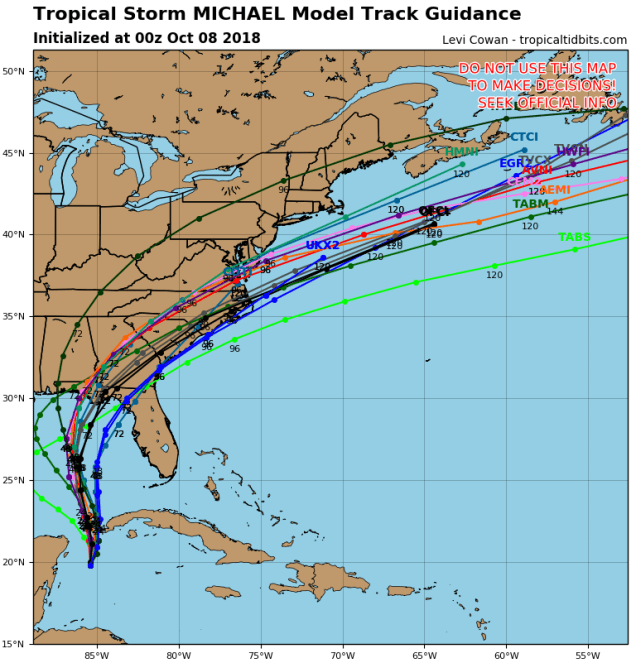
The track of Michael will likely take it inland in the Florida panhandle, then back out into the Atlantic, passing south of New England. How much will it impact us? Image provided by Tropical Tidbits
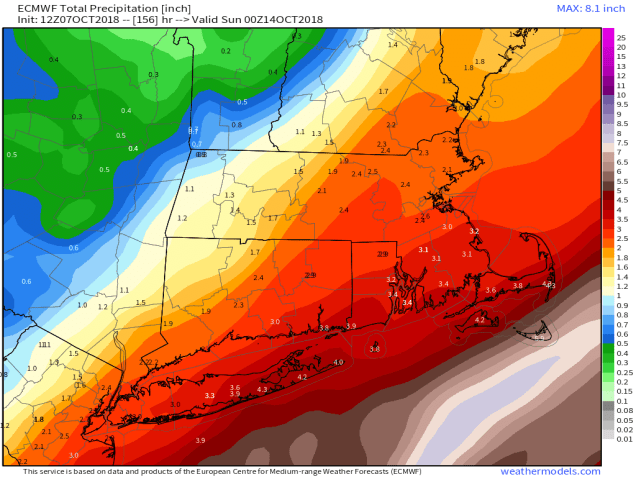
Tropical Storm Michael formed on Sunday and is now moving into the southeastern Gulf of Mexico. Most of the forecast models show the potential for the storm to rapidly intensify before slamming into the Gulf Coast, likely near the Florida Panhandle, on Wednesday. A lot of these models seem a bit too aggressive in their development of Michael, but they are in fairly good agreement on its track. Once inland, it should head northeastward, bringing more heavy rain to the Carolinas (just what they need!), before moving off the Mid-Atlantic coastline and passing south of New England on Friday. At the same time, low pressure moving into southern Canada will drag a strong cold front through the region. These two will combine to bring an end to the warm weather, but also to produce gusty winds and some heavy rain Thursday into Friday. The front brings in some rain on Thursday, then Michael brings in another round on Friday. How heavy the rain on Friday will be is still up in the air, as it depends on the exact track the Michael, or whatever is left of it by then, actually takes. The best chance for heavy rain will be south of the Mass Pike.
The potential exists for some heavy rainfall later this week. Image provided by Weathermodels.com
On Thursday, we may have another wrinkle to throw in – another backdoor front. Some of the models are showing the potential for a backdoor front moving down from Maine Wednesday night, bringing some cooler air into Maine, New Hampshire, and at least northeastern Massachusetts before the front stalls out, and then lifts northward again in the afternoon, before the strong cold front arrives from the west. Other models show Thursday remaining quite mild until the front arrives in the afternoon. We’re going to lean towards the cooler side for now, but keep in mind that it could end up being several degrees warmer than our forecast shows.
Behind the cold front and what’s left of Michael, much cooler weather will move into the region next weekend. How cool? Many of the models show the potential for some wet snow across parts of northern New England, especially in the mountains. One model shows the cold air moving in well before the moisture arrives, with some heavy snow in parts of Maine, extending into the mountains of New Hampshire, but we’re not buying that solution as of yet. As for this area, no snow, but it’ll definitely by cooler with partial sunshine as high pressure tries to build in.
Harvest what’s left in the garden and put another blanket on the bed – it’s going to be chilly next weekend. Image provided by WeatherBell.
Meanwhile, what about the weather in the Bronx this evening for the pivotal Game 3 between the Sox and Yankees? Well, it’ll likely be cloudy, with a light east wind, which is blowing in from center. A shower is possible, but it shouldn’t interrupt the game. Temperatures will likely be in the middle 60s. For Game 4 on Tuesday, we’re expecting partly to mostly cloudy skies, a light southwest wind (blowing out to left), and temperatures starting in the middle 70s, dropping into the upper 60s by the end of the game. If a Game 5 is needed, it’s scheduled for 7:40pm on Thursday at Fenway. Right now, that forecast looks like rain, southwest winds 5-10 mph (blowing out to center), and temperatures around 70. A delay until Friday would likely be needed, and even that wouldn’t be a sure thing.
The greatest rivalry in baseball continues tonight and tomorrow in New York. Image provided by Western Mass News.
Monday: Plenty of clouds, chance for a shower or two. High 57-64.
Monday night: Mostly cloudy. Low 51-58 in the evening, then temperatures hold steady or slowly rise a bit overnight.
Tuesday: Becoming partly sunny, breezy, and warmer. High 71-78.
Tuesday night: Partly to mostly cloudy with some patchy fog developing. Low 60-67.
Wednesday: A mix of sun and clouds, breezy. High 76-83.
Thursday: Cloudy and breezy with showers developing, becoming a steady rain at night. High 68-75.
Friday: Mostly cloudy and cooler, with a chance for more rain, possibly heavy, especially south of the Mass Pike and mainly during the morning. High 59-66.
Saturday: More clouds than sunshine, windy. High 49-56.
October has arrived, which means that 2018 is now 3/4 over. October can be an interesting month. We’ve had snow before, but we’ve also hit 90. Over average high temperatures start the month in the upper 60s, and end the month in the upper 50s. Most locations in our area will see their first frost during October in most years. Of course, October is also one of the best months of the year if you’re a sports fan. The Patriots season is in full swing, the Red Sox start the playoffs this week, the Bruins open their season this week, the Celtics start their season in a couple of weeks, and the Revolution…..ummm….sorry Revs fans, another disappointing season is almost over. What about the weather for this week? Well, we’re going to have another week with a little bit of everything (except snow).
A backdoor cold front brings in cooler weather today. The milder air may try to move back in Tuesday night and early Wednesday, but areas north of the Mass Pike may remain quite cool. Loop provided by Weathermodels.com
The week starts off with a backdoor cold front dropping down from the north. We’ll have a mild day ahead of it south of the Mass Pike, but a few showers are possible late in the day and tonight as the front moves through. The front will stall out near or just south of the region, and a wave of low pressure will ride along it on Tuesday. This will bring in a period of steadier rain. While some of the rain could be heavy, we’re not looking at a repeat of some recent systems that have dropped several inches of rain on the area.
Much of Central and Southern New England received 6-10″ of rain (or more) during September Image provided by the Northeast Regional Climate Center.
High pressure builds in on Wednesday with drier conditions, but as the high slides offshore, another warmup is expected for Thursday. This warmup will be short-lived however, as another cold front brings in more showers Thursday night. Another high pressure area builds in for Friday and Saturday with dry and cooler conditions once again. It doesn’t look like there will be any weather problems aside from cool temperatures for Game 1 of the American League Division Series at Fenway on Friday, or Game 2 on Saturday (times still unknown), but we’ll keep an eye on things, as the pattern can change fairly quickly. By Sunday, high pressure moves offshore again, with another warmup expected across the area.
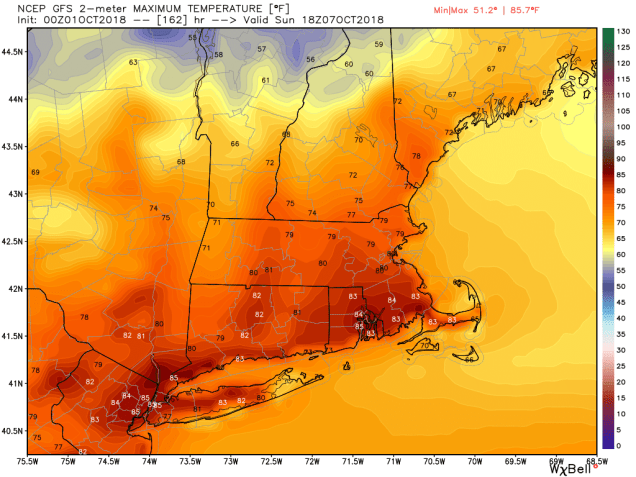
One model is forecasting some summer-like warmth next Sunday. We’re not convinced yet that it will be this warm, but for now, next Sunday does like quite mild. Image provided by WeatherBell.
Monday: Some sunshine to start, especially south of the Mass Pike, then clouding up with showers developing during the afternoon. High 58-65 north of the Mass Pike, 65-72 south of the Pike.
Monday night: Mostly cloudy with a chance of showers along with some drizzle and fog. Low 51-58.
Tuesday: Cloudy with showers likely, possibly a period of some steady rain late in the day. High 59-66, possibly warmer south of the Mass Pike.
Tuesday night: Rain tapers off and ends, with some gradual clearing developing towards daybreak. Low 54-61 in the evening, with temperatures holding steady overnight, possibly rising a bit, especially south of the Mass Pike.
Wednesday: Intervals of clouds and sunshine. High 67-74.
Thursday: Becoming mostly cloudy and breezy with a chance for a few showers during the evening. High 70-77.
Friday: Some early clouds, then becoming partly sunny, breezy., and cooler. High 59-66.
We’ve entered the final week of September, and once again, we’ve got a little bit of everything in the forecast this week (except for snow).
The week starts off on a chilly note as high pressure moves across Maine and into Atlantic Canada. There will likely be frost and freezing temperatures across Northern New England to start the day. With high clouds filtering the sunshine and a chilly airmass in place, temperatures may struggle to reach 60 across our area. We commented to our fellow blogger and friend at Woods Hill Weather a few days ago that Monday looked like the first “Stop at Dunks for a Hot Chocolate” afternoon of the year.
Highs may not reach 60 this afternoon across much of the area. Better dig out those sweatshirts from the closet. Image provided by Weathermodels.com
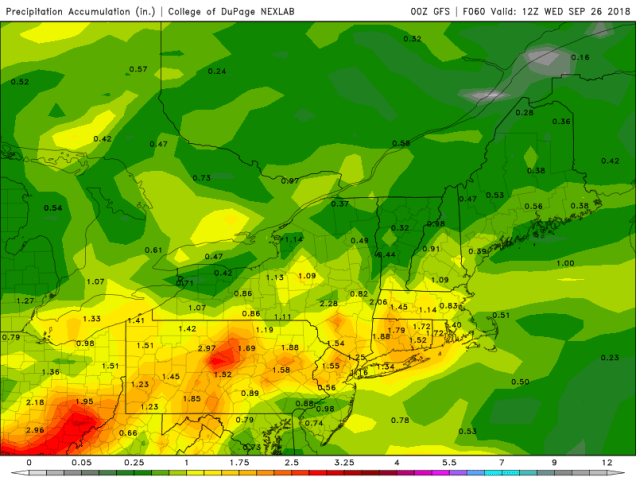
The cool air won’t hang around too long, as a warm front will move through late Tuesday. It will be preceded by some heavy rainfall. While this round of rain won’t compare to last week, when many places picked up 2-4 inches or more, we are still looking at 1-2 inches of rain for much of the region, which will lead to some nuisance flooding and ponding on roadways. The heaviest of the rain looks to fall from right around the morning commute until right around the evening commute. So, much of the day will be a washout.
Another round of heavy rain is expected on Tuesday. Image provided by the College of DuPage.
Wednesday will actually be another warm and humid day. with the warm front north of the region Temperatures should get well up into the 70s, with some lower 80s possible if we can get enough sunshine. However, you’ll need to keep the umbrellas handy once again. We may have some lingering showers in the morning, especially south of Boston, but it’s the afternoon that we need to keep an eye on. With a cold front approaching from the west, some thunderstorms will likely develop, and some of them could be strong to severe. The main threats with these storms will be heavy downpours and strong winds. While severe weather is uncommon in New England this late in the year, it is not unheard of. In fact, one of the strongest tornadoes ever recorded in New England, an F4, struck Windsor Locks, Connecticut on October 3, 1979.
Once the cold front moves through, high pressure builds in for the end of the week and into the weekend with dry and seasonably mild conditions. There are a few chances for a little rain, depending on which forecast model you happen to look at. So, this period might not be completely dry, but we’re certainly not looking at a washout either, at least not at this point.
Monday: Sunshine filtered through high clouds, but those clouds will start to thicken up late in the day. High 56-63.
Monday night: Cloudy. Low 47-54.
Tuesday: Breezy with periods of rain developing. possibly heavy at times. High 62-69.
Tuesday night: Rain tapers off to occasional showers, gradually ending overnight. Low 58-65 in the evening, then temperatures slowly rise overnight.
Wednesday: A few lingering showers south of Boston early, otherwise plenty of clouds with some sunny breaks. Breezy. Showers and thunderstorms develop in the afternoon, some of which may contain gusty winds and heavy downpours. High 73-80.
Thursday: Partly to mostly sunny. High 63-70.
Friday: Sunshine and a few clouds. High 64-71.
Saturday: Mostly sunny. High 65-72.
Sunday: Intervals of clouds and sunshine, slight chance for a shower. High 62-69.
Yup, It’s gonna rain alright. In fact, it’s gonna rain a LOT. But, overall, the week won’t be that bad.
The week actually starts off with high pressure hanging on for one more dry day. We may have some fog around in the morning, but once it burns off, we’ll see the sun come out. However, high clouds will start streaming in, dimming the sunshine. They’ll thicken up as the day goes on. Showers will develop at night what’s left of Florence starts to move toward the region.
Exactly where the heaviest rain will fall is still a question, but a widespread heavy rainfall event is likely on Tuesday. Image provided by Weathermodels.com
The remains of Florence will move through on Tuesday, bringing us rain – a lot of it. Now, we’re not going to get 2-3 feet like they had in the Carolinas, but a widespread 1-3 inches is likely, with some heavier amounts. The rain will come down heavy at times, and winds will be a little gusty at times. We may even have a few rumbles of thunder. Some localized flooding is possible, so you may want to be careful if you’re out and about on Tuesday.
Rainfall totals across North Carolina from Florence through Sunday afternoon. To put this in perspective, Boston has received a total of 34.46″ of rain and melted snow since January 1. Swansboro, NC received 33.90″ of rain in the past 72 hours. Image provided by the National Weather Service Eastern Region Headquarters.
The rain ends Tuesday night, but skies may be slow to clear on Wednesday. Once they do high pressure builds in with drier and cooler conditions that last into Thursday. Another quick-moving system may bring in some more showers on Friday, before high pressure returns on Saturday. Then, another system quickly moves in for Sunday with more showers expected.
Monday: Morning fog burns off revealing sunshine which then fades behind increasing and thickening clouds. High 77-84.
Monday night: Cloudy with showers developing, becoming a steady rain by daybreak. Low 63-70.
Tuesday: Breezy with periods of rain, heavy at times, possibly a rumble of thunder. High 71-78.
Tuesday night: Showers ending in the evening, but skies remain mostly cloudy. Low 57-64.
Wednesday: Clouds eventually give way to partly to mostly sunny skies. High 66-73.
Thursday: A mix of sun and clouds. High 64-71.
Friday: Cloudy and breezy with some showers possible in the morning and then again late in the day and at night. High 72-79.
Saturday: Partly to mostly sunny. High 66-73.
Sunday: Cloudy with some rain possible. High 65-72.
Since our last blog post about the tropics yesterday, we’ve had some subtle, but important changes with most of the systems we’re watching.
As of early Wednesday afternoon, Hurricane Florence was centered about 485 miles southeast of Wilmington, North Carolina, moving toward the northwest at 15 mph. Maximum sustained winds are near 130 mph, making Florence a Category 3 Hurricane. Florence may strengthen a bit today as it moves over the warmer waters of the Gulf Stream while continuing on a northwestward track. Once it gets close to the coastline is where things start to get complicated.
GFS forecast for the track of Hurricane Florence. Loop provided by Tropical Tidbits.
The upper-level steering currents will collapse as the storm nears the coastline, which will cause the storm to slow down, and perhaps even stall out. Many of the models show this stall, followed by a slow drift toward the southwest. Exactly where it stalls is somewhat important. If the storm makes landfall, and then stalls out over southern North Carolina, it will quickly weaken, lessening the wind impact, but prolonging the heavy rainfall. If the storm stalls while the center is still offshore, it will weaken more slowly as it slowly churns up the warm water it is sitting over, but this will prolong the wind and storm surge impacts along the coast.
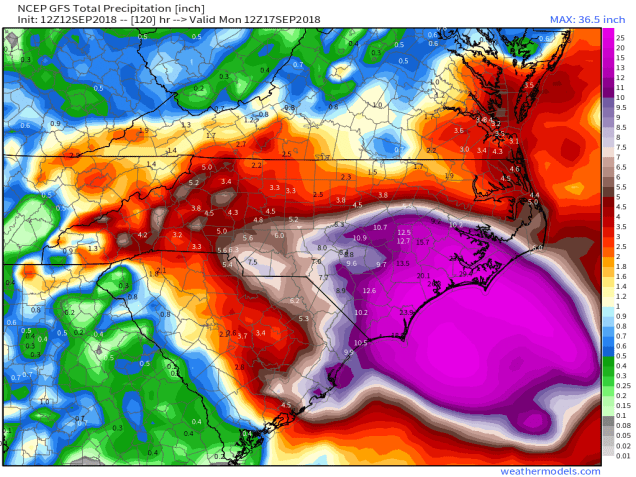
Tremendous amounts of rain are still expected in the Carolinas, leading to catastrophic flooding. Image provided by Weathermodels.com
These changes are actually a bit of good news for some areas, and bad news for others. This shift in track will significantly lessen the impact and amount of rainfall expected across the Mid-Atlantic states and even northern parts of North Carolina. While heavy rain is still expected, rainfall totals of 2-4 inches and locally heavier will not cause as much flooding as 6-12 inches of rain would. To the south, this is bad news – really bad news. The impact of rain, wind, and storm surge will be prolonged across southern North Carolina, and now will extend into a large portion of South Carolina. If the southwest trend in the track were to continue even longer, as a few models of shown, these impacts could even spread into parts of Georgia.
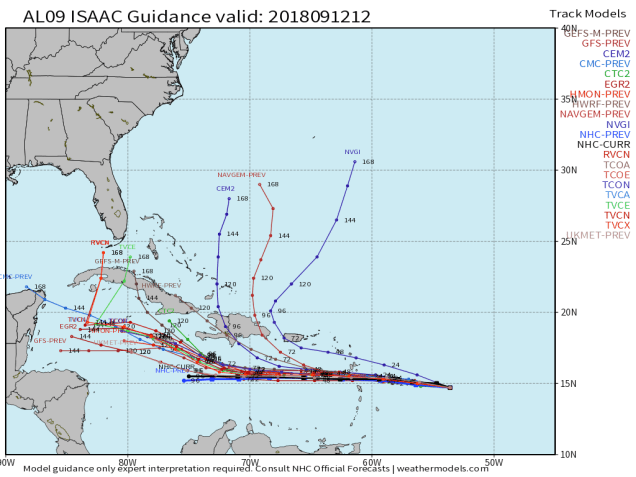
Model forecasts for the track of Tropical Storm Isaac. Image provided by Weathermodels.com
To the south, Tropical Storm Isaac is looking even weaker today, and the threat to parts of the Caribbean is diminishing. As of early Wednesday afternoon, Isaac was centered about 420 miles east of Martinique, moving toward the west at 17 mph. Maximum sustained winds have decreased to near 60 mph. Westerly shear has been impacting Isaac since Tuesday afternoon and is starting to rip the system apart. Since this shear is not expected to relax for another day or two. Tropical Storm Watches and Warnings are in effect for much of the Lesser Antilles. Isaac should cross the islands early on Thursday, bringing heavy rain and gusty winds to the region. However, the system should continue to weaken, and could degenerate into an open wave as it moves into the eastern Caribbean. It will still bring some heavy rain into Puerto Rico and the Virgin Islands, but won’t have anywhere near the impact of last year;s powerful storms. Some of the forecast models show the potential for the system to regenerate and strength as it moves into the western Caribbean this weekend, so even if the system does become an open wave in the next day or two, we’ll still keep an eye on its progress as it heads westward.
Model forecasts for the track of Hurricane Helene. Image provided by the University of Wisconsin.
As for Hurricane Helene, not much has changed. As of midday Wednesday, Helene was centered about 1350 miles south-southwest of the Azores, moving toward the north-northwest at 14 mph. Maximum sustained winds remain near 90 mph. Helene is expected to continue northward, steadily weakening while move over cooler waters. The current forecast calls for Helene to pass very close to or over the Azores this weekend as a tropical storm. Heavy rain and gusty winds would be the main threats to the Azores. The system should lose tropical characteristics over the weekend, but may impact parts of the British Isles as a strong extratropical system early next week.
A disturbance in the Gulf of Mexico could become a tropical depression in the next 24-36 hours. Loop provided by NOAA.
Meanwhile, an area of disturbed weather is slowly getting organized in the Gulf of Mexico. If this trend continues, the system could become a tropical depression tonight or Thursday. It should continue on a west to west-northwest track, heading towards Texas. The main threat with this system will be heavy rains across portions of southeastern Texas, likely leading to flooding in some areas.
Another disturbance is developing several hundred miles west of the Azores. Conditions are favorable for more development and this system could also become a tropical storm in the next day or so. This system will likely remain over open waters for the next several days, and is not a threat to any land areas right now.
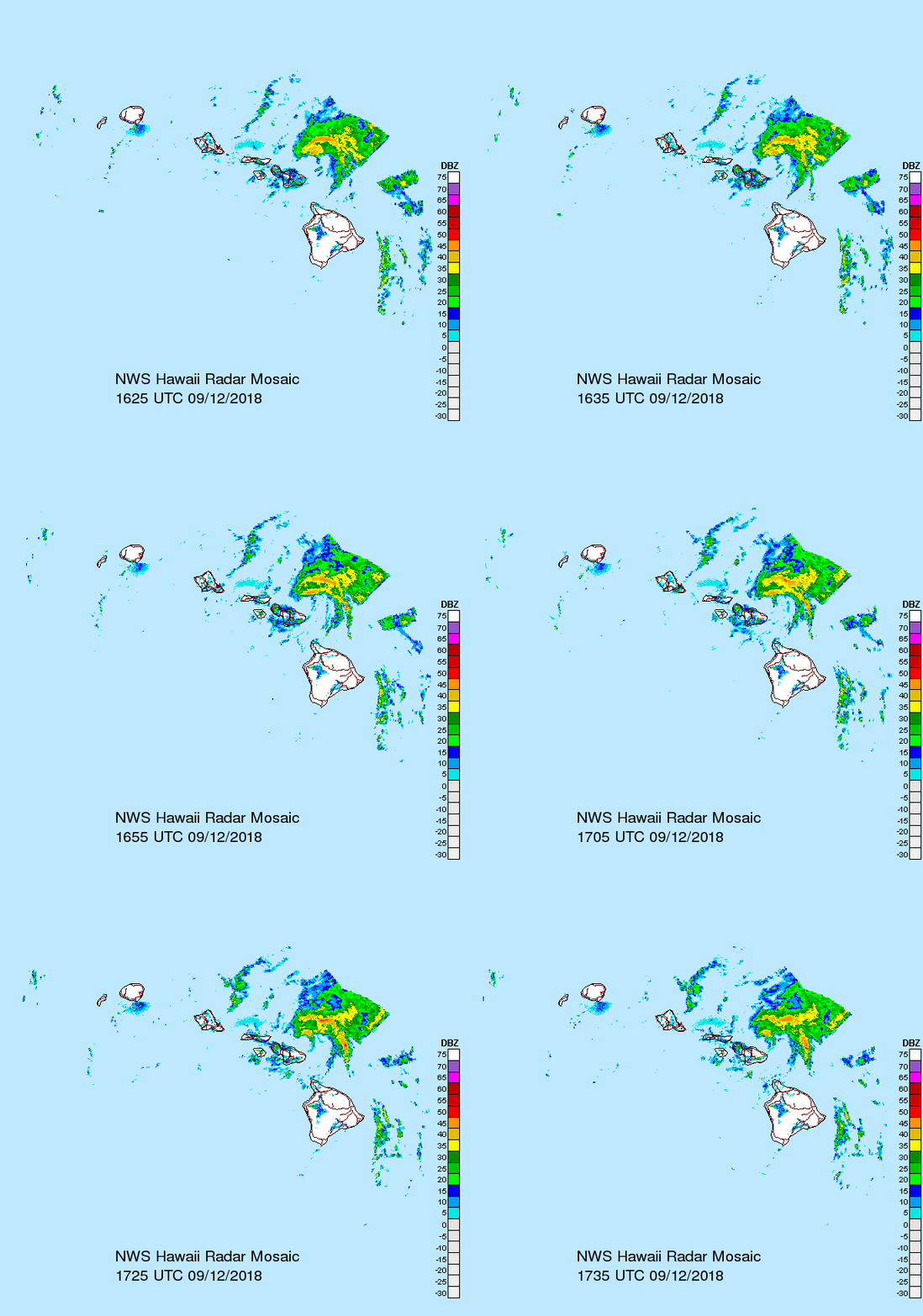
In the Pacific, Tropical Storm Olivia is gradually weakening while approaching the Hawaiian Islands. As of Wednesday morning, Olivia was centered about 140 miles east of Honolulu, moving toward the west at 12 mph. Maximum sustained winds have decreased to near 45 mph, and some additional weakening is expected. Tropical Storm Warnings remain in effect for Oahu and Maui County. Olivia will continue to bring heavy rain and gusty winds to the islands today. Rainfall totals of 5-10 inches and locally heavier will produce flooding in some areas. Once past the islands, Olivia should continue westward, likely dissipating over the open waters of the Central Pacific later this week.
Tropical Storm Barijat is passing south of Hong Kong. Loop provided by NOAA.
In the western Pacific, Tropical Storm Barijat remains fairly weak. As of midday Wednesday, Barijat was centered a little more than 100 miles south-southwest of Hong Kong, moving toward the west at 10 mph. Maximum sustained winds were near 45 mph, and Barijat is expected to slowly weaken while continuing westward, likely making landfall in southern China over the next 12-18 hours. Heavy rain may lead to flooding across portions of southern China and northern Vietnam before the system dissipates.
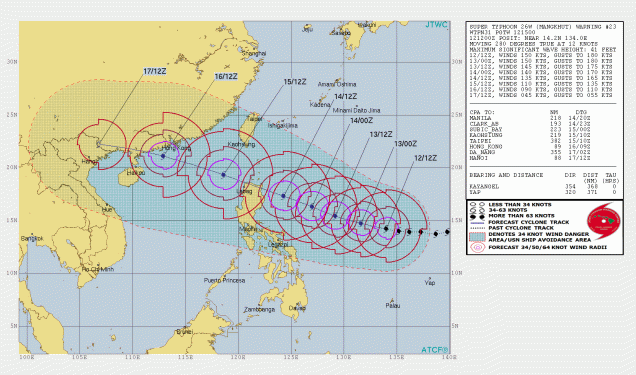
Super Typhoon Mangkhut will become an increasing threat to the Philippines later this week. Image provided by the Joint Typhoon Warning Center.
Meanwhile Super Typhoon Mangkhut remains a beast of a storm this afternoon. As of midday Wednesday, Mangkhut was centered about 870 miles east of Manila, moving toward the west at 14 mph. Maximum sustained winds are near 170 mph, making Mangkhut the strongest storm on the planet so far this year. Mangkhut has likely peaked in intensity, and a slow weakening trend is expected over the next few days. As for Mangkhut’s future, the forecast track has shifted a bit to the south since yesterday. This will now bring the center of the storm close to or over northern portions of Luzon, the largest of the islands in the Philippines. The northern tip of the island is somewhat rural, with hilly terrain, which means the storm wouldn’t affect as many people, but it will still be at or close to Super Typhoon intensity at the time, so a major impact is still expected. After that, a track into the South China Sea is still expected, with some additional weakening likely before a final landfall late this weekend early next week in the same vicinity of where Barijat is expected to make landfall today or tomorrow.
There are currently 7 active tropical systems in the Atlantic and Pacific Ocean, and amazingly, 6 of them could be threats to land within the next 5 days.
The storm that is rightfully gaining the most attention (and hype) is Hurricane Florence. As of early Tuesday afternoon, Florence was centered about 370 miles south-southwest of Bermuda, moving toward the west-northwest at 17 mph. Florence reached Category 4 strength Monday evening, before undergoing and eyewall replacement cycle. What that means is that the intense thunderstorms surrounding the eye of the storm essentially weaken, but a new ring of storms forms farther away from the center. These eventually contract to form a new eyewall. While this will weaken a storm a bit, it also expands the radius of the wind field. Now that Florence has undergone this process (which will likely happen again at some point in the next day or two), its maximum sustained winds have decreased to around 130 mph, making it a Category 3 hurricane. A Hurricane Watch and Storm Surge Watch have been issued for most of the coastline of North Carolina and South Carolina.
This probably isn’t a good time for a trip to the Outer Banks. Image provided by WeatherBell.
Florence is expected to continue in a general west-northwest direction for the next day or two, with some additional strengthening expected. It should regain Category 4 status later today, and there is a chance it could reach Category 5, depending on when the next eyewall replacement cycle takes place. By Thursday, high pressure will build in north of Florence, which will start to slow the system down as it approaches the North Carolina coastline.
That’s a lot of rain, and the scary part is, this might be an underestimate. There’s going to be a LOT of flooding, even well inland. Image provided by Weathermodels.com
Most of the forecast models show the system slowing to a crawl or even stalling out by Friday. The big question is, does it stall out before landfall or after landfall? No matter where it stalls, many of the effects will be the same, it will just determine what happens down the road. The strongest winds will be confined to areas closest to the coastline. Once the storm stalls out, especially if it is over land, it will start to weaken, with winds becoming less of a problem, especially the farther away from the center you area. Storm surge will also be a major problem, especially across the Outer Banks and Pamlico and Albemarle Sounds, but again, once the storm is weakening (and likely inland), the storm surge threat starts to decrease. By far, rainfall and resultant flooding is the largest threat. Tropical systems already produce copious rainfall, but when they stall out, the amounts become that much higher – just look at what Hurricane Harvey did to Texas last year. In this case, with the storm expected to sit near or over the Carolinas for a few days, we could be looking at rainfall totals of 15-30 inches or more, which could lead to some of the worst flooding the region has ever seen. The torrential rain will also spread into neighboring parts of Virginia as well. Beyond that, we’ll have to see where the storm actually goes before we can tell if the heavy rain will spread to other areas.
To the south, Tropical Storm Isaac is a threat to portions of the Lesser Antilles, but how much of a threat is a question mark. After briefly reaching hurricane status, Isaac weakened to a tropical storm on Monday. As of early Tuesday afternoon, Isaac remained a tropical storm with maximum sustained winds near 70 mph. It was centered about 725 miles east of the Lesser Antilles, moving towards the west at 16 mph. This track is expected to continue for the next few days, and as a result, Hurricane Watches and Tropical Storm Watches have been issued for some of the islands. Isaac is encountering some westerly shear that produced the weakening on Monday, and this will likely continue, preventing the system from strengthening much, and could result in some additional weakening. The official forecast calls for Isaac to be near hurricane strengthen when it approaches the Lesser Antilles, but we wouldn’t be surprised if it was significantly weaker. Either way, Isaac will bring gusty winds and heavy rain to many of the islands as it moves through on Thursday. It should remain south of Puerto Rico and the Virgin Islands, which are still recovering from last year’s double whammy of Irma and Maria. Some locally heavy rainfall is possible across these islands from Isaac’s outer bands as it passes to the south, but a direct hit is not expected. Beyond that, Isaac may weaken further as it continues across the Caribbean Sea.
Isaac is heading toward the Caribbean. Image provided by the National Hurricane Center.
To the east, Hurricane Helene is starting to weaken over cooler waters in the Eastern Atlantic. As of midday Tuesday, Helene was centered about 1550 miles south-southwest of the Azores, moving toward the northwest at 12 mph. Helene’s maximum sustained winds were near 110 mph, but gradual weakening is expected over the next few days as the storm heads more toward the north. As we get toward the weekend, Helene should weaken to a tropical storm and may start to lose is tropical characteristics as it approaches the Azores. Gusty winds and heavy rain would be the main threats to the islands. Beyond that, it could impact parts of the British Isles as an extratropical system early next week.
Helene is a fish storm for now, but it could impact the Azores…..and Ireland? Image provided by the University of Wisconsin.
Another disturbance is moving across the northwestern Caribbean and into the Yucatan Peninsula this afternoon. This system remains disorganized for now, but as it moves into the Gulf of Mexico over the next day or two, conditions could become favorable for some development. Whether it develops or not, it will bring heavy rainfall to parts of the Yucatan today and the Gulf Coast, especially Texas, over the next several days. There’s also another weak area in the North Atlantic being watched well southeast of Newfoundland. However, it’s not tropical now, it might not ever be tropical, and it’s not going to amount to much more than a fish storm if it even becomes tropical or subtropical, so we’re not even going to bother to say any more about it.
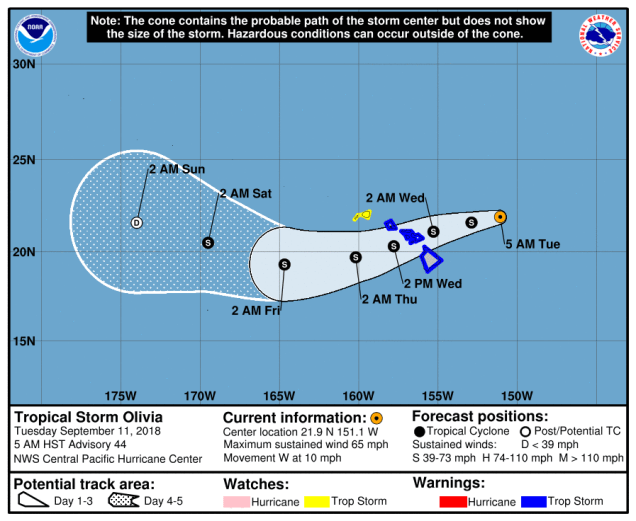
Olivia looks like it’s going to go right across the Hawaiian Islands. Surf’s up, but so are the Tropical Storm Warnings, and in another day or two, the water levels as well. Image provided by the Central Pacific Hurricane Center.
In the Eastern Pacific Tropical Depression Paul is nearly 1000 miles southwest of Mexico, and expected to dissipate over open water in the next 24-36 hours, so we really don’t need to spend any more time on that storm. To the west, Tropical Storm Olivia is bearing down on the Hawaiian Islands. As of early Tuesday afternoon, Olivia was centered about 380 miles east of Honolulu, moving toward the west at 10 mph. Maximum sustained winds were near 65 mph, and slow by steady weakening is expected over the next few days. Tropical Storm Warnings are in effect for most of Hawaii, except Kauai where a Tropical Storm Watch is in effect. Olivia is expected to cross the Hawaiian islands on Wednesday. Unlike Hurricane Lane a few weeks ago which produced heavy rain across the Big Island, but stayed offshore, Olivia will likely bring heavy rain and gusty winds to much of the island chain. In some of the mountain areas, especially on the Big Island, rainfall totals of 10-20 inches and locally heavy may result in flooding in some areas once again.
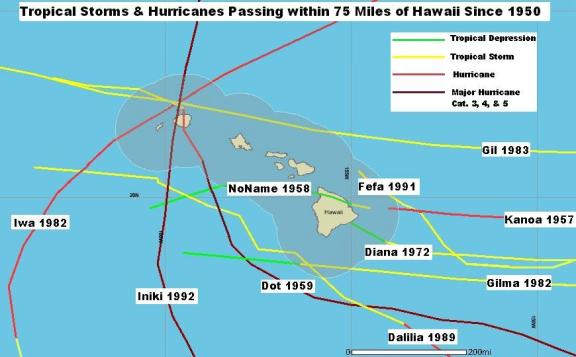
Most tropical systems that impact Hawaii don’t come in from the east, especially not ones moving across the central part of the island chain. Image provided by the Central Pacific Hurricane Center.
In the Western Pacific, Tropical Storm Barijat is expected to move across the South China Sea over the next few days while remaining fairly weak. As of midday Tuesday, Barijat was centered about 215 miles southeast of Hong Kong with maximum sustained winds near 40 mph, moving towards the west at 12 mph. It should continue on a general westward track for the next day or so with some strengthening possible, before crossing China’s Leizhou Peninsula late Wednesday. After that, it is expected to weaken before making a final landfall as a weak tropical storm or a tropical depression in northern Vietnam on Thursday or Friday. Heavy rain is the main threat with this system.
Tropical Storm Barijat remains weak southeast of Hong Kong, but does have a nice cluster of strong thunderstorms near the center. Loop provided by NOAA.
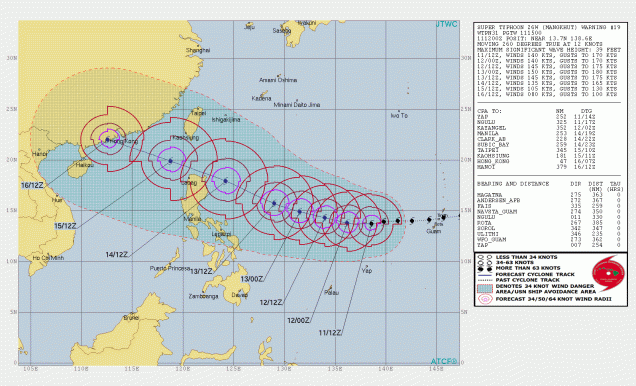
The bigger story in the Western Pacific is Super Typhoon Mangkhut. At midday Tuesday, Mangkhut, located roughly halfway between the Northern Mariana Islands and northern Philippines, had maximum sustained winds near 160 mph. It is moving westward at 14 mph, but a turn more toward the west-northwest is expected over the next day or two. Mangkhut has likely not peaked in intensity yet, and could strengthen a bit more over the next 24-36 hours. Yesterday, it crosses the Northern Mariana Islands, producing wind gusts of up to 90 mph and dropping over 10 inches of rain on Guam.
Mangkhut is a Super Typhoon, and should remain one for another 2-3 days. After that, how strong it is will be determined by how close it comes to northern Luzon. Image provided by the Joint Typhoon Warning Center.
The current forecast calls for Mangkhut to pass just north of the Philippines later this week, likely close enough to bring heavy rain and strong winds to Luzon. A deviation slightly to the south of the expected track could result in landfall, and significant impacts to northern Luzon. Beyond that, a track into the South China Sea and some slow weakening is expected. The storm will become an increasing threat to southern China, including Hong Kong, by this weekend.










 Monday: Plenty of clouds, chance for a shower or two. High 57-64.
 Sunday: A mix of sun and clouds. High 53-60.










 Storm HQ