Potential Hurricane Next Week? Let’s Worry About Real Systems First

OK, let’s dispense with this right away – despite what you may have seen or heard about online today, the odds of a hurricane hitting the East Coast next week are still fairly small. Just because a couple of computer models are showing that possibility does not make it a fact. The “storm” in question hasn’t even formed yet, and may not form this weekend (or at all).

Having said that, the tropics are getting active. In the Northern Hemisphere, tropical activity normally peaks during the latter half of August and much of September. So far, it looks like 2016 will follow that pattern, as there are currently five active systems around the world, and a couple of other areas being monitored for development.

abpwsair (1)
Satellite image showing three active tropical systems and a potential system in the Western Pacific Ocean. Image provided by the Joint Typhoon Warning Center.

The most active area right now is the Western Pacific Ocean, where there are three active systems, a third that is dissipating in northern Vietnam, and another disturbance that could develop in the next day or two.
1609-00 (1)
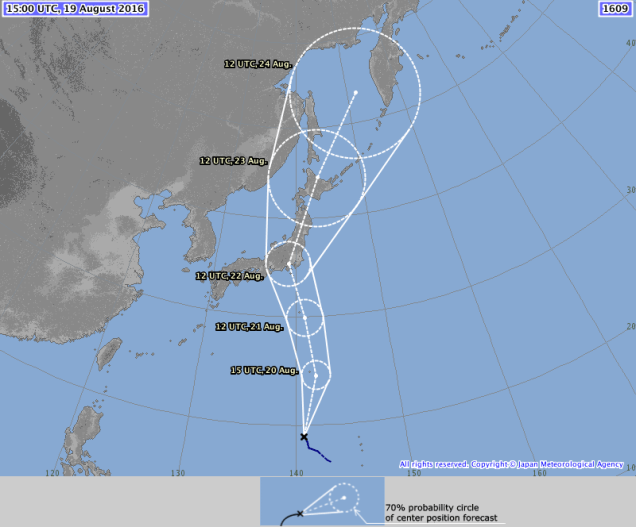
Forecast track for Tropical Storm 10W (Mindulle). Image provided by the Japanese Meteorological Agency.

Tropical Storm 10W (Mindulle) is probably the most immediate threat to land. The system is located several hundred miles east of Japan, moving towards the northwest at 10 mph. Maximum sustained winds are near 50 mph, and additional strengthening is expected. Mindulle could become a typhoon this weekend. Computer model forecasts indicate a northerly track over the next few days, with landfall possible in southern Japan towards the end of the weekend or beginning of next week.

wp1216
Forecast track for Tropical Storm 12W (Lionrock). Image provide by the Joint Typhoon Warning Center.

Tropical Storm 12W (Lionrock) is actually closer to the south coast of Japan right now than Tropical Storm Mindulle, but is less of a threat. Lionrock is expected to head westward to southwestward over the next few days, with some slow strengthening expected. Lionrock could threat some of the islands southwest of Japan during the early to middle portion of next week.

Elsewhere in the Western Pacific, Tropical Storm 11W (Dianmu) made landfall in northern Vietnam earlier today. The system will continue moving inland while dissipating. It will continue to bring heavy rain to parts of the region, with flooding likely. Another disturbance in the Western Pacific, located about 1000 miles southeast of Japan, is being monitored for development. The system could become a tropical depression this weekend while heading on a general northwesterly track. It could be a threat to parts of northern and eastern Japan towards the middle of next week.

143633W5_NL_sm
Forecast track for Tropical Storm Kay. Image provided by the National Hurricane Center.

In the Eastern Pacific, Tropical Storm Kay has formed. As of midday Friday, Kay had top winds near 40 mph and was passing very close to Socorro Island, off the coast of Mexico. Some slight strengthening is possible tonight and Saturday before Kay moves over colder waters and starts to weaken and eventually dissipate. Once Kay moves away from Socorro Island this afternoon and evening, it should not be a threat to any land areas.
vis_lalo-animated
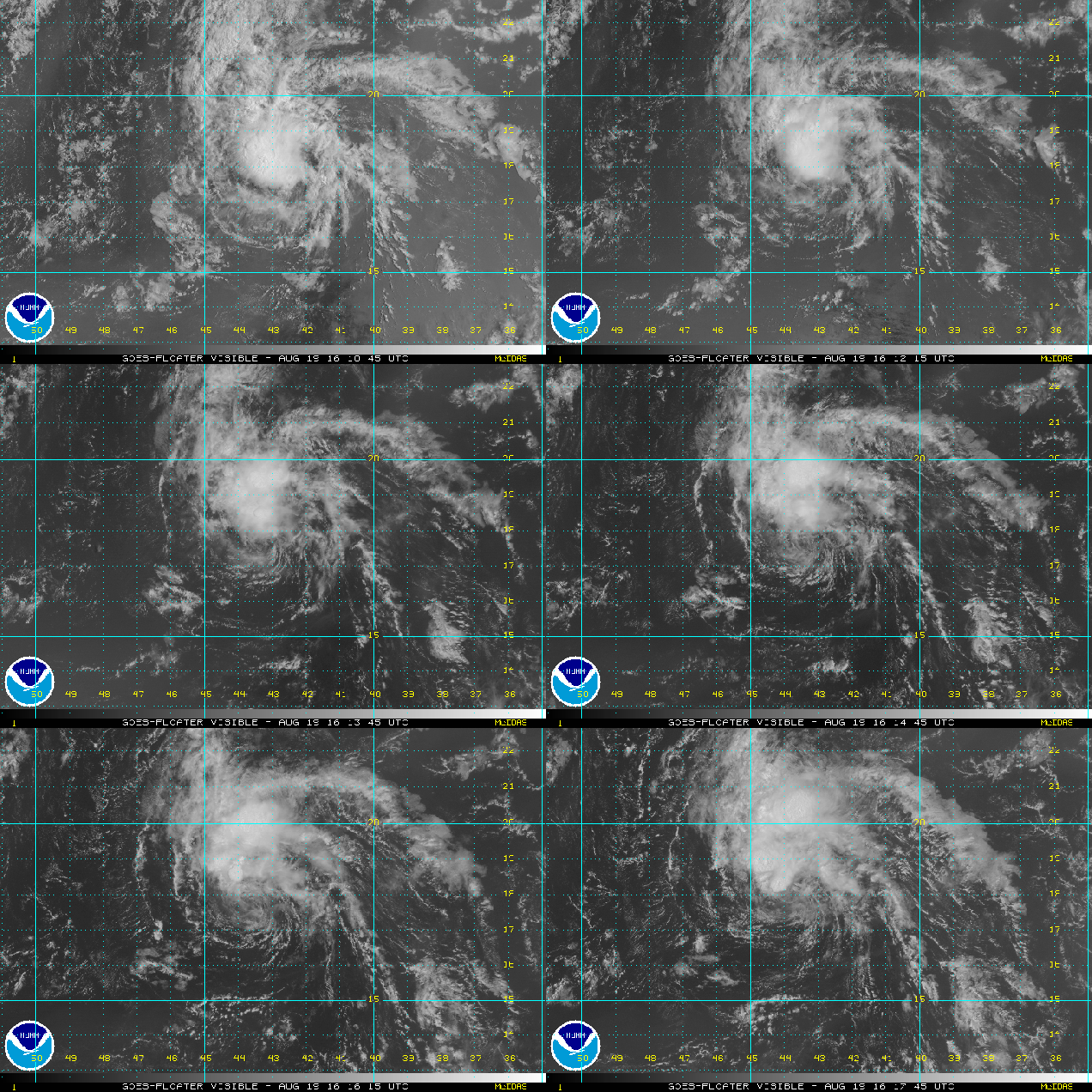
Satellite loop of Tropical Storm Fiona. Image provided by NOAA.

Finally, we get to the Atlantic, where we have Tropical Storm Fiona. As of Midday Friday, Fiona was centered about 1300 miles west of the Cape Verde Islands, moving towards the west-northwest at 10 mph. Top winds are near 45 mph, but conditions are not favorable for additional strengthening. Indications are that Fiona should remain a weak system over the open waters of the Central Atlantic right through the weekend, with no threat to any land areas.

Farther to the east, a tropical wave located about 600 miles southwest of the Cape Verde Islands, is being monitored for further development. The system should remain weak through the weekend, but conditions should become favorable for development as it moves into the Central Atlantic Ocean by the beginning on next week. Many of the computer models are forecasting the system to develop into an organized tropical system during that time frame. If these forecasts are correct, the system could become a threat to the islands in the eastern and northeastern Caribbean by the middle of next week. Anyone with interests in that region should keep an eye on the system and it’s progression.

AL99_current
Computer model forecasts for the track of a disturbance in the Central Atlantic. Image provided by WeatherBell.

What this system does once it gets past the islands is pure speculation at this point, assuming it even develops and gets that far. Just based on some of the computer models today, it will either A) Not develop at all, B) Stay over water the entire time and never threaten land, except possibly Bermuda, or C) Make landfall just before Labor Day Weekend somewhere between the Central Gulf Coast and Newfoundland. If you hear someone say something about the “hurricane that’s going to hit the East Coast next week”, then they don’t have a clue as to what they’re talking about. It’s pure hype ad speculation, and we’ll have no part of it.
Hurricane Earl Hits Belize

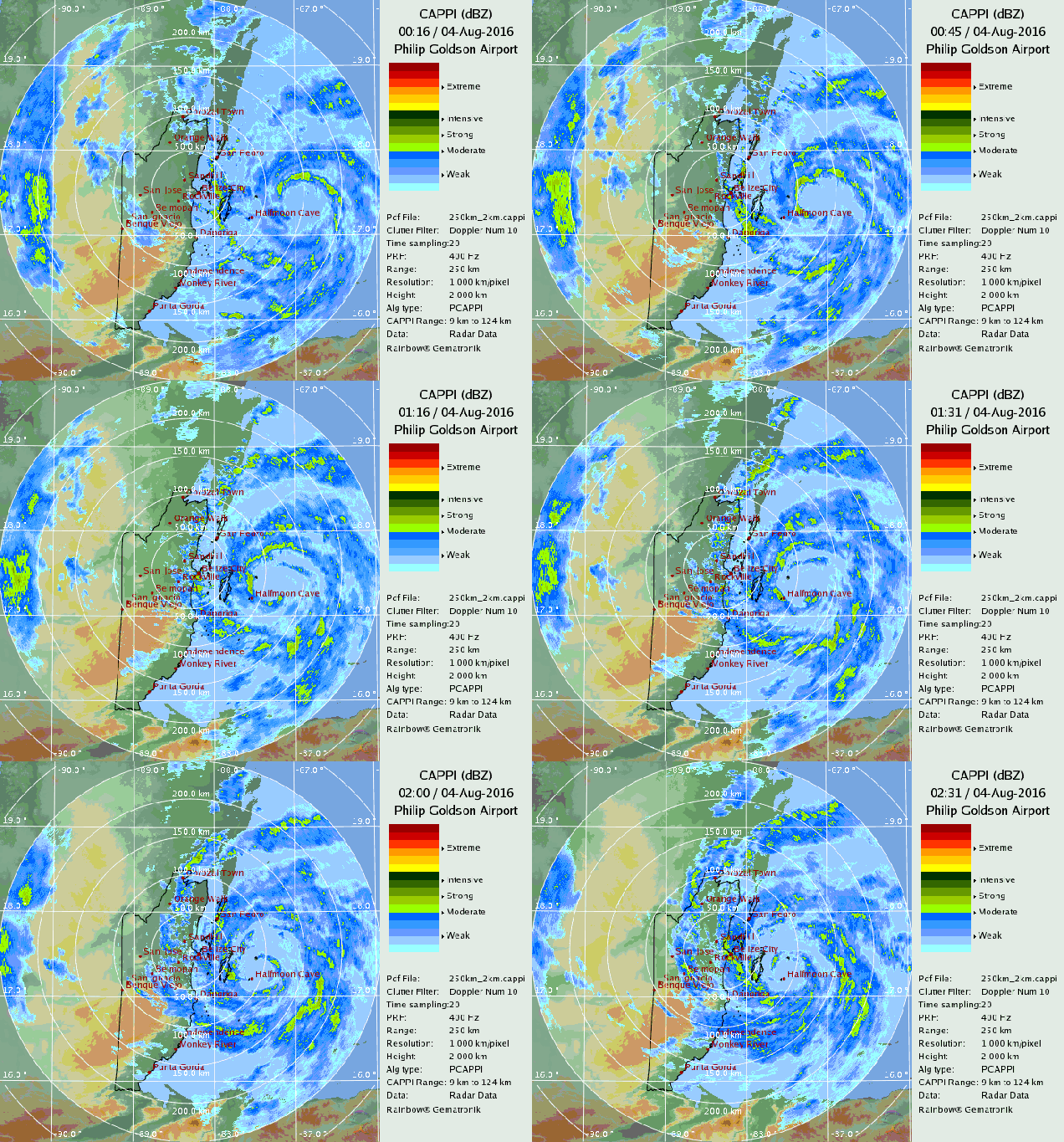
After a quiet July across the Atlantic Ocean, August began with Tropical Storm Earl forming southwest of Jamaica on Tuesday. Earl strengthened into a Hurricane Wednesday afternoon while approaching Central America, with landfall expected in Belize around midnight.

latest_250kmloop (1)
Radar loop showing the center of Hurricane Earl approaching the coast of Belize. Loop provided by the National Meteorological Service of Belize.

As of 11pm EDT, Hurricane Earl was centered about 40 miles east of Belize City, moving towards the west at 15 mph. Maximum sustained winds are near 75 mph, with little additional strengthening expected in the next few hours before Earl makes landfall.

vis_lalo-animated.gif
Satellite loop of Hurricane Earl. Loop provided by NOAA.

Hurricane warnings are in effect from Puerto Costa Maya, Mexico southward to the Belize/Guatemala border. A Tropical Storm Warning is in effect from Puerto Costa Maya to Punta Allen, Mexico.

Most of the strong winds are in the northeastern quadrant of Earl, which will spare coastal locations in Honduras and Belize from significant wind damage. Right along the immediate coast, a storm surge of 4-6 feet, along with large waves will result in coastal flooding, especially near and north where the central makes landfall in Belize. The biggest threat by far is flooding and mudslides from torrential rainfall. Rainfall totals of 10-15 inches, with isolated totals in excess of 20 inches, are expected across Belize, Guatemala, and southeastern Mexico over the next few days.

qpf_acc_mm.mx
GFS model forecast for rainfall over the next 4 days. Image provided by Pivotal Weather.

Once Earl moves inland, it would steadily weaken, likely being downgraded to a tropical depression by Thursday night. Earl should continue on a westward track, but the exact track will be critical for Earl’s future. If Earl remains over land, it will dissipate over southern Mexico. However, if the center can emerge in the southern Bay of Campeche, it could regain a little strength before making landfall again in Mexico.

Elsewhere in the Atlantic, things are mainly quiet. A tropical wave will bring showers and thunderstorms along with some gusty winds to the Lesser Antilles late Thursday, moving across the Virgin Islands and Puerto Rico Thursday night and Friday.  Further development isn’t expected at this time.

vis_lalo-animated (1)
Satellite loop of Tropical Storm Ivette. Loop provided by NOAA.

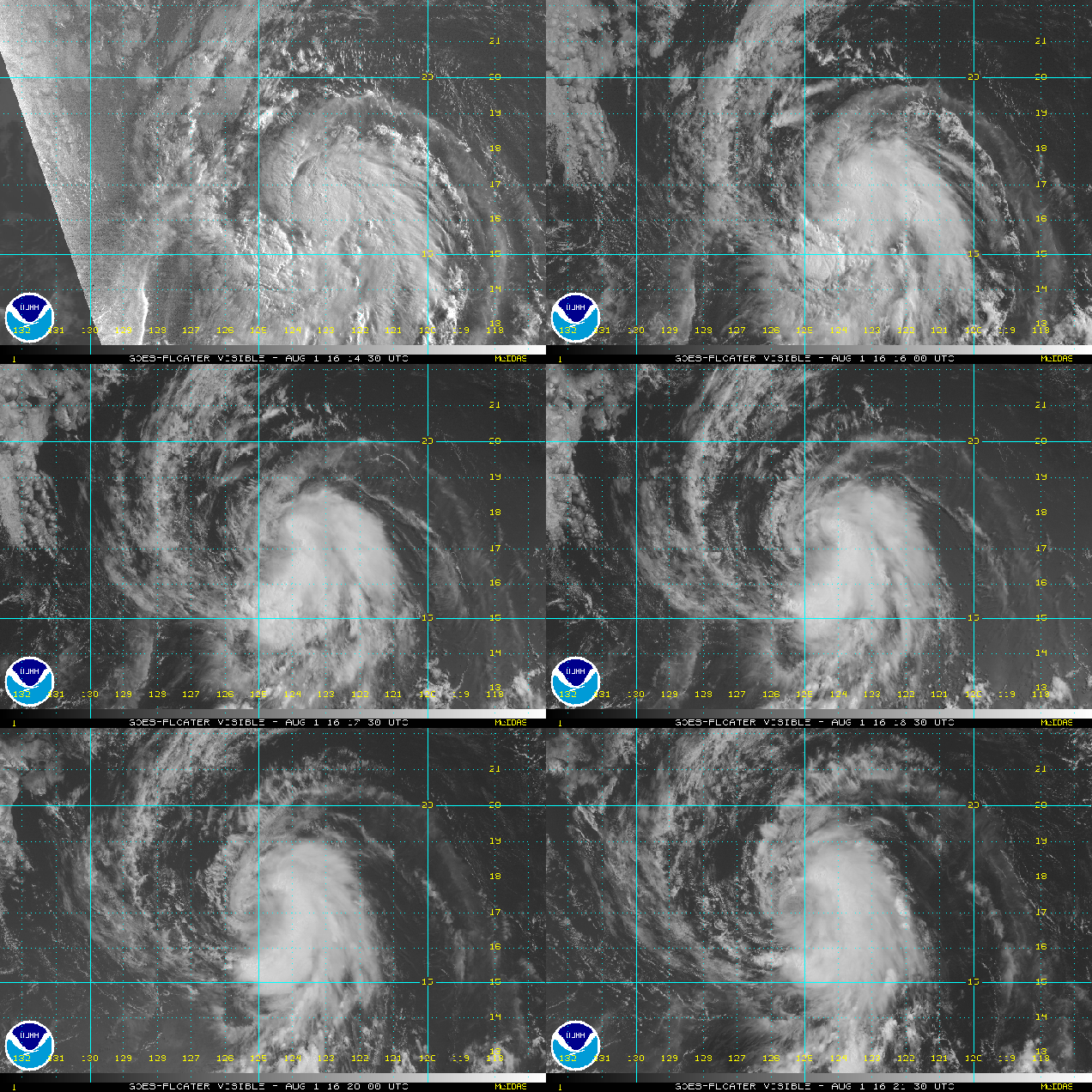
Meanwhile, in the Eastern Pacific, Tropical Storm Ivette continues to gather strength this evening. As of 11pm EDT, Ivette was centered a little more than 1000 miles west-southwest of Cabo San Lucas, Mexico, moving toward the west at 16 mph. Ivette has maximum sustained winds near 45 mph, and additional strengthening is expected. Ivette could become a hurricane in the next day or two while moving over open waters in the Eastern Pacific.

A Tropical Storm in the Caribbean? Too Earl-y to Say For Sure

vis_lalo-animated
A tropical disturbance southeast of Jamaica could become Tropical Storm Early on Tuesday. Loop provided by NOAA.

Now that we’re in August, the tropics are starting to get active all around the world. We’ll take a look at all of the systems out there, starting close to home.

A strong tropical wave is centered about 200 miles southeast of Kingston, Jamaica late this evening. The system is producing heavy rain and gusty winds across parts of the Dominican Republic, Haiti, and Jamaica, and these conditions will spread into the Cayman Islands on Tuesday. Although the system looks pretty good in satellite photos, it does not have a closed circulation as of yet. Once that occurs, the system will likely be upgraded to Tropical Storm Early.An Air Force Reserve Reconnaissance Aircraft will investigate the storm early on Tuesday to see if that has happened.

97L_tracks_latest
Computer model forecasts for the track of a tropical disturbance in the Caribbean. Image provided by Tropical Tidbits.
97L_intensity_latest
Computer model forecasts for the intensity of a tropical disturbance in the Caribbean. Image provided by Tropical Tidbits.

Whether or not the system develops, it should continue to move in a general westward direction at a fairly fast pace for the next few days. The system will likely move across the Yucatan or Belize towards midweek. After that, if it moves into the Bay of Campeche it could strengthen some more before hitting Mexico again late in the week. One thing that is likely is that heavy rainfall will lead to flash flooding and mudslides across pparts of the Dominican Republic, Haiti, and Jamaica through Tuesday, and parts of the Yucatan and Belize later this week. For the latter locations, rainfall totals of 8-15 inches are possible, which some heavier amounts not ruled out.

vis_lalo-animated (1)
Satellite loop of Tropical Storm Howard. Loop provided by NOAA.

In the Eastern Pacific Ocean, Tropical Storm Howard is centered about 1125 miles west-southwest of Cabo San Lucas, Mexico late this evening. Howard has maximum sustained winds near 50 mph, and is moving towards the west-northwest at 14 mph. Howard is expected to continue moving toward the west-northwest or west over the next few days while steadily weakening as it moves over colder waters.

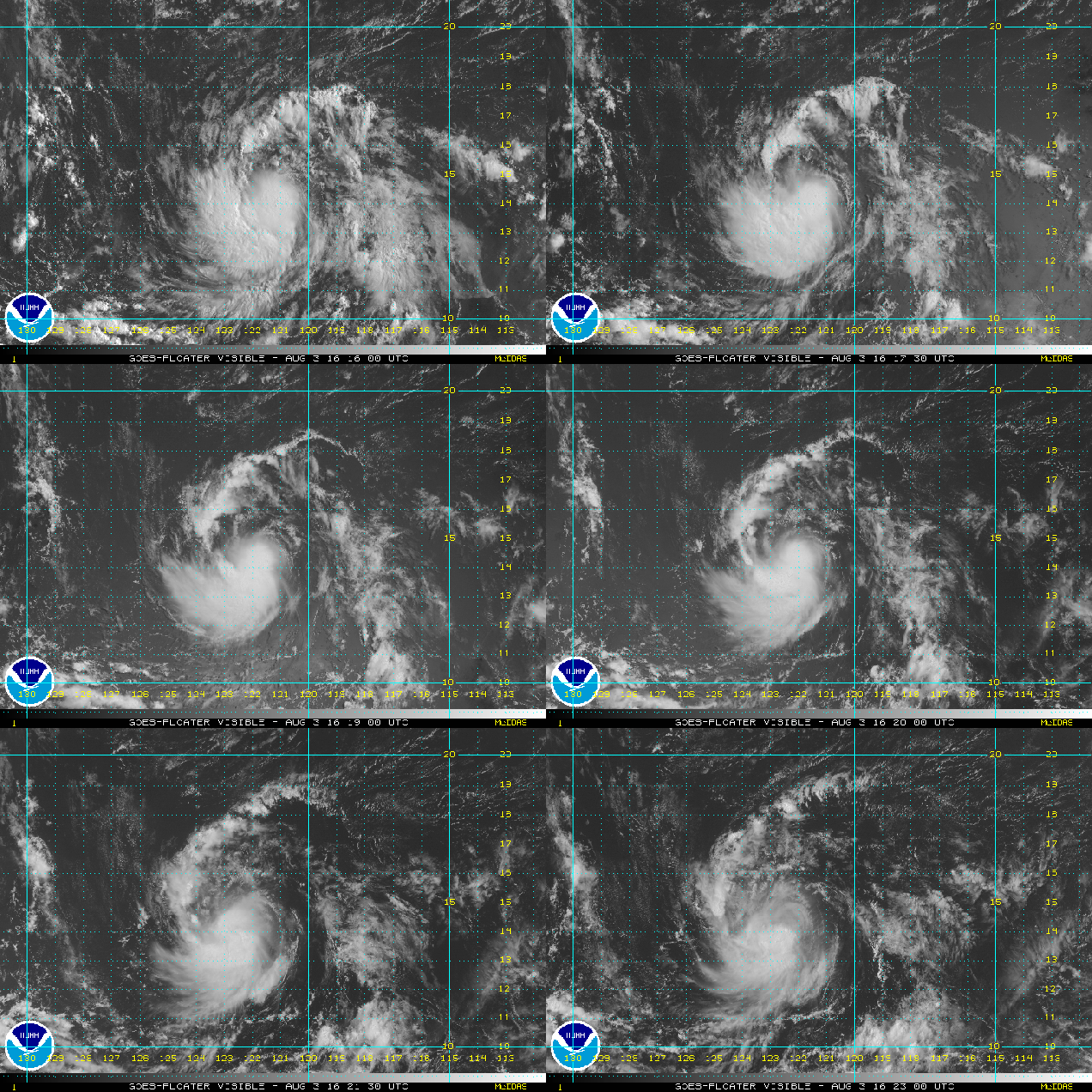
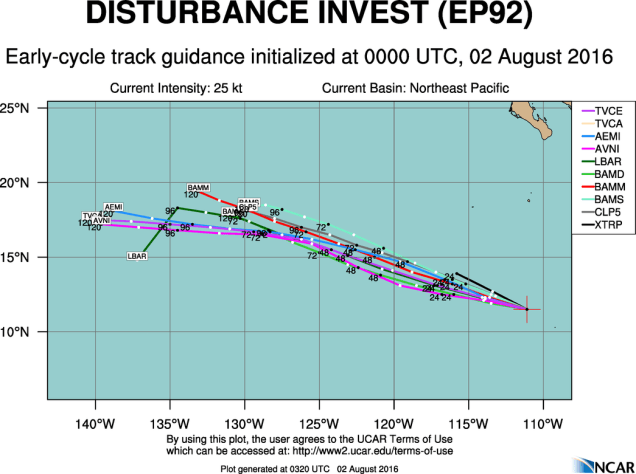
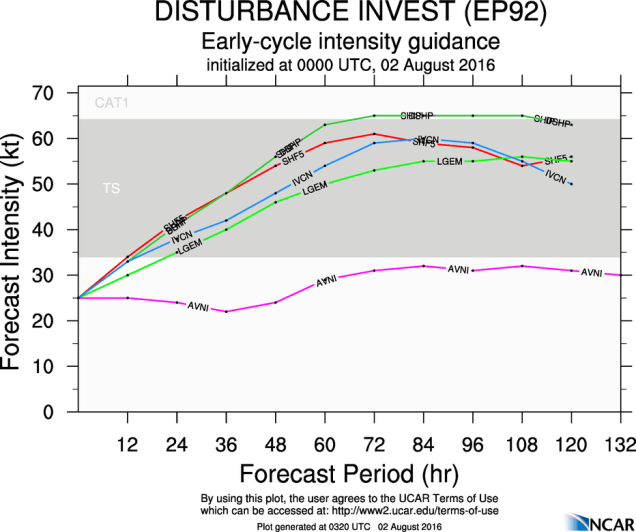
A little to east of Howard, a cluster of thunderstorms well southwest of Manzanillo, Mexico is being watched for development. Conditions look favorable for this system to develop over the next few days and it could become a tropical depression later this week. Forecast models show some steady strengthening through the week, and if the system gathers enough strength, it will be named Ivette.

aep92_2016080200_track_early
Computer model forecasts for the track of a tropical disturbance in the Eastern Pacific. Image provided by NCAR.
aep92_2016080200_intensity_early
Computer model forecasts for the intensity of a tropical disturbance in the Eastern Pacific. Image provided by NCAR.

In the Western Pacific Ocean, Typhoon 06W (Nida), made landfall very close to Hong Kong earlier on Tuesday. After lashing the northern Philippines with up to 10 inches of rain on Sunday, Nida took aim at Hong Kong on Monday. It made landfall in the pre-dawn hours of Tuesday just east of Hong Kong, producing a wind gust to 64 mph at Hong Kong International Airport, and a gust to 94 mph at Ngong Ping. Nida will continue to move inland on wednesday while dissipating. Rainfall totals of 6-12 inches are possible in the region, likely leading to flooding in some areas.

rb_lalo-animated
Satellite loop of Typhoon Nida. Loop provided by NOAA.


The Tropics Are Getting Active Again

As we approach the end of July, tropical cyclone activity normally starts to ramp up across both the Atlantic and the Pacific. This year, that is the case once again, with one active system right now and three other areas of disturbed weather that are being monitored for development.

wp0616 (1)
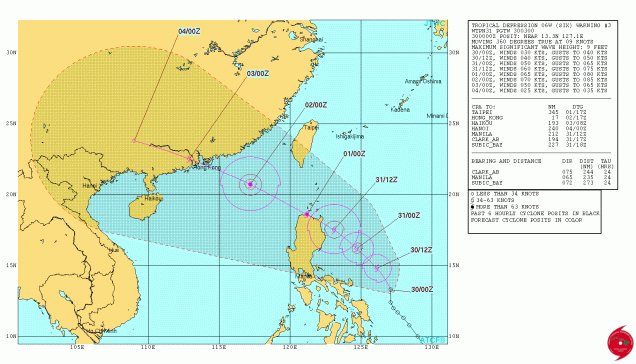
Forecast track for Tropical Depression 06z. Image provided by the Joint Typhoon Warning Center.

The only active tropical system right now is located in the Western Pacific Ocean. Tropical Depression 06W formed Friday afternoon about 450 miles east-southeast of Manila in the Philippines. The system is expected to steadily strengthen on Saturday, likely becoming Tropical Storm Nida. The current track calls for the system to become a typhoon before passing very close to northern Luzon on Sunday. This track will likely bring very heavy rainfall to northern portions of Philippines. Rainfall totals of 10 to 20 inches are possible, with some heavier amounts. Flooding and mudslides are likely across this area. After passing near or over northern Luzon this weekend, the storm will head west-northwestward into the South China Sea. A track towards southern China seems likely, with a landfall near Hong Kong possible. Flooding has been reported in southern China recently from heavy monsoonal rains, and additional heavy rain from a tropical system will likely worsen flooding in the region.

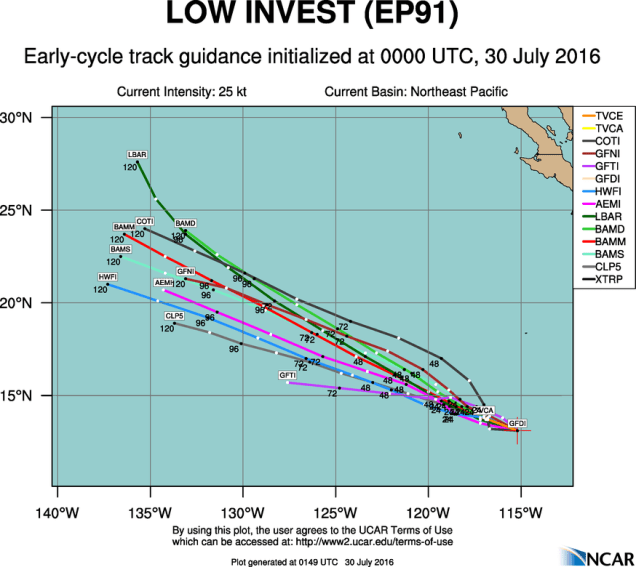
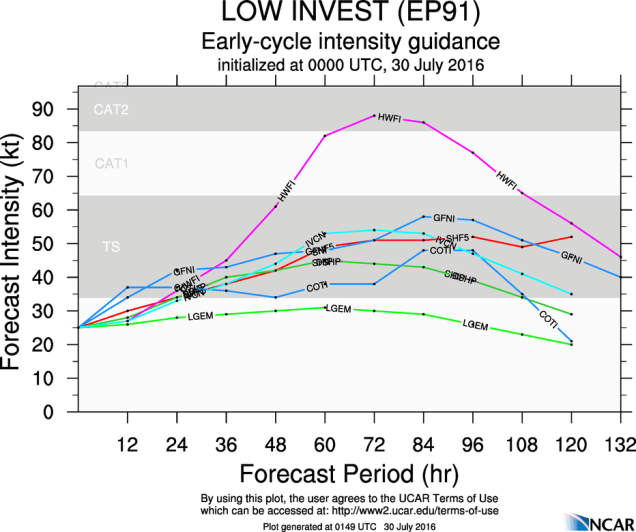
Heading eastward, a cluster of showers and thunderstorms centered about 750 miles south-southwest of Cabo San Lucas, Mexico is being watched for signs of development. Although the shower activity is disorganized right now, conditions are favorable for the development of a tropical depression this weekend. Some slow but steady strengthening is expected into early next week. The system will not be a threat to any land areas.

aep91_2016073000_track_early
Model forecasts for the track of a tropical disturbance in the Eastern Pacific. Image provided by NCAR.
aep91_2016073000_intensity_early
Model forecasts for the intensity of a tropical disturbance in the Eastern Pacific. Image provided by NCAR.

In the Atlantic, after a record-setting start to the season, things have been quiet throughout the month of July. As we flip the calendar into August, that could change.

two_atl_2d0
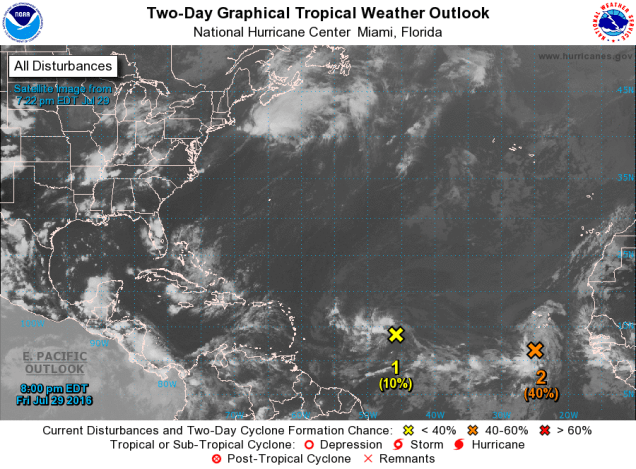
There are two disturbances in the Atlantic that are being monitored for development. Image provided by the National Hurricane Center.

During the first part of hurricane season (June/July), attention is mainly focused on the Gulf of Mexico, Caribbean, and the Bahamas for tropical development. These are the areas where water temperatures are warm enough to sustain tropical systems, but also areas where conditions are usually more favorable for systems to develop. Out across the open waters of the Atlantic, strong easterly winds can bring surges of Saharan dust off of Africa and send them across the Atlantic towards the Caribbean. This dry, dusty air inhibits the development of thunderstorms. As we get into August, the easterlies usually calm down a bit, and tropical waves start rolling off of Africa every few days. Some of these waves look impressive as they exit the coast, with plenty of shower and thunderstorm activity, only to quickly collapse when they hit the colder waters right off the coast of Africa. Others survive that part of the trip and make their way across the Atlantic. The ones that develop quickly into tropical systems are known as “Cape Verde Storms”, since the often form not far from the Cape Verde Islands. With plenty of time to cross the Atlantic, some of these storms are the most powerful storms we’ve seen.

7_21_31_nhc
Location of all tropical storms and hurricanes that formed between July 21 and 31 during the years 1851-2009. Image provided by the National Hurricane Center.

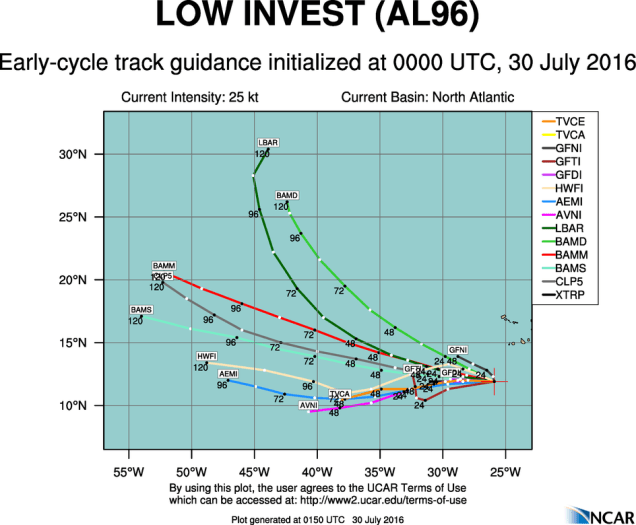
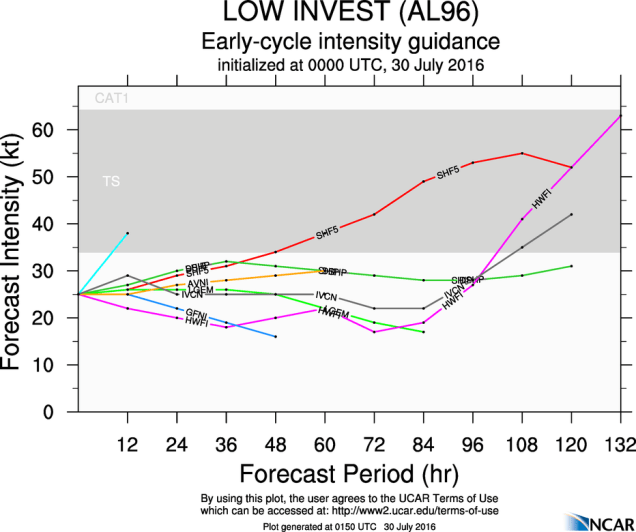
Right now, there are two areas of disturbed weather we’re watching in the Atlantic. One of these is a cluster of thunderstorms passing south of the Cape Verde Islands. Although the system is disorganized at the moment, conditions are favorable for some development this weekend. As we head into the beginning of next week, conditions look less favorable. Most of the forecast models indicate that the system should remain weak, if it develops at all, and remain over open waters, with no threat to any land areas.

aal96_2016073000_track_early
Model forecasts for the track of a tropical disturbance near the Cape Verde Islands. Image provided by NCAR.
aal96_2016073000_intensity_early
Model forecasts for the track of a tropical disturbance near the Cape Verde Islands. Image provided by NCAR.

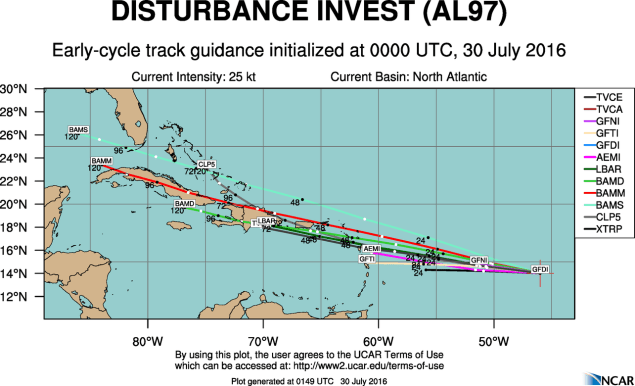
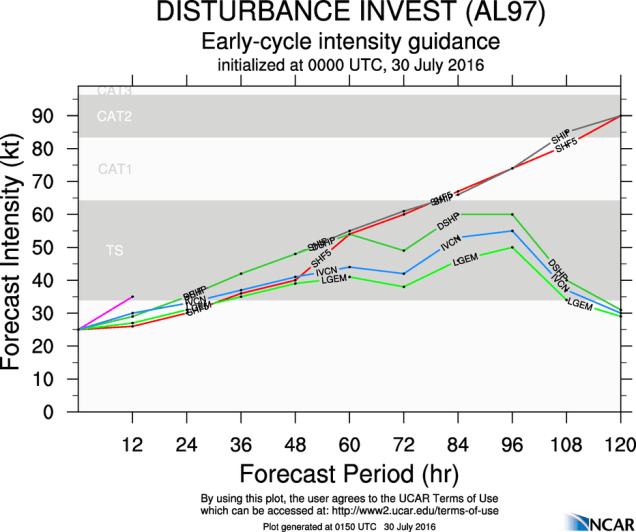
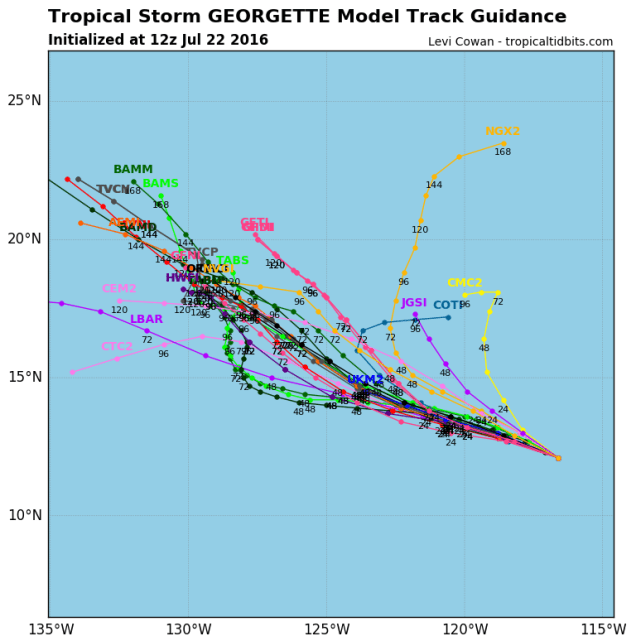
The second disturbance is the one that bears watching, and will have impacts on land areas. A tropical wave is centered about 1000 miles east of the Lesser Antilles this evening, producing disorganized showers and thunderstorms. The wave is moving along rather quickly (around 20-25 mph), and this fast motion will likely preclude much development over the weekend. The wave will bring showers and thunderstorms along with gusty winds to the islands of the eastern and northeastern Caribbean this weekend. Parts of this region are still recovering from a drought, so the rainfall will be welcome. As this system moves into the Caribbean, we’ll need to keep a close eye on it. Some models have the center of the system pass north of the islands, and towards the Bahamas, some have it pass directly over the islands, and others have it pass south of the islands and across the Caribbean, then possibly towards the Gulf of Mexico. The exact track it takes will determine whether it has a chance to develop or not. At this time, it’s far too early to tell which way it will go, so we’ll need to keep an eye on it.
aal97_2016073000_track_early
Model forecasts for the track of a tropical disturbance in the Central Atlantic. Image provided by NCAR.

aal97_2016073000_intensity_early

As we head into August, tropical activity should continue to ramp up across the Atlantic and the Pacific as we head towards the peak of the season, which is usually from late August to late September.

Beneficial Rain? Not For Most of Us

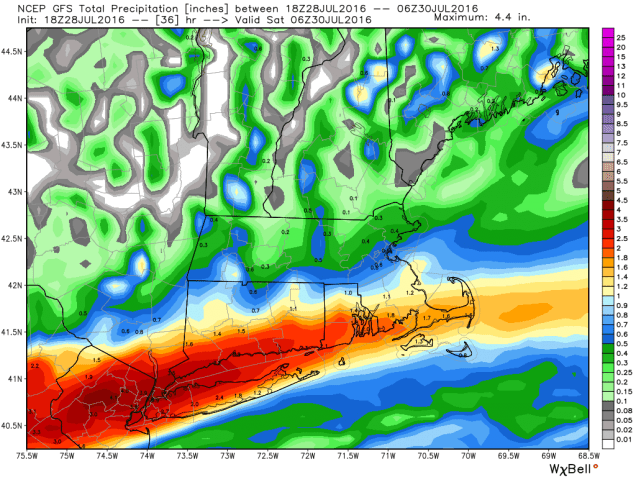
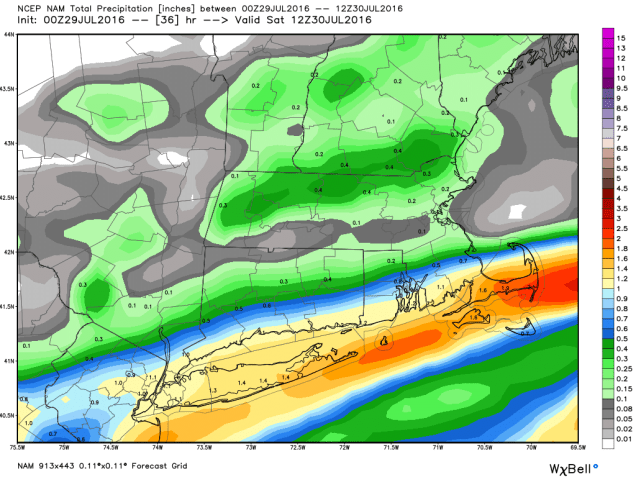
Last night, we told you about the old adage “When in Drought, Leave It Out.” Well, a lot of meteorologists around here decided to ignore that because many of the computer models were forecasting heavy rain across Southern New England on Friday. If you checked out a forecast anywhere on TV, Radio, or the Internet, all you heard was that heavy rain was expected on Friday. However, our forecast, along with the one from our comrades at Woods Hill Weather, was for most of the heavy rain to remain to our south. Well, most of the computer models started leaning that way today as well, and all of the other forecasts started to backpedal off of their “heavy rain” forecasts.

gfs_tprecip_boston_7
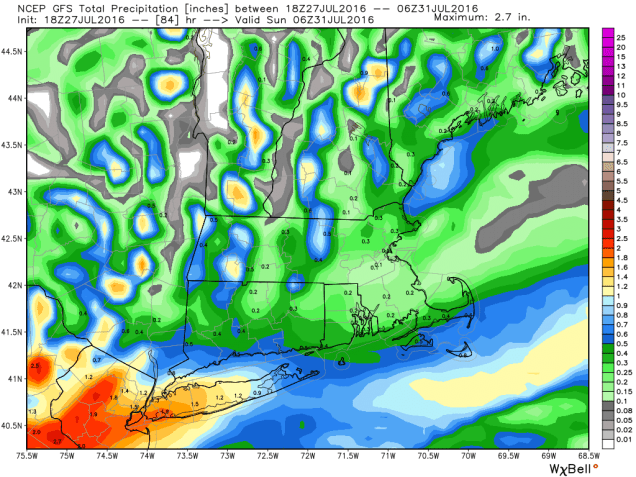
GFS model forecast for rainfall through early Saturday morning. Image provided by WeatherBell.
nam_total_precip_boston_13
NAM model forecast for rainfall through early Saturday morning. Image provided by WeatherBell.

As you can see in the maps above there will be a sharp cutoff from heavy rain to very little rain across the region. We’re confident that heavy rain will fall along the south coast on Friday, and we’re fairly confident that the heavy rain shouldn’t make it as far north as Boston. Areas in between Boston and Providence? That’s a toss-up. A Flash Flood Watch is in effect for most of Southeastern Massachusetts, Rhode Island, and Connecticut through Friday evening. Some flooding is likely with some of the heavier downpours, especially in some of the places that usually experience flooding in heavy rain. Unfortunately, not much rain is expected in the areas that really need it, especially the Merrimack Valley.

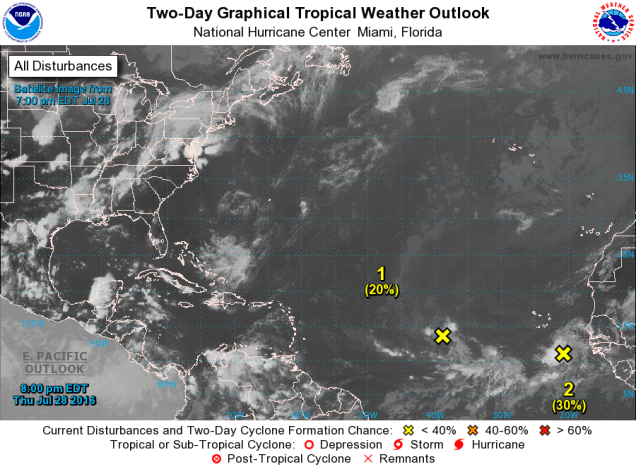
In yesterday’s post, we also mentioned the possibility of the tropics heating up. We told you about the tropical disturbance that was being watched in the eastern Atlantic. Well, we’re still watching it today, but we also have our eyes on a second area of disturbed weather out there.

two_atl_2d0
We have not one, but two disturbances to keep an eye on now. Image provided by the National Hurricane Center.

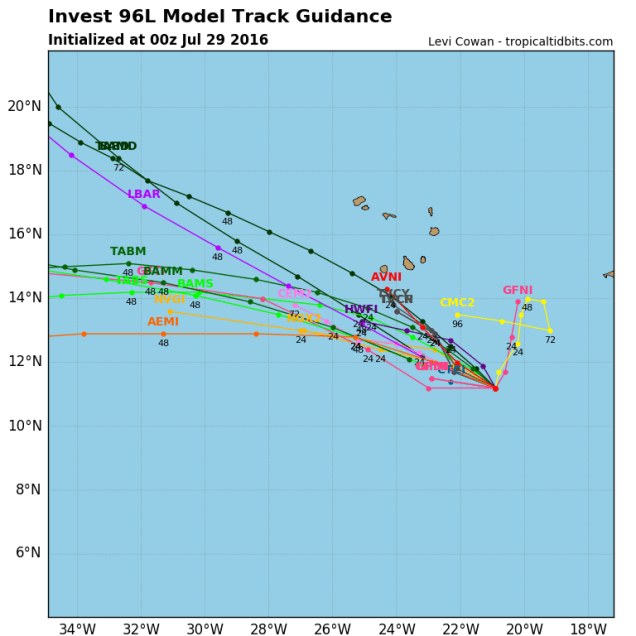
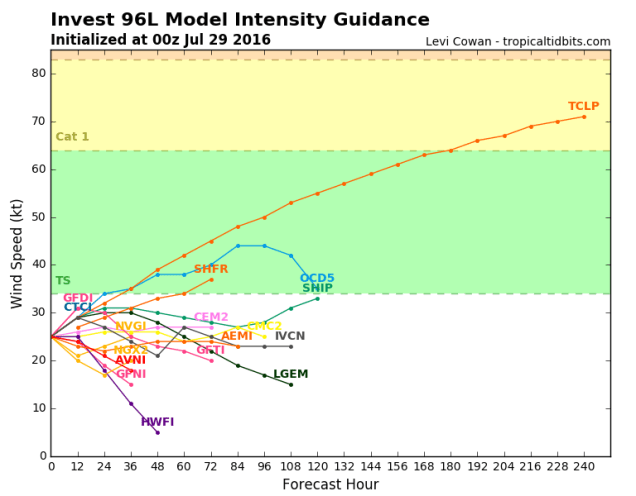
The first disturbance is passing south of the Cape Verde Islands this evening. It remains weak, but conditions are favorable for some development over the next few days. However, that window of opportunity will likely start to close as the system gets into the central Atlantic by the end of the weekend. Most of the forecast models don’t expect much development of this system, and frankly, neither do we. It’s something to keep an eye on through the weekend, but we’re not expecting much.

96L_tracks_latest
Model forecasts for the track of a tropical disturbance south of the Cape Verde Islands. Image provided by Tropical Tidbits.
96L_intensity_latest
Model forecasts for the intensity of a tropical disturbance south of the Cape Verde Islands. Image provided by Tropical Tidbits.

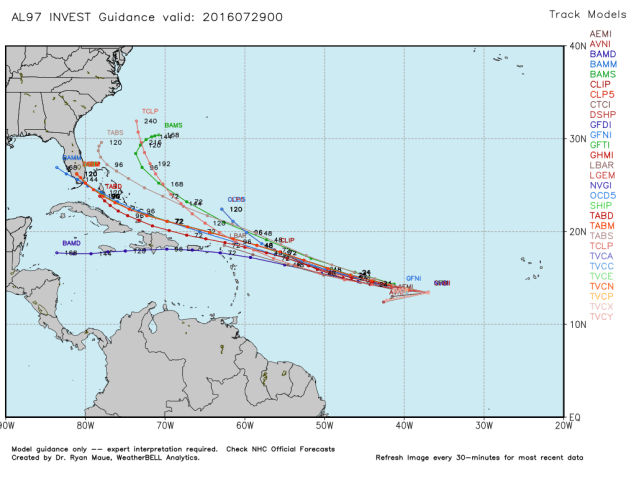
Meanwhile, farther to the west, another disturbance is about halfway between Africa and the Caribbean, and quickly heading westward this evening. The fast movement will likely preclude much development for now, but it should bring some gusty winds to the Lesser Antilles this weekend. Assuming it survives that long, we will need to keep an eye on it. As you can see below, many of the tropical models bring in just north of the Islands and into the Bahamas. There are other models that bring the system into the Caribbean and possibly the Gulf of Mexico well down the line. There are others that don’t expect the system to survive more than a few days.As the system gets closer to the Caribbean, we should start to get a better idea of what it might do and where it might go. Until then, it’s just something to keep an eye on.
AL97_current
Model forecasts for the track of a tropical disturbance in the Central Atlantic. Image provided by WeatherBell.
97L_intensity_latest
Model forecasts for the intensity of a tropical disturbance in the Central Atlantic. Image provided by Tropical Tidbits.


“When in Drought, Leave it Out”

“When in Drought, Leave it Out”

We don’t know who first coined that phrase, but like most meteorological rules of thumb, it tends to hold true most of the time. Here in New England, especially Southern New England, we are definitely in a drought.

20160719_northeast_trd
Latest update from the U.S. Drought Monitor.

A persistent pattern has led to warm and dry conditions across the Northeast for the past several months.While scattered showers and thunderstorms have produced locally heavy rainfall in some areas recently, widespread rainfall has been lacking. Many cold fronts have come across the region with little rainfall and coastal storms are rare in the summer to begin with. Even waves of low pressure passing south of New England along stalled out cold fronts have been too far south to produce much rain across our area.

m3ppct_northeast_jun16
Rainfall since the start of April has been well below normal across the region, especially in the Merrimack Valley. Image provided by the Northeast Regional Climate Center.


The dryness has been most noticeable since the beginning of June. Since June 1, Boston’s Logan Airport has recorded just 1.99″ of rain. This is the driest June/July on record in the city. The current record is 2.03″ from 1949. If Boston does not receive more than 0.04″ before Sunday night, a new record will be set (more on that later). In Worcester, the 3.18″ during the same timeframe is the 4th lowest total on record. In Lowell, 3.12″ of rain has been reported since June 1. This is the 8th lowest total on record.

So, is there any relief on the way? Maybe, though we wouldn’t count on it. A cold front will move across the region late Thursday and early Friday, then stall out south of New England. A wave of low pressure will ride along the wave, passing south of us on Friday. This wave will produce locally heavy rain and thunderstorms across the Ohio and Tennessee Valleys on Thursday, before it heads for the Mid-Atlantic states Thursday night. The question then is, how far north does the low and its associated rain shield get? This is the same situation we often see in the winter when trying to determine if a storm will miss us completely, bury us with heavy snow, or come too close and give us rain instead of snow. Thankfully, we don’t have to worry about snow for another 3-4 months at least.

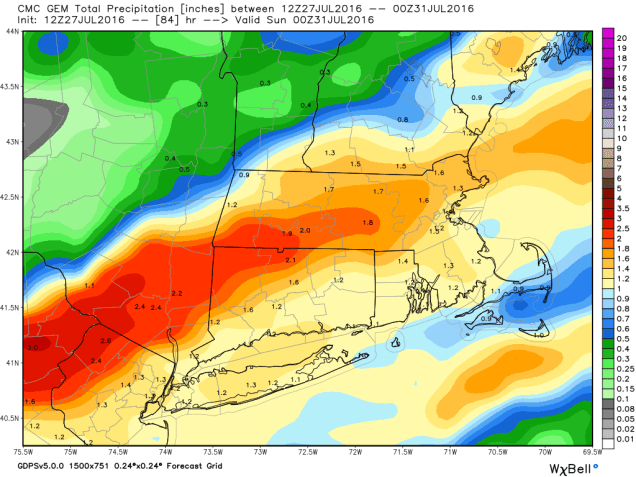
Right now, there are several different solutions among the models, which have a rather large impact on the forecast.

gfs_tprecip_boston_15
GFS model forecast for total rainfall through Saturday night. Image provided by WeatherBell.
cmc_total_precip_boston_15
GEM (Canadian) model forecast for total rainfall through Saturday night. Image provided by WeatherBell.
nam_total_precip_boston_29
NAM model forecast for total rainfall through Saturday night. Image provided by WeatherBell.

For the past few months, as we’ve mentioned previously, most of these storms have passed too far south to have much of an impact on us. For this reason, we’re inclined to lean that way with the forecast for Friday as well. That means we’re going with the GFS model above. Is there a possibility that one of the other models is right and we do get heavy rain? Sure, they could very well be right, but we’re not betting on it.

Droughts feed on themselves, which is how the expression at the top of the page came into existence. When the ground is dry, there is even less moisture available for approaching systems. When there’s less moisture available, less rain falls. When less rain falls, the drought gets worse. So how do we break the drought? When we have one in the summer, usually, the answer is with a tropical system. Either a tropical storm/hurricane comes up the coast and slams into New England dumping copious amounts of rain on us, or one hits farther down the coast (North Carolina or the Gulf) and weakens inland and the remains of it move this way with heavy rainfall. The Summer of 1955 was hot and dry like this one has been. Then, in the span of a week in August, two Tropical Storms (Connie and Diane) brought record rainfall to the region, with widespread flooding. Of course, that’s not the scenario we prefer. A more gradual transition to a wetter pattern is the best case scenario, but that isn’t how is usually works.

So, right now, you’re probably asking “is there a tropical system heading our way?” No, there isn’t, not yet. Since our record-setting June, there hasn’t been any activity at all in the Atlantic in July, but that could be changing. A tropical wave moved off the coast of Africa on Tuesday, producing plenty of shower and thunderstorm activity. Although some of that activity diminished today, conditions are still favorable for some development over the next few days. The odds of the system becoming a tropical depression are still fairly low, and the odds of it impacting any land, let alone New England, are still fairly remote.

al962016
Model forecasts for the track of a tropical disturbance in the Eastern Atlantic. Image provided by the University of Wisconsin.
al962016_inten
Model forecasts for the intensity of a tropical disturbance in the Eastern Atlantic. Image provided by the University of Wisconsin.

Now that we’re approaching the beginning of August, these waves should start to move off the coast of Africa every few days. At least a few of these will eventually become tropical systems as we approach the peak of hurricane season, which is late August into late September. Another area to watch is down near the Bahamas. Sometimes tropical systems form in this region, and they can quickly strengthen and head up the coast within a couple of days, which is exactly what Hurricane Bob did in August of 1991.

For now, do your rain dance and pray for rain to save your garden or lawn. It doesn’t look like any beneficial rain is coming anytime soon (unless the NAM is right on Friday).

Trouble in Paradise? Tropical Storm Darby Threatens Hawaii

After a rather slow start to the Hurricane Season, the Eastern Pacific has gotten very active, setting records in the process.

ir2-l
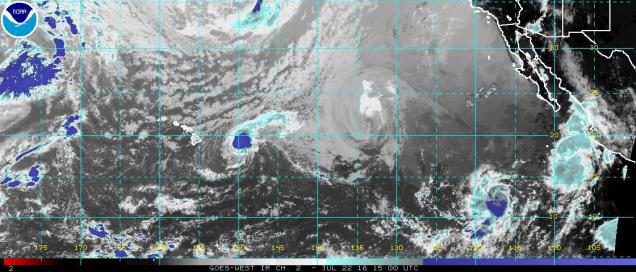
Satellite photo of the Eastern Pacific showing 4 active tropical cyclones (from Left to Right: Darby, Estelle, Georgette, Frank). Image provided by NOAA.

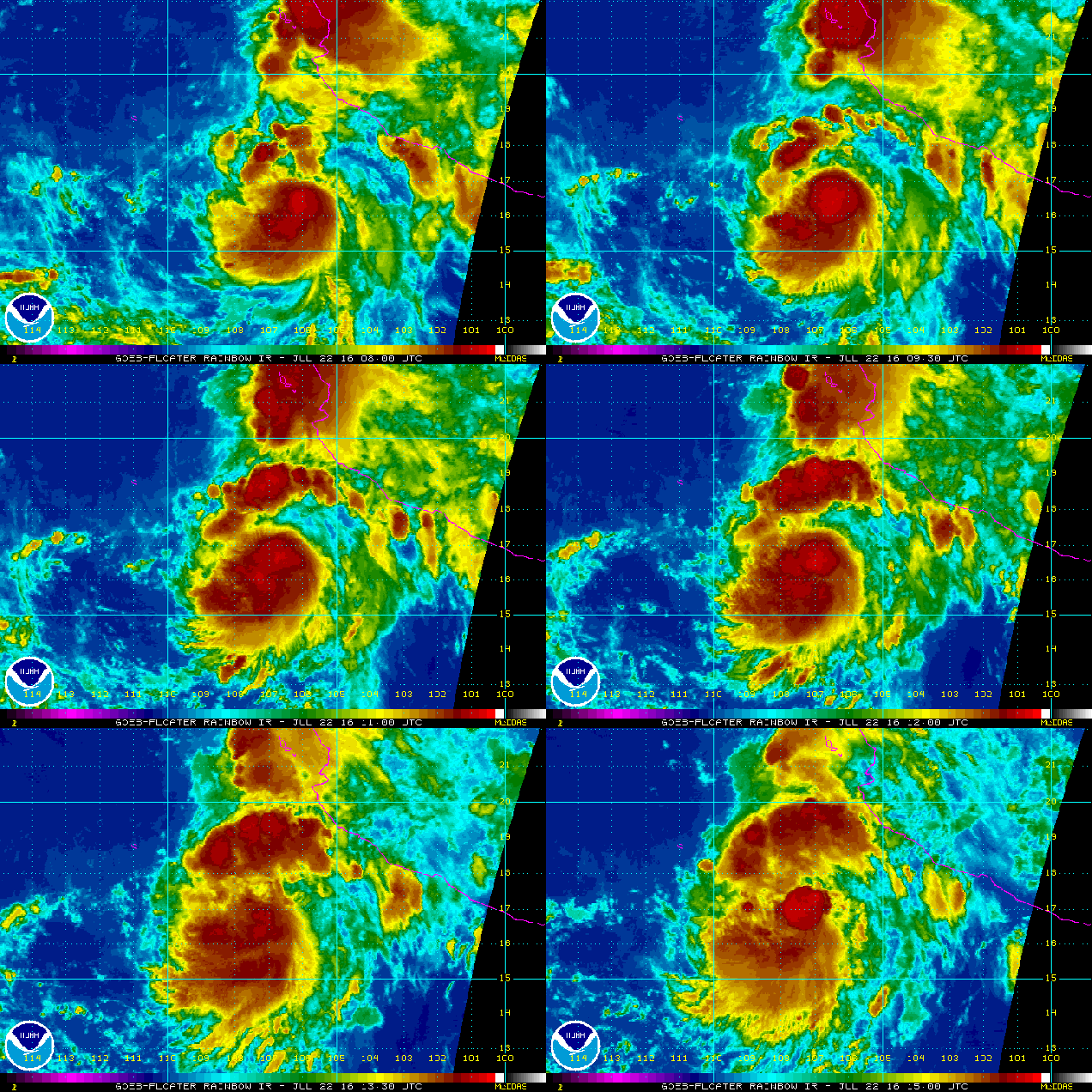
Late Friday morning, Tropical Depression Eight-E strengthened into Tropical Storm Georgette, the seventh named storm to form in the Eastern Pacific this month. This ties July of 1985 for the record for most storms to form during the month of July in the Eastern Pacific. as of 8am PDT, Georgette was centered about 870 miles south of Cabo San Lucas, Mexico, moving toward the west-northwest at 13 mph. Georgette had maximum sustained winds near 45 mph, and additional strengthening is expected. Georgette could become a hurricane this weekend while moving across the open waters of the Eastern Pacific Ocean.

08E_tracks_latest
Computer model forecasts for the track of Tropical Storm Georgette. Image provided by Tropical Tidbits.

08E_intensity_latest

Closer to Mexico is Tropical Storm Frank. As of 8am PDT, Frank was centered about 235 miles west-southwest of Manzanillo, Mexico with top winds near 50 mph, moving towards the northwest at 14 mph. Frank is expected to continue moving toward the northwest this weekend with some additional strengthening possible. Frank could become a hurricane before a weakening trend starts. By the end of the weekend, Frank is expected to start weakening while moving over colder waters west and southwest of Baja California. While Frank does not appear to be a threat to land at this time, anyone with interests in the Southern Baja Peninsula should monitor Frank’s progress, in case it tracks a bit farther east of the current projections.

rb_lalo-animated
Satellite loop of Tropical Storm Frank. Loop provided by NOAA.

To the west, Tropical Storm Estelle was centered about 1500 miles west of Cabo San Lucas, Mexico as of 8am PDT. Estelle continues to weaken, with maximum sustained winds down to 40 mph. Estelle is expected to dissipate over the open waters of the Eastern Pacific this weekend.

Despite all the activity in the Eastern Pacific, most of the attention is centered on the Central Pacific Ocean, where Tropical Storm Darby is bearing down on Hawaii.

probEP052016_160722_1530_sata
Satellite photo and track forecast for Tropical Storm Darby. Image provided by NOAA.

As of 5am HST, Darby was centered about 390 miles east of Hilo, HI moving toward the west at 12 mph. Maximum sustained winds have decreased to near 60 mph, and some additional weakening is expected. Darby is expected to turn more towards the northwest this weekend, passing very close to or right over portions of the Hawaiian Islands. A Tropical Storm Warning has been issued for the island of Hawaii, and a Tropical Storm Watch has been issued for the islands of Maui, Molokai, Lanai, and Kahoolawe. While Darby may bring gusty winds, possibly to 50 mph at times, to portions of Hawaii this weekend, the main threat will be rainfall and resultant flooding. Rainfall totals of 5-10 inches are possible, with some heavier amounts expected. Conditions should improve across the islands by Monday as the storm pulls away from the region and continues to weaken.

The Pacific is Getting Active. The Atlantic? No So Much.

After a very quiet start to the season, the Pacific Ocean is starting to get active.

rb_lalo-animated (1)
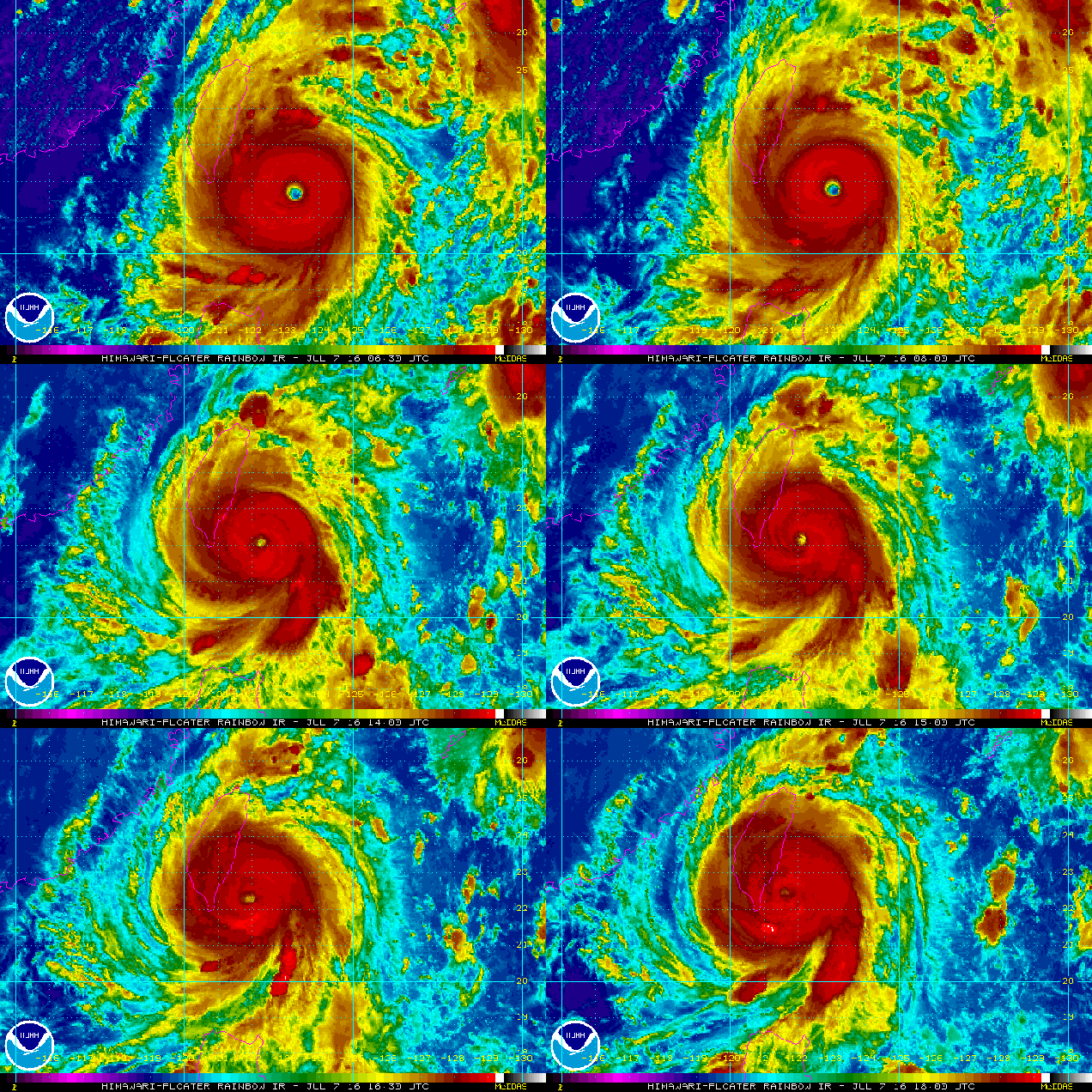
Satellite loop of Super Typhoon 02W (Nepartak). Loop provided by NOAA.

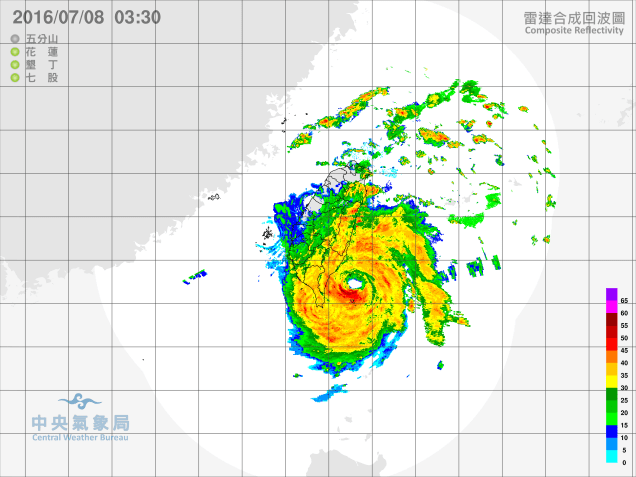
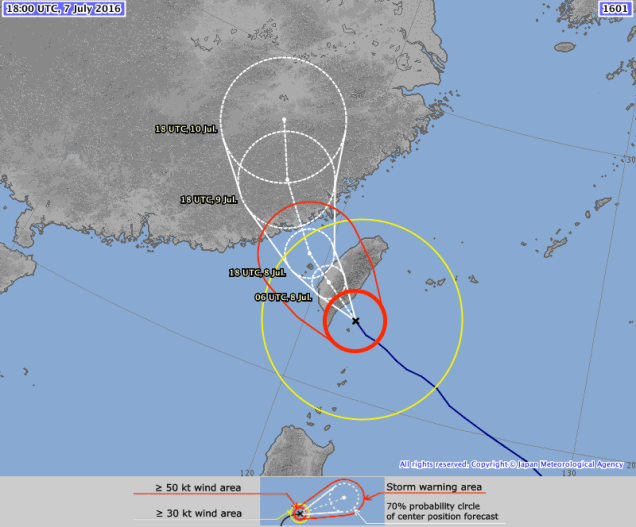
Super Typhoon 02W (Nepartak) has been gathering strength while crossing the Western Pacific Ocean for the past few days. After peaking with top winds near 170 mph on Wednesday, some slight weakening has occurred today, with winds decreasing to near 160 mph. Unfortunately, only a little additional weakening is expected before the storm makes landfall in Taiwan late Thursday.

CV1_3600_201607080330
Radar image of SuperTyphoon 02W (Nepartak) approaching Taiwan. Image provided by yhe Taiwan Central Weather Bureau.
1601-00
Forecast track for SuperTyphoon 02W (Nepartak). Image provided by the Japanese Meteorological Agency.

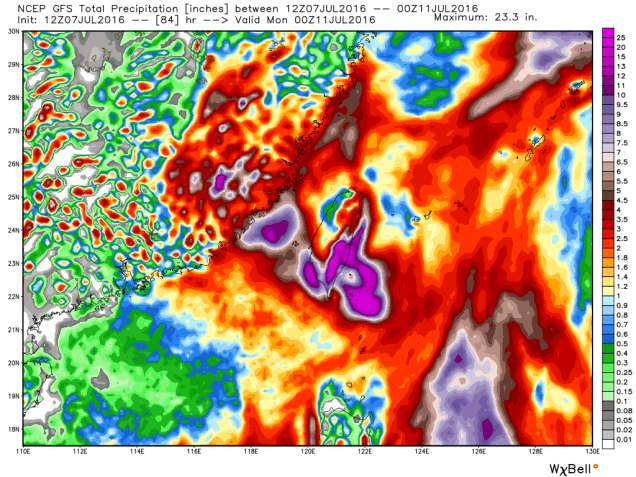
After crossing Taiwan, the storm will steadily weaken before moving into eastern China. While wind and storm surge will still be threats along the coast, the bigger threat to much of the region will be heavy rainfall and the resulting flooding. Recent heavy rain has already created flooding that result in the dozens of deaths across the region. Another 5 to 10 inches or more is expected with the storm, likely worsening conditions across the region.

gfs_tprecip_taiwan_15
GFS model forecast for rainfall through the weekend across Taiwan and eastern China. Image provided by WeatherBell.

Meanwhile, in the Eastern Pacific, there are currently two active storms, though neither is a threat to land.

vis_lalo-animated
Satellite loop of Hurricane Blas. Loop provided by NOAA.

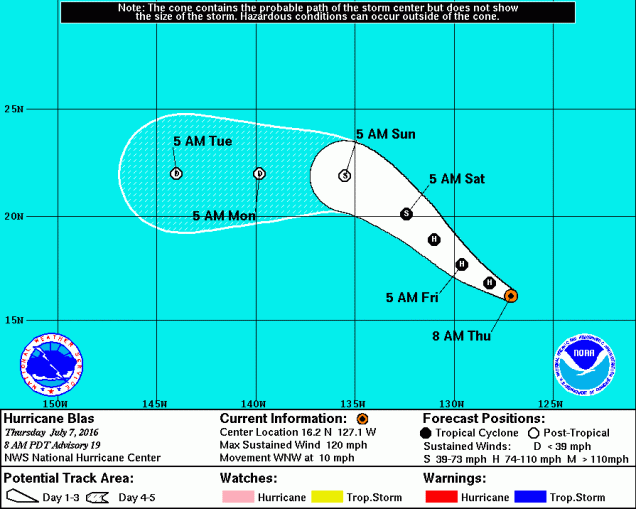
Hurricane Blas peaked on Tuesday night as a Category 4 Hurricane with top winds near 140 mph. As of Thursday afternoon, Blas was centered a little more than 1200 miles west-southwest of Cabo San Lucas, Mexico with top winds near 120 mph, making it a Category 3 Hurricane on the Saffir-Simpson Scale. Blas is moving towards the west-northwest at 10 mph, and Blas is expected to continue heading across the open waters of the Eastern Pacific while steadily weakening over the next few days.

144029W5_NL_sm
Current forecast track for Hurricane Blas. Image provided by the National Hurricane Center.

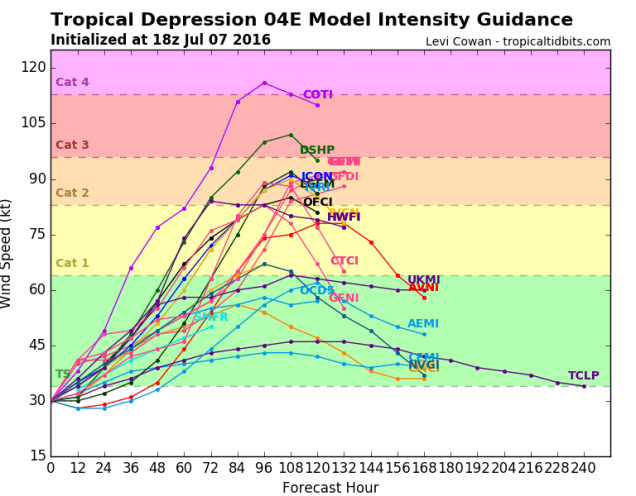
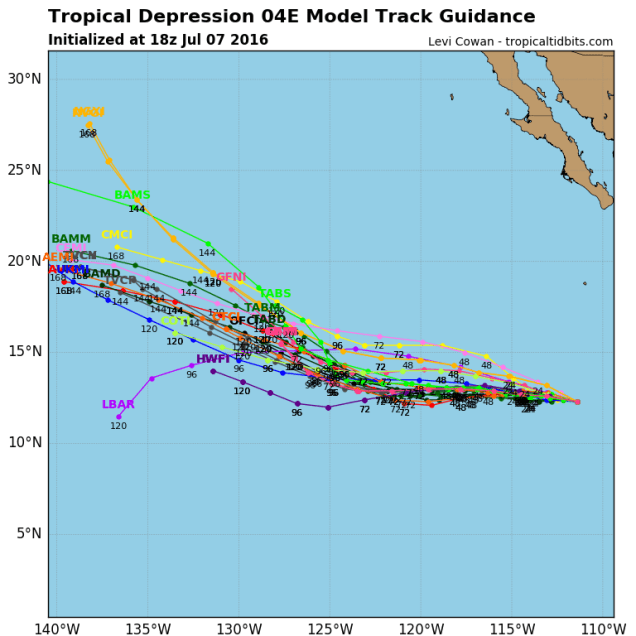
Closer to Mexico is Tropical Depression Four-E, which formed late Wednesday. As of midday Thursday, the depression was centered about 700 miles south of Cabo San Lucas, Mexico with top winds near 35 mph. The depression was heading towards the west-northwest at 8 mph. The forecast for the system is for it to continue heading away from Mexico and out into the open waters of the Eastern Pacific over the next few days. The system could become a Tropical Storm in the next 24-36 hours, at which point it would be given the name Celia.

04E_intensity_latest
Computer model forecasts for the intensity of Tropical Depression Four-3. Image provided by Tropical Tidbits.
04E_tracks_latest
Computer model forecasts for the track of Tropical Depression Four-3. Image provided by Tropical Tidbits.

While the Pacific is active, the Atlantic has quieted down after a record-setting June. A large area of high pressure continues to dominate the region, suppressing most of the tropical waves well to the south. In additional, strong easterly winds keep sending surges of Saharan Dust across the region, which inhibits thunderstorm development. Conditions should remain quiet across the Atlantic into next week.

vis-animated
Satellite loop of the Atlantic Ocean. Loop provided by NOAA.

Colin (or what’s left of it) is Hitting Florida, Severe Weather on Tuesday in New England?

Often, you’ll hear meteorologists say not to focus on the center of a tropical system, because its effects can be felt far from the center. Tropical Storm Colin is a terrific example of this.

vis_lalo-animated
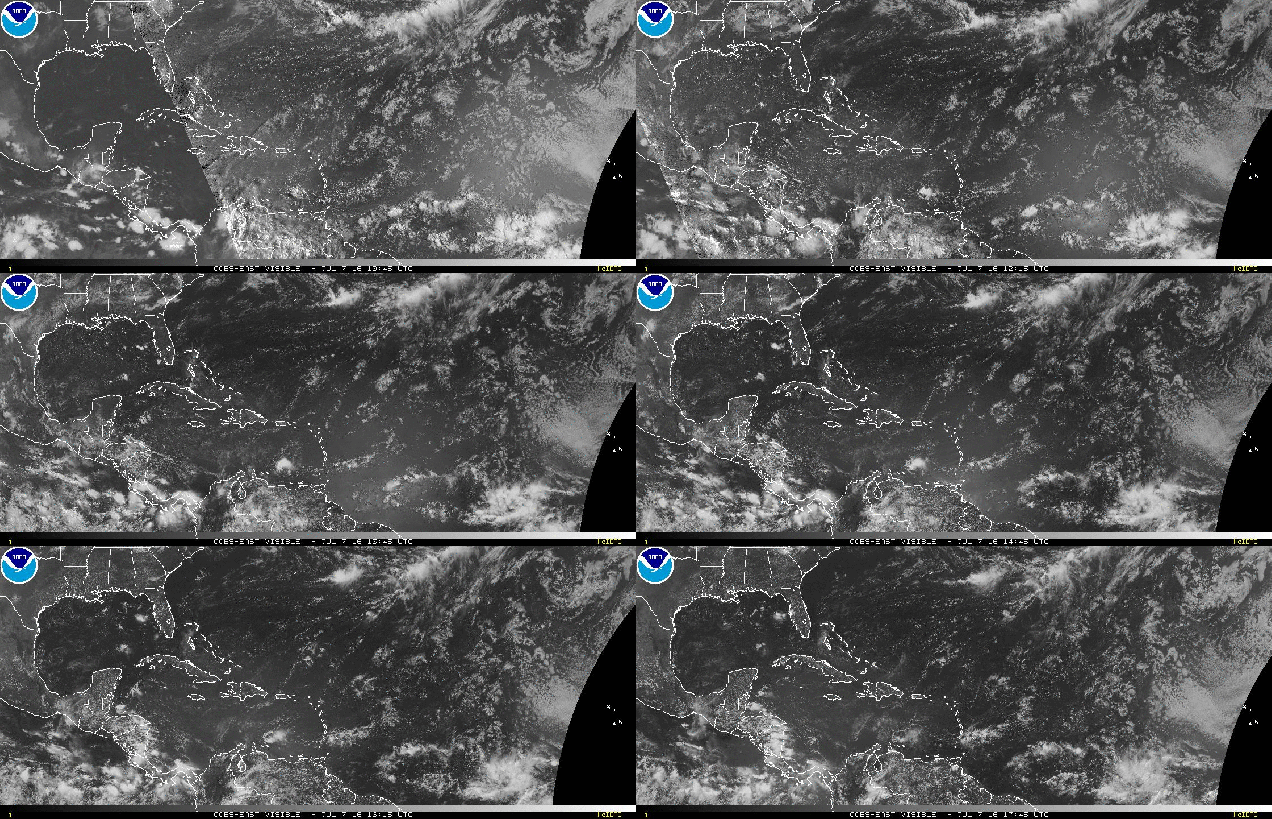
Satellite loop of Tropical Storm Colin from Monday afternoon. Loop provided by NOAA.

The “center” of Tropical Storm Colin is about to cross the coast of the Big Bend of Florida this evening. As of 11pm, the center was about 70 miles east of Apalachicola, Florida, moving northeast at 22 mph. Maximum sustained winds are near 50 mph. While the center is about to cross the coast, most of the thunderstorm activity is located east and northeast of the center. Heavy rain has been falling for most of the day across much of Florida as well as parts of Georgia and the Carolinas, but there have only been a few reports of tropical-storm force winds.

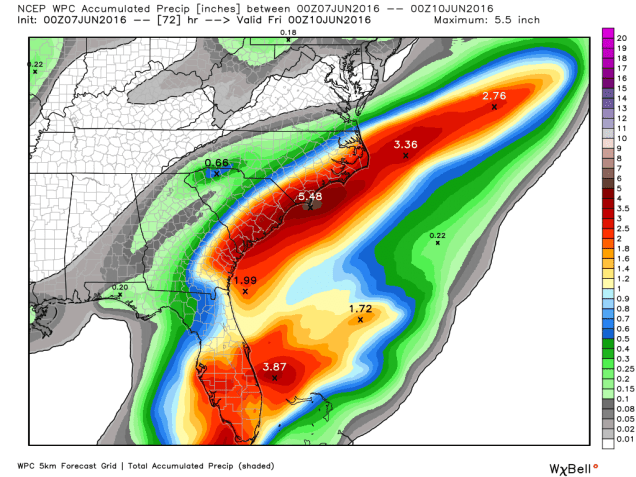
Tropical Storm Warnings remain in effect for the Gulf Coast of Florida from Indian Pass to Englewood, and along the Atlantic coast from Sebastian Inlet, Florida northward to Oregon Inlet, North Carolina. The current forecast from the National Hurricane Center calls for Colin to cross northern Florida and southern Georgia overnight, then move back into the Atlantic on Tuesday. Colin will likely have lost tropical characteristics by then (some would that it is already doing that), but it may still strengthen a bit as it passes offshore of the Carolinas. The main impact will be heavy rain and flooding near the coast. Flood watches are in effect for much of the region.

wpc_total_precip_se_12
Expected rainfall between Monday evening and Thursday evening. Image provided by WeatherBell.

Once Colin or its remains pull away from the Carolinas it will head out into the open Atlantic. Aside from impacting the fish and marine traffic, the system could pass close enough to Newfoundland to bring some gusty winds and rainfall to the island later this week.

Meanwhile, the first tropical depression of the season has formed in the Eastern Pacific Ocean. As of 11pm EDT, Tropical Depression One-E was centered about 125 miles south-southwest of Salina Cruz, Mexico, heading towards the northeast at 7 mph. A Tropical Storm Watch has been posted for the coast of Mexico from Puerto Escondido to Boca De Pijijiapan.

01E_intensity_latest
Computer model forecasts for the intensity of Tropical Depression One-E. Image provided by Tropical Tidbits.
01E_tracks_latest
Computer model forecasts for the track of Tropical Depression One-E. Image provided by Tropical Tidbits.

The system is expected to remain weak while drifting towards the northeast over the next day or two. The system could dissipate before making landfall. One thing it will do is produce very heavy rainfall across southern Mexico and adjacent Central America. Rainfall totals of 5-10 inches are expected with heavier amounts possible. This will lead to flash flooding and mudslides across the region.

qpf_acc_mm.mx
GFS model forecast for rainfall across Mexico for the next 4 days. Image provided by Pivotal Weather.

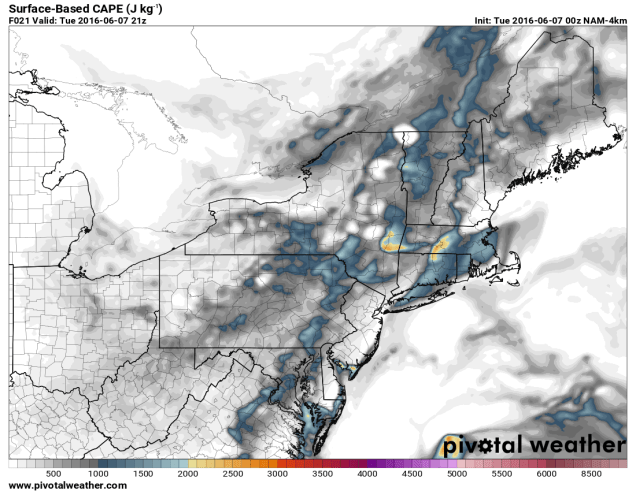
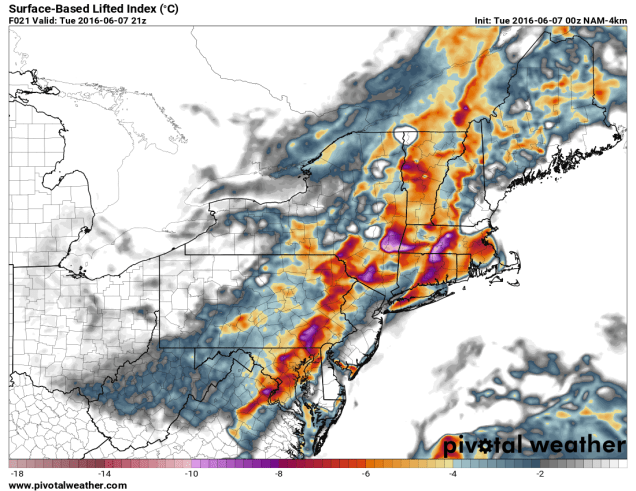
Closer to home, we have a possibility of severe weather around here on Tuesday. A cold front will cross the region during the afternoon, likely producing some showers and thunderstorms. Before that, we’ll have some cloud cover and showers around in the morning. If we can get enough sunshine to develop during the afternoon, it could help produce instability for another round of showers and thunderstorms, some of which could be strong to severe. Right now, it looks like the best chance for and strong storms will be from western and central Massachusetts into southern Vermont and southern New Hampshire, but again, this is dependent on how much sunshine we get. Any storms that do form may contain heavy downpours, gusty winds, and hail.

sbcape.us_ne (1)
NAM model forecast of CAPE values for 4pm Tuesday. Notice that the higher values are across central and western Massachusetts. Image provided by Pivotal Weather.
sbli.us_ne (1)
NAM model forecast of Lifted Index values for 4pm Tuesday. Notice that the higher values are across central and western Massachusetts. Image provided by Pivotal Weather.

After the front moves through, cooler weather will settle in for Wednesday, but a secondary cold front may produce another round of showers and thunderstorms Wednesday afternoon. With much cooler air aloft, there’s a better chance that any storms that form on Wednesday may contain small hail, but widespread severe weather isn’t expected.

Attention Florida – Colin is Calling

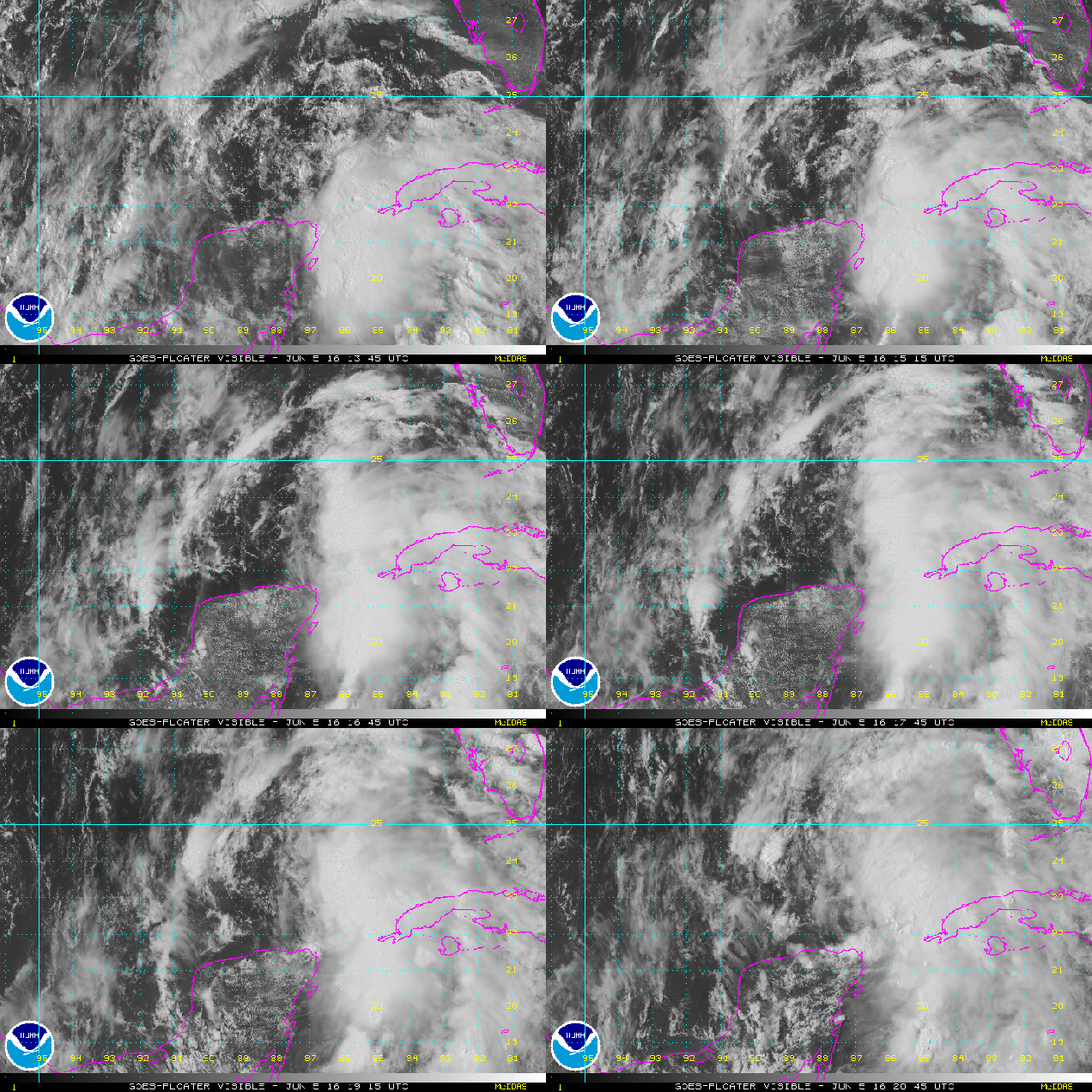
Just when you thought it was safe to call the tropics quiet with Bonnie disappearing, a new tropical depression has formed.

Earlier today, Tropical Depression Three was born in the southern Gulf of Mexico. As of 5:30pm EDT, the system was upgraded to Tropical Storm Colin with top winds near 40 mph. Colin was centered about 465 miles southwest of Tampa, Florida, moving towards the north at 12 mph. The current forecast is for Colin to turn more towards the northeast over the next day or so and strengthen.

vis_lalo-animated
Colin already looks more impressive than Bonnie did. Loop provided by NOAA.

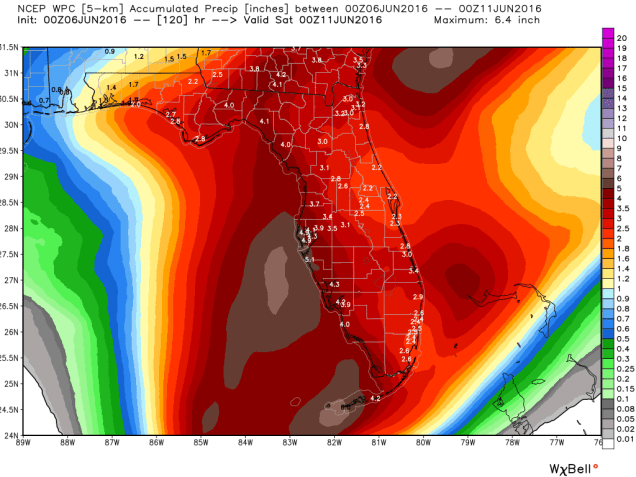
Based on the current forecast track, a tropical storm warning has been issued for the west coast of Florida from Indian Pass to Englewood. A tropical storm watch has also been issued for the Atlantic coast from Altamaha Sound, Georgia to the Flagler/Volusia County border in Florida. While the system will likely bring gusty winds to the region along some minor storm surge flooding near where it makes landfall, the biggest impact by far will be heavy rainfall and the flooding it likely produces.Most of the state can expect between 2 and 5 inches of rain, with isolated totals of up to 10 inches possible. Flood watches are already in effect for portions of the state, and more will likely be issued.

wpc_total_precip_florida_20
Expected rainfall across Florida over the next five days. Image provided by WeatherBell

Once the system crosses Florida it will likely move into the Atlantic and continue on a northeasterly track out into the open Atlantic. The system may be close enough to the coast to bring additional heavy rain to parts of the Carolinas that were deluged by Bonnie a week ago. This could lead to additional flooding in this area.

03L_tracks_latest
Computer model forecasts for the track of Tropical Storm Colin. Image provided by Tropical Tidbits.
03L_intensity_latest
Computer model forecasts for the strength of Tropical Storm Colin. Image provided by Tropical Tidbits.

Meanwhile, in the Eastern Pacific Ocean, there are now two areas being monitored this evening. The first one is the same one we’ve been watching all week. An area of low pressure is centered about 1100 miles southwest of Cabo San Lucas, Mexico, heading westward out into the open waters of the Pacific. Despite the models insisting all week that the system would develop (and some continue to insist on this happening), the system has not gotten its act together, and conditions won’t remain favorable for more than another day or two. So, we can probably write this system off.

The more immediate concern is a disorganized cluster of showers and thunderstorms a few hundred miles south of Acapulco, Mexico. This system will slowly drift towards the northeast over the next few days, with some strengthening possible. It could become the first tropical depression of the season in the Eastern Pacific by midweek.

92E_tracks_latest
Computer model forecasts for the track of a tropical disturbance south of Mexico. Image provided by Tropical Tidbits.
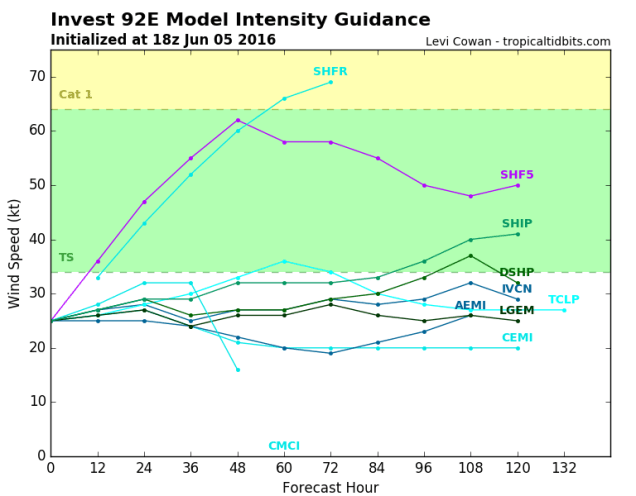
92E_intensity_latest
Computer model forecasts for the intensity of a tropical disturbance south of Mexico. Image provided by Tropical Tidbits.

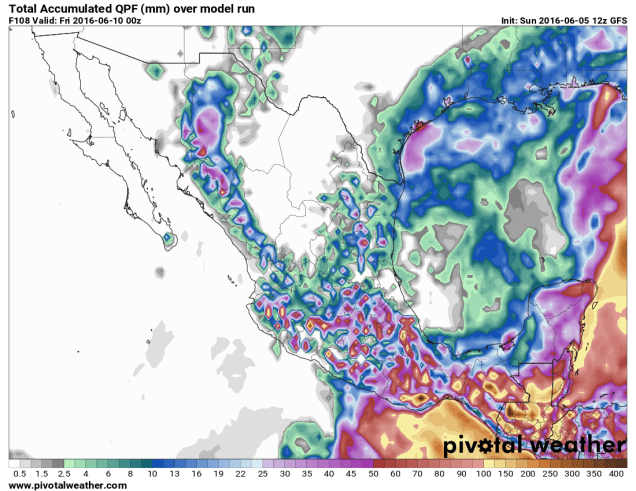
Whether the system develops into a tropical depression or not, it will bring heavy rainfall to portions of southern Mexico and Guatemala over the next several days. Rainfall totals of 5-10 inches are possible in this area, with some heavier amounts likely. This will also certainly lead to flash flooding across parts of the region.

qpf_acc_mm.mx
Rainfall forecast from the GFS model for the next four days for Mexico and adjacent Central America. Image provided by Pivotal Weather.