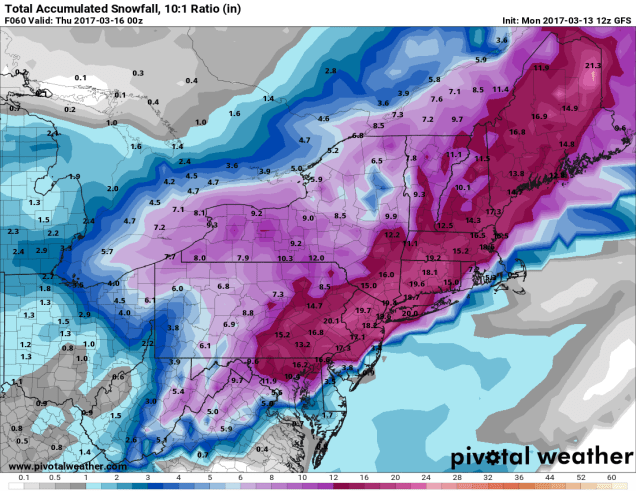
Thursday Will Not Be a Fun Day

So, as you may have heard from the relentless media hype over the past few days, we’ve got a storm headed our way on Thursday. While this will be an extraordinary storm for places like Florida, Georgia, and the Carolinas, up here, we’ve seen a lot worse.
GFS SE Snow
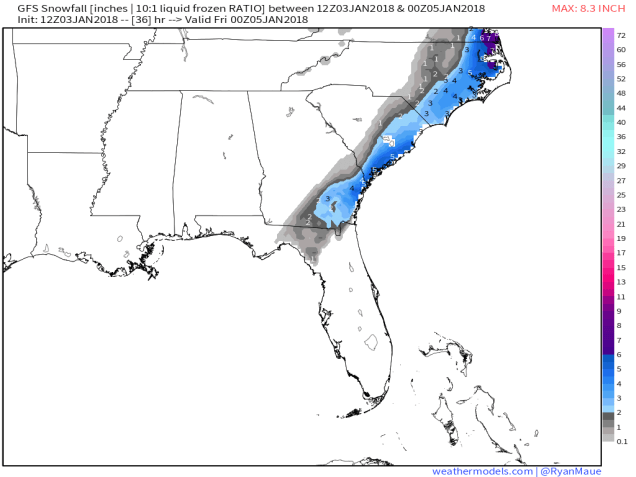
Snowfall accumulations of 2-5 inches from northern Florida into eastern North Carolina? That doesn’t happen too often. Image provided by Weathermodels.com

Snow and sleet have been falling today across portions of northern Florida, Georgia, and South Carolina. Several inches are expected to fall today, especially along the coastline. Given how rarely this happens in some of these locations, it will probably bring the region to a halt, while those of us in the North point and laugh. Don’t worry, our time is coming tomorrow.

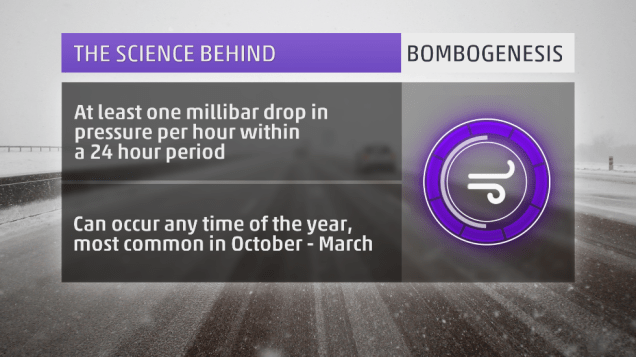
The storm that is producing the snow down South will move up the East Coast later today and Thursday, rapidly intensifying as it does so. You may have heard the terms “bombogenesis” or “weather bomb” used as part of the media hype in the last few days to describe this storm. These are terms that have been around for quite some time. Bombogenesis happens when the lowest pressure of a storm drops more than 24 millibar in a 24 hour period. This happens several times a year with storms off the East Coast. It is nothing out of the ordinary. The reason this storm is getting the attention, aside from the Southern snow, is that the pressures are much lower than a typical winter storm. This will be a strong storm system, but again, we’ve had powerful storms off the East Coast plenty of times before.
fd8d2f50-baa8-4cb1-8497-d04c48d4afb5
Definition of “bombogenesis”. It’s a fairly common occurrence. Image provided by Weather.com

As the storm gets cranked up off the East Coast, it will generate strong winds,, especially along the coast. While we’re looking at wind gusts to 40-50 mph, possibly even higher, things could be a lot worse. We don’t have a large high pressure system to our north (more on that in a minute). If we had a high to our north, increasing the pressure gradient between the storm and the high, winds would be even stronger. The tighter the gradient, the stronger the winds. This is why we can have strong winds with weaker systems, if there is a large high in place to the north.

Along with the winds, coastal residents also have to worry about coastal flooding. Since we’re just past the full moon, tides remain astronomically high. Add in strong onshore winds, and residents along north to northeast facing beaches could experience some coastal flooding around the midday/early afternoon high tide on Thursday. By the time we get to the high tide Thursday night, winds will have shifted into the west or northwest, thus limiting the flooding potential.

Back to the high pressure, or lack thereof, to our north. High pressure has been sitting to our north or northwest all week, which is why we’ve been frigid since before New Year’s. That high has shifted offshore now, allowing somewhat milder air to settle in today. Normally, to get heavy snow, we need that high pressure area to stay to our north or northwest, to lock the cold air into place. With that not the case this time, we’re going to have to deal with a rain/snow line. That seems hard to believe given how cold the past week has been, but it is the case. Water temperatures are still in the lower 40s off our coast, so a strong onshore wind will warm up the lowest layers of the atmosphere enough for a change to rain. This seems like across Cape Cod, but the question becomes, how far inland does that rain/snow line penetrate? The models have varying ideas on this, but a portion of southeastern Massachusetts may see a changeover.

26169151_1559673427444150_4898784041387586845_n
Winter Storm Warning are in effect for virtually the entire East Coast, with Blizzard Warnings (in red) for parts of coastal New England. Image provided by NOAA.

So, we’ve talked about strong winds, coastal flooding, and a rain/snow line. Now, for the only part that most of you are interested in – snow. First, we’ll talk about the timing. Snow should develop from south to north across the region between about 3 and 6am. So, by the time most of you wake up, it will likely be snowing. The snow will end between 7 and 10pm for most of us. The worst of the storm will be between about 9am and 4pm. Snow will be moderate to heavy at times, which combined with strong winds, will create whiteout or blizzard conditions, especially along the coast. If you don’t have to be out tomorrow morning/afternoon, we’d recommend staying where you area. Blizzard warnings have been posted for parts of eastern and southeastern Massachusetts, the NH Seacoast, as well as coastal and Downeast Maine. Remember, the amount of snowfall has absolutely nothing to do with blizzard conditions. You can have a blizzard with no snow falling at all. By definition, you have a blizzard when visibility is 1/4 mile or less due to falling or blowing snow and you have sustained winds or gusts to 35 mph or more for 3 consecutive hours or more.

So, how much snow are we looking at? There isn’t really one model that we completely agree with, so we’re going with a blend of the ideas. Because the storm will be moving along fairly quickly, we’re not looking at any blockbuster amounts. The trickiest part is where the rain/snow line sets up.  Right now, we’re thinking somewhere close to the Cape Cod Canal. As for amounts, here’s the breakdown:

Outer Cape Cod/Islands: 3-5″
Upper Cape Cod: 4-8″
Southeastern Massachusetts (south and east of I95): 8-14″
Northern RI/Interior Eastern Massachusetts/North Shore: 6-12″
Central Massachusetts/Merrimack Valley/Southern NH/Seacoast: 5-9″

The biggest wild card is Southeastern Massachusetts, especially the closer to Cape Cod you get. The farther the rain/snow line moves inland, the less accumulations will be. This is the area of biggest “bust potential”.
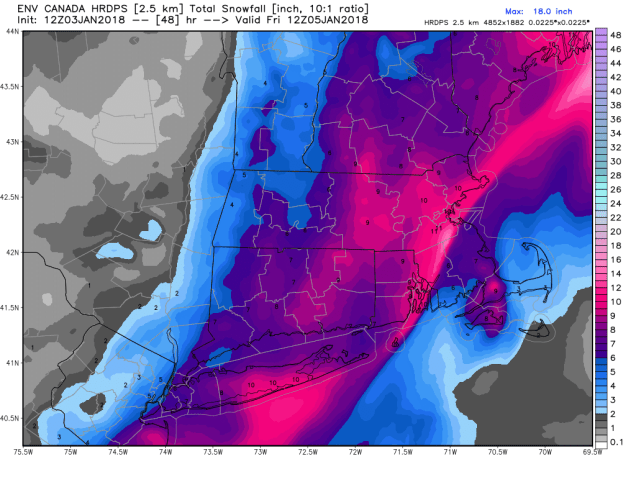
hrdps_snow_boston_49
The Canadian HRDPS model is probably closest to our thinking, but not exactly the same. Image provided by WeatherBell.

Once the storm moves by, we’ll slowly clear out on Friday, but gusty northwest to west winds will usher another arctic blast into the region. Saturday may be even colder than any of the days we’ve had over the past week. Especially with fresh snowcover, temperatures will plunge again, with the worst of it on Saturday, when high temperatures likely stay in the single digits. Sub-zero lows are likely across much of the region Saturday morning and especially Sunday morning.

Bing’s Dream Will Be Reality for Most of Us.

We’ve all heard the opening line of the song more times than we can remember:

“I’m dreaming of a white Christmas, just like the ones I used to know”

Well, this year, it won’t be a dream for a large portion of the region, it’ll be reality. Across southeastern parts of New England, mainly south and east of I-95, – sorry, it’ll be a green Christmas for you, with mostly rain from the system.

Christmas Eve will actually be a fairly nice December day by New England standards. We’ll start the day with some sunshine, but clouds will move in during the afternoon as low pressure moves into the eastern Great Lakes. High temperatures will reach the upper 30s to lower 40s, which is right around normal for late December.

nam.refcmp_ptype.us_ne.2017122400-loop
The NAM model shows the progression of the system with the secondary area of low pressure developing off the New Jersey coast and crossing the Outer Cape. Loop provided by Pivotal Weather.

As we head into Sunday night, right around the time Santa is making his rounds, snow will break out across the region, with rain across southeastern Massachusetts and parts of Rhode Island. At the same time, a secondary area of low pressure will start to take shape off the Mid-Atlantic coastline. This low will start to head northeastward, likely passing very close to, or perhaps right over, the Outer Cape, on Christmas morning. As a result of this track, the rain/snow line will likely penetrate as far inland as a Boston-Providence line. Obviously, any variation in track will impact how far inland that warmer air penetrates, which will impact the snowfall forecast. The snow will come down at a steady pace for much of Christmas morning, tapering off and ending by midday as the storm moves into the Gulf of Maine, where it will really get cranked up (more on that in a moment).

So, how much are we looking at?

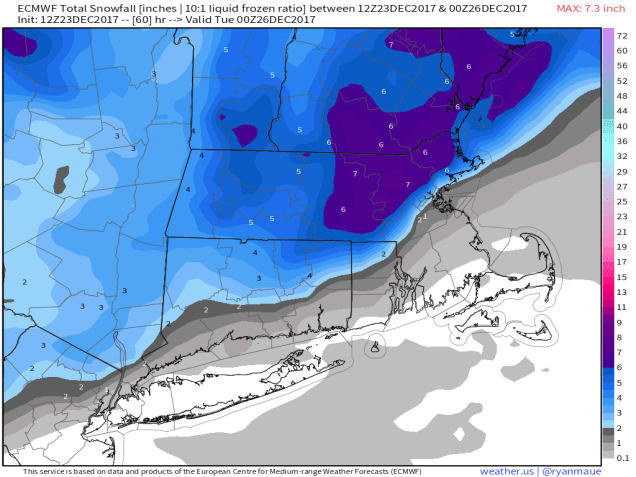
If you live south and east of a line that runs from Boston to Providence (roughly Interstate 95), probably just a brief dusting at the tail end of the storm as colder air comes back in as the precipitation is ending.

If you live just west of I-95, from Northern Rhode Island into the Boston area and Metro West, 1-3 inches.

Anywhere outside of there, especially the I-495 belt from Central Massachusetts into the Merrimack Valley, North Shore, Southern New Hampshire, and the New Hampshire Seacoast, 3-6 inches, with some isolated spots picking up as much as 8 inches.

ecmwf_acc_snow_massachusetts_60
The ECMWF is closest to our thinking for snowfall with the Christmas storm system. Image provided by Weather.us


As the system moves into the Gulf of Maine Monday night into Tuesday, gusty winds are likely behind it, ushering much colder air into the region. Low temperatures Tuesday morning will drop into the middle teens to lower 20s, but wind chills will be in the single numbers and even below zero in spots Tuesday morning. This is also bad news for places that had mainly rain during the day, as it will ice everything up in the evening, creating some slippery travel. This bitterly cold air looks to remain in place for much of the week as a large area of high pressure builds in. We’ll get into more detail in our Weekly Outlook Monday morning, but this high pressure area is good news, as it may help to deflect a potential storm later in the week off to our south (much to the chagrin of the Facebook Forecasters who were already trumpeting about a potential snowstorm a week in advance because some of the models showed it).

Big Changes for Friday/Saturday

In our Weekly Outlook this past Monday, we talked about a storm heading into the Great Lakes this weekend, with a warm front bringing rain and mild conditions on Saturday, but Friday would be cool as the warm front struggled to cross our area. Well, things have changed considerably, and not for the better.

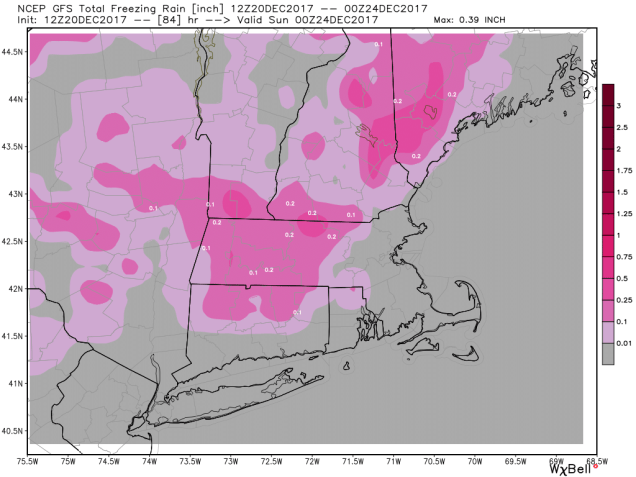
Low pressure will still move into the Great Lakes Friday/Saturday, and a warm front will get hung up to our south. The problem is, that warm front may not make it any farther north than the South Coast. Even worse, we’re looking at precipitation streaming in on Friday, continuing more or less into Saturday afternoon. Cold air in place, precipitation moving in, warmer air eventually moving in aloft. If you’ve lived around here long enough, you that means we’re looking at a snow to freezing rain situation.

gfs_frz_rain_boston_15
Freezing rain could be a significant problem from northern Connecticut into central/western Massachusetts and southern New Hampshire Friday into Saturday. Image provided by WeatherBell.


Snow should develop across southern New Hampshire and northern Massachusetts around midday Friday, with a mix of snow, sleet and freezing rain moving into the Boston area during the afternoon, and rain, possibly mixed with a little snow south of Boston by late in the day. Eventually, a change to freezing rain will take place north and west of Boston Friday night as warmer air moves in aloft. The problem is, that cold air at the surface will be pretty tough to dislodge. Temperatures will slowly drift up, likely getting above freezing by Saturday morning inside Route 495. However, from the Merrimack Valley into southern New Hampshire, there is the chance that temperatures never reach 32, or if they do, it won’t be until late in the day, after most of the precipitation has fallen.

gfs_t2max_boston_15 (1)
The GFS is only forecasting high temperatures in the middle 30s from Boston northward and westward on Saturday. That may even be too optimistic. Image provided by WeatherBell.


Before the change to freezing rain, we are looking at some snow accumulation, mainly north and west of Boston. As much as 1-3″ could fall in the Merrimack Valley, with 3-5″ from the Seacoast over into southern New Hampshire. If the changeover takes even longer than we currently expect, then these totals could end up higher.

ecmwf_acc_snow_massachusetts_96
A few inches of snow is expected before the change to freezing rain late Friday into Saturday. The best chance for significant snow (6″+) would be in southern and central NH. Image provided by Weather.us


As for the potential for a White Christmas – we told you on Monday that the odds were low, but not zero, despite what some of the folks on TV were saying. Well, those odds have raised significantly. After a cold front moves through here late Saturday, it will stall offshore. Another wave of low pressure will ride along it on Christmas Day. Exactly where that front stalls is obviously key to the forecast. There’s still a large range in what the models are showing – anything from just a few flurries to heavy snow inland with rain along the coast, but it certainly seems like we’re in for *something* on Christmas Day. We’ll take a look at that in more detail once we get past the Friday/Saturday storm. Oh, and if you hear any hype for another storm next week – yes, the models are showing something, but it’s still over a week away. We don’t have to tell you that the forecasts can and will change several times before then, because you already knew that. Remember, it was just 2 days ago that we were talking about highs in the 50s on Saturday, not an ice storm.


It’s Here – The First Accumulating Snow of the Season

You can’t put it off any longer. We warned you on Monday that it was coming. The inevitable has arrived. Our first measurable snowfall of the season is knocking on the door. For those of you that hate snow – we apologize in advance.

gfs.prateptype_cat.us_ne.2017120812-loop
GFS model forecast for the progression of our system on Saturday. Image provided by Pivotal Weather.

It’s our first storm of the winter, and it shouldn’t be a big deal. The good news is, it’s going to happen over the weekend, which will minimize problems on the road. The number of people around here that can’t drive properly to begin with is already fairly high, and when you add precipitation into the mix, that number increases. Add in wintry precipitation, and the number increases even more. So, to have most of the snow fall during a Saturday evening/night will keep the number of people on the roads to a minimum.

The front that moved through here a few days ago, bringing an end to our mild weather, stalled out offshore. A wave of low pressure will ride along it this weekend, strengthening as it moves over the Atlantic south and east of the region. This is fairly typical, and how we get a lot of our snow events in the winter. It should spread precipitation into the South Coast by daybreak Saturday, spreading northward across our area during Saturday morning and early afternoon. Snow will quickly change to rain across Cape Cod, with a change to rain also expected right along the eastern coast and across parts of southeastern Massachusetts. Water temperatures are still well into the 40s, so any wind blowing off the water will bring milder air into coastal areas. Winds won’t be that strong, and they’ll be more northerly than northeasterly, which will likely prevent the warmer air from penetrating too far inland. As winds shift into the northwest behind the storm early Sunday morning, this will likely change the rain back to snow, even at the coast and across much of the Cape.

So, how much are we looking at? The map below is a close approximation, but we’ll break down a bit farther:

Cape Cod: Little to no accumulation.
Coastal SE Mass/Cape Ann: 1″ or so, maybe 2″
Interior SE Mass/Providence/Boston/North Shore/Seacoast: 2-4″
Much of the rest of Eastern Mass/Southern NH/Northern RI: 3-6″

We do think a few places could see 7 or even 8″ of accumulation, with the best chance of that happening from the hills in NW Rhode Island into Worcester County and possibly parts of the Merrimack Valley.

gfs_snow_Ku_acc_boston_9
Snowfall forecast from the GFS model. This closely matches our thinking for how much snow is expected. Image provided by WeatherBell.


Even though the snow will start by midday, it might not stick to pavements right away. Ground temperatures are getting colder, but pavements are a bit warmer, and having cars on the roads will keep the temperatures up a bit due to the friction. Once some steadier snow moves in, that won’t matter as much. So, if you’re heading out Saturday afternoon or evening, especially north and west of Boston, be careful. Hopefully, road crews will be ready for this, since it is the first storm of the season.

Once this system goes by, we’ll turn our attention to the next one on Tuesday. There’s still plenty of disagreements among the models on that one, so we’ll get into more detail in our Monday morning Outlook.

From Drought to Flood in Under a Week?

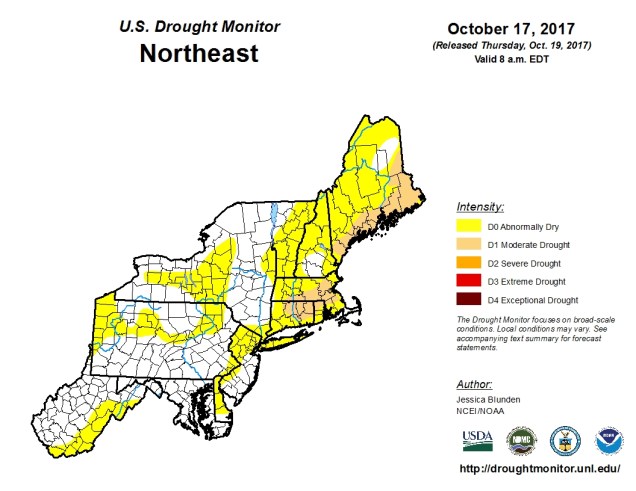
While everyone has been enjoying the extended summer around here, one thing that hasn’t been noticed by many is the recurrence of drought conditions across the region. However, that drought may be on the way out……again.

20171017_Northeast_text
Much of New England has slipped back into Abnormally Dry or Moderate Drought conditions over the past few weeks. Image provided by the US Drought Monitor.


As you may recall, we had a fairly significant drought around here in 2016 and early in 2017. By the end of the winter, the pattern shifted, and we started getting rain…a lot of it. This wiped out the drought across the region by early summer. Everyone’s lawn was green again and once it started getting warm, everyone was happy. Then, the rains essentially stopped again. Since it was dry and warm for the latter half of summer and into fall, nobody really complained that much. Sure, lawns weren’t so green any more, and maybe the foliage wasn’t as spectacular as usual, but it was in the 70s in October for days on end! Well, the pattern is shifting once again.

pp1_today
Heavy rainfall fell across much of New England over the past 24 hours. Image provided by the Northeast River Forecast Center.


The changes already started on Tuesday. Heavy rain and thunderstorms moved slowly across the region. Rainfall totals of 1.5 to 4.5 inches were observed, with the heaviest amounts in the Connecticut Valley. Localized flooding was observed with the heavy rain, but most rivers and streams were running fairly low, so river flooding isn’t a concern at the moment. While all this rain at once isn’t always good, it will help to put a dent in the drought, and eliminate some of the rainfall deficit we’ve accumulated since the beginning of summer.

m3ppct_northeast_sep17
Except for Cape Cod, rainfall has been below to well below normal across most of New England since early July. Image provided by the Northeast Regional Climate Center.


As you may have noticed, the heavy rain of the past 24 hours has pushed offshore, but we’re not done with it yet. A cold front is slowly making its way across the region, and while temperatures will drop back to normal over the next few days, it will bring us more rain today and Thursday. As waves of low pressure ride up the front, they will bring more rainfall into the area, some of it heavy. For the rest of Wednesday, we can expect showers and drizzle, with some occasional bouts of steadier and heavier rain, especially in eastern New England. On Thursday, a stronger wave of low pressure will ride up the front, bringing another round of heavy rain into the region. Once again, the heaviest rain will be focused in eastern areas, with some downpours likely.

us_model-en-087-0_modusa_2017102506_54_519_220
Some of the rain in this map fell during the predawn hours of Wednesday. Still, some heavy rainfall totals are expected across eastern Massachusetts through Friday morning. Image provided by weather.us


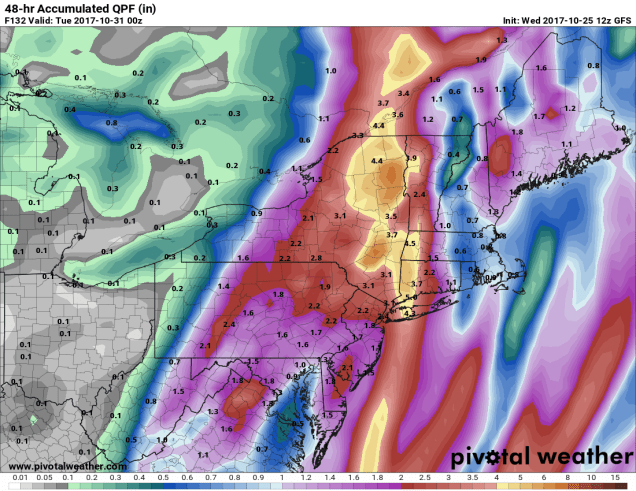
The wave moves out, the front pushes offshore, and high pressure builds in for Friday and Saturday with sunshine and more seasonable temperatures. Meanwhile, another front will be approaching from the west. The storm system responsible for this front will produce the first significant snowstorm of the season from the Dakotas into the Great Lakes over the next few days. (Don’t worry, we’re not expecting any snow here.) Meanwhile, well to the south, there is a disturbance in the western Caribbean that is being monitored for development. It could become a tropical depression by this weekend before heading northward. Whether it develops or not, the system itself will likely get absorbed by the front approaching from the west, adding plenty of moisture. The result is another round of heavy rain across the region Sunday into Monday. Right now, it looks like the heaviest rainfall with this system will be focused on western New England and eastern New York, but given that it’s still 4-5 days away, we’ll keep an eye on this in case anything changes. While we’re expecting less rainfall in eastern areas, some gusty winds are likely, especially along the coastline.

qpf_048h.us_ne
The heaviest rain Sunday into Monday looks to be centered across western New England and eastern New York. Image provided by Pivotal Weather.


Between the rain with the current system, and the rain expected Sunday into Monday, some rivers may see significant rises, with some flooding possible. At the very least, we’ll see additional flash flooding like we saw on Tuesday from the heavy downpours.

Once that system moves out, drier weather moves in for Halloween. For trick-or-treaters, expect clear to partly cloudy skies with temperatures in the upper 40s to middle 50s across the area during late afternoon/early evening hours. Beyond that, it looks like we’ll have another system come through the region Wednesday night into Thursday, though this one should produce lighter rainfall.


Summer Arrives (in the East)! Winter’s Back (in the Rockies)!

The current weather pattern across the country is one that is fairly typical of Spring. However, the results of that pattern are Winter in the Rockies and Summer in the East. In between, there is plenty of severe weather, which is fairly typical of Spring.

US500.20170517.12
A ridge in the East, a trough in the West. Not that uncommon of a pattern. Image provided by College of DuPage.

An upper-level low pressure area will move out of the Pacific Northwest and into the nation’s midsection over the next few days. While one storm system moves into the Upper Midwest today, a second one will develop east of the Rockies and move into the Plains states on Thursday. With cold air moving in behind these systems, and warm, moist air flowing northward from the Gulf of Mexico ahead of them, strong to severe thunderstorms are likely again for the next few days across the Plains states.

day2otlk_1730
Thursday could be a very active day for severe weather in the Central and Southern Plains. Image provided by the Storm Prediction Center.

Severe weather has plagued the Plains states and Great Lakes for the past few days, with over 500 reports of severe weather between Monday and Tuesday. Nearly 30 tornadoes were reported, along with hail as large as softballs, and hundreds of reports of wind damage from gusts as high as 85 mph.


Behind the low pressure area, a late-season snowstorm is expected across the Rocky Mountains. Heavy snow will continue across portions of Montana and Idaho today, spreading into Wyoming and Colorado for Thursday into Friday. Across the higher elevations, totals of 1-3 feet are expected, which will keep the ski season going for a while longer. Snow may also spread into the High Plains of eastern Colorado and western Nebraska, with some minor accumulations possible. In Denver, it looks a couple of slushy inches may fall, though at least 1 model is forecasting much heavier amounts. In a normal year, Denver averages 1.7″ of snow, and the city has seen measurable snow during the month of May in 11 out of the last 16 years, so snow in May is not uncommon, though a heavy snowstorm, if it materializes, would be. Denver has only received 10 or more inches of snow in the month of May 6 times in a 135 years of records, with a record total of 15.5″ set back in May of 1898.

gfs_6hr_snow_acc_cw_13
A late-season snowstorm may drop up to 3 feet of snow in the higher elevations of the Rockies. Image provided by WeatherBell.

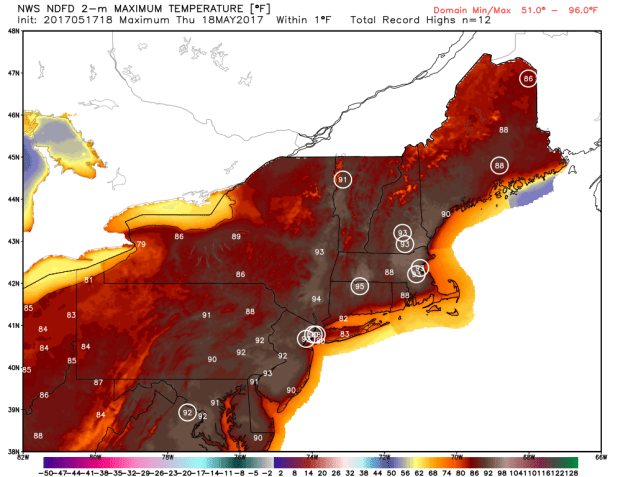
Meanwhile, in the East, an early taste of summer is ongoing, thanks to a ridge of high pressure aloft, and a surface high pressure area off the East Coast. Temperatures soared into the 80s and lower 90s on Wednesday, setting several records, but the hottest day for many locations will be Thursday. High temperatures will climb into the lower to middle 90s in many locations, likely breaking records across much of the region. When you combine the heat with dewpoints well into the 60s, it will definitely feel like a mid-summer afternoon across the region. A cold front will move through the area of Friday, possibly triggering a few showers and thunderstorms, but also sending temperatures back to where they should be in the middle of May.

ndfd_record_hi_neng_2
A lot of record high temperatures may be broken across the Northeast on Thursday. Image provided by WeatherBell.

Mother’s Day Gift Idea – An Umbrella

It’s been a very wet spring across much of the Northeast, and it’s going to get a lot wetter over the next few days.

GrowPNormNRCC
The last 2 months have seen well above normal rainfall across the Northeast. Image provided by Northeast Regional Climate Center.

After experiencing drought conditions for much of the past year, a much wetter pattern has settled in across the Northeast this Spring. Much of the region has received 6-12 inches of rain since the middle of March, which is up to twice the normal amount. As a result, flooding has developed in some places, especially north of the border into portions of Ontario and Quebec. Persistent heavy rains across these provinces has flooded hundreds of communities in the past few weeks.

Instead of relief, it looks like conditions will worsen this weekend. Low pressure will move into the Carolinas on Friday, then off the East Coast on Saturday, slowly moving northeastward over the weekend. Rain and thunderstorms will move across the Mid-Atlantic states on Friday, spreading northeastward during the day.  The rain should reach the New York City area around daybreak Saturday, moving into Southern New England during the afternoon. As the system slows down south of Long Island, heavy rain is likely across portions of the Northeast Saturday night into Sunday. Although the rain will taper off Sunday afternoon, it may not completely end until sometime on Monday as the storm takes it time to depart the region.

gfs_tprecip_neng_18
A lot of rain may fall in a short time across portions of New England this weekend. Image provided by WeatherBell.

While heavy rain and flooding are the main threats with this system, they are not the only threats. As the system intensifies over the North Atlantic, gusty winds are expected, especially along the coastline of New England and Long Island. Sustained winds of 20-30 mph with gusts to 50 mph are likely. These winds will help churn up some rough seas, which may lead to some coastal flooding on Sunday, especially along east-facing shorelines in New England.

500wh.conus
An upper-level low pressure area has remained in place across the Northeast for the past several days. Image provided by Pivotal Weather.

Much of the last week to 10 days has been characterized by cool and damp conditions across the Northeast, thanks to an upper-level low pressure area that has been anchored in placed. That pattern is finally changing, and the result will be welcome news across the region. A ridge of high pressure will build in for much of the upcoming week, which means the clouds and below normal temperatures will be replaced by sunshine and near to above normal temperatures.

500wh.conus (1)

High temperatures across the Northeast have only been in the 50s and 60s for the past several days across much of the region, which is 5 to 10 degrees below normal. By mid-week, temperatures should reach the 70s and 80s across much of the region, which will be 5 to 10 degrees (or more) above normal.

gfs_t2max_neng_30
The GFS model is forecasting summer-like temperatures on Thursday. Will it verify? We’ll see. Image provided by WeatherBell.

Severe Weather in the South Today, but a Bigger Threat Looms for Friday

Severe weather is likely across portions of the Gulf Coast and Mississippi Valley today, but another, perhaps more widespread, outbreak is possible at the end of the week. While that is happening, a snowstorm might also be brewing in the Rockies. Spring can feature a little bit of everything across the nation.

fema06_swody1
Severe weather is expected across portions of the Mississippi Valley today. Image provided by NOAA.

A strong cold front is moving into the Mississippi Valley and Texas this afternoon, and it is helping to trigger strong to severe thunderstorms across portions of the region. Ahead of the front, temperatures are into the 70s and lower 80s, with dewpoints in the upper 60s and 70s, so there’s plenty of warm, moist air in place. Behind the front, temperatures quickly drop into the 40s and 50s. Thunderstorms will continue to develop in the unstable airmass ahead of the front, with some of the storms containing large hail, heavy downpours, damaging winds, and possibly some tornadoes. Earlier this morning, some storms produced baseball-sized hail and wind gusts in excess of 70 mph in portions of Missouri, Arkansas, and Oklahoma. The threat should start to diminish across the region as we head into the overnight hours.


A more significant severe weather outbreak is possible later Friday into Saturday from the Southern Plains and Texas into portions of the Mississippi and Tennessee Valleys. Low pressure will move out of Texas and head northeastward, drawing warm, moist air northward from the Gulf of Mexico once again. North and west of the system, much cooler air will be in place (more on that in a moment).

sbli.us_sc
Lifted index values of -10 and lower across Texas and the Lower Mississippi Valley show that the airmass will be very unstable on Friday. Image provided by Pivotal Weather.
sbcape.us_sc
CAPE values of 4000 J/kg and higher across Texas and the Lower Mississippi Valley show that the airmass will be very unstable on Friday. Image provided by Pivotal Weather.

As low pressure rides along the boundary between the two airmasses, it will help to trigger strong to severe thunderstorms across the region. The threat will continue into the overnight hours Friday night, shifting into the Mississippi and Tennessee Valleys on Saturday as the system continues to progress northeastward. Some of the storms may produce torrential downpours that could trigger flash flooding, large hail, damaging winds, and tornadoes.

gfs_tprecip_mc_21
The GFS model shows the potential for 5-10 inches of rain (or more) in parts of the Mississippi Valley through Sunday. Flooding is likely. Image provided by WeatherBell.

Behind the storm, as colder air settles into the region, a different threat is evolving – heavy snow. While it’s getting late in the season, heavy snow is not uncommon in the Central and Southern Rockies at this time of year. Some of the higher elevations in Colorado and New Mexico could receive 1-2 feet of snow Friday into Saturday. East of the Continental Divide, especially in the High Plains, snow is also possible, especially from eastern Colorado and western Kansas into portions of the Oklahoma and Texas Panhandles. In Denver, there is still a big question as to whether to precipitation falls mainly as rain, snow, or a wintry mix. Some snow accumulation seems likely at this point, but it’s still a little too early to tell whether there will be heavy snow in the city itself. The heavy snow threat will expand into the portions of the Upper Midwest and southern Canada Sunday into Monday as the storm moves into that region.

gfs_6hr_snow_acc_mc_21
GFS model forecast for snowfall in the Rockies and High Plains through Sunday. Winter is definitely not over there. Image provided by WeatherBell.

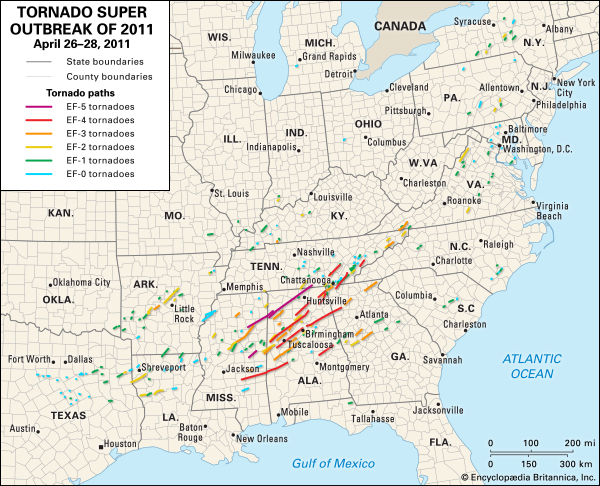
Severe weather outbreaks are not uncommon at this time of year. In fact, from late March into early May is when they are most likely. The largest tornado outbreak on record occurred 6 years ago this week. Between April 25 and 28, 2011, a total of 362 tornadoes were observed from Texas to New York and portions of southern Canada, resulting in 324 fatalities, 317 of them on April 27, the most active day.

149638-004-5B45E68E
Map showing tracks of all 362 tornadoes from the April 2011 “Super Outbreak”. Image provided by Encyclopedia Brittanica.

As for our part of the country – the clouds and rain and cool temperatures will eventually move out. Things will start to improve on Thursday with some sunny breaks possible and temperatures into the 60s. By Friday, there will be more sunshine and temperatures getting into the 70s. Saturday looks like the best day, as temperatures could get into the lower 80s in some spots. We will have to watch out for some late-day showers and maybe a thunderstorm. Sunday looks to be significantly cooler thanks to a northeast wind off of the still-chilly Atlantic.

Out Like A Lamb? Not This Time

March is supposed to come in like a lion and go out like a lamb, or so the old saying goes. Well, it certainly came in like a lion, but now it’s also going to go out like a lion too. Don’t worry, a repeat of the April Fool’s Blizzard in 1997 is not coming, but we do have some snow to worry about across parts of the region.

day1otlk_1300
Looks like an active day for severe weather from the Ohio Valley to the Gulf Coast today. Image provided by the Storm Prediction Center.

The storm that we’ll have to contend with Friday into Saturday is moving into the Midwest today, with plenty of severe weather expected ahead of it. This system has already produced a lot of severe weather from the Southern Plains and Texas into the Mississippi Valley over the past couple of days. Don’t worry, we won’t have to contend with severe weather up here. As the storm heads into the Midwest, it will eventually redevelop off the Mid-Atlantic coastline and pass south of New England late Friday into Saturday. Meanwhile, high pressure will move into eastern Canada, keeping some marginally cold air in place, setting the stage for a return of wintry weather to New England.

We’ll have some snow or rain showers developing Friday morning, but with temperatures in the 30s to lower 40s, we won’t see much, if any, accumulation during the daytime. The sun angle is getting relatively high, so even with the cloud cover, it still is strong enough to prevent much accumulation, at least on paved surfaces.

nam4km.refcmp_ptype.us_ne.2017033012-loop
Forecast for the high-resolution NAM model for the Friday/Saturday storm system. Loop provided by Pivotal Weather.

After the sun sets, things get a lot more complicated. Without the sun, and with temperatures dropping into the lower to middle 30s, along with the heaviest precipitation moving in, we’re looking at a changeover to snow for most places, especially away from the coastline. The problem is, some warmer air looks like it will move in aloft for a while. With a warm layer aloft, the snow that’s falling melts, then starts to refreeze as it moves back into the colder air below that layer. The result is sleet, and possibly a lot of it well inland. This will significantly cut back on snowfall accumulations.

Once we get into Saturday morning, a change to rain is likely for much of the region, but even where it stays mostly snow, we won’t have much additional accumulation, at least on paved surfaces.  A few showers may linger into Sunday as an upper-level storm system moves across the region, then high pressure brings sunshine and seasonably cool temperatures in for Opening Day at Fenway on Monday.

So, how much snow are we looking at? We’ve bumped up amounts a little since yesterday, but nothing significant:

South of the Mass Pike: A coating at most.
Metro Boston: 1-2″
128 Belt: 2-4″
Merrimack Valley: 3-5″
NH Seacoast/North Shore: 3-6″
Southern NH: 4-7″
Worcester Hills/Monadnocks: 5-10″

hires_snow_boston_61
The high-resolution NAM model is probably closest to our thinking for snowfall amounts. Image provided by WeatherBell.

Before you ask, no, this is probably not the last time we’ll see snowflakes this season. It may be the last “snowstorm”, but even that’s not a definite. Remember, we’ve had snowstorms around here into late April and early May before.

March Madness Has Arrived

It’s time for March Madness once again, and we’re not talking about the NCAA Basketball Tournament. No, this time we’re talking about the relentless hype ahead of a March snowstorm. You’d think that we’ve never had a big storm around here in March before with the way the media is reacting. It’s almost as if everyone has forgotten about the storms in 199319972007, and 2013, never mind the ones we’ve had in April (or May).

Well, enough about that, let’s get right to the details of the storm. Low pressure is moving across the Ohio Valley today while a second area of low pressure is starting to develop off the Southeast coast. As the Ohio Valley system weakens tonight, it will transfer its energy to the coastal storm, and then the fun really begins.

The low will move up the coastline tonight into Tuesday and rapidly strengthen. Snow will break out across the region around daybreak Tuesday, and will fall heavy at times from mid-morning into the evening. Snowfall rates of 1-3 inches per hour seem likely. The snow will be accompanied by winds gusting to 40-50 mph at times, even higher near the coast, and especially across Cape Cod. This may create blizzard conditions at times, with significant blowing and drifting snow expected. We’d recommend that you stay off the roads, as travel will be dangerous at best during the daytime hours. The good news is that the storm will be moving relatively quickly, so the snow will taper off in the evening, and end at night.

hires_gust_boston_31
Strong winds will accompany the storm on Tuesday across much of the region. Image provided by WeatherBell.

The big wildcard at this point is the exact track of the storm. Some of the models are trying to indicate that the storm will move across southeastern Massachusetts late in the day, while others keep the storm near or just east of Cape Cod. The farther the storm tracks to the west, the more likely a change to sleet and/or rain becomes across southeastern Mass, possibly as far inland as the I-95 corridor. Obviously, that will have a big impact on snowfall totals.

So, how much snow are we looking at? Well, many in the media have been throwing out amounts like 1-2 feet or some other ridiculous numbers. The fact is, with a storm moving as quickly as this one is (it’s only going to snow for about 12-15 hours), it’s tough to get amounts that high. Our forecast is as follows:

Cape Cod: 3-6″ on the Outer Cape and Islands, 5-10″ closer to the Canal

SE Mass/RI: 6-10″ from I-95 south and eastward, 10-16″ north and west of there.

The remainder of Central & Eastern Mass/N RI/Southern NH/southern ME: 12-18″, with isolated heavier amounts.

sn10_acc.us_ne (1)
GFS model forecast for snowfall through Wednesday evening. This model most closely matches our thinking for snowfall right now. Image provided by Pivotal Weather.


Even though the snow will be winding down Tuesday night, Wednesday won’t be a great day for cleanup. With an upper-level low moving across the region, and the storm itself getting cranked up in Atlantic Canada, it’ll be cloudy, windy, and cold, with scattered snow showers. While there shouldn’t be much additional accumulation. Another inch or two is possible in a few spots.