The heat and humidity continue to start the week, but relief is on the way.
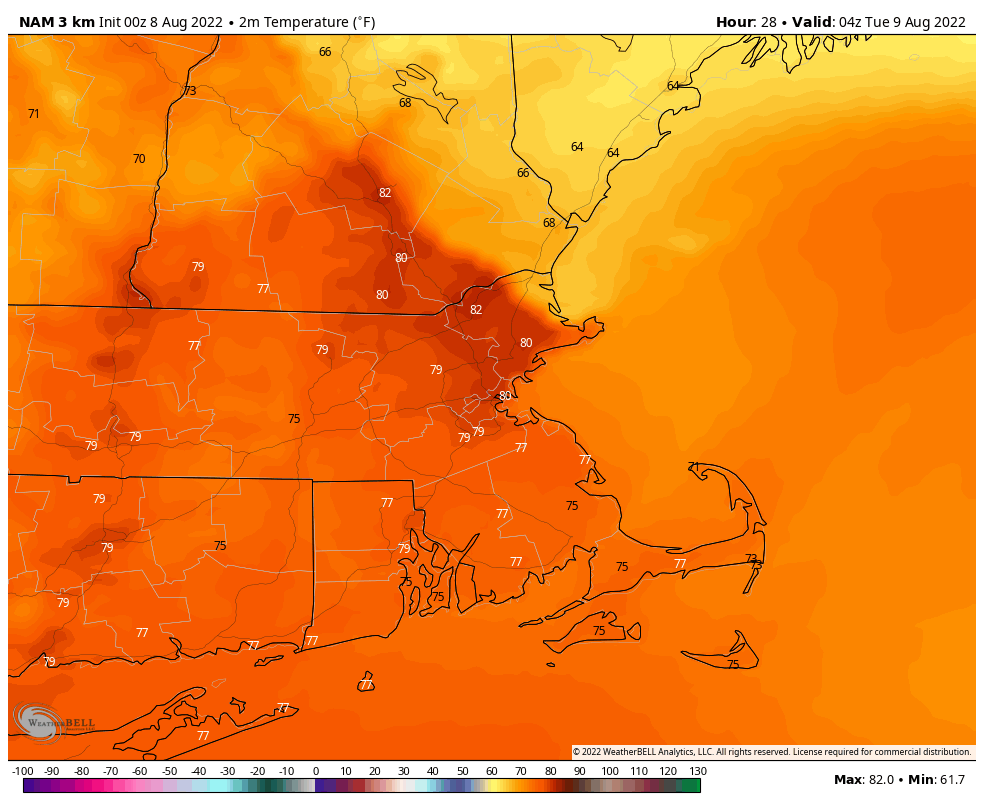
High pressure remains in place off the East Coast, which means heat and humidity continue into Tuesday. Temperatures likely top 90 for many areas both days, with very humid conditions likely. There is the possibility of a little relief for the coast of Maine, New Hampshire Seacoast, and possibly northeastern Massachusetts. Some models show the potential for a backdoor cold front to drop down into these areas later today and into tonight, bringing some cooler air in. The front likely doesn’t make it past Cape Ann, and should start to retreat northward before daybreak on Tuesday, but a few hours of relief are possible.
A backdoor cold front may drop temperatures into the 60s along the coast of Maine, New Hampshire and extreme northeastern Massachusetts this evening. Image provided by WeatherBell.
We’ll see some pop-up showers and thunderstorms again this afternoon, but they’ll probably be a bit more widespread on Tuesday as a cold front approaches the region. That front will stall out near or just south of the region for Wednesday into Thursday, allowing cooler air to finally move in, but it will likely remain on the humid side. A wave of low pressure will ride along the front, bringing in some showers and thunderstorms late Wednesday into Thursday. This big question is, where does the front stall out? If it’s near the South Coast, as most of the models show, then we could see some beneficial rainfall finally fall, especially south of the Mass Pike. If it stalls out offshore, then the beneficial rain may be confined to the South Coast. Recent history suggests that the latter scenario is more likely, despite the majority of the models forecasting the former, so even though our forecast is calling for showers and thunderstorms, we’re not expecting either day to be a washout.
Some beneficial rain is possible this week, but how much and where the heaviest rain falls is still up for debate. Images provided by Pivotal Weather.
The end of the week and the weekend is even trickier. Some models are showing the potential for low pressure to develop off the Mid-Atlantic or Carolina coast and head northward or northeastward, potentially having some impact here. Given the time of year, and the fact that the water off the East Coast is fairly warm, we wouldn’t be shocked if the National Hurricane Center tries to slap a name on this system if it develops, whether it truly is tropical or not. Whether the system is tropical or not (if it even develops) it appears as though we could be in a period of cool and wet weather, or the models could completely change their tune tomorrow and bring the heat and humidity back. They’ve been pretty unreliable beyond 3 days or so, so at this point, we’re going to lean toward a dry forecast, because as the old saying goes “when it drought, leave it out”. That’s why we do a Weekend Outlook on Thursday afternoons, because we’ll be 3 days closer to the weekend and should have a better idea of what is going on.
Several members of the GFS Ensemble show the potential for low pressure off the East Coast next Saturday, Image provided by Weathermodels.com
Speaking of the tropics, it appears as though the Atlantic is starting to awaken, right on time. It’s been 5 weeks since we had “Tropical Storm Colin” (which was really just a big thunderstorm near the Carolina coast, but we digress), and June/July are usually fairly quiet. Activity usually starts to ramp up in August, with the peak of the season coming around September 10. Tropical waves have been rolling off the coast of Africa every few days for the past few weeks, but none of them have amounted to much, as Saharan dust has been inhibiting the thunderstorm development. That appears to be changing. A tropical wave moved off the coast of Africa on Sunday, and even though it is disorganized right now, conditions will be favorable for development over the next few days. As it moves across the Atlantic, it could become a tropical depression toward the middle of this week. If it does develop, chances are that it probably wouldn’t be a strong storm, and it may never be a threat to land. No matter what, we’ll be paying attention and following closely.
We’re keeping our eyes on a system in the eastern Atlantic. Image provided by HurricaneIntel.com
Monday: Partly to mostly sunny, breezy, showers and thunderstorms develop in the afternoon. High 90-97.
Monday night: Partly cloudy. Low 72-79, possibly cooler along the coast from Cape Ann northward.
Tuesday: Some morning sun, then increasing clouds with showers and thunderstorms likely in the afternoon. High 91-98.
Tuesday night: Partly to mostly cloudy, showers and storms taper off in the evening. Low 64-71.
Wednesday: Plenty of clouds and much cooler with more showers possible during the afternoon and at night. High 76-83.
Thursday: Clouds and some sunny breaks with more showers possible, especially in the morning. High 75-82.
The first weekend of meteorological summer has arrived, and although it won’t feel like summer on Friday, the rest of the weekend should. Meanwhile, the first tropical system of the season is expected to impact Florida.
Moderate drought conditions are developing across parts of southeastern New England. Image provided by the National Drought Mitigation Center.
An area of showers will move across the region tonight, ending towards midday Friday. This is good news, because we really need the rain, as drought conditions are developing across the region. Clouds will hang tough for most of the afternoon, keeping temperatures on the cool side for one more day, but some breaks if sunshine may develop in the afternoon. Skies clear out Friday night, but a cold front will move across the region on Saturday. It will generate some additional clouds, but only a sprinkle or two is expected. After that, high pressure builds in for Sunday and Monday with dry and seasonably warm conditions.
Potential Tropical Cyclone One will impact parts of Cuba, Florida, and the Bahamas on Friday and Saturday. Image provided by the National Hurricane Center.
Meanwhile, it appears as though the first tropical system of the season is developing in the southeastern Gulf of Mexico. Potential Tropical Cyclone One was centered about 80 miles north-northwest of Cozumel, Mexico this evening, moving toward the north at 5 mph. The system still had a broad circulation, and conditions aren’t that favorable for development, but many of the models do insist that it will develop into a tropical depression and eventually Tropical Storm Alex over the next 12-24 hours. As a result, tropical storm watches have been issued for parts of western Cuba, central and southern Florida, and the northwestern Bahamas. The system should head northeastward, crossing Florida on Saturday. Gusty winds and a minor storm surge will be threats with this system, but the main threat, whether it develops or not, is heavy rainfall. Rainfall totals of 5-10 inches and heavier are likely across western Cuba, southern Florida and the northwestern Bahamas over the next few days, leading to flooding in many areas. Across central Florida, rainfall totals of 2-6 inches will likely produce flooding as well. We’ll likely post an updated blog on just this system on Friday if it does develop.
Heavy rain will produce flooding across southern Florida and the Bahamas this weekend. Image provided by Weathermodels.com
Thursday night: Cloudy with showers likely. Low 50-57.
Friday: Showers end in the morning, some sunny breaks develop during the afternoon. High 64-71, a little cooler near the coast.
Friday night: Gradual clearing. Low 51-58.
Saturday: Sunshine and a few clouds, very slight chance for a sprinkle. High 72-79.
Saturday night: Clear skies. Low 48-55.
Sunday: Mostly sunny. High 70-77.
Sunday night: Mostly clear. Low 49-56.
Monday: Sunshine and some afternoon clouds. High 71-78.
For the first time since 2014, we made it to the official start of Hurricane Season without having a named storm already develop.
Satellite photo for each of the 21 named storms that developed during the 2021 Hurricane Season, Image provided by NOAA.
2021 featured another very active season, with a total of 21 named storms (we’re still skeptical on at least a few of them), making it the 3rd most active storm on record. Only one storm, Ida, had its name retired. Ida slammed into Louisiana as a Category 4 storm, inflicting more than $60 Billion in damage and resulting in 55 deaths. Here in New England, we had 2 tropical storms make landfall last season. Both Elsa and Henri each made landfall near Westerly, Rhode Island about 6 weeks apart. This is just the 5th time since 1851 that two tropical systems made landfall in Southern New England or Long Island in the same year, and only the 2nd time (1961 being the other), that both storms were only tropical storm strength. (We’ll have more info on New England tropical systems a little later in this post)
2021 was another very active hurricane season. Image provided by the National Hurricane Center.
It looks like another active season is expected this year. NOAA issued their seasonal hurricane outlook on May 24, and it calls for a 65 percent chance for an above normal season, a 25 percent chance for a normal season, and a 10 percent chance for a below normal season. Many of the other hurricane outlooks issued by various outlets are also expecting a busy season, due to a number of factors. An average season consists of 14.4 named storms, of which 7.2 become hurricanes and 3.2 become major hurricanes (Category 3 or higher on the Saffir-Simpson scale). NOAA’s forecast for this season calls for 13-20 named storms, 6-10 hurricanes, and 3-5 major hurricanes. The Tropical Meteorology Project at Colorado State, the first group to forecast how active a hurricane season would be, originally led by Dr. Bill Gray, will issue their updated forecast on June 2. Their initial forecast from April called for 19 named storms, 9 hurricanes, and 4 major hurricanes. They also pegged the chance at a storm making landfall in the United States at 71% (52% is the average in any given year), and the odds of a storm making landfall along the East Coast at 47% (31% is the average). The last 7 seasons have all featured above normal activity across the Atlantic.
List of names for storms that form during the 2022 Hurricane Season. Image provided by NOAA.
Despite the early start for the past several years, the average date for the first named storm in the Atlantic is still June 20, and the average date for the first hurricane is August 11. Over 97% of all named storms in the Atlantic form between June 1 and November 30. Most early season storms tend to be on the weaker side. A hurricane hasn’t made landfall in the United States before July 1 since Hurricane Bonnie came ashore as a minimal hurricane near the Texas/Louisiana border on June 26, 1986.
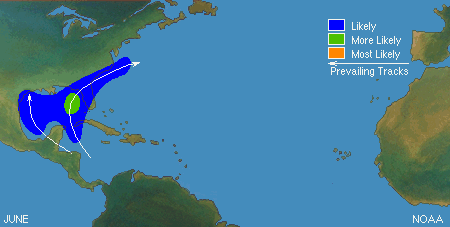
Based on climatology, the most likely spots for an early season storm are in the Gulf of Mexico or northwest Caribbean. Image provided by the National Hurricane Center.
A busy season does not always mean that multiple storms (or any storms for that matter) will impact the United States, though 2020 saw much of the Gulf Coast and East Coast threatened by tropical systems. In 2010, 19 named storms were observed in the Atlantic, 12 of them became hurricanes, and 5 were major hurricanes. Only one storm made landfall in the United States, and that was Bonnie, which was a minimal tropical storm at landfall. In 1990, there were a total 14 named storms, 8 of them hurricanes and 1 major hurricane. Not a single one of them made landfall in the United States. On the flip side, an inactive year doesn’t mean much for landfall probabilities as well. Only 7 named storms formed in 1992, and the 1st one didn’t develop until August 16. That storm, however, was named Andrew, and it made landfall just south of Miami as a category 5 storm. It only takes one storm to ruin your entire year.
Here in New England, we should always pay attention when a storm is nearing the Bahamas, as those are the ones that have the potential to impact us, and we are very overdue for a hurricane to head this way. Using data back to 1851, here are some stats that show how overdue we are:
Since 1851, 39 storms of tropical storm strength of greater have made landfall in New England or Long Island, an average of one every 4.4 years. The longest we’ve ever gone without one is 11 years, between 1897 and 1908 and also between 1923 and 1934. Last year, we had two tropical storms (Elsa and Henri) make landfall in the region.
Since 1851, 32 strong tropical storms (maximum sustained winds of 60 mph or more) have made landfall in New England or Long Island, an average of one every 5.3 years. The longest we’ve ever gone without one is 19 years, between 1897 and 1916. Last year, we had two strong tropical storms (Elsa and Henri) make landfall in the region.
Since 1851, a hurricane has made landfall in New England or Long Island 18 times, an average of one every 9.5 years. The longest we’ve ever gone between hurricane landfalls is 38 years, between 1896 and 1934. It’s been 31 years since Bob, our 2nd longest drought on record.
Since 1851, 8 hurricanes of Category 2 intensity or stronger have made landfall in New England or Long Island, an average of one every 21.4 years. The longest we’ve gone between hits by storms of that intensity is 69 years, between 1869 and 1938. We’re at 31 years since Bob, the last one to do so.
Since 1851, New England/Long Island has had 3 Major Hurricanes (Category 3 or higher) make landfall – an unnamed storm in October of 1869, the infamous 1938 Long Island Express, and Hurricane Carol in 1954. That’s an average of 1 every 57 years, and the longest time between 2 major hurricanes is 69 years (1869-1938). We’re at 67 years since Carol. There are also 3 documented storms from before 1851 – The Great Colonial Hurricane of 1635, the 1815 New England Hurricane, and the Norfolk and Long Island Hurricane of 1821. That’s it. That changes the numbers to 6 in 387 years, or one every 64.5 years, with a longest drought of 180 years.
Satellite photo of Hurricane Bob approaching New England. Bob was the last hurricane to make landfall in New England – 27 years ago. Image provided by NOAA.
We all saw what Sandy did in 2012, and that was a minimal hurricane that eventually made landfall in southern New Jersey (technically as an extratropical storm). When (not if) the next big storm comes up the coast, much of this region will not be prepared for the storm or its aftermath.
The Atlantic is quiet right now (more on that in a moment), but even if something were to form off the East Coast in the next few weeks and head this way, the waters off of New England are much too cold to sustain a tropical system, so we’d see something more like a typical nor’easter. Only two tropical storms have ever made landfall in the Northeast before the end of June. The first was an unnamed minimal tropical storm that crossed extreme eastern Long Island and went into southeastern Connecticut on May 30, 1908. The other was Tropical Storm Agnes, which made landfall near New York City on June 22, 1972, then caused devastating flooding across parts of the Mid-Atlantic states. In terms of hurricanes, the earliest one to ever make landfall up this way was Hurricane Belle, which slammed into Long Island with 90 mph winds on August 9, 1976. We did have Hurricane Arthur pass just offshore of Nantucket on July 4, 2014. While it did not make landfall, it made for a rather wet and cool holiday, especially across Cape Cod and southeastern Massachusetts. Statistically, the most likely time for a hurricane to hit New England is between the middle of August and late September. Of the 18 hurricanes that made landfall in New England or Long Island since 1851, 15 of them have done so between August 19 and September 27.
The most likely time for a tropical system to impact our area is August of September. Image provided by the National Weather Service office in Norton, MA.
As always, you should get your weather information from a trusted source, especially when dealing with tropical systems. Much like with snowstorms in the winter, there will be plenty of hype and exaggeration on Twitter and Facebook, as well as people posting doom and gloom maps showing how a thunderstorm near the coast of Africa will develop into a Category 5 storm and head right for the East Coast in the next 2 weeks. We’re not among that group, we give you facts and our best forecasts, without any hype. If there’s reason to worry, we’ll let you know with plenty of advance warning. It’s always best to prepare ahead of the season. Chances are, you won’t have anything to worry about, but in case you do, it’s always good to be prepared, as we’ve learned recently.
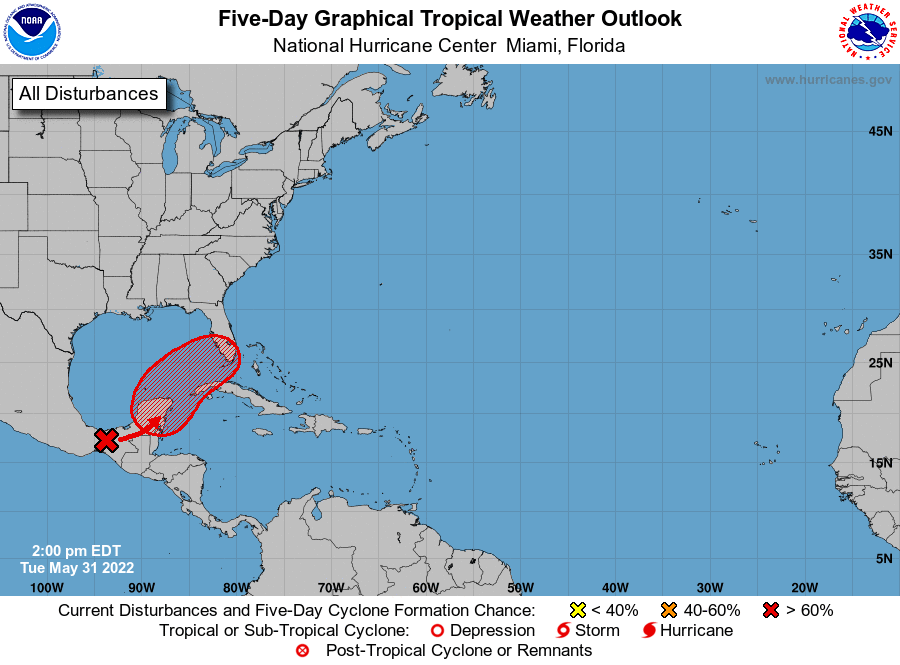
Could a tropical depression develop later this week in the southeastern Gulf of Mexico? It’s possible. Image provided by the National Hurricane Center.
There is something we’re keeping an eye on as hurricane season begins. Hurricane Agatha made landfall on the Pacific side of Mexico yesterday. It will dissipate today or tomorrow, but what’s left of it will drift towards the Yucatan Peninsula and then likely the southeastern Gulf of Mexico As it does so, conditions could be favorable for it to become a new tropical depression toward the end of the week. Whether it does or doesn’t develop, it will bring some heavy rain to parts of Florida, Cuba, and the Bahamas this weekend.
As we enter the climatological peak of Hurricane Season, the Atlantic is getting active again.
The Atlantic is getting active again. Image provided by the National Hurricane Center.
The main focus right now is Tropical Storm Nicholas, centered about 105 miles south of Port O’Connor, Texas, moving northward at 12 mph. Maximum sustained winds are near 60 mph. A Hurricane Watch, Tropical Storm Warning, and Storm Surge Warning are all in effect for much of the Texas coastline. The good news is that Nicholas doesn’t have too long to strengthen, as landfall is likely along the Texas coastline this evening. The bad news is that it will be a prolific rain-maker for Texas (and Louisiana). Rainfall totals of 8-16 inches and locally heavier will produce widespread flooding across the region, including the Houston metropolitan area.
Very heavy rain is likely in southeastern Texas and Louisiana this week, Image provided by Weathermodels.com
While heavy rain and resultant flooding are the main threat with Nicholas, they aren’t the only threat. Tropical Storm force winds are already impacting the Texas coast, and will continue into tonight. With Nicholas expected to be close to hurricane strength at landfall, wind gusts may exceed 70 mph along the coast. Storm surge is the other concern. A surge of up to 5 feet is possible near and just to the right of where the center makes landfall. This will result in coastal flooding, in addition to the freshwater flooding that the heavy rain will produce.
Nicholas is the only active system in the Atlantic right now, but it’s not the only system that we’re keeping an eye on. A tropical wave that just moved off the coast of Africa is disorganized right now, but should move into an area of favorable conditions as it continues westward this week. It could become a tropical depression toward the latter half of the week, but it is still at least a week away from impacting any land areas, if it ever does. We’ve got plenty of time to watch this one as it makes its way westward.
Forecast tracks from the various members of the GFS Ensemble for the system that just moved off of Africa. Image provided by Weathernerds.org
A little closer to home, we need to keep our eyes on the Bahamas. Many of the forecast models are showing the potential for a cluster of storms near the Bahamas to interact with a tropical wave, and organize into a low pressure area later this week. Most of these models keep the system fairly weak, but it could become a tropical depression or even a weak tropical storm as it makes its way northward over the warm waters of the Gulf Stream. At the very least, it should bring some rainfall to parts of the East Coast, but there’s a chance that the leftover moisture from Nicholas could be infused into the system, which would enhance the rainfall with the system. We’ll have to watch this system to see if it develops, and if so, how it develops, to get a better idea of what, if any, impact if will have on the East Coast.
Much of the East Coast is clear (aside from some smoke) today, but the cluster of storms near the Bahamas should be watched. Loop provided by NOAA.
Typhoon Chanthu continues to slowly weaken in the Western Pacific. After grazing Taiwan over the weekend it has moved northward, but has slowed down off the eastern coast of China, just east of Shanghai. It is expected to resume moving northeastward on Tuesday while continuing to weaken, passing near or just south of South Korea on Wednesday as a tropical storm. Gusty winds and heavy rain are expected, especially in southern portions of South Korea.
Forecast track for Typhoon Chanthu. Image provided by the Korean Meteorological Administration.
Finally, we’ll leave you with this. Former Hurricane Larry remains a powerful storm near Greenland at this time. Over the weekend, it dropped up to 4 feet of snow on the island, and more is falling today. It is already beginning to impact Iceland, where winds have gusted to 46 mph at Reykjavik today. We may be at the peak of hurricane season, but the fall and winter are not far away for those of us in the Northern Hemisphere.
Former Hurricane Larry is burying Greenland with heavy snow and will impact Iceland over the next day or two. Loop provided by NOAA.
5:00 PM – We’re shutting down the live coverage for the day. Our Weekly Outlook will be published as usual early Monday morning, where we’ll have more info on the remains of Henri and the rainfall threat across eastern New England. Thank you for following along today!
4:55 PM – All coastal warnings have been discontinued. Tropical Storm henri now has 40 mph sustained winds and is centered about 20 miles southeast of Hartford, Connecticut, moving toward the west-northwest at 7 mph. Winds are still gusting to 30-40 mph in spots, mainly along the coast, but they should continue to diminish over the next few hours.
At this point, the forecast remains unchanged. What’s left of Henri will eventually stall out over western New England, then what’s left will head eastward across central New England on Monday. Heavy rain continues tonight from northern New Jersey and eastern New York into western New England, gradually shifting eastward on Monday. Rainfall totals of 5-10 inches are likely in parts of Connecticut, western Massachusetts and eastern New York, with some totals of up to 12 inches in northern New Jersey. Flooding will be spread spread across this area. On Monday, rainfall totals of up to 2 inches are possible from eastern Massachusetts into southern New Hampshire and southern Maine.
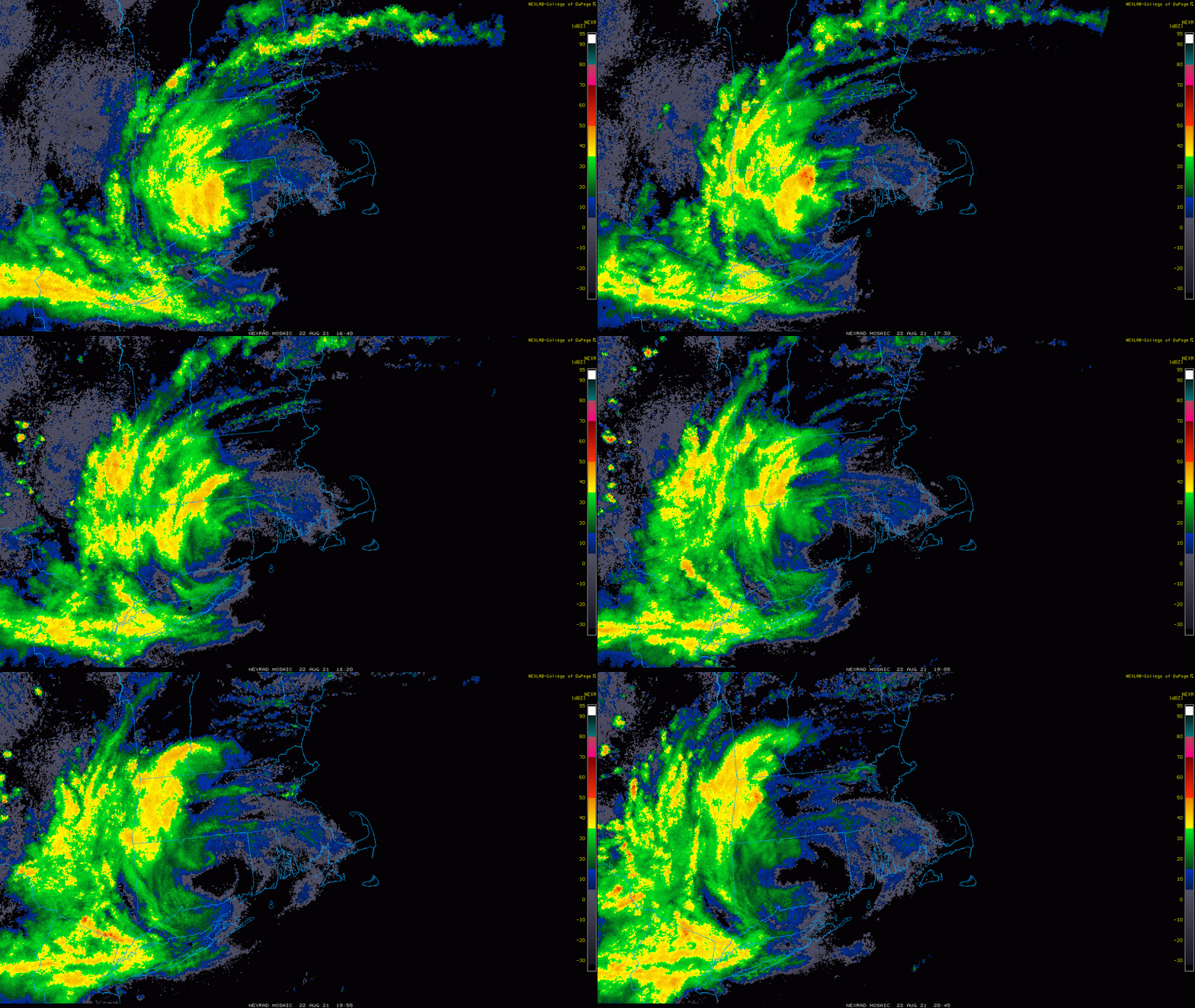
Radar loop of Tropical storm Henri. Loop provided by the College of DuPage.
3:15 PM – As Henri continues to push into Connecticut, if you’re in eastern Massachusetts you wouldn’t even know that there’s a tropical storm centered 100 miles to the west. Some breaks of sunshine are developing, and temperatures are in the 70s. It’s still quite breezy, in fact Blue Hill Observatory recently had a wind gust to 47 mph, but otherwise, it’s just a warm, humid, and breezy afternoon. The rain will move back into this region on Monday as what’s left of Henri heads eastward.
Satellite loop showing Henri making landfall in RI and then heading into CT while some breaks of sun develop in eastern MA. Loop provided by the College of DuPage.
2:00 PM – Henri continues to push inland and weaken. It is now centered over southeastern Connecticut and is moving toward the northwest at 9 mph. Maximum sustained winds are down to 50 mph, and additional weakening is expected for the rest of the day. Wind gusts of 30-40 mph are still being observed along the coasts of Rhode Island and Massachusetts, but they should subside over the next few hours. Heavy rain continues to push across much of Connecticut and western Massachusetts. Flash Flood Warnings are in effect for a good portion of the region.
The heavy rain continues to push into Connecticut and western Massachusetts. Loop provided by Weathermodels.com
12:15 PM – Henri has officially made landfall close to Westerly, RI with maximum sustained winds near 60 mph. There have been several reports of wind gusts of 60-70 mph along the coast of Rhode Island and Massachusetts already. Winds are still gusting as high as 45-55 mph or more in places. We’ve passed the morning high tide, and with the center moving inland, the water levels should start to subside through the afternoon as the tide rolls out. There is still a concern for some coastal flooding during the high tide cycle this evening. Wind damage will still be a concern though the afternoon from southeastern Massachusetts across Rhode Island and into eastern Connecticut.
At this point, the concern shifts to heavy rain. Additional rainfall totals of 3-6 inches and locally heavier are likely over the next 24 hours across Connecticut, eastern New York, and western Massachusetts. As what’s left of the storm drifts eastward on Monday, some heavy rain is possible in parts of southern New Hampshire and Massachusetts.
Concern now shifts to heavy rain across parts of the region. Image provided by WeatherBell.
11:30 AM – Looks like Henri is just about to make landfall along the southern Rhode Island coast. A wind gust to 70 mph was reported in Point Judith, RI, with an unofficial report of a gust to 76 mph on a hand-held anemometer in Point Judith.
Radar shows Henri’s center just about at the Rhode Island coast. Loop provided by WeatherTap.
11:00 AM – Tropical Storm Henri now has maximum sustained winds near 60 mph. After crossing Block Island, Henri is centered about 15 miles east of Montauk, NY, moving toward the north-northwest at 12 mph. Landfall is expected along the Rhode Island coast in the next few hours. Tropical Storm Warnings remain in effect from central Long Island to Cape Cod. A sustained wind of 51 mph with a gust to 69 mph was reported in Point Judith, RI within the past few minutes.
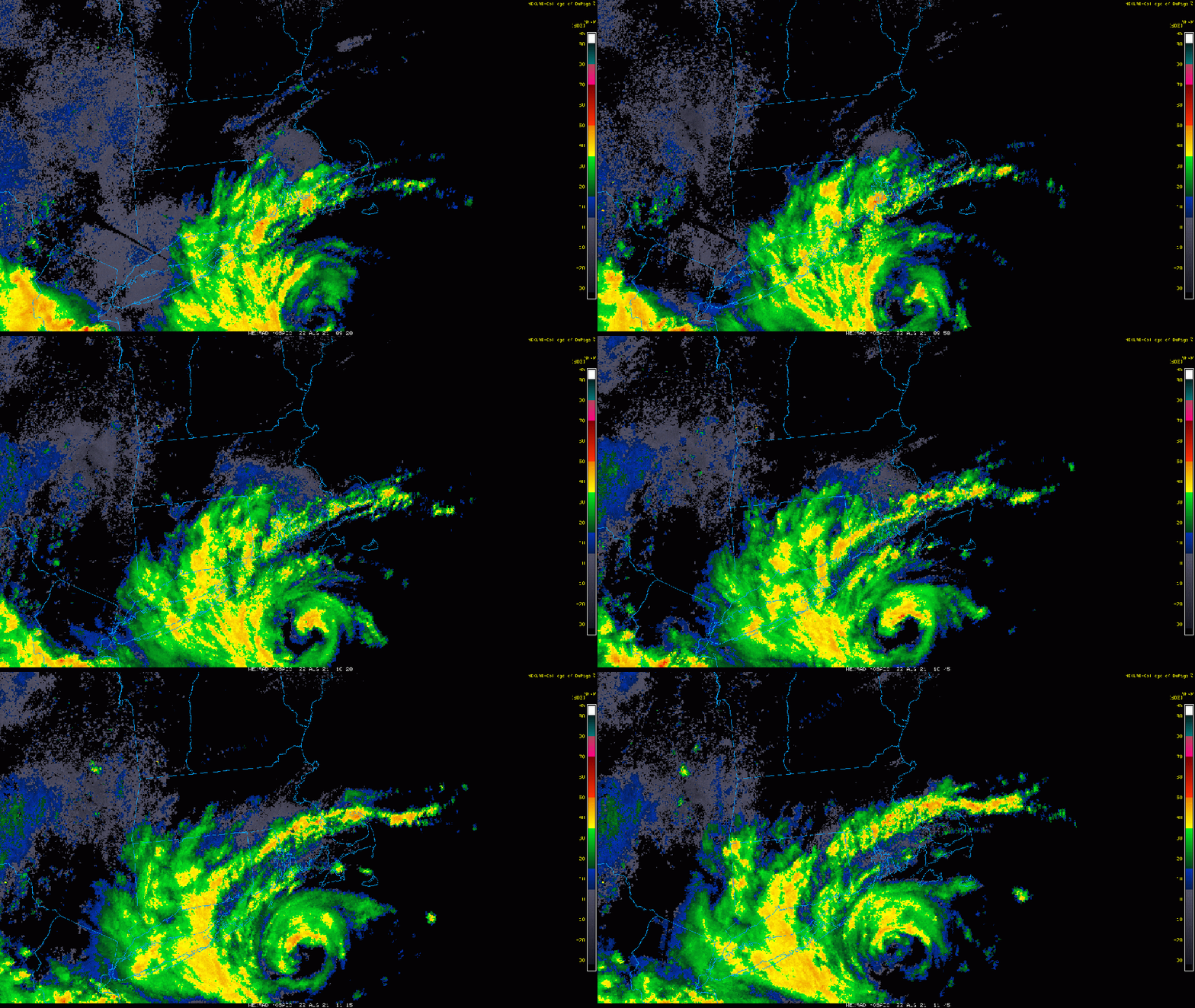
Radar shows Henri taking on the classic signature of a tropical system impacting New England with most of the rain to the left of the center. Loop provided by Weathermodels.com
Once inland, Henri will continue northwestward while rapidly weakening, stalling out overnight, before heading eastward on Monday. Heavy rain will continue across parts Connecticut, eastern New York, and western Massachusetts tonight, shifting into parts of southern Vermont, southern New Hampshire, northern Massachusetts and southern Maine on Monday. Flood Watches are in effect for parts of this region.
10:35 AM – The pressure has started dropping on Block Island again, and has now bottomed out at 989mb but is starting to rise a bit. Sustained winds of 44 mph have been recorded on the island recently. There are also an increasing number of wind damage reports showing up from the south coast of both Rhode Island and Massachusetts.
Once Henri finally pulls away on Monday – hot and humid weather will return for a few days as the cleanup begins. High temperatures will be well into the 80s with some lower 90s possible.
Warm to hot and humid weather returns for Tuesday through Thursday. Image provided by weathermodels.com
10:10AM – The pressure appears to have bottomed out at 992mb on Block Island. Meanwhile, in Massachusetts, a wind gust to 62 mph was reported in Westport. A coastal flood advisory has also been issued for the east-facing shoreline of the Bay State. A storm surge of 1-3 feet on top of the astronomical high tides will result in some flooding today, especially the high tide around midnight tonight, and in the usual places such as Scituate and Morrissey Boulevard in Dorchester.
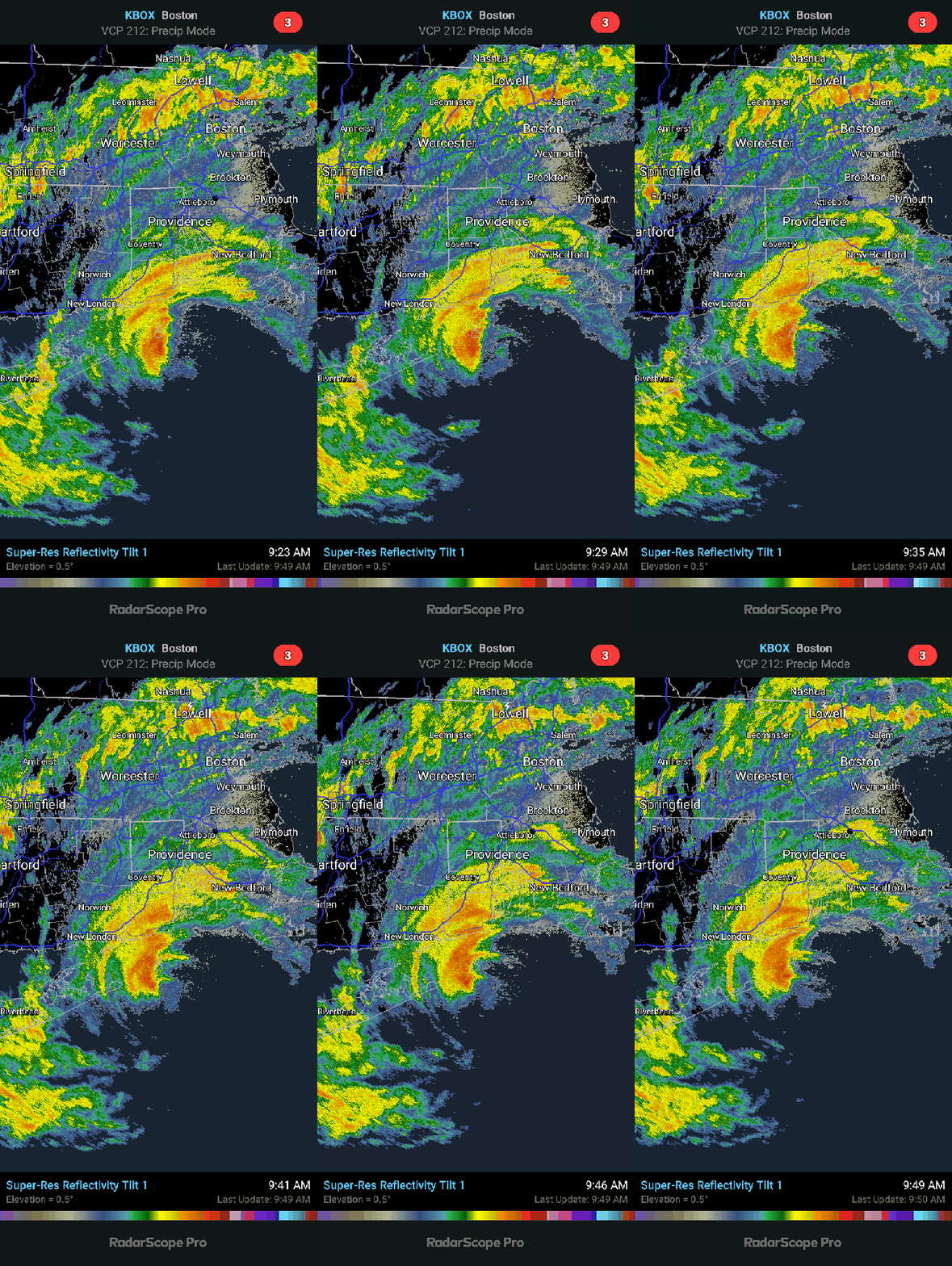
9:50 AM – The center of Henri is moving across Block Island. Sustained winds as high as 50 mph and a peak gust to 68 mph have been reported from the island.
Radar shows the center moving across Block Island. Loop provided by RadarScope
9:30 AM – A wind gust to 63 mph has been reported on Block Island. The initial outer band moved across Southern New England over the past few hours, producing up to 0.75″ of rain in a short period with some wind gusts to 20-30 mph. This pales in comparison to the band that moved across New York City last night that produced flooding across the Tri-State area.
In addition to being the wettest day since 2014… the 1.94" of rain that fell from 10pm to 11pm at Central Park last night was the wettest hour on record for New York City.
More rain fell in that one hour than any other since record keeping began. #Henri#NYCwx
9:00 AM – Tropical Storm Henri is now centered about 70 miles south of Providence. Maximum sustained winds have decrease to near 65 mph as Henri continues to weaken over colder waters. Water temperatures south of New England are 21-24C, well below the 27C threshold that tropical systems need to sustain themselves. Sustained winds of 47 mph and a wind gust to 59 mph have been reported on Block Island. The airport in Block Island is reporting North-Northeast winds at 33 mph with a gust to 55 mph. The automated station at the entrance to Buzzards Bay is reporting sustained winds of 47 mph with a gust to 58 mph. Note – the anemometer for this station is at 25 meters above the sea, while the standard anemometer height is 10 meters, so winds will read a bit stronger than at sea level.
8:00 AM – Tropical Storm Henri is centered about 75 miles south of Providence, Rhode Island, moving toward the north-northwest at 16 mph. Maximum sustained winds have decreased to near 70 mph. Tropical Storm conditions are already spreading across southern New England and Long Island.
Henri’s bands are spreading across southern New England while the center shows up on radar to the south. Loop provided by the College of DuPage.
Wind gusts of 15-30 mph are already common across the region, with some gusts to 50 mph reported in southern Rhode Island. All Hurricane Warnings have been discontinued, but Tropical Storm Warnings remain in effect across the region.
Peak wind gusts expected across the region. Image provided by the National Weather Service office in Norton, MA
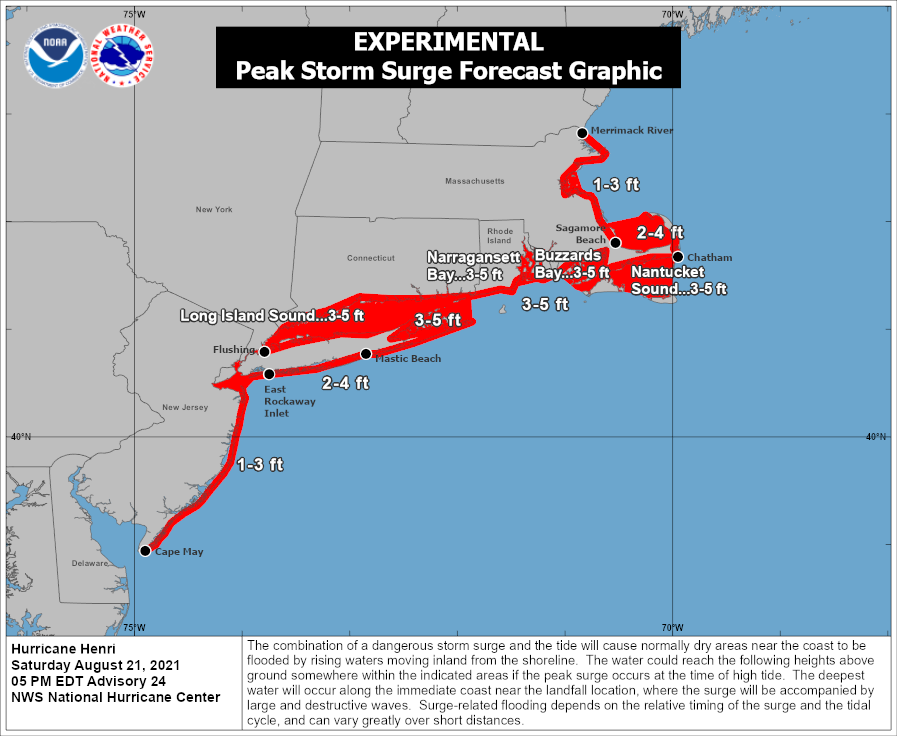
Henri should continue northward, likely making landfall in southern Rhode Island by early afternoon. Once inland, it will rapidly weaken, with heavy rain continuing west of the track, and gusty winds with occasional showers east of the track. There is also the threat for a few tornadoes east of the track. Along the coast, a storm surge of 3-6 feet is expected on top of astronomical high tides. Luckily, the high tides are this morning, with low tide in the middle of the afternoon, which will help offset the surge a little.
A storm surge of 3-5 feet is still expected along the coast. Image provided by the National Hurricane Center.
This will be only the 5th time since 1851 that New England/Long Island has had 2 landfalling storms in the same year, and only the 2nd time that both storms were tropical storm strength only:
1985 9/24 Tropical Storm Henri 9/27 Hurricane Gloria (Category 2)
2021 7/9 Tropical Storm Elsa 8/22 Tropical Storm Henri
Counting Elsa, 37 storms have made landfall in Long Island or New England as a tropical storm or stronger – an average of one every 4.6 years. The longest we’ve ever gone without a direct hit from a storm of tropical storm strength or stronger is 11 years, between 1897 and 1908, and again between 1923 and 1934. Elsa’s landfall earlier this year ended a 10-year drought without a landfalling storm.
Hurricane Henri continues to move up the East Coast with eastern Long Island or Rhode Island apparently in its sights for Sunday.
Satellite loop of Hurricane Henri. Loop provided by NOAA.
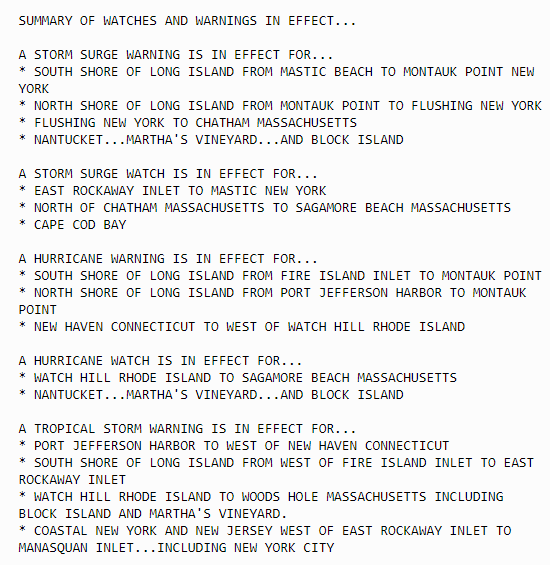
Henri strengthened into a hurricane this morning with maximum sustained winds near 75 mph. As of 5pm it was centered about 335 miles south of Montauk Point, Long Island, moving toward the north-northeast at 18 mph. A hurricane warning is in effect across central and eastern Long Island, and along the south coast of New England from New Haven, CT to Westport, MA, including Block Island. A Tropical Storm Warning is in effect west of New Haven to Manasquan Inlet, NJ, including western Long Island and New York City. A Tropical Storm Warning is also in effect east of Westport, MA to Chatham, MA, including Nantucket and Martha’s Vineyard. A Storm Surge Warning in effect from Flushing, NY to Chatham, MA, including most of Long Island, Block Island, Martha’s Vineyard, and Nantucket.
Forecast track for Hurricane Henri. Image provided by the National Hurricane Center.
There is a little more confidence in the forecast this afternoon, but still some some uncertainty. Henri is being steered north-northeastward by a ridge of high pressure to its east and a developing upper-level low over the Mid-Atlantic states. With less wind shear and warmer waters beneath it, Henri may strengthen a bit more over the next 6-12 hours while continuing northward. At that point, the question becomes – does Henri feel the influence of the upper-level low and bend northwestward, or does it continue off to the north? This will have significant implications to where it makes landfall and what conditions we can expect across the region. The current forecast from the National Hurricane Center has landfall Sunday afternoon near Montauk just below hurricane strength. The forecast models have shifted eastward a bit today, showing landfall anywhere from Central Long Island to as far east as Cape Cod. However, over the past 18 hours, the forecast models have trended a bit more to the east. Right now, our thinking is that landfall will be somewhere between extreme eastern Long Island and Narragansett Bay Sunday afternoon. With Henri weakening over colder waters as it approaches the coast, it will likely be a strong tropical storm at landfall, though there is a chance it could still be a minimal hurricane.
There is still a wide range of landfall possibilities among the various members of the GFS and ECMWF Ensembles. Image provided by Tomer Burg.
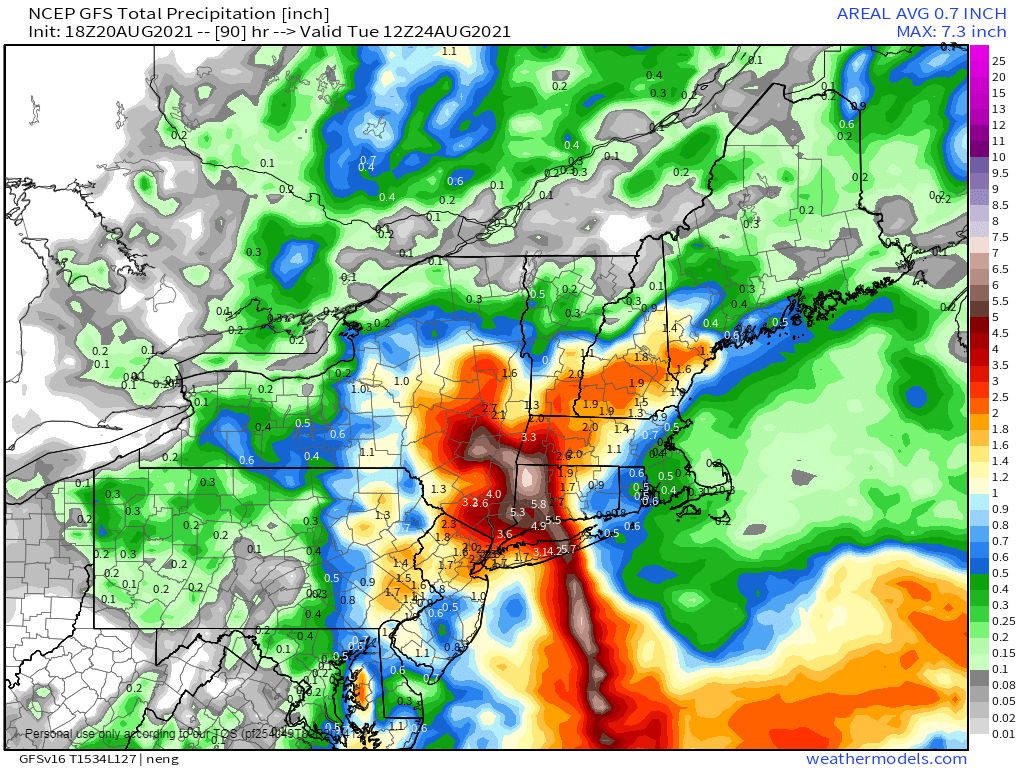
Once inland, Henri will rapidly weaken, but the track still will have an impact on the forecast. If it turns northwest, it will eventually stall out and then head eastward, but this will prolong the rainfall across the region, especially north and west of the track. Much of the region has received very heavy rain over the past 2 months. This has saturated the soil. As a result, some trees may be more susceptible than usual to winds of this strength, which may result in more widespread wind damage. The heavy rains will also lead to flooding, especially from western New England into parts of southeastern New York and Long Island.
Most of the models agree that the heaviest rain will be across western New England, southeastern New York, and Long Island. Images provided by Pivotal Weather.
To the east of the track, rainfall will just be spotty, with some gusty winds, mainly confined to coastal areas, where some gusts of 40-50 mph are possible. This is also where a storm surge of 3-5 feet on top of astronomical high tides will result in some coastal flooding, especially in parts of Rhode Island and southeastern Massachusetts. East of the track is also where we will need to keep an eye out for some short-lived tornadoes. Many landfalling tropical cyclones produce small tornadoes in the right-front quadrant of the storm. For a northward-moving storm like this, that means areas north and east of the center.
A storm surge of 3-5 feet may result in flooding from Long Island Sound to Cape Cod. Image provided by the National Hurricane Center.
Once Henri dissipates, the Atlantic looks a bit more quiet for now. However, we’re approaching the peak of hurricane season, so the quiet period likely won’t last that long.
Tropical Storm Henri has made the long-awaited northerly turn and now is heading towards New England or Long Island while Hurricane Grace has rapidly strengthened as it nears the coast of Mexico.
Satellite loop of Tropical Storm Henri. Loop provided by NOAA.
As of 11pm Friday, Tropical Storm Henri was centered about 615 miles south of Montauk, New York, moving toward the north at 9 mph. Maximum sustained winds were near 70 mph. Henri is expected to strengthen for the next 24 hours or so as wind shear begins to lessen and the storm remains over the warm waters of the Gulf Stream. Henri will likely become a hurricane on Saturday.
Watches and Warnings are in effect for a large portion of the Northeast coast. Image provided by the National Hurricane Center.
With a ridge of high pressure building in to the east of Henri, and an upper-level low pressure area developing over the Great Lakes, Henri will be steered northward for the next 24 hours, Beyond that, the upper-level low will start pull Henri northwestward and slow it down as it begins to approach Long Island or Southern New England. Since it will be over cooler water at that time, it will begin to weaken. Current forecasts show that Henri may still be a minimal hurricane at landfall, but there is also a good chance that it may weaken to a tropical storm by the time it reaches land.
The various members of the GFS and ECMWF Ensembles show landfall anywhere from New York City to Cape Cod. Image provided by Tomer Burg.
Although the exact track and intensity are still in question, the general impacts should be similar to most tropical systems that impact the Northeast. These systems tend to become lopsided, with the strongest winds mainly to the right of the center, and most of the rain shifting to the left of the track. The current forecast of a track towards eastern Long Island would mean that gusty winds and the highest storm surge would impact parts of Rhode Island and southeastern Massachusetts, including Cape Cod. The storm surge will be compounded by the fact that with a full moon on Sunday, tides will be astronomically high, exacerbating any storm surge flooding. The western track would also mean that the heaviest rain and greatest threat of freshwater flooding, would shift to Long Island, western portions of Connecticut and Massachusetts, and eastern New York.
Expected peak storm surge associated with Henri. Image provided by the National Hurricane Center.
While the winds won’t be particularly strong across much of Southern New England, tree damage could be more extensive that you’d normally expect. It has been a very wet summer across the region, with many places receiving 10-20 inches since the beginning of July. As a result, the ground is saturated across much of the area, so it won’t take strong winds to knock trees over. It also will result in more extensive flooding in areas that receive heavy rain.
Rainfall totals of 4-8 inches are possible where the heaviest rain falls. Image provided by Weathermodels.com
As the steering currents weaken late Sunday and Sunday night, Henri or what’s left of it, may stall out across western New England or eastern New York, then eventually start moving eastward, bringing more rain to parts of central and northern New England. Conditions will improve from west to east on Monday as the storm departs and high pressure starts to build into the region.
Satellite loop of Hurricane Grace. Loop provided by NOAA.
Meanwhile, in the Bay of Campeche, Hurricane Grace rapidly intensified into the Category 3 Hurricane this evening, with maximum sustained winds near 105 mph. As of 11pm, Grace was centered approximately 75 miles east-southeast of Tuxpan, Mexico, moving toward the west at 10 mph. A Hurricane Warning is in effect for the Mexican coastline from Puerto Veracruz to Cabo Rojo. Grace may strengthen a little more before it makes landfall in Mexico overnight, with storm surge and strong winds likely near the coastline. Rainfall totals of 6-12 inches and heavier will result in flooding and mudslides across the region.
Who’s ready for a nice quiet weekend weatherwise? Might I suggest a trip to Los Angeles then, because you’re not going to get one here, with or without Henri.
The remains of Tropical Storm Fred will continue to pull away this evening, but a few showers are still possible, otherwise, we’ll start to dry out a little overnight. However, warm and humid conditions will remain in place on Friday, with plenty of clouds and some sunny breaks, and possibly a few showers or thunderstorms. Saturday looks to be similar with some sunshine, but also some showers and thunderstorms possible as a warm and humid airmass remains in place. This brings us to Sunday and Monday, which is entirely dependent on the track of Henri.
Satellite loop of Tropical Storm Henri. Loop provided by NOAA.
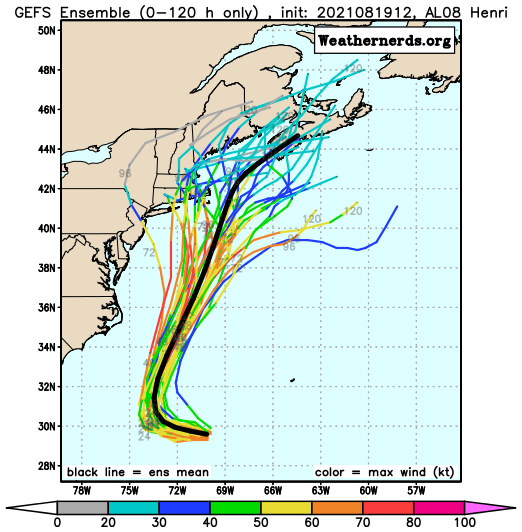
As of 11am Thursday, Tropical Storm Henri was centered about 810 miles south of Nantucket, moving toward the west at 10 mph. Maximum sustained winds were near 70 mph. An Air Force Reconnaissance aircraft is investigating the storm right now to assess the true strength and structure of it. This should help improve the forecasts for the storm. Henri is fighting off some northerly wind shear as it moves around the edge of a ridge of high pressure, which is preventing it from strengthening. As it reaches the edge of the ridge tomorrow, it should turn more northward, and the shear will lessen. Combined with the fact that it will be over the warm waters of the Gulf Stream means that it should strengthen into a hurricane. As the same time, an upper-level low pressure area will develop over the Great Lakes, helping to steer Henri northward as well. This is where the largest uncertainty comes into play, and it has a giant impact on the forecast. Does the combination of the low to the west and ridge to the east remain strong and keeping Henri on a northward track, or does the ridge weaken a bit and allow Henri to turn more toward the northeast? If that wasn’t enough to complicate things, we also need to see how fast Henri is traveling at that point. The water off the Northeast coast is not warm enough to sustain a tropical system, so it will start to weaken. The faster it is moving, the less time it will have to weaken before reaching our latitude. These are questions that we can’t answer yet.
Forecast track for Henri from the various members of the GFS Ensemble. Image provided by Weathernerds.org
Since Henri formed, our thinking all along has been that it would pass close to or just south and east of Cape Cod, close enough for some impact across the Cape and Islands at least. That remains a plausible scenario. There are plenty of models that have landfall across Rhode Island or Southeastern Massachusetts as either a hurricane or strong tropical storm, and others that show no landfall and keep the storm offshore. Either way, it’s important to remember that as storms reach this latitude, they become lopsided, with most of the heavy rain to the left of the center, and the stronger winds confined to the right of the center. So, a track near or just off the Cape would spare most of the region from the strong winds, but result in heavy rainfall, especially across eastern Massachusetts. A track across southeastern Massachusetts would bring strong winds onto the Cape and Islands, and shift the heavy rain inland a bit more. The track will also impact the storm surge. With a full moon on Sunday, we’re already going to have astronomical high tides, which can create some coastal flooding on their own in spots. Add in a storm surge, and significant coastal flooding is likely, especially just to the right of the storm track. With all of these things possible, the National Hurricane Center will likely issue a Tropical Storm or Hurricane Watch for parts of the region on Friday.
Probability of tropical storm fore winds and the most likely arrival time. Image provided by the National Hurricane Center.
Most of the impacts from Henri are likely from Sunday afternoon into Monday morning, but again, this is dependent on the track and speed of the storm. Either way, conditions should start to improve Monday afternoon as Henri begins to pull away.
Thursday night: Partly to mostly cloudy, a few showers possible during the evening. Low 66-73.
Friday: Intervals of clouds and sunshine, chance for a shower or thunderstorm. High 79-86. Offshore: Southwest 10-15 knots, gusts to 20 knots seas 3-5 feet.
Friday night: Partly cloudy, patchy fog may develop. Low 66-73.
Saturday: Partly sunny, a few showers and thunderstorms are possible in the afternoon. High 81-88. Offshore: Southeast 5-10 knots, seas 2-4 feet.
Saturday night: Mostly cloudy. Low 65-72.
Sunday: Cloudy and becoming breezy with some showers developing, possibly becoming a steadier and heavier rain late in the day. High 72-79. Offshore: Tropical storm conditions likely
Sunday night: Breezy to perhaps windy with rain, possibly heavy. Low 62-69.
Monday: Diminishing winds with rain tapering off to showers and ending, some sunny breaks may develop in the afternoon. High 74-81. Offshore: Tropical storm conditions likely, subsiding late in the day.
What’s left of Tropical Storm Fred is dumping heavy rain on parts of the Mid-Atlantic states this afternoon, but there are still two active tropical systems in the Atlantic, and both could cause significant problems.
Satellite loop showing Hurricane Grace south of Cuba and Tropical Storm Henri southwest of Bermuda. Loop provided by NOAA.
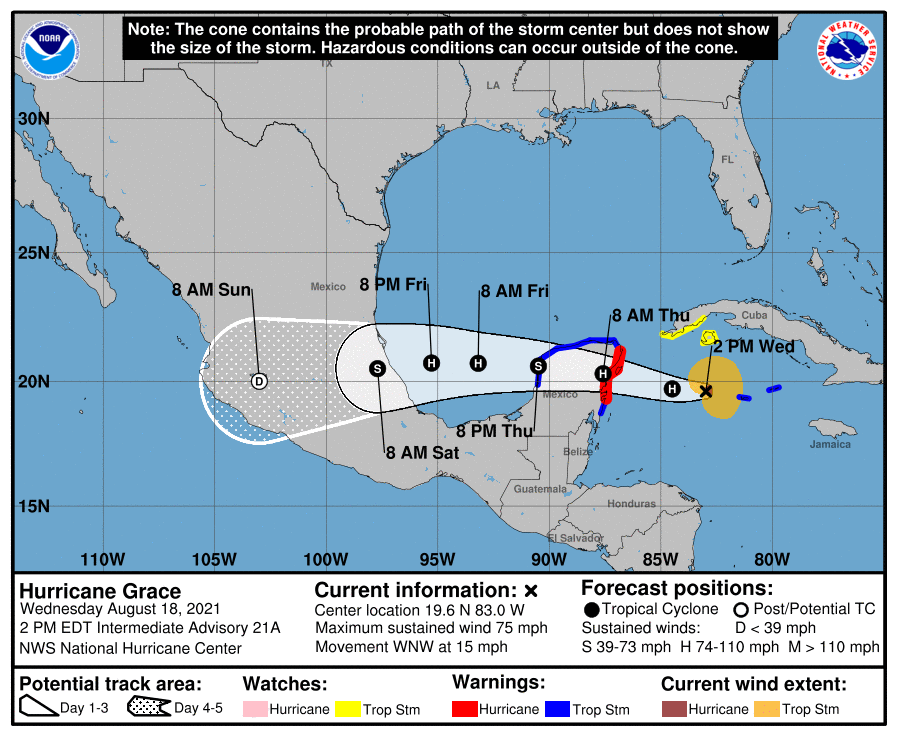
Hurricane Grace is the more immediate threat. As of early Wednesday afternoon, Grace was centered about 295 miles east of Tulum, Mexico, moving toward the west-northwest at 15 mph. Maximum sustained winds were near 75 mph. A Hurricane Warning is in effect for eastern portions of the Yucatan Peninsula, with a Tropical Storm Warning for other portions of the Yucatan as well as the Cayman Islands.
Forecast track for Hurricane Grace. Image provided by the National Hurricane Center.
Grace’s forecast is fairly straightforward. It should strengthen a bit more today and tonight before making landfall in the Yucatan early Thursday. It should weaken a bit over land, then move back into the Bay of Campeche late Thursday. It will likely strengthen again, likely regaining hurricane status before a second landfall in Mexico late Friday or early Saturday between Veracruz and Tampico. Strong winds, torrential rainfall that will lead to flooding and mudslides, and storm surge flooding are all expected across the region.
Grace will bring torrential rainfall to parts of Mexico over the next several days. Image provided by WeatherBell.
Grace produced heavy rain and flooding over the past several days from the Leeward Islands across Puerto Rico and the Virgin Islands, into Hispaniola, Jamaica, the Cayman Islands, and parts of Cuba. Rainfall totals of up to 10 inches were observed in some areas. While winds haven’t been a huge factor thus far for much of the region, wind gusts exceeded 50 mph on Jamaica, with some gusts to near hurricane force reported in the Cayman Islands this morning as Grace pulled away.
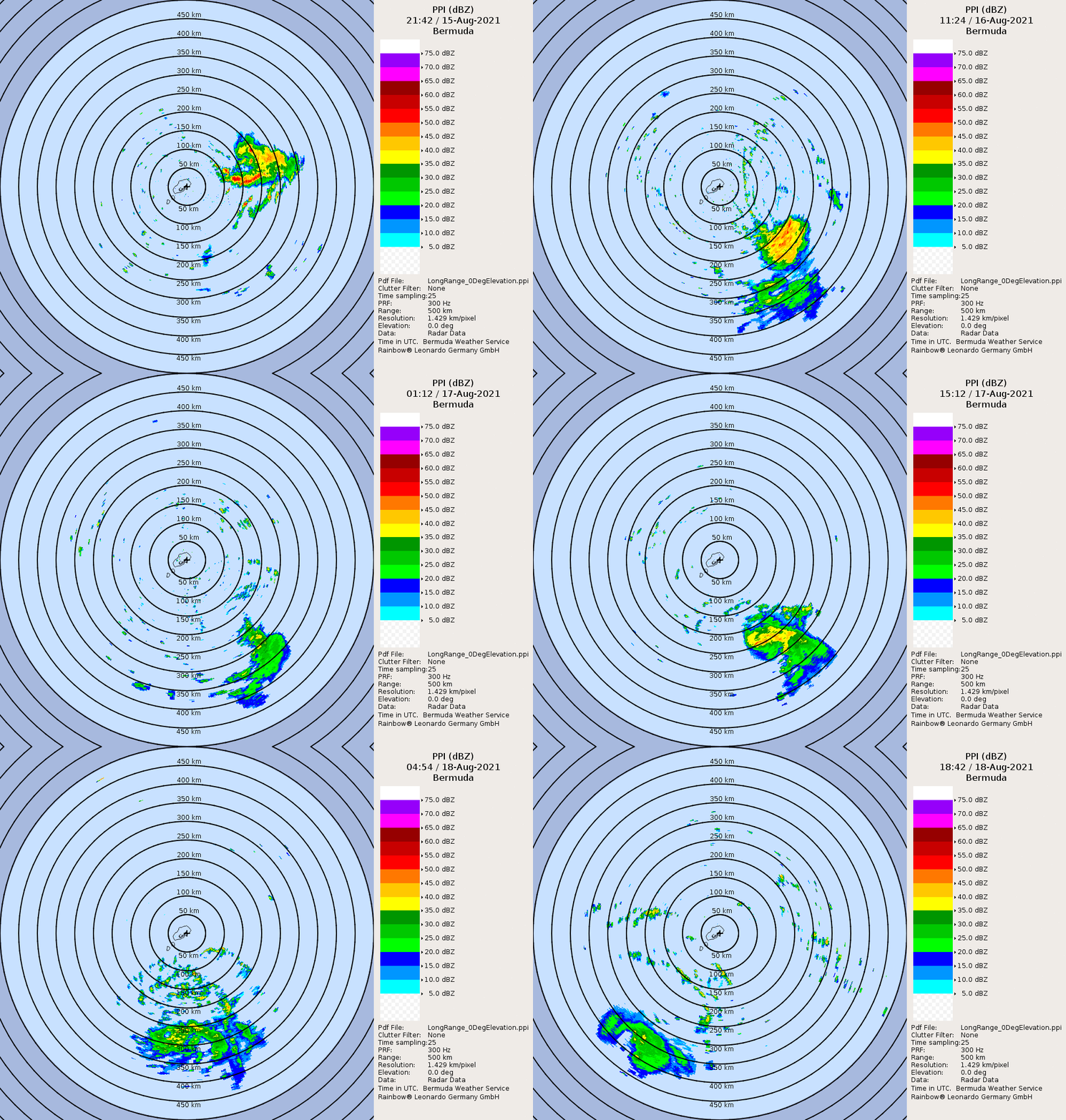
While Grace is preparing to slam into the Yucatan, all eyes here in New England are focused on Tropical Storm Henri. As of early Wednesday afternoon, Henri was centered about 190 miles southwest of Bermuda, or 795 miles south-southeast of Nantucket, moving toward the west at 8 mph. Maximum sustained winds were near 65 mph. Some slow strengthening is expected, and Henri could become a hurricane over the next few days.
Radar from Bermuda shows Henri’s path around the islands. Loop provided by Brian McNoldy, University of Miami, Rosenstiel School
Henri’s future track is highly uncertain at this point. With a ridge of high pressure to the north and east, it should continue westward for the next day or so before it reaches the western edge of the ridge and begins to turn northward. At the same time, an upper-level low pressure area will begin to develop over the Great Lakes. These two features will combine to send Henri up the East Coast, but that’s where the uncertainty really begins. Some models have Henri continue moving around the ridge and turning northeastward, either heading out to sea or possibly impacting parts of Atlantic Canada. Some models have the upper low strengthen a bit more and the ridge build back in, allowing Henri to keep heading north, possibly even turning toward the northwest like Sandy did, which would result in landfall across New England or Long Island. Given that this is still around 4 days or so away from any potential impact, it is just too early to tell which scenario is more likely. Either way, residents of Southern New England should keep a close eye on Henri’s progress.
The various members of the GFS Ensemble show the wide range in potential tracks for Henri. Image provided by Tropical Tidbits.
With the forecast as it is, and knowing how the media can be, we are issuing an Extreme Hype Watch for the region. An Extreme Hype Watch is issued when conditions are favorable for media hype of an event to reach extreme levels within the next 48-72 hours. If conditions warrant, a Hype Advisory or Extreme Hype Warning will be issued as the event draws nearer.
Tomorrow marks 30 years since Hurricane Bob made landfall near Newport, Rhode Island. The 30 years is the 2nd longest we’ve ever gone without a hurricane landfall in New England or Long Island.
Since 1851, a hurricane has made landfall in New England or Long Island 18 times, an average of one every 9.4 years. The longest we’ve ever gone between hurricane landfalls is 38 years, between 1896 and 1934. It’s been 30 years since Bob, our 2nd longest drought on record. (Of the 18 hurricanes that made landfall in New England or Long Island since 1851, 15 of them have done so between August 19 and September 27.)
Since 1851, 9 hurricanes of Category 2 intensity or stronger have made landfall in New England or Long Island, an average of one every 18.9 years. The longest we’ve gone between hits by storms of that intensity is 69 years, between 1869 and 1938. We’re at 30 years since Bob, the last one to do so.
Since 1851, New England/Long Island has had 3 Major Hurricanes (Category 3 or higher) make landfall – an unnamed storm in October of 1869, the infamous 1938 Long Island Express, and Hurricane Carol in 1954. That’s an average of 1 every 56.7 years, and the longest time between 2 major hurricanes is 69 years (1869-1938). We’re at 67 years since Carol. There are also 3 documented storms from before 1851 – The Great Colonial Hurricane of 1635, the 1815 New England Hurricane, and the Norfolk and Long Island Hurricane of 1821. That’s it. That changes the numbers to 6 in 386 years, or one every 64.3 years, with a longest drought of 180 years.
Satellite photo of Hurricane Bob approaching New England. Bob was the last hurricane to make landfall in New England – 30 years ago. Image provided by NOAA.
There is some history involving New England and the two current names, Grace and Henri. In 1991, Grace was a hurricane off the East Coast in late September. As it moved northward, it was absorbed by a much larger extratropical system which eventually started moving south and then southwest off the coast of New England. This became the “No-Name Halloween Storm”, or as the book and movie were later titled – ‘The Perfect Storm”. Grace was a new addition to the name list in 1991, as the previous “G” storm had its name retired. That storm was Gloria in 1985, which slammed into Long Island on September 27. As for Henri, it also hit New England in 1985, a few days before Gloria. Most people don’t remember it for two reasons. First, it was very weak – it weakened to a tropical depression right at landfall near Westerly, Rhode Island on September 24 and rapidly dissipated. It did not produce much rain or wind across the region. Second, all eyes were on the much more powerful Hurricane Gloria which was starting to move up the East Coast
There are now three active systems in the Atlantic and two more in the Pacific. All but one are a threat to land.
Satellite loop showing Fred nearing the Florida Panhandle, Grace over Haiti, and TD 8 near Bermuda. Loop provided by NOAA.
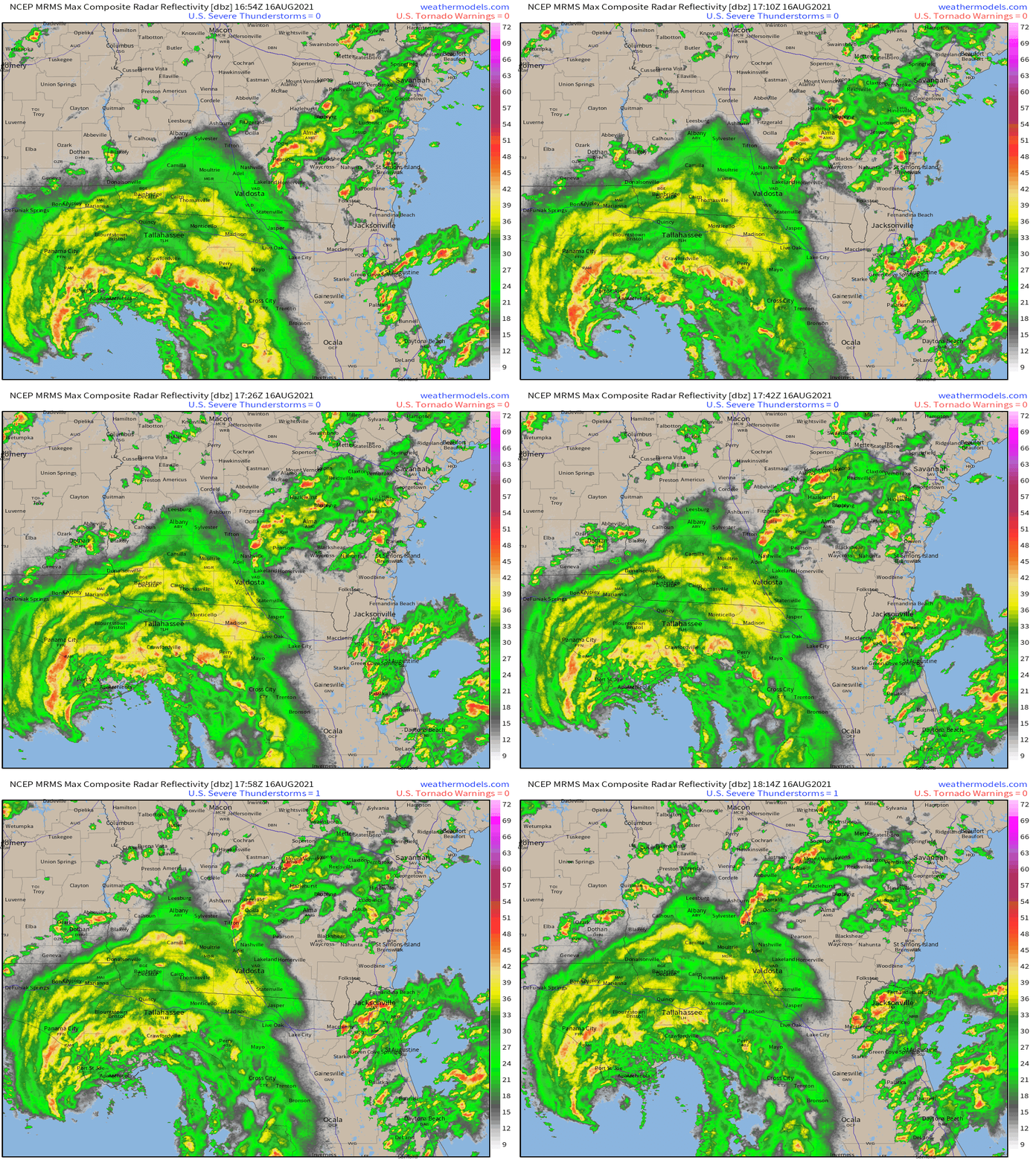
The most immediate threat is Tropical Storm Fred. After sputtering over Cuba this past weekend, Fred emerged into the eastern Gulf of Mexico and has become better organized. As of early Monday afternoon, Fred was centered about 35 miles southwest of Apalachicola, Florida, moving toward the north at 10 mph. Maximum sustained winds have increased to 65 mph. Tropical Storm Warnings and Storm Surge Warnings are in effect for parts of the Florida Gulf Coast. Fred may strengthen a little more before it makes landfall late this afternoon or evening. Once inland, it should rapidly weaken. The main threats from Fred are strong winds, heavy rain, and storm surge, along with the possibility of a few tornadoes.
Radar shows the center of Fred approaching the Florida Panhandle. Loop provided by Weathermodels.com
Fred will produce 4-8 inches of rain across parts of Florida and southern Georgia, with some locally heavier amounts. As it moves inland and weakens, the moisture will start to interact with a frontal system, bringing heavy rain to parts of the Southeast, Mid-Atlantic States, and the Appalachians. In these areas, rainfall totals of 3-6 inches and locally heavier will likely lead to flooding over the next few days.
Forecast models show the potential for heavy rain from the Southeast into the Mid-Atlantic states. Images provided by Pivotal Weather.
While Fred heads for Florida, Grace may be starting to get its act together near Haiti Grace brought heavy rain to parts of the northeastern Caribbean this weekend, but was very poorly organized. It looks a bit healthier this afternoon as it nears the south coast of Haiti. It was centered about 70 miles southeast of Port-au-Prince, Haiti early Monday afternoon, moving toward the west-northwest at 12 mph. It is still a tropical depression with maximum sustained winds near 35 mph. A Tropical Storm Warning is in effect for parts of southern Cuba and the Cayman Islands, while Tropical Storm Watches are in effect for Haiti, Jamaica, and parts of southern Cuba.
Grace is expected to continue on a general westward course for the next several days. As it pulls away from Haiti late tonight, it will move over the warm waters of the northwestern Caribbean, and gradual strengthening is expected. The current forecast calls for it to be a strong tropical storm as it approaches the northern Yucatan Peninsula in a few days. Beyond that, a track into the Gulf of Mexico seems likely at this point.
Forecast track for Tropical Depression Grace. Image provided by the National Hurricane Center.
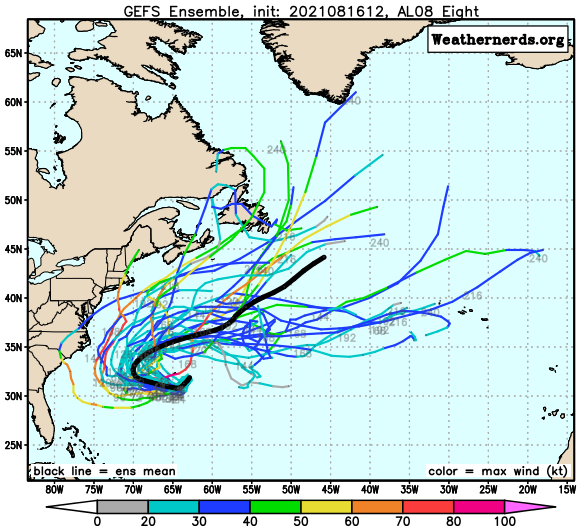
Out in the central Atlantic, Tropical Depression Eight developed late Sunday night. As of early Monday afternoon, it was centered about 140 miles southeast of Bermuda, moving toward the south at 9 mph. Max sustained winds were near 35 mph. A Tropical Storm Watch is in effect for Bermuda. The system is expected to become a tropical storm later today or tonight as it turns westward and rides around a ridge of high pressure. Eventually, it will turn back to the north and northeast and head out into the open Atlantic. There is a slight chance that it could impact the East Coast, depending on how quickly it makes the turn. It should bring some rough seas to the coastal waters from the Carolinas to New England later this week.
Forecast track for Tropical Depression Eight from the various members of the GFS Ensemble. Image provided by Weathernerds.org.
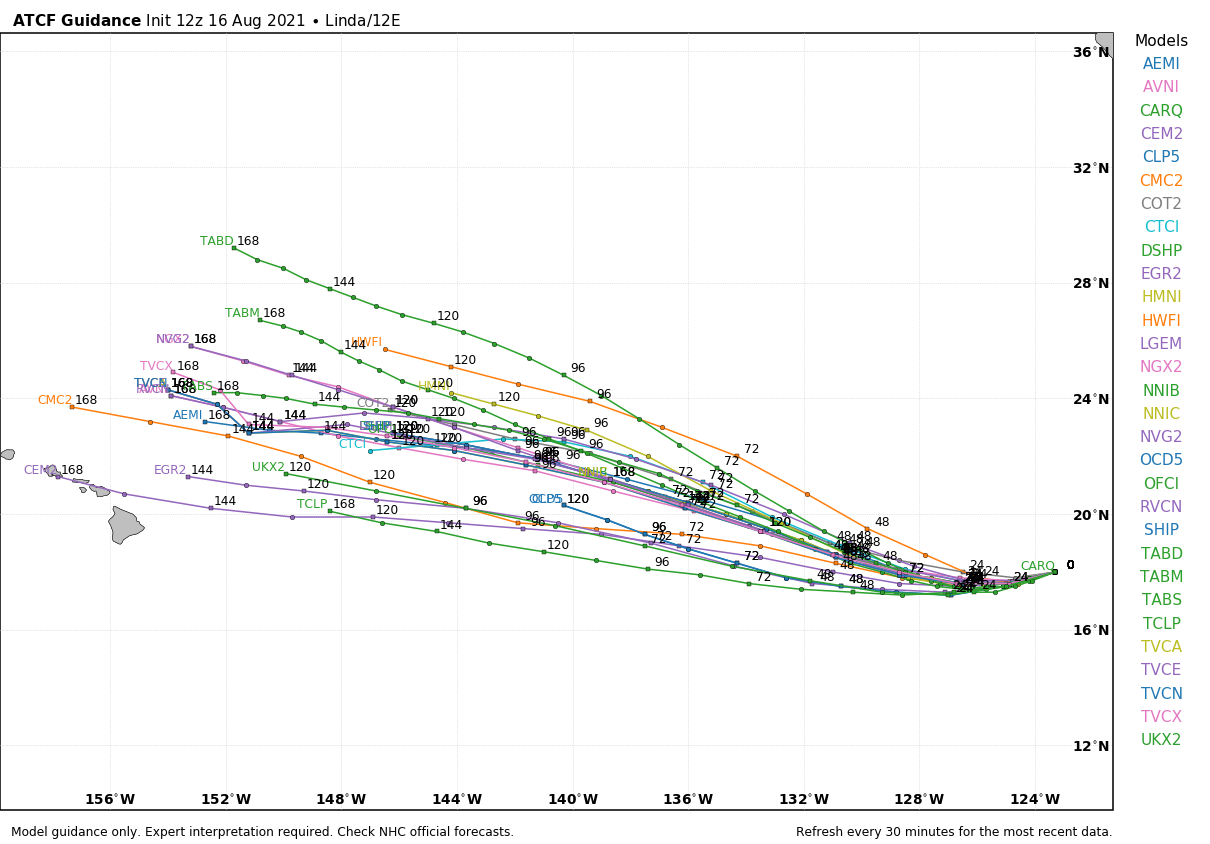
In the Eastern Pacific, Hurricane Linda still has maximum sustained winds near 105 mph at midday. It was centered about 955 miles west-southwest of Cabo San Lucas, Mexico, and moving toward the west-southwest at 9 mph. Linda reached Category 4 strength over the weekend, but now is gradually weakening over open water. It should continue on a general west to west-northwest track this week while slowly weakening. It should pass well north and east of Hawaii late this week as a weakening extratropical system, with little impact other than some rough surf.
Model forecasts for the track of Hurricane Linda. Image provided by WeatherBell.
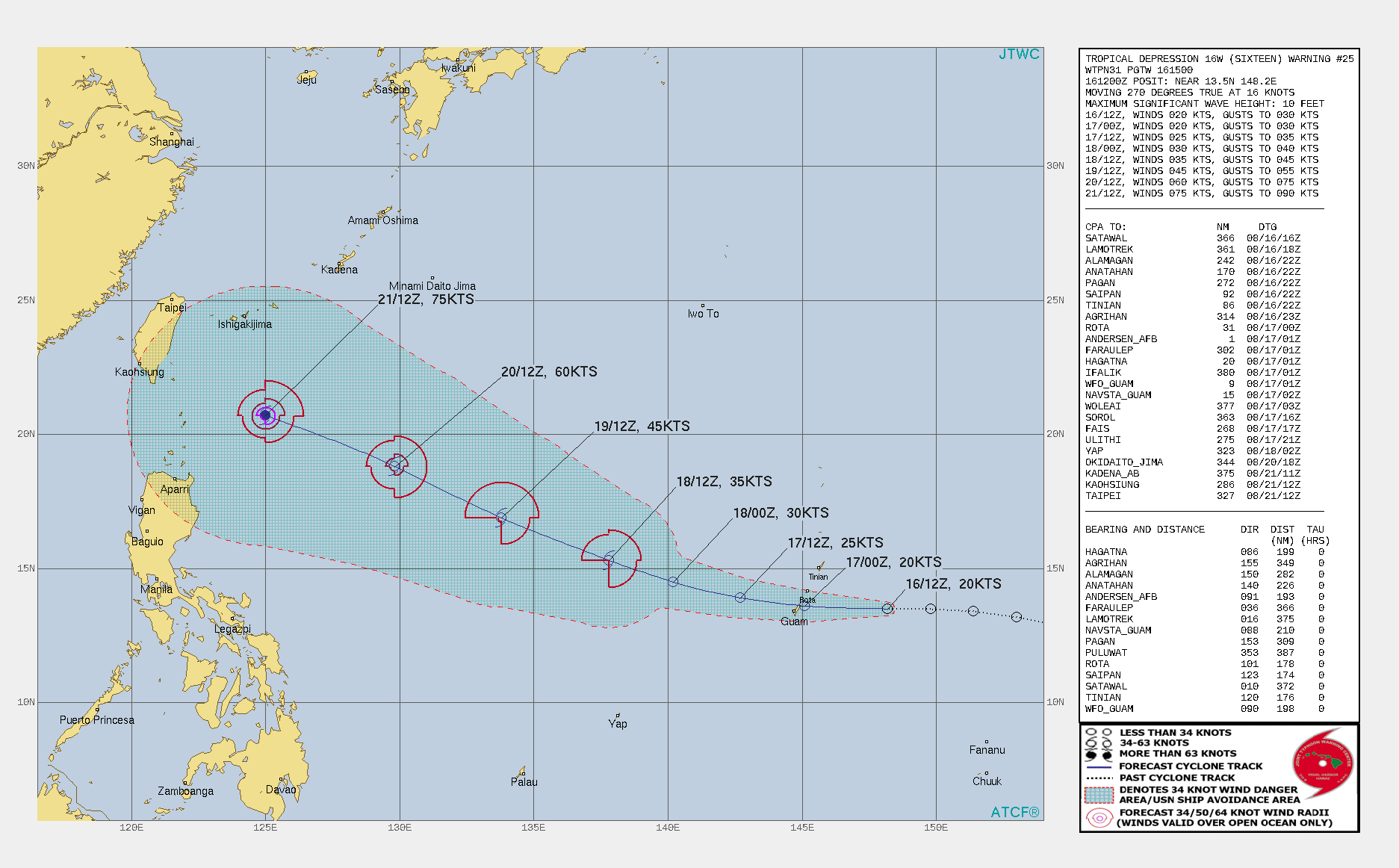
Out in the Western Pacific Ocean, Tropical Depression 16W remains fairly weak. It has maximum sustained winds near 25 mph, and is centered about 180 miles east of Guam, moving toward the west at 18 mph. It will bring heavy rain and some gusty winds to the Northern Mariana Islands over the next day or so as it passes very close to Guam.
Forecast track for Tropical Depression 16W. Image provided by the Join Typhoon Warning center.
The system may start to strengthen once it gets past the Northern Marianas and turns a bit more toward the northwest. Some forecasts call for it to become a tropical storm, and possibly a typhoon by the end of the week. Where it will go is highly uncertain at this point. While the official forecast from the Joint Typhoon Warning Center has it heading towards Taiwan, various models have it continuing westward to the Philippines, continuing west-northwestward toward Taiwan and/or eastern China, or turning northward and heading toward Japan. It will have to be watched closely later this week.






















 Storm HQ