Weekly Outlook: July 5-11, 2021

After a chilly and wet weekend, heat and humidity are set to return to the region.

Our pesky upper-level low pressure area finally pulls away and high pressure builds in today, bringing some sunshine and warmer temperatures back into the region. A warm front will move through tonight, and it may produce a few showers and thunderstorms, but the more noticeable impact will be an increase in humidity once again. This sets up a hot and humid day on Tuesday. Many locations may top 90, and heat indices will be well into the 90s across the region. A weak boundary will move in during the afternoon though, and this may trigger showers and thunderstorms, some of which could become strong to severe. Any storms that do form could produce gusty winds, frequent lightning, and heavy downpours. If you’ve got outdoor plans for Tuesday afternoon and evening, keep an eye to the sky and on the radar, and be prepared to head indoors.
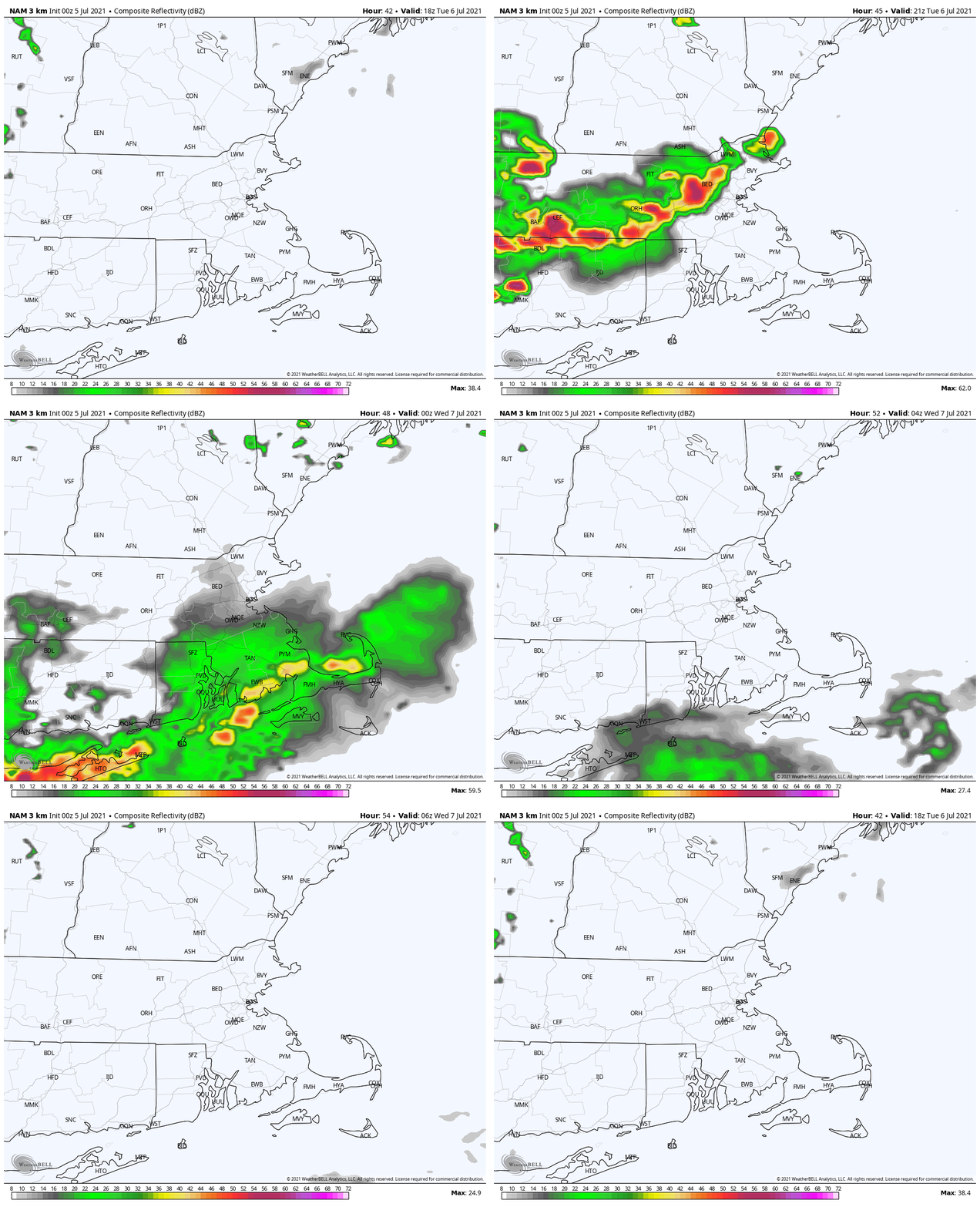
Strong to severe thunderstorms may cross the region Tuesday afternoon. Loop provided by WeatherBell.

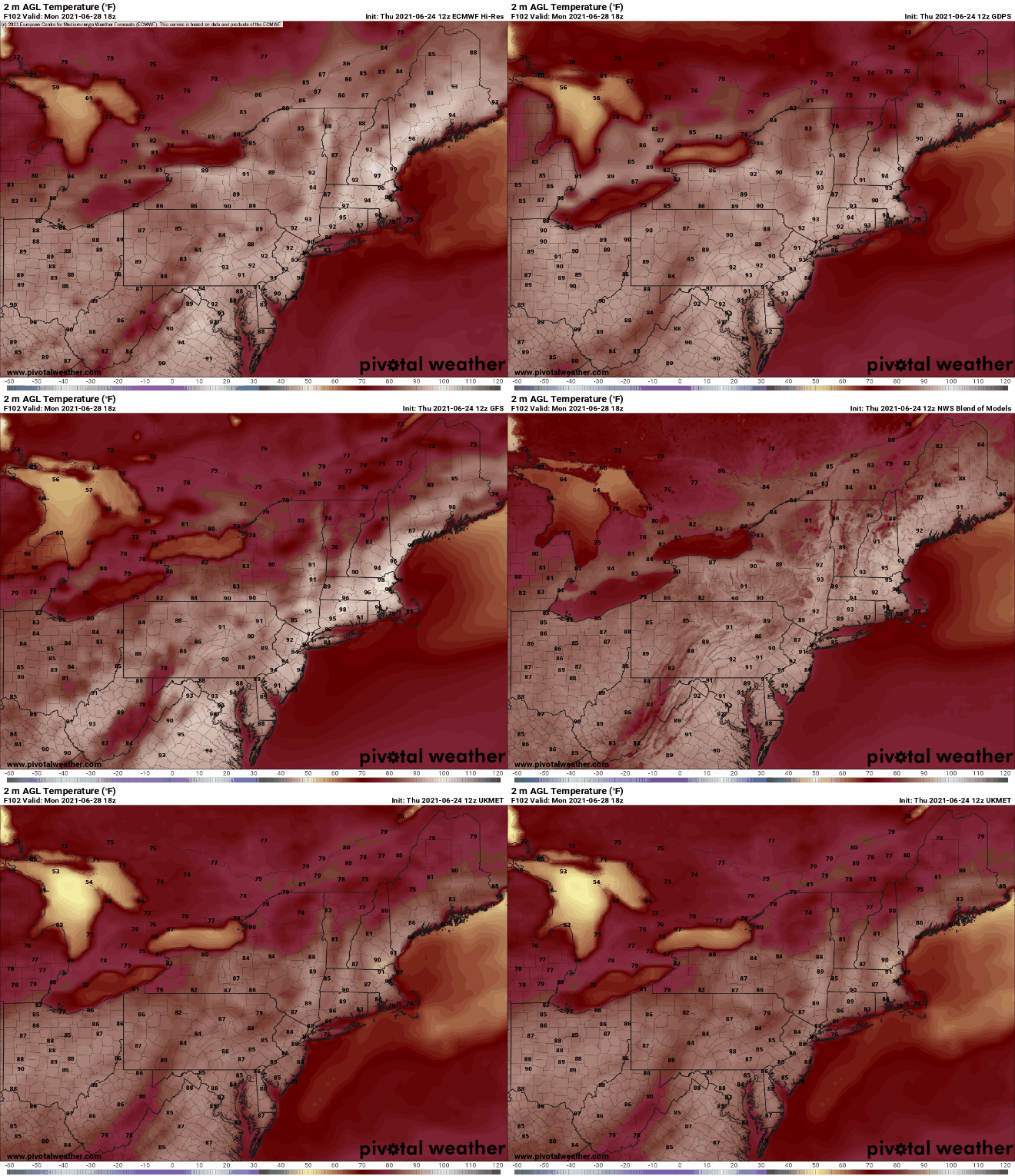
Wednesday looks to be very warm and humid once again, but temperatures will depend on how much cloud cover there is. A cold front will be approaching from the north and west, and this will produce another round of showers and thunderstorms during the afternoon and evening. This is where forecast confidence drops significantly. That front will eventually stall out near or just south of the region. Where it stalls out will have a big impact on Thursday temperatures, with warm and humid air still in place to the south, but cooler air to the north. Complicating things is the fact that a wave of low pressure may ride along the front, bringing in some rain once again.

The models have a wide variety of ideas about Thursday’s temperatures. Images provided by Pivotal Weather.

If Thursday wasn’t complicated enough, on Friday we may have to deal with Elsa or its remains. We’re not expecting Elsa to make a direct hit on New England. It should be heading out to sea well to the south. However, it may be close enough to interact with that frontal boundary, and send more rain into the region. It also may produce some gusty winds across the Cape and Islands, and some rough seas, especially along the South Coast.
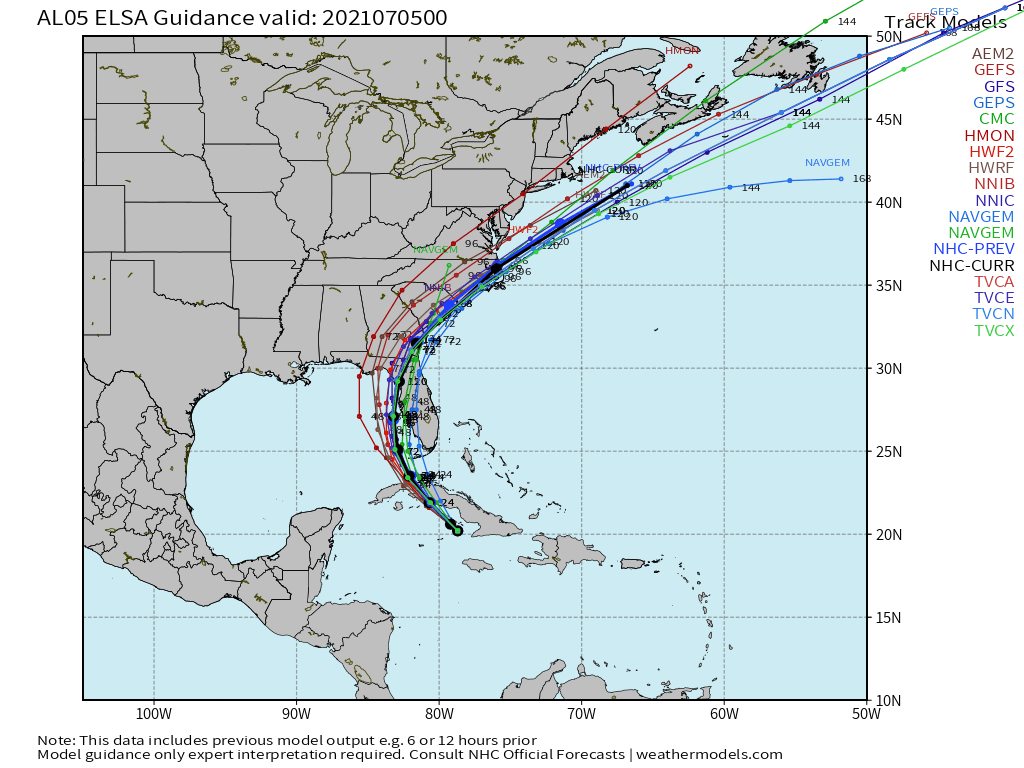
Elsa or its remains should stay pass south of New England. Image provided by Weathermodels.com

We should dry out on Saturday with a warm day expected, but humidity will return on Sunday, along with the chance for more showers and thunderstorms as another frontal boundary approaches the region.

Monday: Becoming partly to mostly sunny. High 71-78.

Monday night: Partly cloudy, chance for a few showers or thunderstorms. Low 60-67.

Tuesday: Partly sunny, breezy at times, more humid, showers and thunderstorms are possible during the afternoon, some may be strong to severe. High 84-91, cooler along the South Coast.

Tuesday night: Any showers or storms end in the evening, otherwise partly cloudy. Low 65-72.

Wednesday: A mix of sun and clouds, humid, showers and thunderstorms possible during the afternoon and evening. High 84-91, cooler along the South Coast.

Thursday: Partly to mostly cloudy with a chance for rain or showers. High 76-83, possibly cooler across southern New Hampshire and northern Massachusetts.

Friday: Plenty of clouds, more rain or showers possible. High 77-84.

Saturday: Becoming partly sunny. High 77-84.

Sunday: Intervals of clouds and sunshine, showers and thunderstorms possible during the afternoon and evening. High 80-87.
Elsa Heads Toward Cuba, Florida

Tropical Storm Elsa has its sights set on Cuba and Florida over the next couple of days.

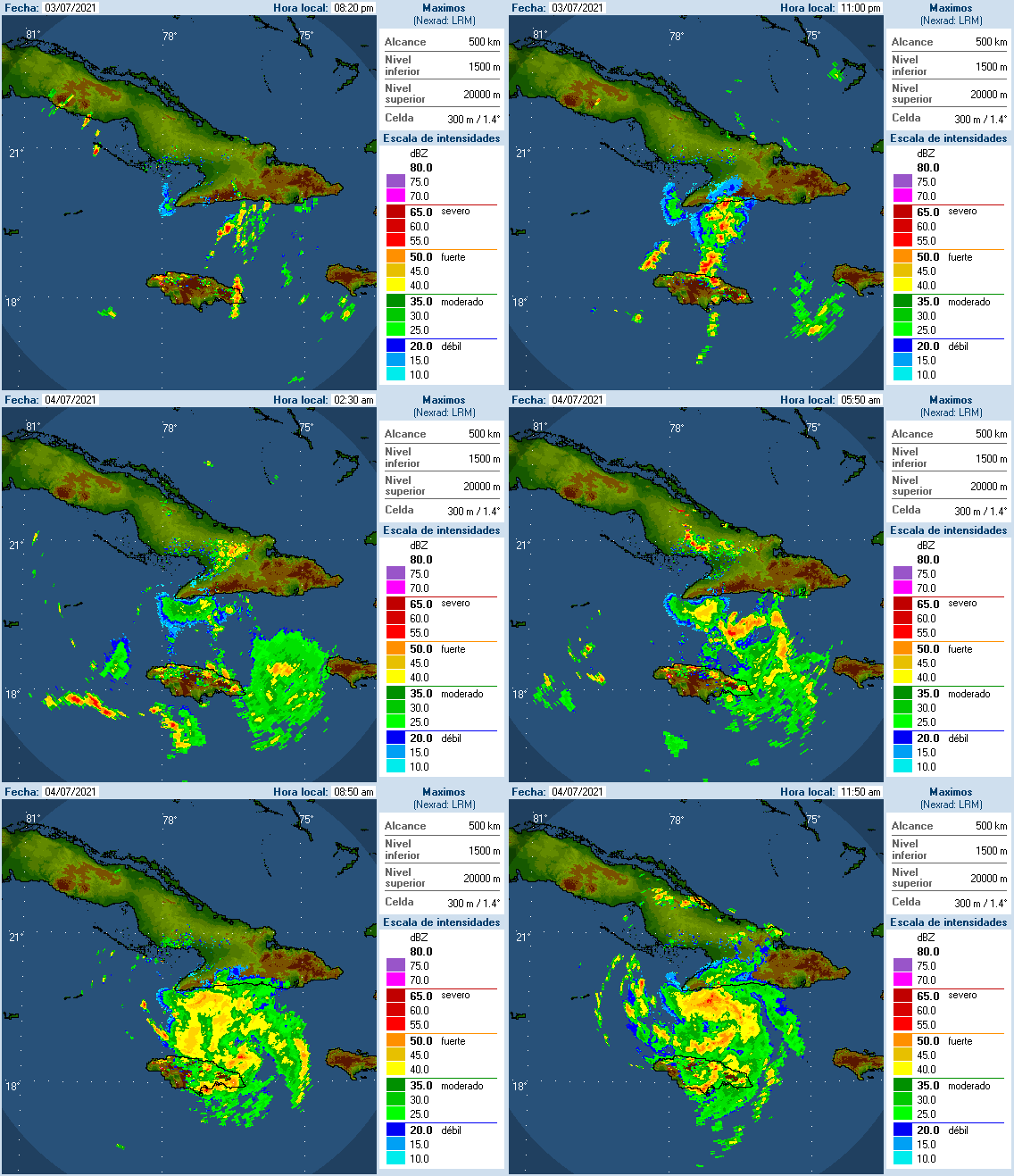
Radar from Cuba shows Elsa bringing heavy rain to Jamaica and parts of Cuba. Image provided by Brian McNoldy, Univ. of Miami, Rosenstiel School.

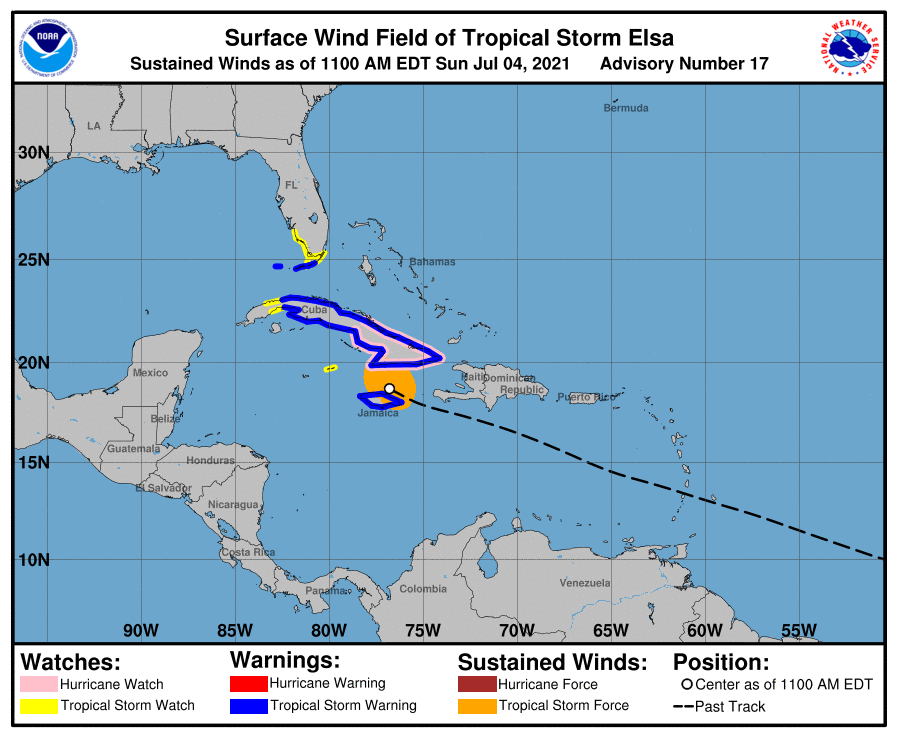
After weakening to a Tropical Storm, Elsa has been battering parts of the Dominican Republic, Haiti, and Jamaica with strong winds and heavy rainfall over the past couple of days. Cuba is starting to feel the effects, and they’ll become more widespread today and Monday. Tropical Storm Watches and Warnings are in effect for Jamaica, most of Cuba, parts of the Cayman Islands, as well as the Florida Keys and parts of South Florida.

Tropical Storm Watches and Warnings are in effect for parts of the Western Caribbean and South Florida. Image provided by the National Hurricane Center.

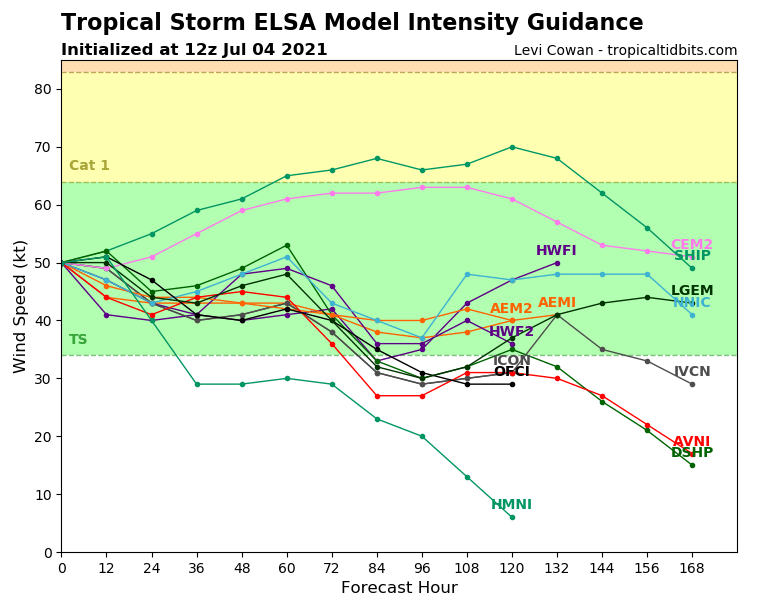
As of midday Sunday, Elsa was centered about 50 miles north of Kingston, Jamaica, moving toward the west-northwest at 13 mph. Maximum sustained winds were near 60 mph. While the storm may strengthen a little today, weakening is expected tonight as the center crosses Cuba. Once it reemerges in the Florida Straits on Monday, it will head northward toward the Florida Keys. While the water is plenty warm enough to support some intensification, shear will begin to increase as well, which acts to weaken the storm. The current forecast calls for the system to maintain its intensity Monday and Tuesday. Since intensity is usually the hardest thing to forecast in tropical systems, we wouldn’t be surprised if it re-intensified back into a hurricane, nor would we be surprised if it continued to weaken as it is moving northward off the west coast of Florida.

Some models show Elsa intensifying again after crossing Cuba, others don’t. Image provided by Tropical Tidbits.

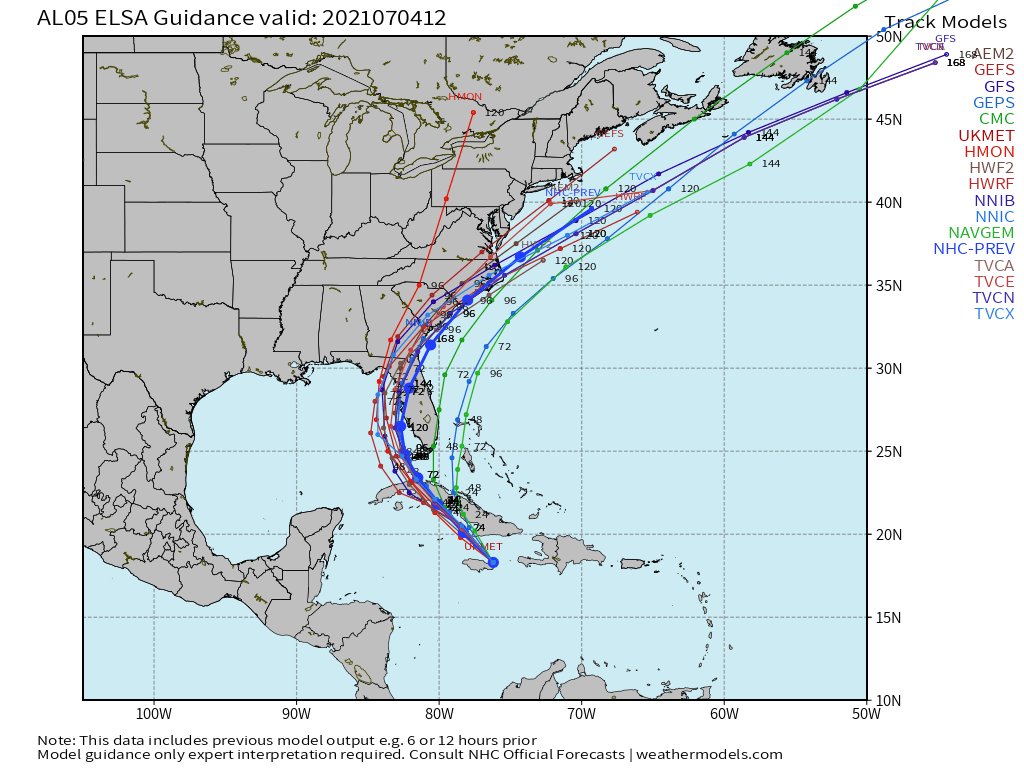
Once Elsa crosses the Florida Keys it will continue northward, eventually turning northeastward as it moves around the edge of a large ridge of high pressure centered over the western Atlantic. When it starts making that northeast turn will determine where landfall is expected in Florida. At this point, anywhere from Fort Myers to Pensacola could be the spot. Either way, heavy rain is likely across Florida over the next couple of days, especially western Florida. Rainfall totals of 4-8 inches and locally heavier will result in flooding in some areas.

Model forecasts for the track of Tropical Storm Elsa. Image provided by Weathermodels.com

Once it makes the turn, we have another question that we can’t answer yet – when will the center re-emerge over the Atlantic? Obviously, the longer it remains over land, the weaker it will be, but if it were to move offshore closer to northern Florida or Georgia instead of over North Carolina, there would be a window for a little strengthening as it moves over the warm waters of the Gulf Stream. Either way, it will bring heavy rain and gusty winds to parts of Georgia and the Carolinas toward the middle of the week. Once it moves back offshore, it should continue northeastward and out to sea while becoming extratropical later this week. Depending on how far north it actually gets, it could interact with a frontal system and bring some rainfall to parts of eastern New England by the end of the week, but there’s a lot that has to happen first before we can have any clarity on that possibility.

Hurricane Elsa Cruises Through the Caribbean

After starting hurricane season with 4 “tropical storms” that were probably not tropical, the first hurricane of the season has developed.

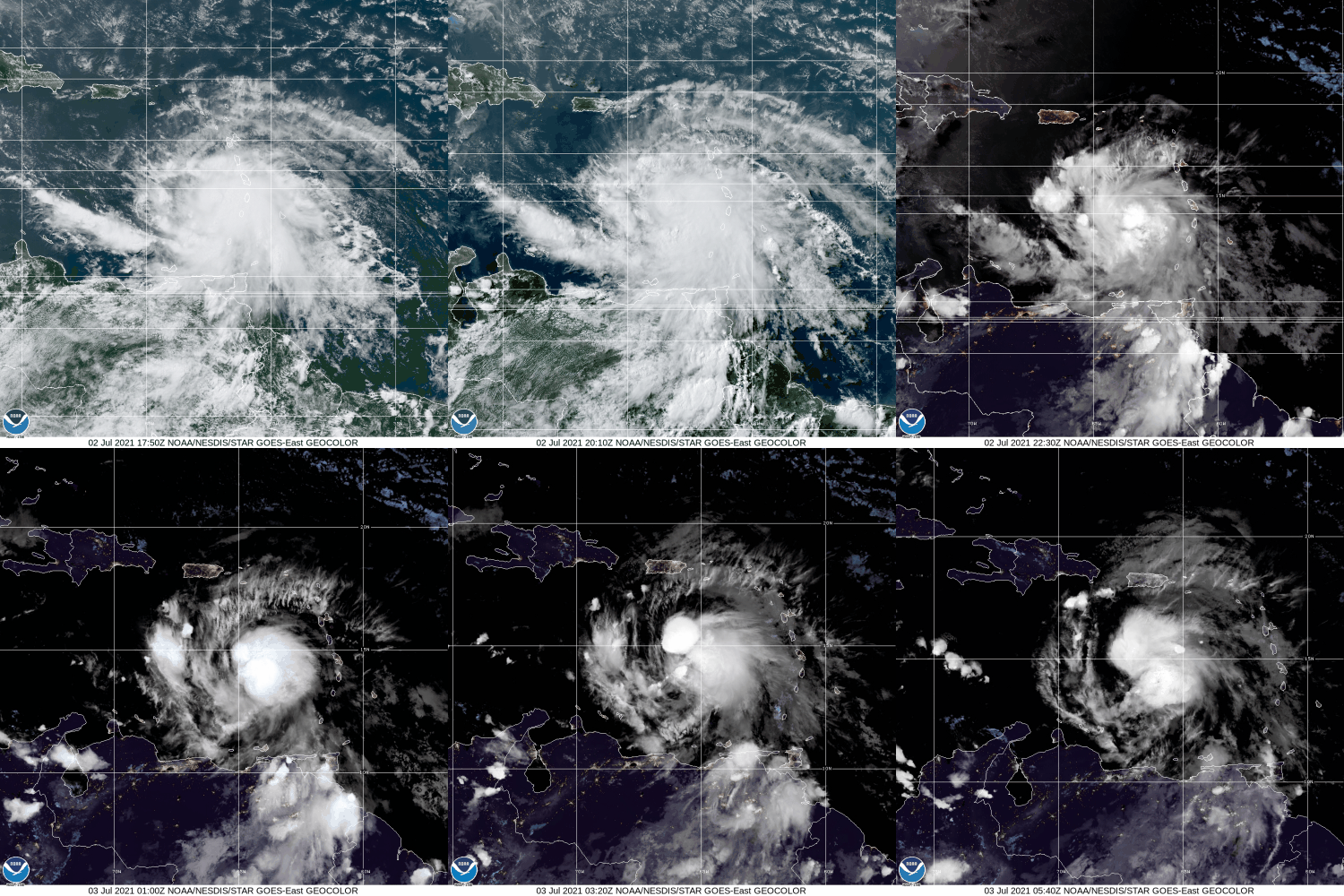
Hurricane Elsa formed as Tropical Depression Five late Wednesday night well east of the Lesser Antilles, and became Tropical Storm Elsa on Thursday. It rapidly intensified into a hurricane Friday morning as it approached Barbados. As Elsa crossed the Windward Islands Friday morning/early afternoon it produced wind gusts as high as 86 mph on Barbados and 79 mph on Saint Lucia. This is the earliest in the season that a storm has hit Barbados, and it is the 2nd earliest Hurricane ever in the eastern Caribbean, trailing only an unnamed storm from 1933.

Satellite loop of Hurricane Elsa. Loop provided by NOAA.

As of 2am Saturday, Hurricane Elsa was centered approximately 620 miles east-southeast of Kingston, Jamaica, moving toward the west-northwest at 29 mph. Maximum sustained winds are near 80 mph.

Hurricane Warnings are in effect for southern portions of the Dominican Republic and Haiti, as well as for the island of Jamaica, with Tropical Storm Warnings for the remainder of the Dominican Republic and Haiti. A Hurricane Watch is in effect for parts of eastern Cuba, and a Tropical Storm Watch is in effect for parts of the Cayman Islands.

Watches and Warnings associated with Hurricane Elsa. Image provided by the National Hurricane Center.

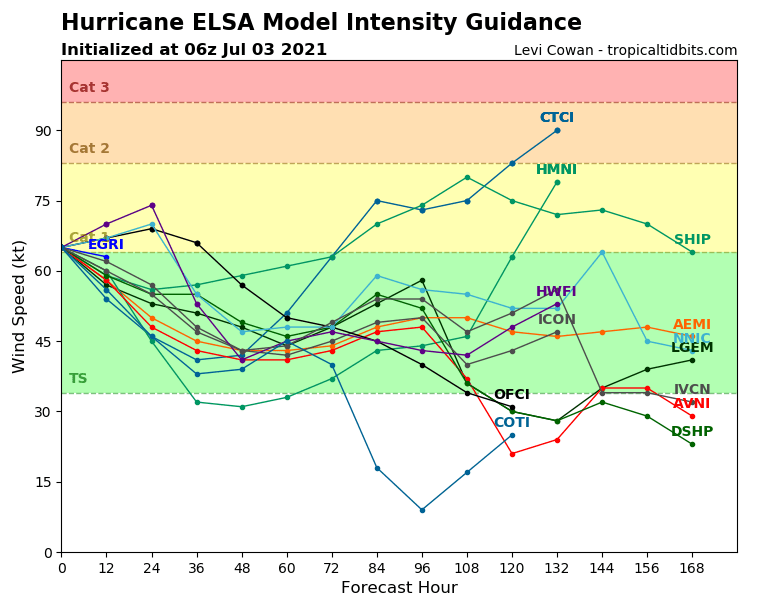
Elsa could strengthen a bit on Saturday, but for the most part, weakening is forecast. Some dry air got entrained in the circulation late Friday, okus the current rapid forward speed with both serve to inhibit any further strengthening, Although Elsa is expected to slow down over the next 24 hours, a turn more toward the northwest is expected. This will bring the storm closer to Hispaniola, where the mountainous terrain could disrupt the circulation as well.

Model forecasts for the intensity of Hurricane Elsa. Image provided by Weathermodels.com.

Current forecasts bring the center of the storm close to southern Haiti Saturday night, then toward southeastern and southern Cuba on Sunday. The intensity of the storm will be determined partially by the track the storm takes. The longer the circulation center stays over water, the better chance that the storm is stronger.

Model forecasts for the track of Hurricane Elsa. Image provided by Weathermodels.com.

As the storm slows down, it increases the chances for heavy rainfall across southern portions of Hispaniola, eastern and southern Cuba, and parts of Jamaica. Rainfall totals of 6-12 inches and locally heavier will lead to flooding and mudslides.

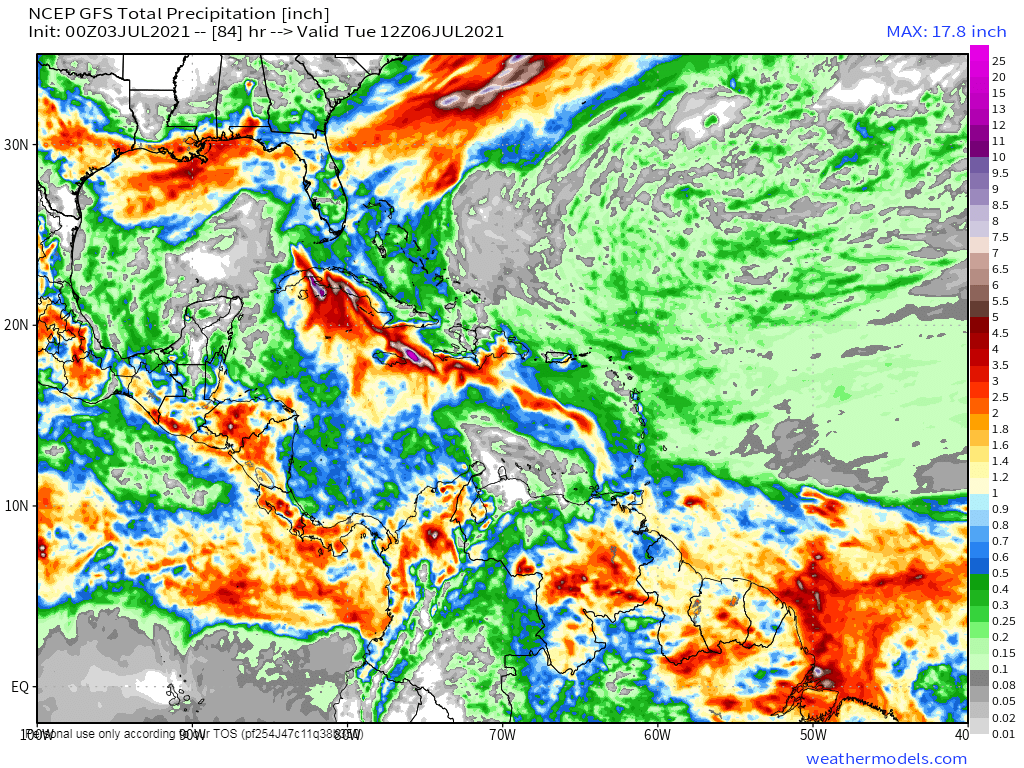
Elsa will bring heavy rainfall to portions of the Caribbean. Image provided by Weathermodels.com

Elsa is expected to cross Cuba on Monday while turning northward. Given that this is already three days out, the uncertainty in the forecast becomes much large. A track towards Florida seems likely, but is far from definite at this point. Several models bring the storm up the west coast of Florida, while many others bring it up the east coast or even over the Bahamas. How strong the storm is at this point is also highly uncertain. Residents from the central Gulf Coast all the way to the Carolinas should keep tabs on the system this weekend, as it has the potential to impact anywhere within that range by the early to middle portion of next week.

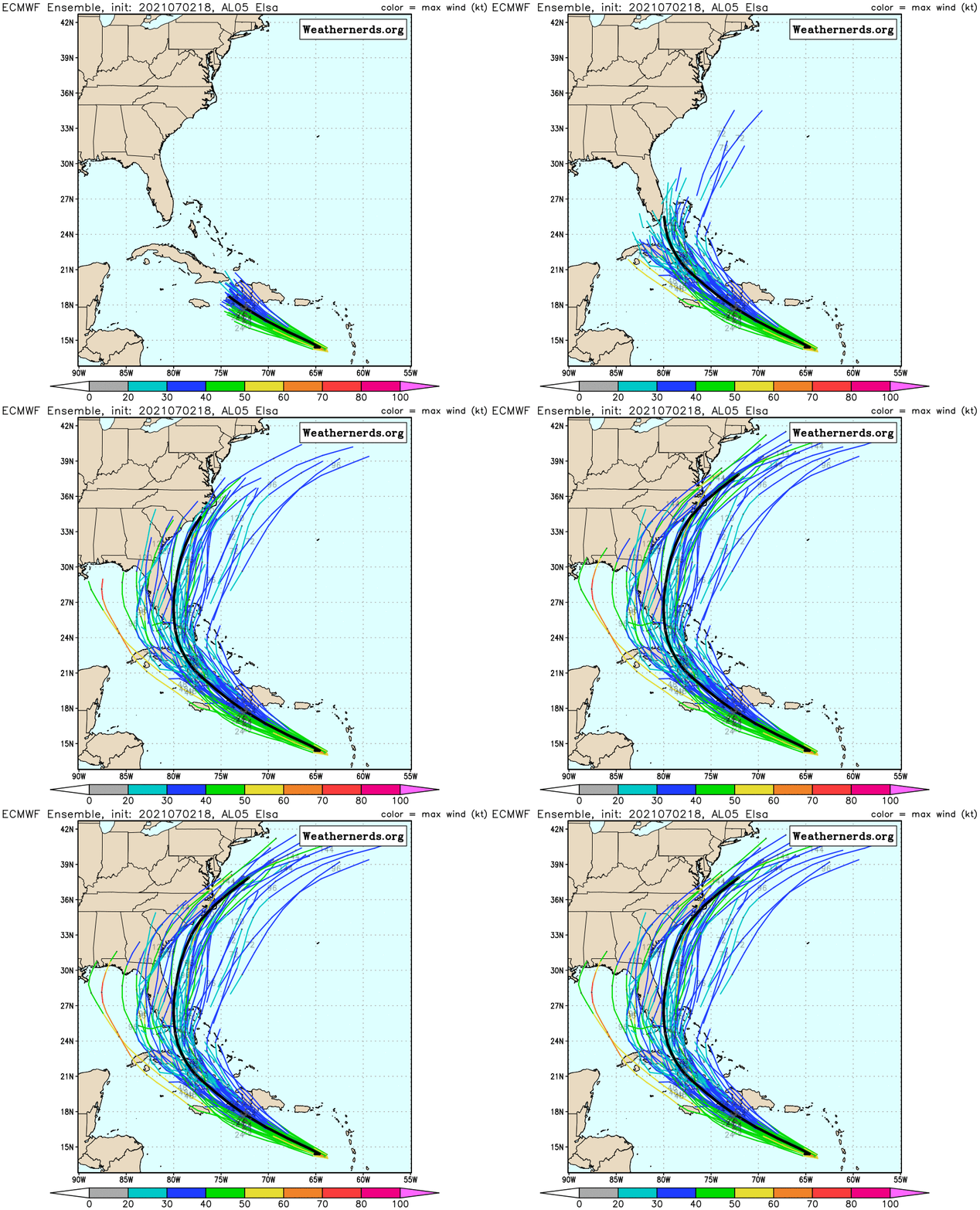
Forecasts for Elsa’s track from the 51 members of the ECMWF Ensemble. Image provided by Weatehrnerds.org

Elsewhere, the tropics remain fairly quiet, with no other organized systems at this time.

Weekend Outlook: July 2-5, 2021

It’s a long holiday weekend for most of you, but unfortunately, it’s not going to be all sunshine and warm temperatures.

What’s left of the warm and humid weather disappears overnight as a frontal boundary settles south of the region. This will bring in showers and thunderstorms, some of which may produce heavy rain. The front stalls out to our south on Friday, with waves of low pressure riding along it, bringing in more showers, along with much cooler conditions. Some of the models are forecasting very heavy rainfall across the region, which could lead to some areas of flooding. We’re not quite sure we believe some of these numbers, but your lawn should definitely get a big drink of water over the next few days.

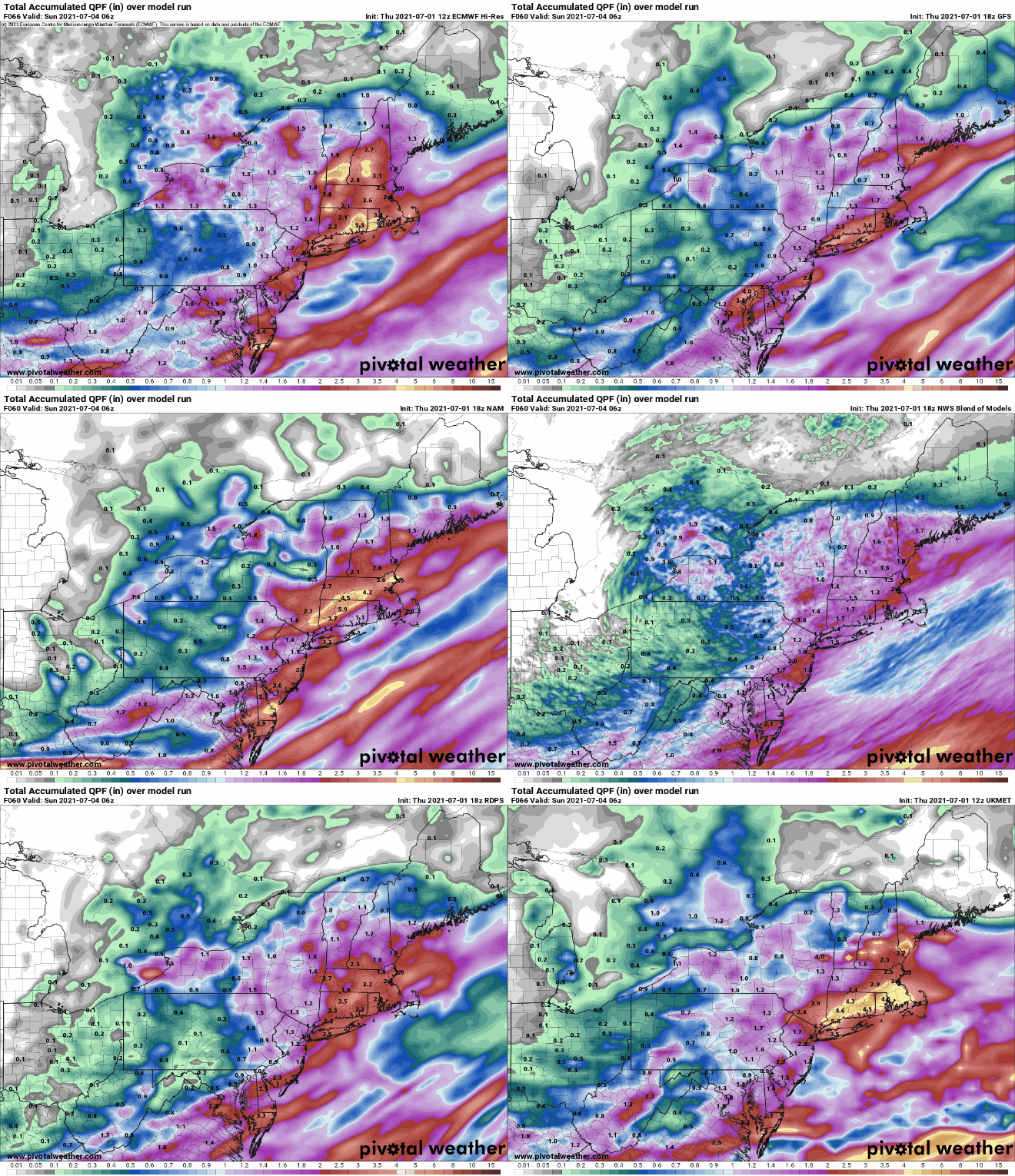
Parts of the region could see quite a bit of rain this weekend. Images provided by Pivotal Weather,

Over the weekend, the front washes out, but an upper-level low pressure system will slowly move across the region. This will keep clouds and cool temperatures in place, especially on Saturday, with some occasional showers, but neither day looks to be a washout. While Sunday isn’t ideal barbecue weather for the Fourth of July, it may not be THAT bad. Just keep an eye on the radar if you do have outdoor plans. By Monday, the upper low moves out, and we get back into sunshine and temperatures closer to normal for early July.

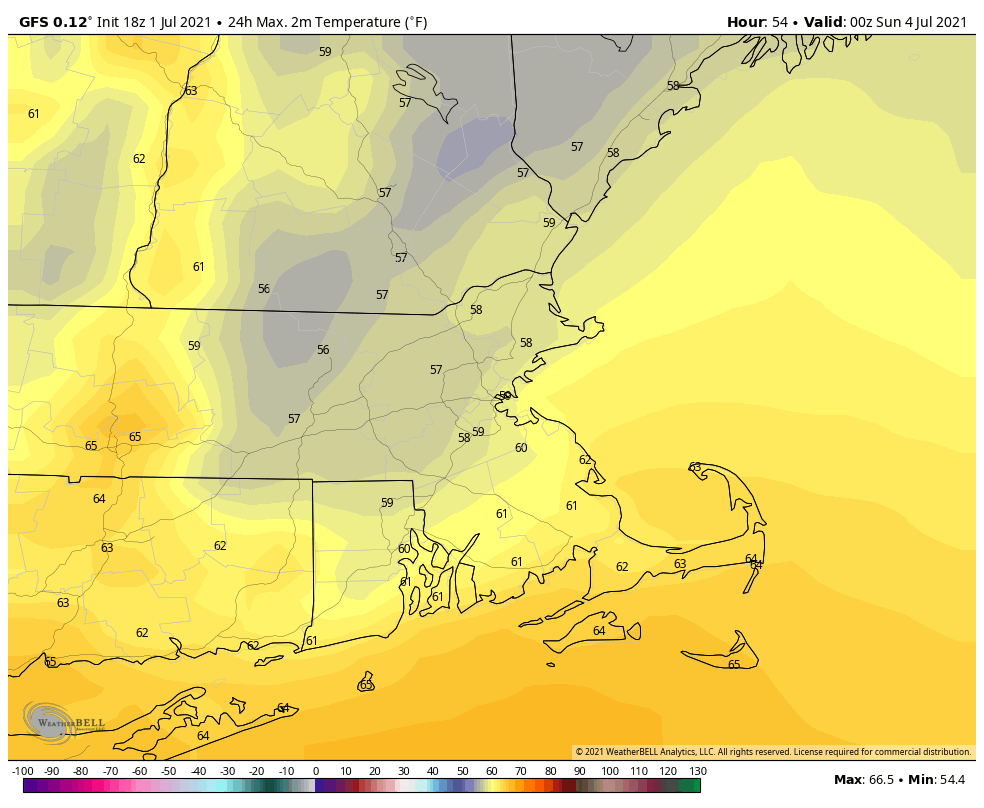
Some models try to keep it very cool around here on Saturday. Image provided by WeatherBell.

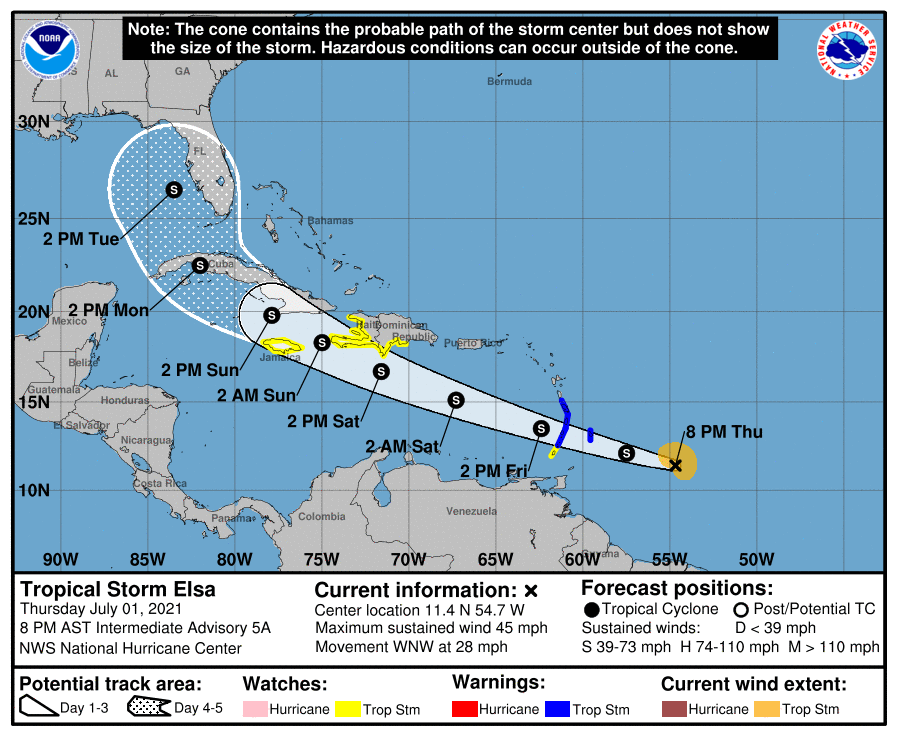
In the tropics, Tropical Storm Elsa was centered about 345 miles east-southeast of Barbados this evening, moving toward the west-northwest at 28 mph. Maximum sustained winds are near 45 mph. Tropical Storm Watches and Warnings are in effect for various islands in the eastern and northern Caribbean. The current forecast calls for some strengthening, as conditions remain favorable for the next day or so, but unless it slows down, it won’t strengthen too much. We’ll take a much more in-depth look at Elsa in a special blog post either Friday afternoon or evening.

Forecast track for Tropical Storm Elsa. Image provided by the National Hurricane Center.

Thursday night: Cloudy with periods of rain and showers and some embedded thunderstorms. Low 59-66, a little milder near the South Coast.

Friday: Mostly cloudy with more showers, especially in the morning. High 64-71. Offshore: Winds becoming northeast to north 10-15 knots, gusts to 20 knots, seas 3-6 feet, visibility under 1 mile in showers and fog.

Friday night: Plenty of clouds with more showers likely. Low 53-60.

Saturday: Mostly cloudy and cool with occasional showers. High 59-66. Offshore: Northeast 10-20 knots gusts to 25 knots, seas 3-6 feet, visibility 1-3 miles in showers and fog.

Saturday night: Mostly cloudy, chance for a few showers. Low 51-58.

Fourth of July: Clouds and some sunny breaks with more showers possible. High 65-72. Offshore: Northwest 10-15 knots, seas 3-6 feet, visibility 1-3 miles in showers and fog.

Sunday night: Showers end in the evening, some clearing late at night. Low 52-59.

Monday: Partly to mostly sunny. High 74-81. Offshore: Southwest 10-20 knots, seas 3-5 feet, visibility 10 miles or better.

Weekly Outlook: June 28-July 4, 2021

If you like heat and humidity, then the first half of the week is perfect for you. If you don’t, well, the end of the week and the weekend might be better, but certainly not perfect.

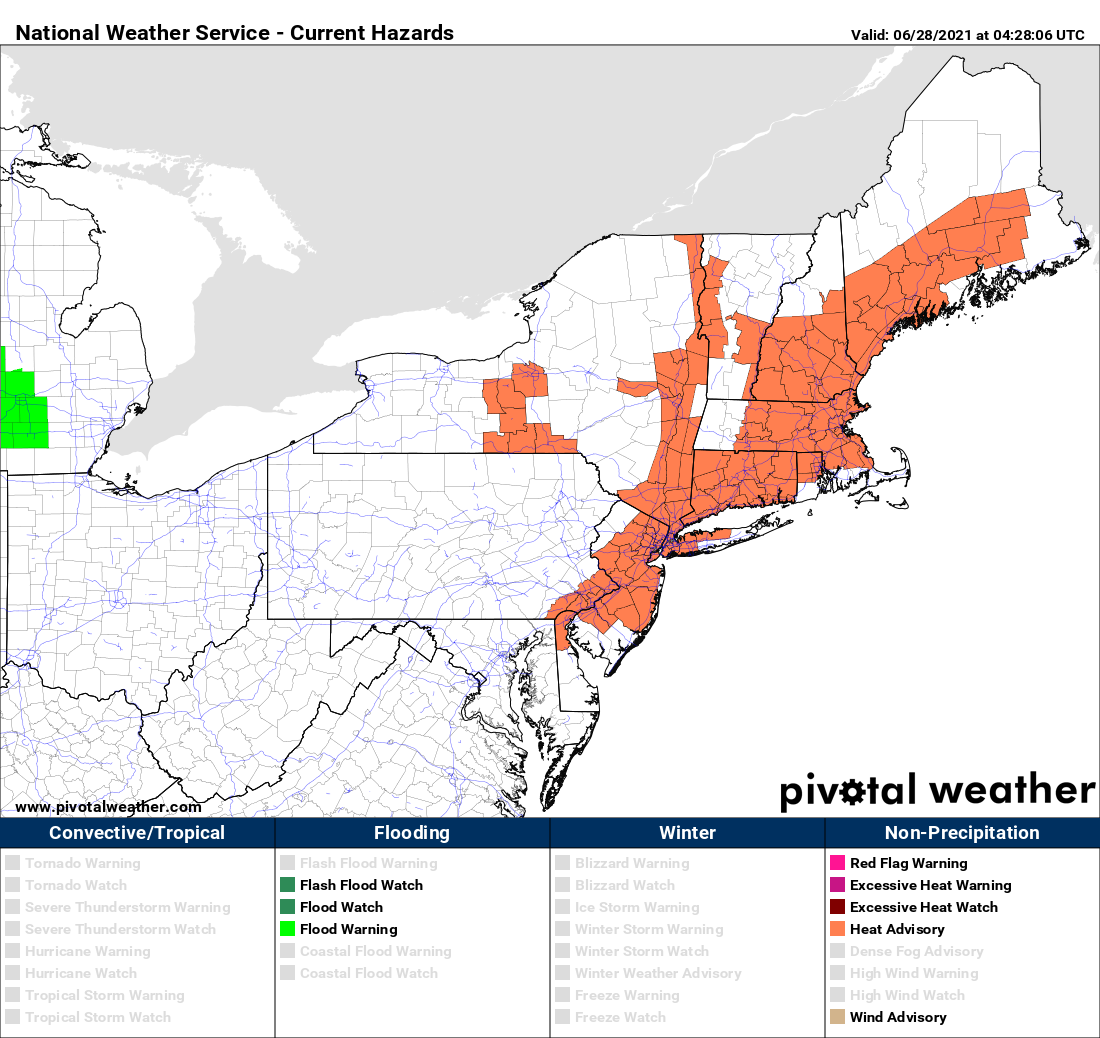
Heat Advisories are in effect for much of the Northeast today. Image provided by Pivotal Weather.

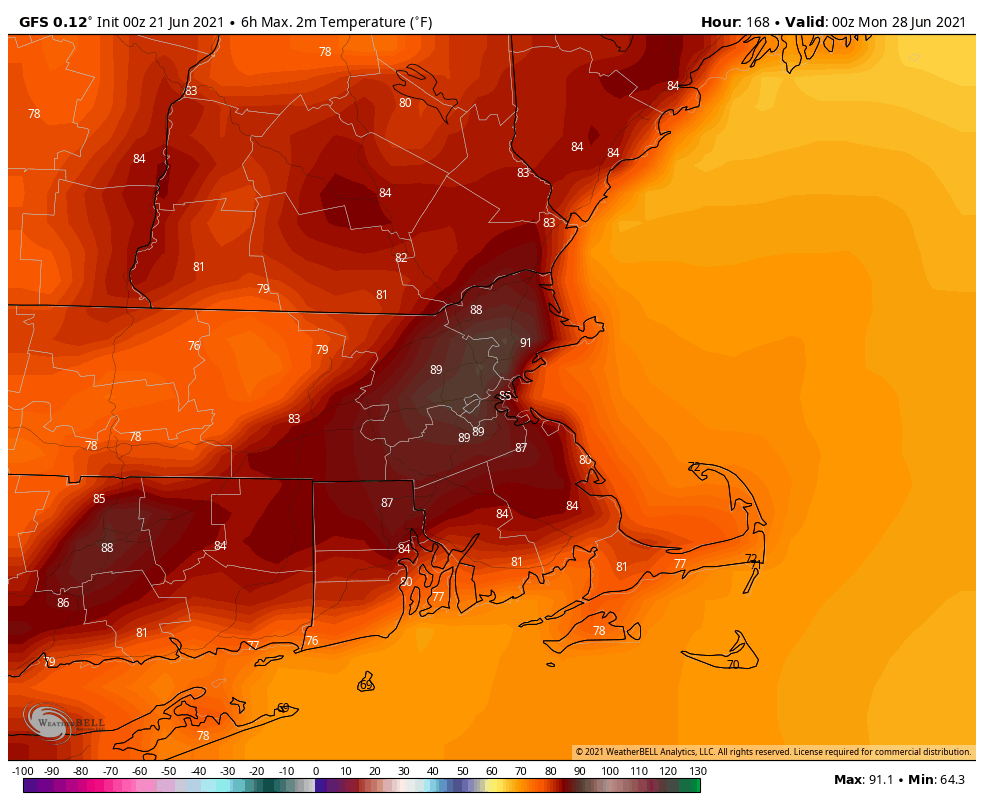
We start the week off with high pressure anchored off the Eastern Seaboard, pumping hot and humid air into the region. Most locations away from the South Coast should get well into the 90s today, tomorrow, and Wednesday. With the humidity factored in, it’s going to feel like it’s near or over 100 degrees. That’s why Heat Advisories have been issued for much of the area. At night, it’ll remain warm and muggy, with lows generally in the 70s. A few showers and thunderstorms may pop up Tuesday and again on Wednesday afternoon, providing a little late-day relief.

Tuesday looks like the hottest day, but we think the GFS might be overdoing things a little on Wednesday. Image provided by WeatherBell.

A cold front will move in late Wednesday or early Thursday, taking the edge off the heat, but with some more widespread showers and thunderstorms accompanying it. Beyond that, things get a little tricky. That front is expected to wash out near or just south of the region on Thursday. Waves of low pressure will ride along it, with showers and thunderstorms possible at times from Friday into the weekend, but this will also depend on how much southward progress the front makes before it washes out. If it’s far enough to the south, then the shower activity may stay a little farther south. No matter where it stalls, we’re looking at one or possibly two very cool days for the end of the week and start of the weekend. Temperatures should start to moderate again for the Fourth of July.

Temperatures on Friday could be 30-40 degrees cooler than Wednesday, if you believe the GFS. Image provided by Weathermodels.com

Monday: Partly sunny, hot, and humid. High 90-97, cooler along the South Coast.

Monday night: Clear to partly cloudy, just a slight chance for a shower or two. Low 70-77.

Tuesday: Sunshine and some afternoon clouds, hot, and humid., a few showers and thunderstorms are possible late in the day. High 91-98, cooler along the South Coast.

Tuesday night: Clear to partly cloudy, any showers or storms end during the evening. Low 69-76.

Wednesday: Partly to mostly sunny, breezy, hot, and humid, showers and thunderstorms are possible during the afternoon and evening. High 89-96 cooler along the South Coast.

Thursday: More clouds than sun with scattered showers and thunderstorms. High 81-88.

Friday: Plenty of clouds and much cooler with more showers possible, especially south of the Mass Pike. High 71-78.

Saturday: Partly to mostly cloudy, chance for showers and thunderstorms. High 68-75.

Fourth of July: More clouds than sun with more showers and thunderstorms possible. High 74-81.

Weekend Outlook: June 25-28, 2021

The first full weekend of summer will feature a return of humidity and heat to the region.

A warm front will cross the region late tonight and early Friday. A few showers may accompany the front, maybe even a rumble of thunder, but they should be gone before midday, and they shouldn’t be that heavy either. Skies will start to clear out in the afternoon, and you’ll start to notice the increase in humidity. With the cloud cover likely hanging on through early afternoon, temperatures may not get that warm, especially along the Maine and New Hampshire Seacoast, where the front will take the longest to move through.

Dewpoints will jump into the middle to upper 60s on Saturday behind the warm front. Image provided by WeatherBell.

The rest of the weekend and Monday will feature typical summertime weather, with sunshine and afternoon clouds, along with a few pop-up showers and thunderstorms. We’ll have a frontal boundary well to our north and west, so we shouldn’t expect any organized severe weather with the front too far away, but any storms that do form could produce some localized downpours and gusty winds. In terms of temperatures, Sunday and Monday look quite toasty, and some models have temperatures getting well into the 90s away from the South Coast. The heat and humidity look to persist into at least the middle of next week.

Monday is looking like it’s going to be hot. Images provided by Pivotal Weather.

Thursday night: Increasing clouds with some showers possible late at night. Low 51-58, but temperatures may start to rise a bit after midnight, especially south of Boston

Friday: Any showers ending in the morning, some partial sunshine develops in the afternoon. High 72-79. Offshore: Southeast to south winds 10-15 knots, seas 2-4 feet.

Friday night: Partly to mostly cloudy. Low 59-66.

Saturday: Partly sunny, slight chance for a shower or thunderstorm. High 80-87. Offshore: South to southwest winds 10-15 knots, seas 2-4 feet.

Saturday night: Partly to mostly cloudy. Low 66-73.

Sunday: A mix of sun and clouds, slight chance for a shower or thunderstorm. High 85-92, cooler along the South Coast. Offshore: Southwest winds 10-20 knots, seas 3-5 feet.

Sunday night: Partly cloudy. Low 67-74.

Monday: Partly sunny, a late-day shower or thunderstorm is possible. High 89-96, cooler along the South Coast. Offshore: Southwest winds 10-20 knots, seas 3-5 feet.

Finally, we’re just going to touch on a couple of other topics. As you may have heard, some incredible heat is expected in the Pacific Northwest this weekend and early next week. Places like Portland, Seattle, and Spokane could shatter all-time records, with temperatures possibly topping 110 degrees. Meanwhile, in the tropics, a rather robust wave has moved off the coast of Africa, and some of the models show the potential for this wave to develop as it crosses the Atlantic. It’s a little early in the season for easterly waves, but we’ll keep an eye on its progress. We plan to write a special blog post on Friday that will cover both of these topics in greater detail.

Weekly Outlook: June 21-27, 2021

Now that we’re officially into summer, we’ve got weather that is appropriate for the season.

The week starts off with high pressure moving offshore and a cold front approaching from the west. This will provided the region with hot and humid conditions, but the bulk of the thunderstorm activity should remain to our north and west, though a few showers and storms could make their way into our area. They’ll become a bit more numerous tonight and possibly again on Tuesday as the front gets closer, eventually moving offshore late in the day on Tuesday.

Dewpoints will get into the low 70s across much of the region this afternoon. Image provided by Weathermodels.com

While the front is approaching, “Tropical Storm Claudette” will pass south and east of the region. We’ve criticized the National Thunderstorm Naming Hurricane Center in the past for some of the storms that have gotten names, and this one is no exception. When it was moving through the Gulf at the end of last week, it was a disorganized storm that lacked a well-defined center, but was producing plenty of thunderstorms. Miraculously, it managed to have a center suddenly become well-defined (their definition of “well-defined” is different than many others), right as it was making landfall, so that way, it could be named. Funny how that worked out. Once over land, it quickly weakened (imagine that?) and dropped a ton of rain across the Gulf Coast and the Southeast. Early this morning, while the center was still over the Carolinas, it managed to strengthen again, without a well-defined center (don’t see too many large bodies of warm water in the middle of North Carolina). It should move offshore today, and the forecast calls for it to strengthen over the Gulf Stream again, then become extratropical on Tuesday south of Nova Scotia. OK, enough ranting from us about a storm that will have no impact here other than a little rough surf over the next few days.

Forecast track for “Tropical Storm Claudette”. Image provided by the Canadian Hurricane Centre.

High pressure builds in for Wednesday and Thursday with cooler and drier conditions once again. As the high moves offshore on Friday, humidity levels and temperatures will start to creep up once again, with a few showers possible as a warm front moves through. By Saturday, low pressure will be heading into the Great Lakes, sending another frontal system toward the region. Some showers and thunderstorms are possible, but it looks like we’ll have a better chance at them next Sunday as the front gets closer.

Sunday could be quite warm once again. Image provided by WeatherBell.

Monday: Partly sunny and breezy, just a slight chance for a late-day shower or thunderstorm. High 85-92, cooler along the South Coast.

Monday night: Mostly cloudy, some patchy fog may develop near the South Coast, a few showers and thunderstorms are possible. Low 64-71.

Tuesday: Plenty of clouds with scattered showers and thunderstorms expected. High 78-85.

Tuesday night: Showers ending from northwest to southeast, followed by gradual clearing. Low 50-57.

Wednesday: Plenty of sunshine, perhaps some lingering clouds across Cape Cod. High 71-78.

Thursday: Sunshine and a few clouds. High 75-82.

Friday: Intervals of clouds and sunshine, chance for a few showers. High 75-82.

Saturday: A mix of sun and clouds, breezy, some showers and thunderstorms are possible. High 79-86.

Sunday: Partly sunny and breezy with a chance for more showers and thunderstorms. High 80-87.

Weekend Outlook: June 18-21, 2021

Summer officially starts Sunday night, but the last weekend of Spring is looking pretty good for the most part.

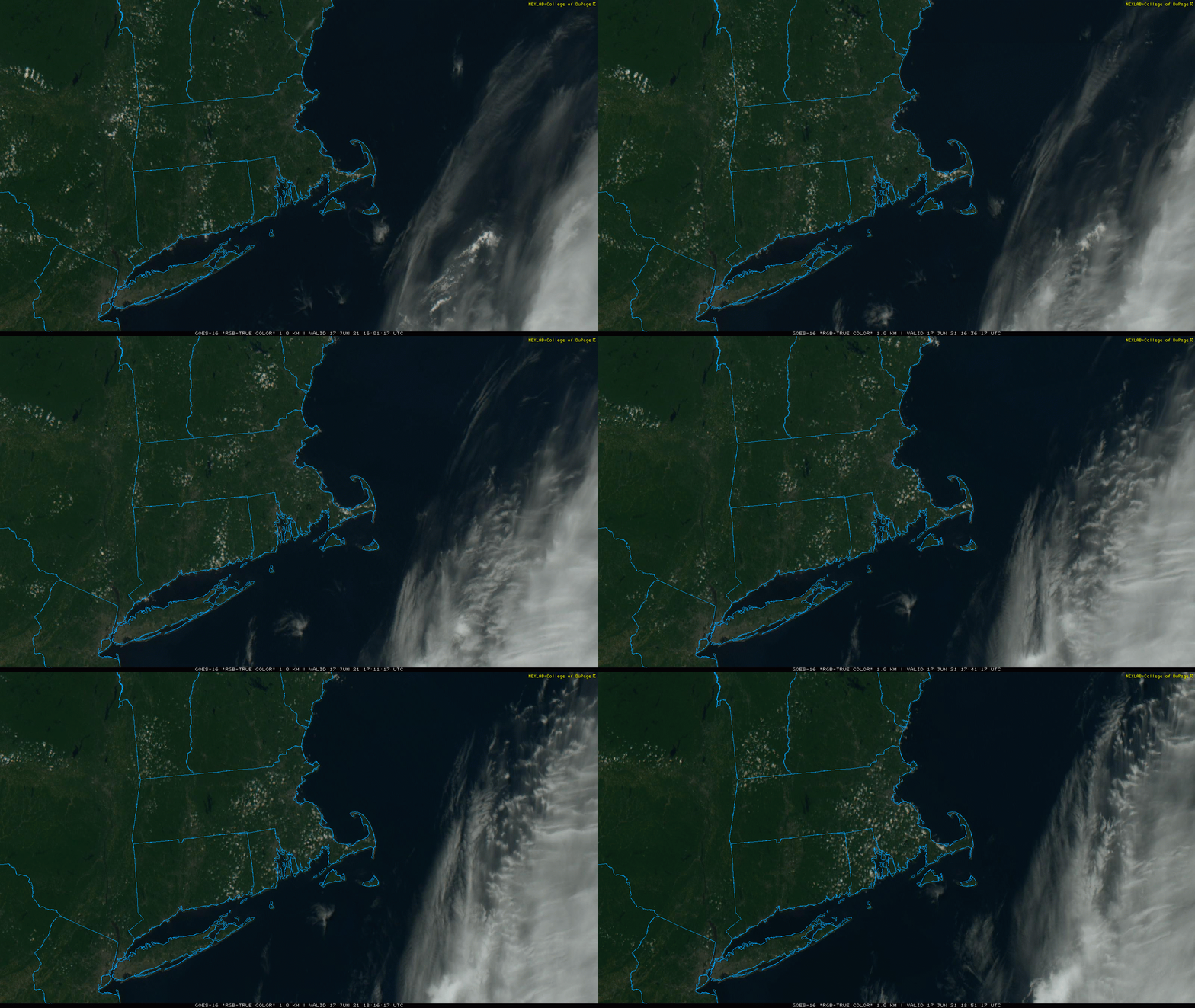
Aside from some pop-up cumulus, it’s a picture-perfect day across the region. Loop provided by the College of DuPage.

High pressure remains in control into Friday with more sunshine and warm temperatures as the high slides offshore. Humidity levels may start to creep up a bit on Friday, but it will still be comfortable. Low pressure will be heading into southern Canada later on Friday, and it will send a warm front our way at night. As that front moves through early Saturday morning, it may produce a few showers or thunderstorms. Not a big deal, and they should be done before most of you have finished your breakfast (or even gotten out of bed). Some sunshine may break out in the afternoon, and it will be quite warm and humid. A cold front will sweep across the region during the afternoon and evening. That front will produce another round of showers and thunderstorms. Depending on the timing of the front, some of those storms could become strong to possibly even severe. Don’t go cancelling any late-afternoon or evening plans, but if you’ll be outside, keep an eye to the sky.

High pressure builds back in on Sunday for the final day of Spring (the Summer Solstice occurs at 11:31pm Sunday night) with lower humidity, but it will remain quite warm. Humidity levels and temperatures will creep back up on Monday ahead of the next frontal system. Any shower or thunderstorm activity with this system should hold off until after dark.

We’ll give a quick mention about the tropics here as well. There are no active systems at this time, but there is a cluster of thunderstorms in the western Gulf of Mexico that is being monitored. It will likely become a tropical depression, possibly as early as tonight, then head northward. It should bring some heavy rain to parts of the Gulf Coast and Deep South this weekend. The National Hurricane Center is going to start issuing advisories on “Potential Tropical Cyclone Three” at 5pm EDT. We’ll likely write a blog post about the system either late tonight or tomorrow, once it actually becomes a tropical depression or tropical storm. Beyond that, some of the moisture from this system could interact with the cold front approaching us Monday night, but it’s still a little early to determine if that will happen or not. We’ll have a better idea by the time we issue our Weekly Outlook early Monday morning.

Satellite loop of the Gulf of Mexico where a tropical depression will likely develop tonight or tomorrow. Loop provided by NOAA.

Thursday night: Clear skies. Low 48-55.

Friday: Morning sunshine starts to fade behind increasing late-day clouds. High 77-84. Offshore: Southwest to south winds 10-15 knots, seas 2-4 feet.

Friday night: Mostly cloudy, chance for a few showers or thunderstorms late at night. Low 59-66.

Saturday: A few early showers, then becoming partly sunny. Another round of showers and thunderstorms is possible late in the day. High 80-87. Offshore: Southwest to south winds 10-20 knots, seas 3-6 feet.

Saturday night: Showers and storms end in the evening followed by clearing. Low 58-65.

Sunday: Sunshine and some afternoon clouds. High 81-88. Offshore: Southwest to south winds 10-15 knots, seas 2-4 feet.

Sunday night: Clear during the evening, clouds start to filter in late at night. Low 59-66.

Monday: Partly sunny. High 85-92, cooler along the South Coast. Offshore: South winds 10-15 knots, seas 2-4 feet.

The Atlantic Awakens

We’re only two weeks into Hurricane Season, and the peak of the season is still three months away, but activity is starting to ramp up in the Atlantic, as another cluster of thunderstorms has received a name.

Satellite loop of Tropical Storm Bill from late Monday afternoon. Loop provided by NOAA.

In our Weekly Outlook early this morning, we mentioned an area of thunderstorms off the North Carolina coast that was disorganized. We also said that given NHC’s history, we fully expected it to be classified as a short-lived tropical depression or storm, even though it really wasn’t one. Well, as expected, the National Thunderstorm Naming Hurricane Center decided that even though there wasn’t much thunderstorm activity along a stationary from Monday morning, it was good enough for them to call it Tropical Depression Two. As of 11pm Monday, it had strengthened into “Tropical Storm Bill”, and was centered about 335 miles east-northeast of Cape Hatteras, NC, moving toward the northeast at 23 mph. Maximum sustained winds were near 45 mph. The system remains weak, and there is not a lot of thunderstorm activity with it at the moment, but it is moving over the warm waters of the Gulf Stream, so there is a small window for the system to intensify over the next 12 hours. After that, it will be moving over colder water, and will weaken before bringing some gusty winds and rainfall to parts of Newfoundland and possibly Nova Scotia tonight and Wednesday.

In the eastern Atlantic, a strong tropical wave has moved off the west coast of Africa, passing south of the Cabo Verde Islands tonight. While this system may develop a little over the next day or two, the combination of unfavorable upper-level winds and dry air will limit any development once the system reaches the central Atlantic Ocean. Once we get a little deeper into hurricane season, conditions should become more favorable as more and more waves roll off of Africa and cross the Atlantic. Some of these storms historically have become powerful systems, as they have plenty of time to develop over open water. We usually need to start paying attention to this region once we get into July.

Saharan dust crossing the Atlantic will limit any storm development. Loop provided by Weathermodels.com

The system that bears watching is in the Bay of Campeche. A cluster of showers and thunderstorms continues to meander around associated with a broad area of low pressure. While this will produce some heavy rain across parts of Mexico and Central America, it is not expected to develop over the next few days. By late in the week however, the system will start drifting northward, and conditions will become more favorable for development. It could become a tropical depression by the weekend, then it may head toward Louisiana or Texas.

Satellite loop of the Gulf of Mexico, including the Bay of Campeche. Loop provided by NOAA.

While it’s still a little early to speculate on any potential track or strength for this system, most of the models are in agreement that most of the rain from this system will head towards Louisiana. Much of southern Louisiana and Mississippi has received 30 to 45 inches of rain over the past 90 days, which is more than twice the normal amount they receive in that time frame. This has led to widespread flooding in areas still attempting to recover from several direct hits during the 2020 hurricane season. A tropical system, even a weak one, could drop 10 or more inches of rain on this area, leading to even more flooding.

Much of the Lower Mississippi Valley has been deluged with more than 30 inches of rain over the past 90 days. Image provided by WeatherBell.

Elsewhere, the only other active system in the tropics is Tropical Depression Carlos in the Eastern Pacific, but it is expected to dissipate on Tuesday over open water.

Weekly Outlook: June 14-20, 2021

We’ve got a typical summertime pattern shaping up for the final week of astronomical spring. Astronomical Summer begins with the Summer Solstice on Sunday June 20, at 11:31pm.

The sun angle is the highest in the Northern Hemisphere on the Summer Solstice. Image provided by the Old Farmers Almanac.

The week will actually start off on a damp note as a cold front approaches the region. This will produce scattered showers and thunderstorms, some of which could produce locally heavy rainfall. The entire day shouldn’t be a washout, as these will be more of the hit-and-miss variety, especially late in the day and tonight. Another round of showers and thunderstorms is expected on Tuesday as the front finally moves through the region. Again, some of these could be heavy in spots.

Parts of the region could pick up a decent amount of rainfall between today and tomorrow. Images provided by Pivotal Weather.

High pressure builds in for Wednesday and Thursday with drier and seasonably warm conditions. An upper-level low pressure area will be in place across the Northeast, helping generate some clouds each day, with a slight chance for a pop-up shower each afternoon, but these will be few and far between. By Friday, that high will slide offshore, allowing warmer and more humid air to start to move back into the area. That warm and humid airmass will be in place on Saturday when another cold front approaches, triggering another round of showers and thunderstorms. High pressure returns next Sunday with drier air.

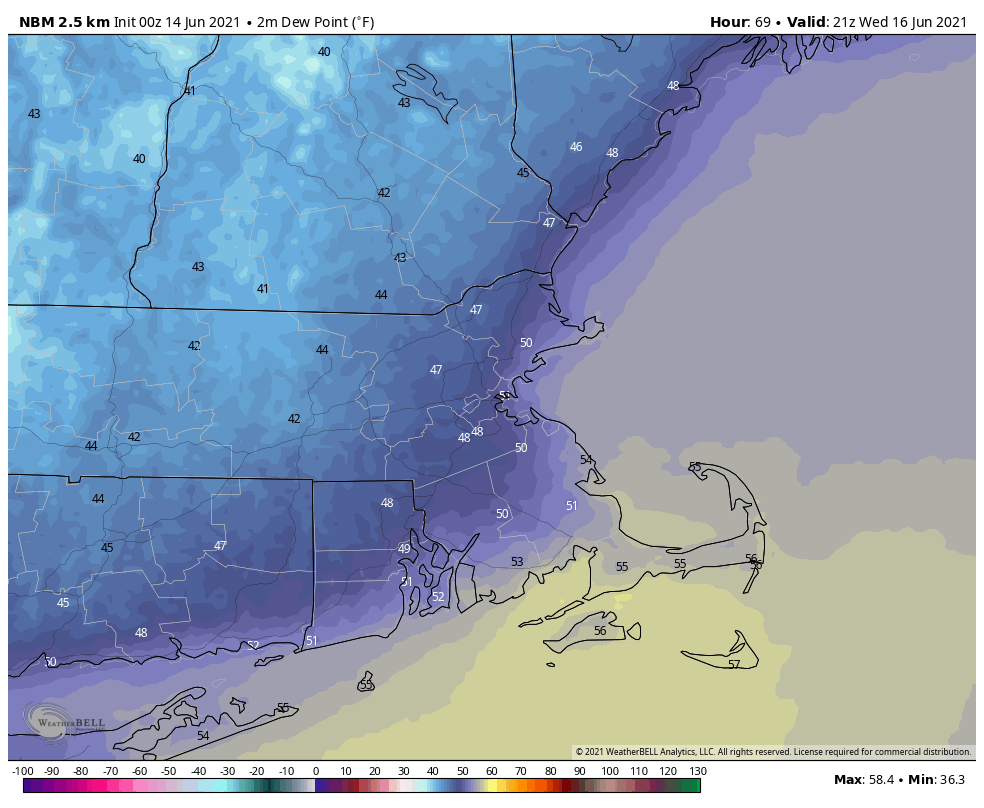
Dewpoints will drop into the 40s and lower 50s by Wednesday afternoon. Image provided by WeatherBell,

Monday: Plenty of clouds with a few showers and thunderstorms, especially early and again late in the day. High 66-73.

Monday night: Mostly cloudy with more showers around. Low 56-63.

Tuesday: Intervals of clouds and sunshine with occasional showers and thunderstorms. High 72-79.

Tuesday night: Becoming clear to partly cloudy. Low 54-61.

Wednesday: Sunshine and some afternoon clouds. High 71-78.

Thursday: Partly to mostly sunny. High 71-78.

Friday: Sunshine fades behind increasing afternoon clouds. High 75-82.

Saturday: Intervals of clouds and sun with scattered showers and thunderstorms. High 78-85.

Sunday: A mix of sun and clouds. High 76-83.

The Atlantic is showing signs of life as we head into mid-June. Image provided by the National Hurricane Center.

Finally, we’re going to mention the tropics. There are two areas that the National Hurricane Center is keeping an eye on in the Atlantic right now. The first one is in the Bay of Campeche. This system will bring heavy rain to parts of Mexico and Central America for the next few days. After that, it should start to drift northward and could get organized. Several forecast models have been showing this potential for a while now. While it’s still too early to tell if anything will actually develop, most of the models are showing a weak system tracking toward either Texas or Louisiana. The more concerning part is that most of the models show the potential for very heavy rain later this week and this weekend, especially in Louisiana. It’s been a VERY wet spring across this area, and additional heavy rain will result in significant flooding. Parts of Louisiana have received 30 to 40 or more inches of rain over the past 90 days, and some models are showing the potential for another 5-10 inches or more next weekend.

The GFS is forecasting a lot of rain at the end of the week for an area that doesn’t need it. Image provided by WeatherBell

The other area being watched is a cluster of thunderstorms off the Carolina coastline. It’s disorganized and non-tropical right now, but will be moving over the warm waters of the Gulf Stream today and tomorrow. Given NHC’s recent history, we fully expect it to be named a short-lived Tropical Depression or Storm (even though it won’t actually be one) before it moves over colder water east of New England and south of Nova Scotia on Wednesday.