Once More Unto the Breach, Dear Friends

Yes, the rumors are true, a storm system is on the way for the weekend, and there is the potential for some significant snowfall. Nothing is definite yet though, so let’s separate the truth from the exaggeration. First, we’ll set the table for what’s going to happen.

Low pressure will move out of the Gulf of Mexico and up the East coast Friday into Saturday while rapidly intensifying. (You’ll hear the word bombogenesis used for sure.) Before that happens, a cold front will move across the Northeast on Friday, producing some snow showers. These are unrelated to the storm system, and could drop an inch or less on the region. That front will likely dissipate south of New England as the approaching coastal storm overwhelms it. Meanwhile, behind that front, a large high pressure system will build into southeastern Canada, locking cold air into place.

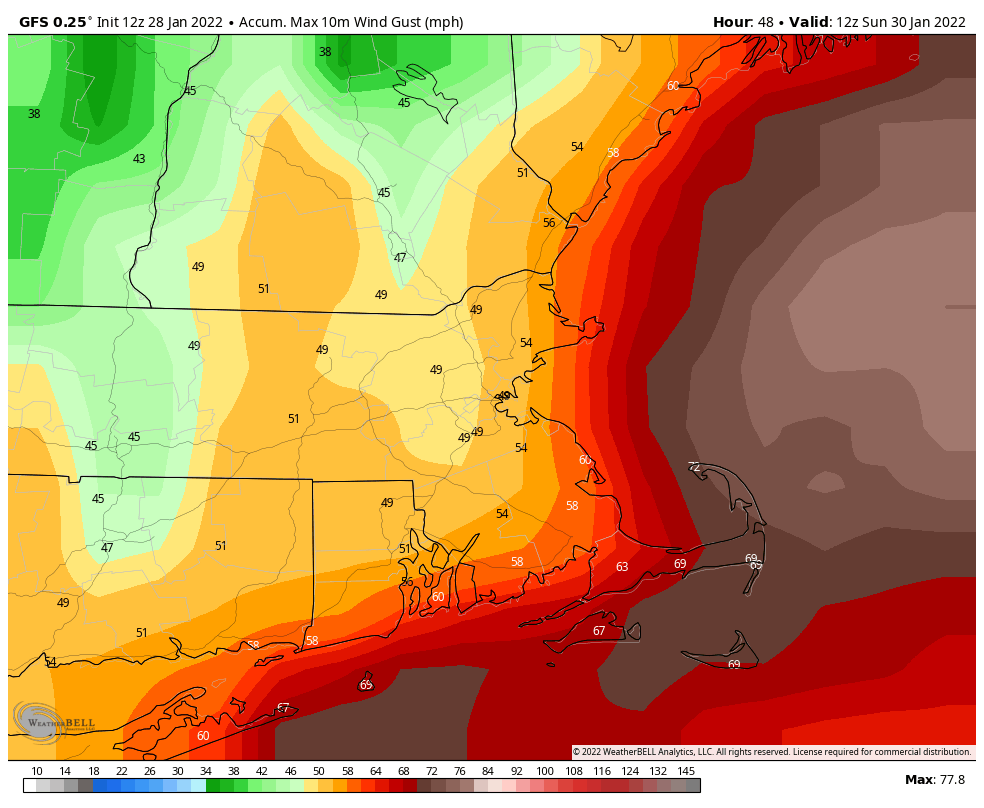
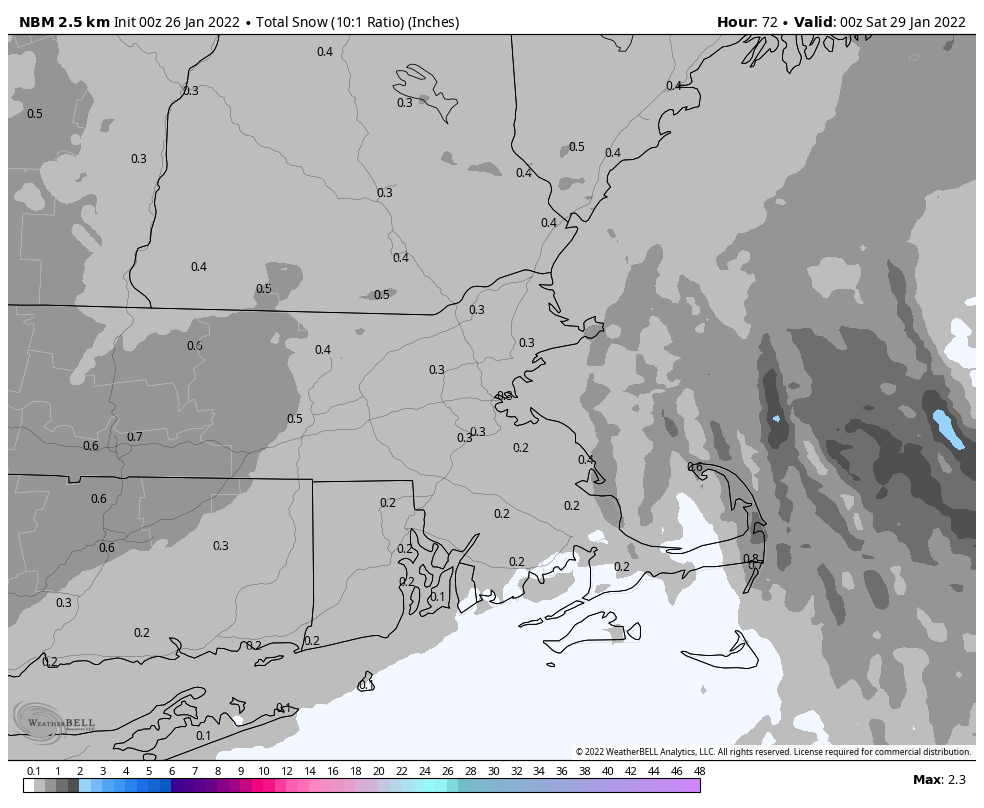
Friday’s cold front will drop less than 1″ of snow on most of the region. Image provided by WeatherBell.

OK, now that we have the basic setup, let’s delve into a few things that we’ve heard or read today and how truthful they are.

Statement: An historic blizzard could set records across the Northeast this weekend.
Truth: Yes, some models are showing a rather extreme storm system with the potential for extraordinary snowfall totals. But, it’s still 4 days away, and a lot can change. This is far from a given. We’ll explain below.

Statement: This will be all snow for the entire region.
Truth: Again, given that there is still some uncertainty in the track, a mix or change to rain can’t be ruled out, especially for Cape Cod, and possibly eastern Massachusetts of Rhode Island. Again, read on for more details.

Statement: Significant coastal flooding is likely.
Truth: This one rings true. With a New Moon on Tuesday (we were that close to a Duran Duran song), tides will be running astronomically high. Add in strong east to northeast winds pounding the shoreline for 2 and potentially 3 high tide cycles, yes, coastal flooding is likely, especially the normally vulnerable locations.

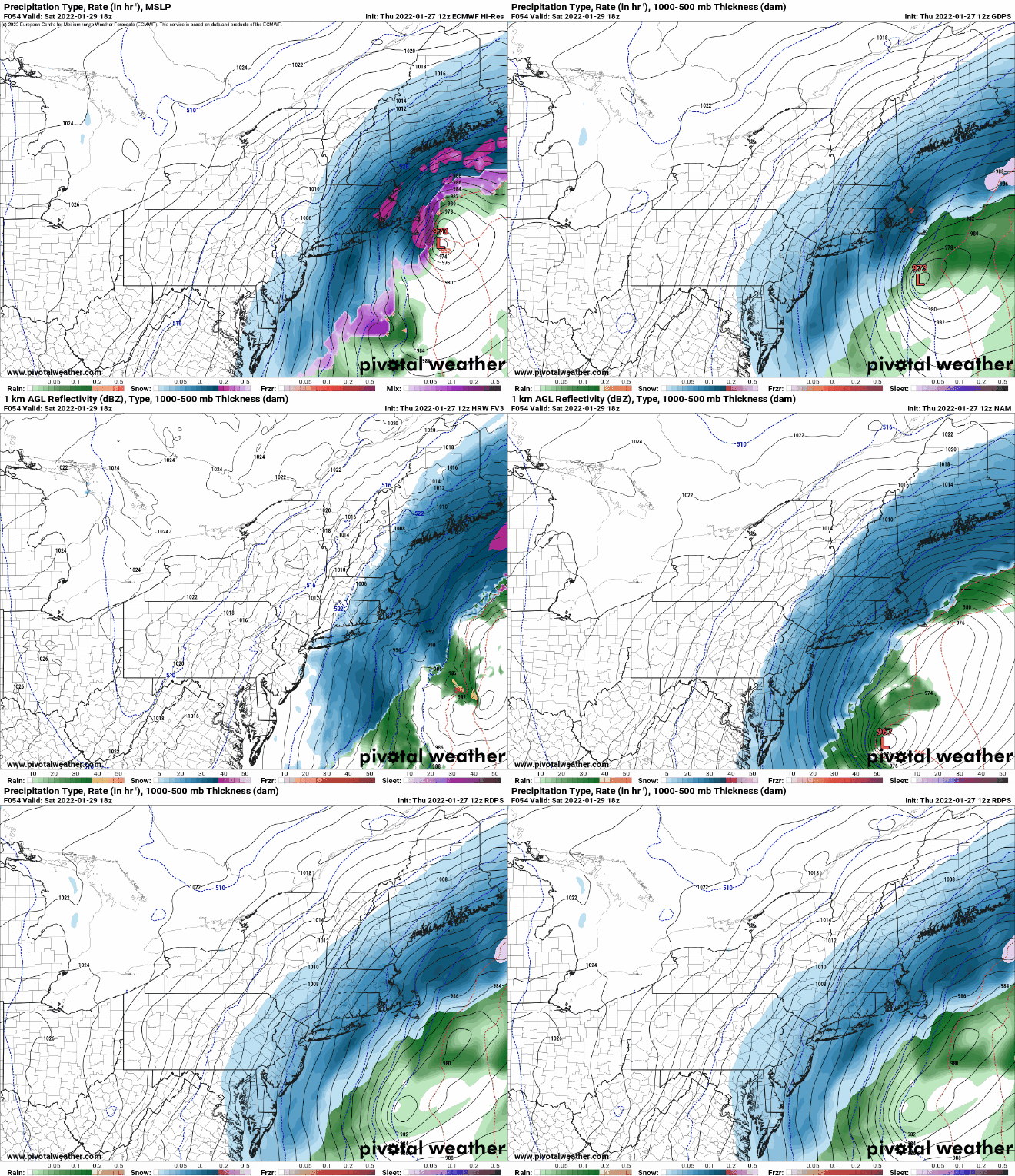
OK, now let’s get into what could happen on Saturday. A rapidly intensifying storm system will head up the East Coast, producing strong winds and heavy snow ahead of it. While most of the models are fairly similar to each other with a track close to the “benchmark” (40N/70W), this is far from definite. The storm could end up farther offshore, which would limit the how far inland the heavy snow extends. The storm could also track closer to the coast, which would allow milder air to move in and change the snow to rain, how far inland the change could occur would be determined by the track obviously. This is the type of the detail that won’t become clearer for another day or two at best.

Our friends at the National Weather Service office in Norton, MA explain the potential error in the model forecast nicely.

One factor in determining that track? The upper-level energy responsible for the storm is just moving into from the Pacific tonight. Why is that important? Let us explain. Every day around the world, we send up weather balloons twice a day to sample the upper atmosphere. This is done at 00UTC and 12UTC everywhere (7am/7pm in EST). This data is then fed into the models. The upper-level energy that will create our storm has been over the Pacific for the past several days, where there is little data. In the past, we would get observations from planes as well to supplement the balloons, especially over the water, where there are no balloon launches obviously. Well, since the pandemic, air traffic is less than half what it used to be, so there are a lot less of those aircraft observations. So, we are basically at the mercy of the balloon data. Once that upper-level energy moves over land, as it is doing now, it will be into the balloon network. The models should now start to have a better idea of its structure and converge on a solution.

The kink in the flow near the British Columbia coast and the one over northern Alberta will eventually combine to create our weekend storm. Once they’re over areas with more data, we’ll have a better idea how strong they are. Image provided by the University of Wyoming.

Complicating things is the fact that some models show the system being captured by the upper-level trough of low pressure, or even getting stuck underneath a “cutoff” upper-level low pressure system. (It’s called that because it becomes cut off from the jet stream.) This would potentially allow the low to stall out south of New England for a while, prolonging the impacts to the region. How strong the storm gets (also up for debate) could determine whether or not this scenario occurs, but will also impact how strong the winds will be and in turn the amount of coastal flooding that may occur. Right now, the timing of the system looks to be generally between midnight Saturday morning and midnight Sunday morning, but obviously, this is far from definite.

The models still do not agree on the strength or location of the storm Saturday afternoon. Images provided by Pivotal Weather.

As for how much snow will fall? Well, we’re not even going to attempt to put any numbers down yet. There is still FAR too much uncertainty. In addition to all the factors we talked about above, another one is temperature. Some models keep the cold air locked into place, with temperatures in the teens and 20s for much of the region during the storm. This would result in a much fluffier snow, making it a little easier to clean up, but also allowing it to pile up a lot quicker. If the warmer air does move in, especially near the coast, then temperatures could be near or even above freezing in spots. The general rule is that 1 inch of liquid precipitation equals 10 inches of snow. This holds true at temperatures close to freezing. With temperatures in the lower 20s, that 1 inch of liquid could result in 20 inches of snow. Most of the snow maps you may see online are ones that use the 10:1 ratio only, so in colder scenarios, like this one could be, they will underestimate the amount of snow.

If you really want, there are plenty of people all over Facebook, Twitter, and the web, who are more than happy to share all of those various model forecast maps, no matter how far-fetched they may seem. We’re not going to do that. We’ll just say that the potential is there for this to be a significant snowstorm.

Given all of this, we are issuing an Extreme Hype Watch for the StormHQ viewing area. An Extreme Hype Watch is issued when conditions are favorable for media hype of an event to reach extreme levels within the next 48-72 hours. If conditions warrant, a Hype Advisory or Extreme Hype Warning will be issued as the event draws nearer. We’ll hazard an initial attempt at amounts when we publish our Weekend Outlook Thursday afternoon. In addition, well do another full blog post on Friday.

Weekly Outlook: January 17-23, 2022

The week is starting off on a very stormy note, but should quiet down later in the week.

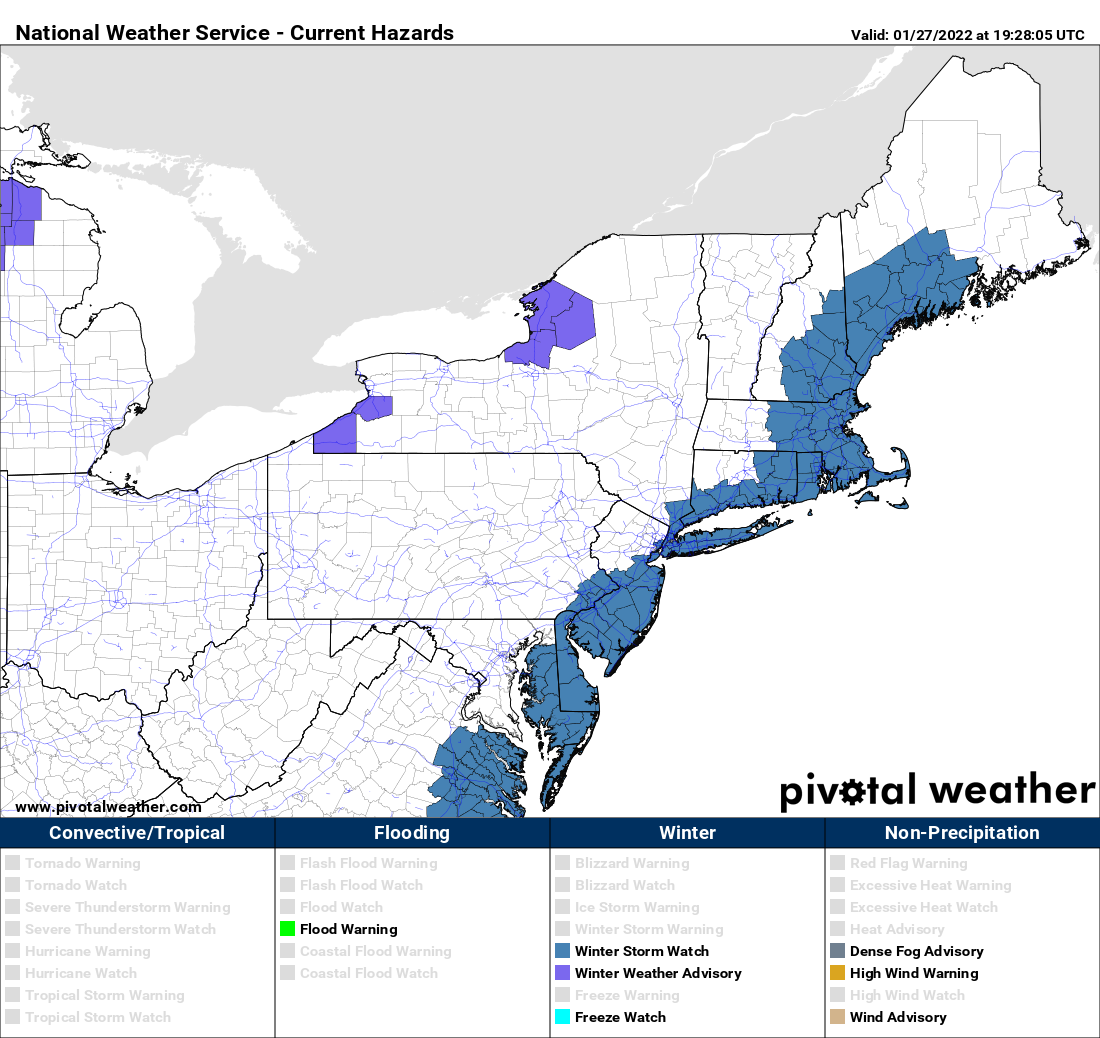
A variety of advisories and warnings are in effect across the Northeast. Image provided by Pivotal Weather.

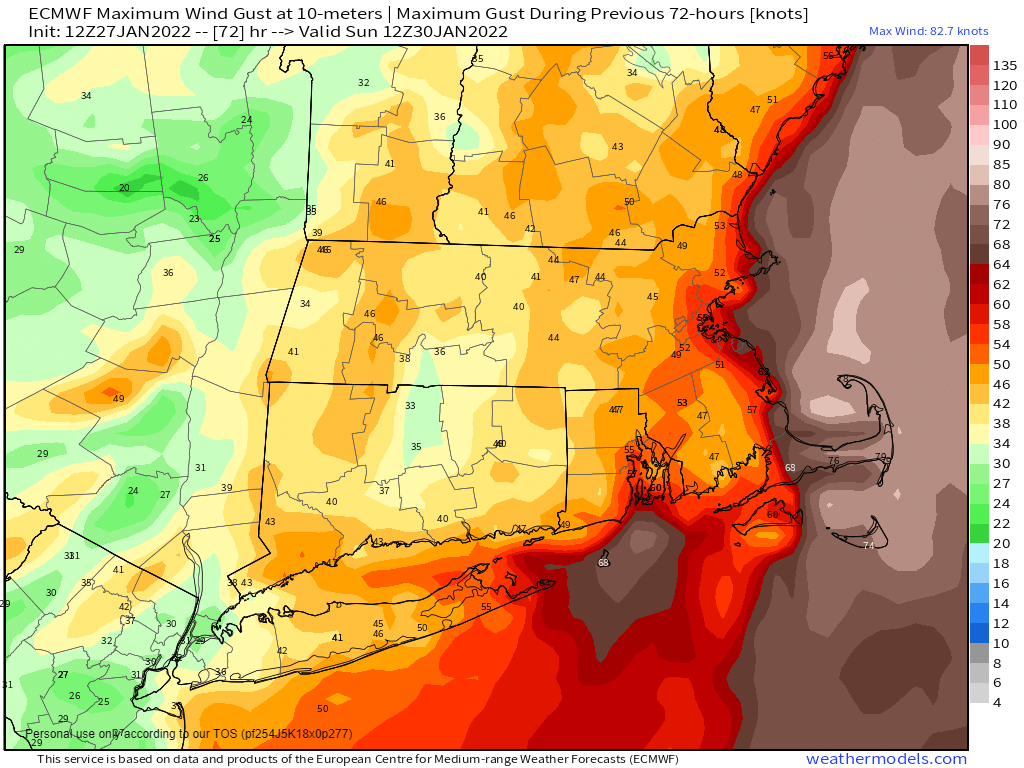
Low pressure will move across the region today, bringing a variety of hazardous conditions in, mainly during the morning hours. Some heavy rain is likely through the morning, tapering off by early afternoon as an occluded front moves across the region. Some strong winds are also likely this morning, especially near the coast, where gusts of 50-60 mph are possible. In addition, some coastal flooding is likely around high tide, due to the combination of strong onshore winds and already astronomically high tides. Notice what we didn’t mention? Snow. Any snow will be confined to areas well north and west of Boston, and likely will have changed to rain and/or ended by the time most of you read this.

Wind gusts could exceed 50 mph along the coast this morning. Image provided by WeatherBell.

During the afternoon it will still be breezy, but winds won’t be nearly as strong as they are in the morning. A cold front will move through by evening as the low passes by to our north, and that front could be accompanied by some rain or snow showers. High pressure then builds in for Tuesday with sunshine, but it will be breezy and turning colder once again. The cold air will be short-lived as another weak system approaches for Wednesday. As this system moves through, we could see some rain or snow showers late Wednesday and Wednesday night. High pressure then builds back in for Thursday and Friday, with a return to much colder weather, though not likely as cold as we had earlier this past weekend. As we head into next weekend, we’ll be keeping our eyes on a potential coastal storm. While some models have shown the potential for it to impact us next weekend, at this point, the more likely scenario is that it stays offshore with little impact, and high pressure continues to build in, keeping us dry and cold. As usual, we should have a better idea of what to expect when we publish our Weekend Outlook on Thursday.

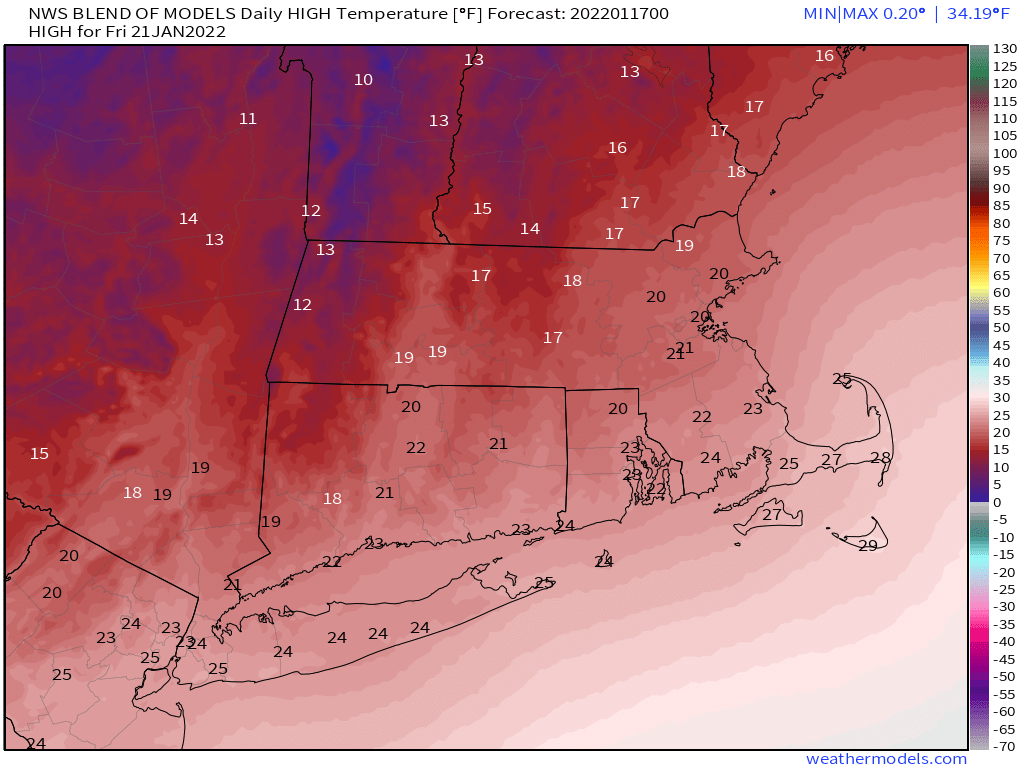
Friday looks like it will be another very cold day across the region. Image provided by Weathermodels.com

Monday: Windy with snow across the interior changing to rain early, elsewhere rain, heavy at times in the morning, ending by early afternoon. Mostly cloudy with diminishing winds in the afternoon. High 41-48 in the morning, temperatures start to drop in the afternoon.

Monday night: Mostly cloudy and breezy, chance for a few rain or snow showers during the evening. Low 18-25.

Tuesday: Becoming partly to mostly sunny, still breezy. High 23-30.

Tuesday night: Clear during the evening, clouds start to move back in late at night. Low 8-15.

Wednesday: Mostly cloudy and breezy, chance for a few snow or rain showers late in the day and at night. High 37-44.

Thursday: Mostly cloudy, any lingering snow showers end early. High 31-38.

Friday: Partly sunny and cold, except mostly cloudy across Cape Cod with a few snow showers possible. High 17-24.

Saturday: Partly to mostly sunny. High 21-28.

Sunday: Mostly cloudy. High 28-35.

Weekend Outlook: January 14-17, 2022

We’ve got a lot going on over the next few days across the region, and you probably won’t like most of it.

A storm system will develop off the Mid-Atlantic coast tonight, and rapidly strengthen as it heads northeastward, passing well south and east of the region on Friday. However, it will be close enough to spread some rain and strong winds into Cape Cod and possibly southeastern Massachusetts. At the same time, a cold front will drop down from the northwest, ushering arctic air back into the region. This may allow the rain to change to snow before it ends. Temperatures will quickly drop Friday afternoon and evening as gusty northwest to north winds continue to send the arctic air in. Any surfaces that are wet from the rain across southeastern Massachusetts will quickly freeze up Friday afternoon and evening, so keep this in mind if you’re heading out that evening.

Northerly winds may gusts to 35-45 mph on Friday, ushering arctic air into the region. Image provided by WeatherBell.

We’ll drop into the single numbers by Saturday morning, with some subzero lows north and west of Boston. With strong winds, wind chills will be well below zero Friday night and Saturday morning, so dress appropriately if you’ll be outside. Saturday looks to be a day similar to this past Tuesday with sunshine and some afternoon clouds, possibly a few snow showers across Cape Cod, and temperatures struggling to reach the lower to middle teens. Winds die down Saturday night, resulting in another chilly night, with subzero lows possible once again. Sunday starts off with some sunshine, but clouds start to move in during the afternoon as temperatures start to moderate. This brings us to the complicated part of the forecast.

With wind chills like this, Saturday morning will be a good time to stay inside. Image provided by WeatherBell.

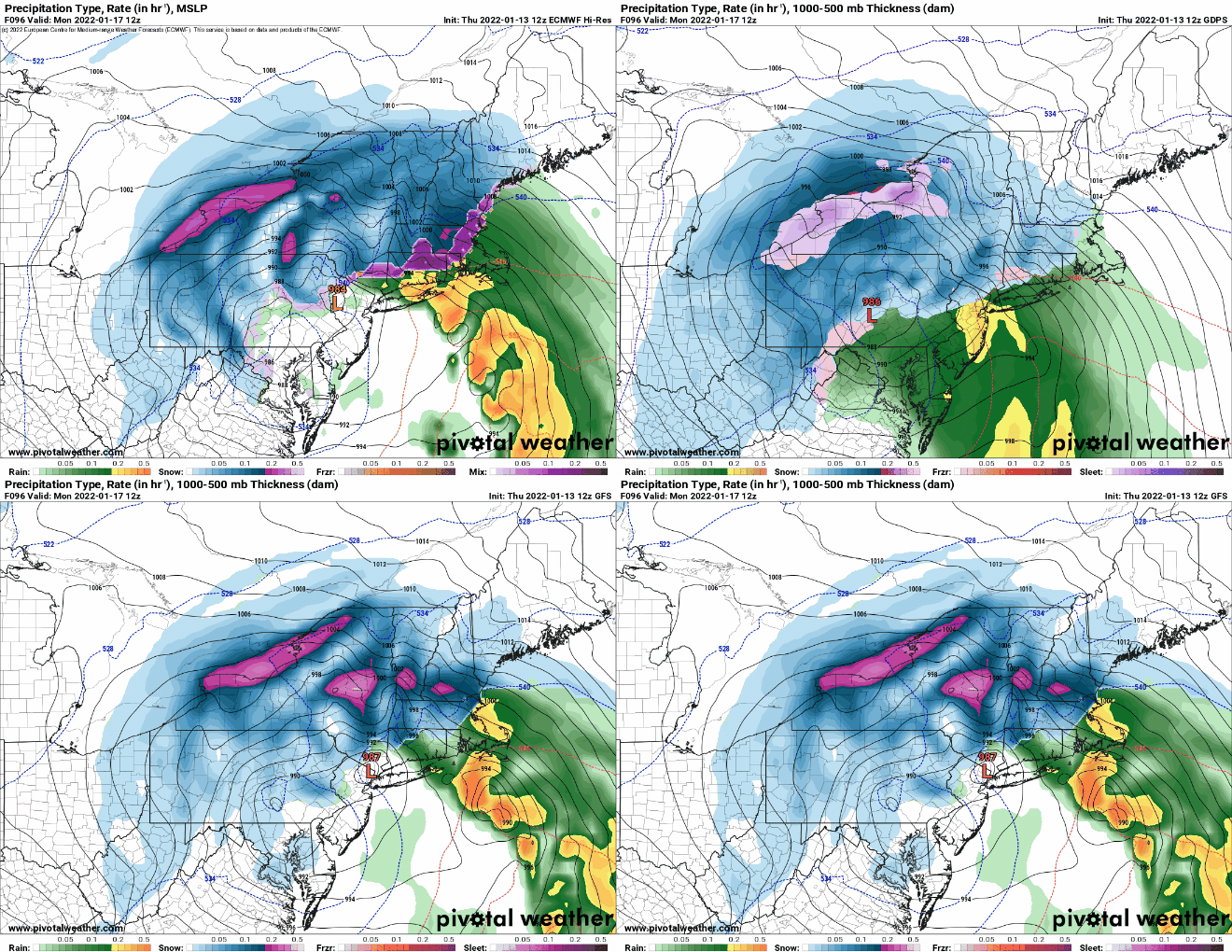
Another strong low pressure system will develop across the Southeast and make its way up the East Coast on Sunday. There is still some uncertainty with the exact track that the storm will take, but for now it looks like it may stay near the coast or just inland, passing directly over, or just west, of our area on Monday, though this is subject to change. This track would result in snow changing to sleet and/or freezing rain and then plain rain across much of the area. However, this is far from a guarantee. There are still some models that bring the storm a little farther south and east, which would result in more snow and less rain, but as we’ve mentioned numerous times, the models have been less than trustworthy beyond 2 or 3 days recently. When (or if) a change to mix and/or rain occurs will also have a significant impact on how much snow accumulates. Given the amount of uncertainty, it’s still WAY too early to try and pin down any potential accumulations, but it’s safe to say that the farther north and west of Boston you are, the better the chance you’ll need to fire up the snowblower or find your shovels. We’ll try to post an update this weekend, once we have some better clarity on the storm.

There is plenty of uncertainty in regards to storm for Sunday/Monday. Images provided by Pivotal Weather.

Thursday night: Partly to mostly cloudy, rain may develop across Cape Cod towards daybreak. Low 26-33.

Friday: Mostly cloudy, rain likely across Cape Cod and southeastern Massachusetts, possibly changing to snow before ending, becoming windy. High 35-42, but temperatures will start to quickly drop in the afternoon.

Friday night: Clearing, windy, and much colder, except partly cloudy with a few snow showers across Cape Cod. Low -3 to +4, except milder across Cape Cod and the Islands.

Saturday: Partly to mostly sunny, breezy, and very cold, except partly sunny with a few snow showers across Cape Cod. High 10-17.

Saturday night: Clear skies with diminishing winds. Low -2 to +5, except milder across Cape Cod and the Islands.

Sunday: Sunshine to start the day, clouds move in during the afternoon. High 23-30.

Sunday night: Cloudy and becoming breezy with snow developing, possibly rain across Cape Cod. Low 14-21.

Monday: Snow, possibly changing to sleet/freezing rain/rain, especially the farther south and east you go. High 39-46.

Weekend Outlook: January 7-10, 2022

Our first snowstorm of the season is on the way for Friday, but it’s just part of a colder pattern we’re heading into for the weekend and beyond.

A variety of advisories, watches, and warnings are in effect across the region. Image provided by the National Weather Service office in Norton, MA.

Low pressure is moving across the Tennessee Valley this afternoon, and it will head east-northeastward, moving off the Mid-Atlantic coast tonight, passing south and east of New England on Friday as it intensifies. We’ll see snow developing before daybreak, and it may fall heavy at times during the morning, which will result in significant problems for the morning commute. The snow should come to an end by mid-afternoon across the region. Based on the trends in the models since last night, we are adjusting our snowfall forecast upwards a bit, but not that much. Here’s our latest projections:

Southern NH: 3-5″
NH Seacoast/Merrimack Valley: 3-6″
MetroWest/I-495 Belt: 4-7″
I/95 corridor/SE Mass/RI: 5-8″
Upper Cape Cod: 3-6″
Outer Cape/Islands: 1-3″

The National Blend of Models is closest to our thinking right now, but it may be a bit on the high side. Image provided by WeatherBell.

The storm pulls away Friday evening, and skies clear out as high pressure builds in, setting up a sunny but rather chilly Saturday, with many places likely staying in the 20s all day. With clear skies and fresh snowcover, temperatures will quickly plunge Saturday evening into the teens and possibly single numbers in some spots. Clouds stream back in late Saturday night as another system moves toward the region. While this system looks a bit milder, with southerly winds warming things up a bit on Sunday, the models have been trending less mild with every run. With that in mind, we’ll probably see some snow showers or a little freezing rain develop north and west of Boston Sunday afternoon, changing to rain by evening. Keep this in mind if you are going to be out and about Sunday afternoon. Elsewhere, just plain rain is expected. The rain may mix with some wet snow before winding down around daybreak Monday. After that, some of the coldest air thus far this winter will pour into the region. Temperatures may not rise much, if at all, Monday afternoon. The coldest weather looks to arrive on Tuesday, when highs may stay in the teens, with subzero lows possible Tuesday night. We’ll have more info on that in our Weekly Outlook early Monday morning.

Tuesday looks like a very cold day across the region. Image provided by Weathermodels.com

Thursday night: Becoming cloudy, snow developing 2-5am. Low 23-30.

Friday: Breezy with snow, possibly heavy at times in the morning, ending 12-3pm. High 28-35.

Friday night: Clearing, colder. Low 11-18.

Saturday: Plenty of sunshine, chilly. High 24-31.

Saturday night: Clear through the evening, clouds start to move back in late at night. Low 10-17, but temperatures may rise a bit after midnight.

Sunday: Cloudy and breezy with showers likely in the afternoon, possibly starting as snow or freezing rain north and west of Boston. High 37-44.

Sunday night: Showers changing to snow showers before ending by daybreak. Low 22-29.

Monday: Becoming partly to mostly sunny and colder. Temperatures hold steady or drop a bit during the day.

Henri Heads for the Hamptons, Grace Grows Greatly

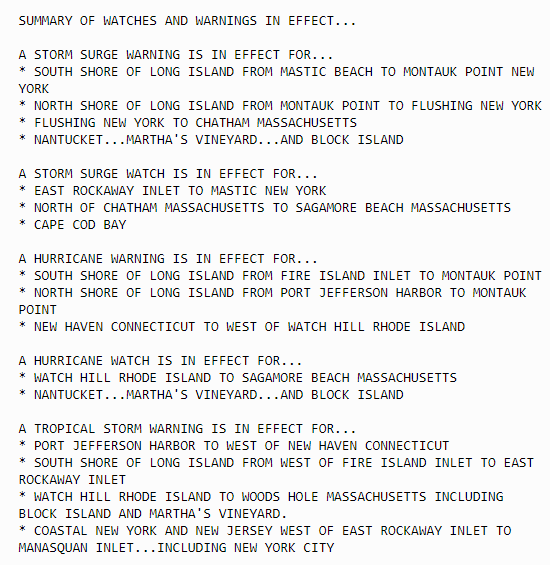
Tropical Storm Henri has made the long-awaited northerly turn and now is heading towards New England or Long Island while Hurricane Grace has rapidly strengthened as it nears the coast of Mexico.

Satellite loop of Tropical Storm Henri. Loop provided by NOAA.

As of 11pm Friday, Tropical Storm Henri was centered about 615 miles south of Montauk, New York, moving toward the north at 9 mph. Maximum sustained winds were near 70 mph. Henri is expected to strengthen for the next 24 hours or so as wind shear begins to lessen and the storm remains over the warm waters of the Gulf Stream. Henri will likely become a hurricane on Saturday.

Watches and Warnings are in effect for a large portion of the Northeast coast. Image provided by the National Hurricane Center.

With a ridge of high pressure building in to the east of Henri, and an upper-level low pressure area developing over the Great Lakes, Henri will be steered northward for the next 24 hours, Beyond that, the upper-level low will start pull Henri northwestward and slow it down as it begins to approach Long Island or Southern New England. Since it will be over cooler water at that time, it will begin to weaken. Current forecasts show that Henri may still be a minimal hurricane at landfall, but there is also a good chance that it may weaken to a tropical storm by the time it reaches land.

The various members of the GFS and ECMWF Ensembles show landfall anywhere from New York City to Cape Cod. Image provided by Tomer Burg.

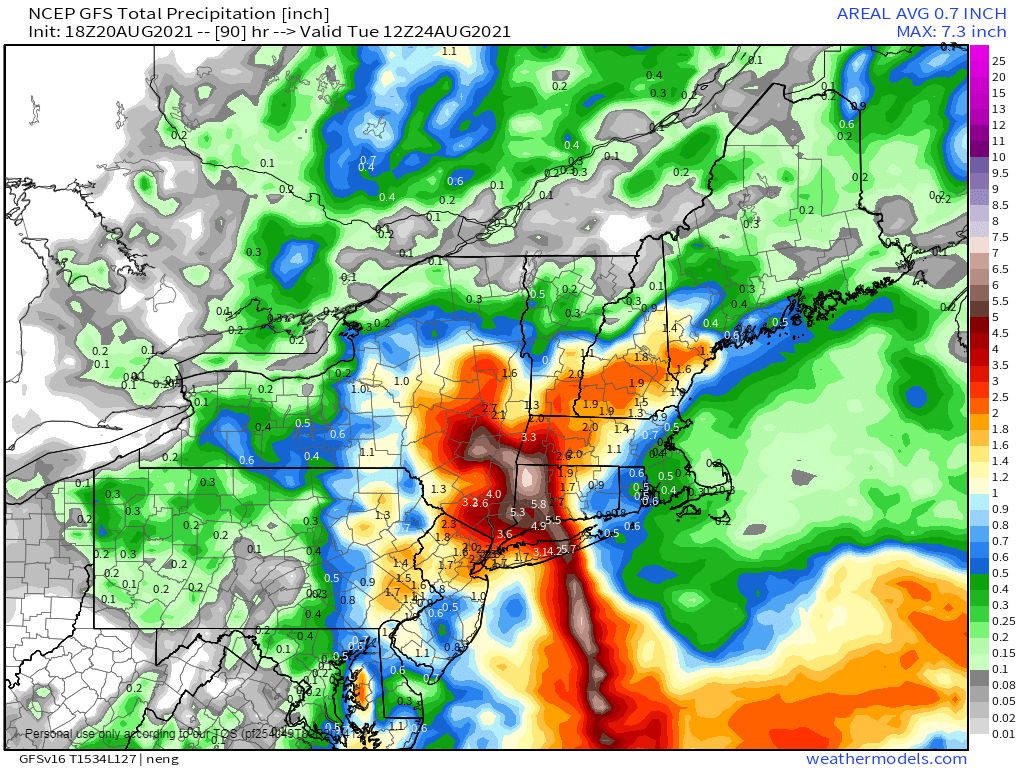
Although the exact track and intensity are still in question, the general impacts should be similar to most tropical systems that impact the Northeast. These systems tend to become lopsided, with the strongest winds mainly to the right of the center, and most of the rain shifting to the left of the track. The current forecast of a track towards eastern Long Island would mean that gusty winds and the highest storm surge would impact parts of Rhode Island and southeastern Massachusetts, including Cape Cod. The storm surge will be compounded by the fact that with a full moon on Sunday, tides will be astronomically high, exacerbating any storm surge flooding. The western track would also mean that the heaviest rain and greatest threat of freshwater flooding, would shift to Long Island, western portions of Connecticut and Massachusetts, and eastern New York.

Expected peak storm surge associated with Henri. Image provided by the National Hurricane Center.

While the winds won’t be particularly strong across much of Southern New England, tree damage could be more extensive that you’d normally expect. It has been a very wet summer across the region, with many places receiving 10-20 inches since the beginning of July. As a result, the ground is saturated across much of the area, so it won’t take strong winds to knock trees over. It also will result in more extensive flooding in areas that receive heavy rain.

Rainfall totals of 4-8 inches are possible where the heaviest rain falls. Image provided by Weathermodels.com

As the steering currents weaken late Sunday and Sunday night, Henri or what’s left of it, may stall out across western New England or eastern New York, then eventually start moving eastward, bringing more rain to parts of central and northern New England. Conditions will improve from west to east on Monday as the storm departs and high pressure starts to build into the region.

Satellite loop of Hurricane Grace. Loop provided by NOAA.

Meanwhile, in the Bay of Campeche, Hurricane Grace rapidly intensified into the Category 3 Hurricane this evening, with maximum sustained winds near 105 mph. As of 11pm, Grace was centered approximately 75 miles east-southeast of Tuxpan, Mexico, moving toward the west at 10 mph. A Hurricane Warning is in effect for the Mexican coastline from Puerto Veracruz to Cabo Rojo. Grace may strengthen a little more before it makes landfall in Mexico overnight, with storm surge and strong winds likely near the coastline. Rainfall totals of 6-12 inches and heavier will result in flooding and mudslides across the region.

Weekend Outlook: July 9-12, 2021

We’re not sure if you’ve heard, but Tropical Storm Elsa is heading this way. It have have some impacts around here tonight and Friday.

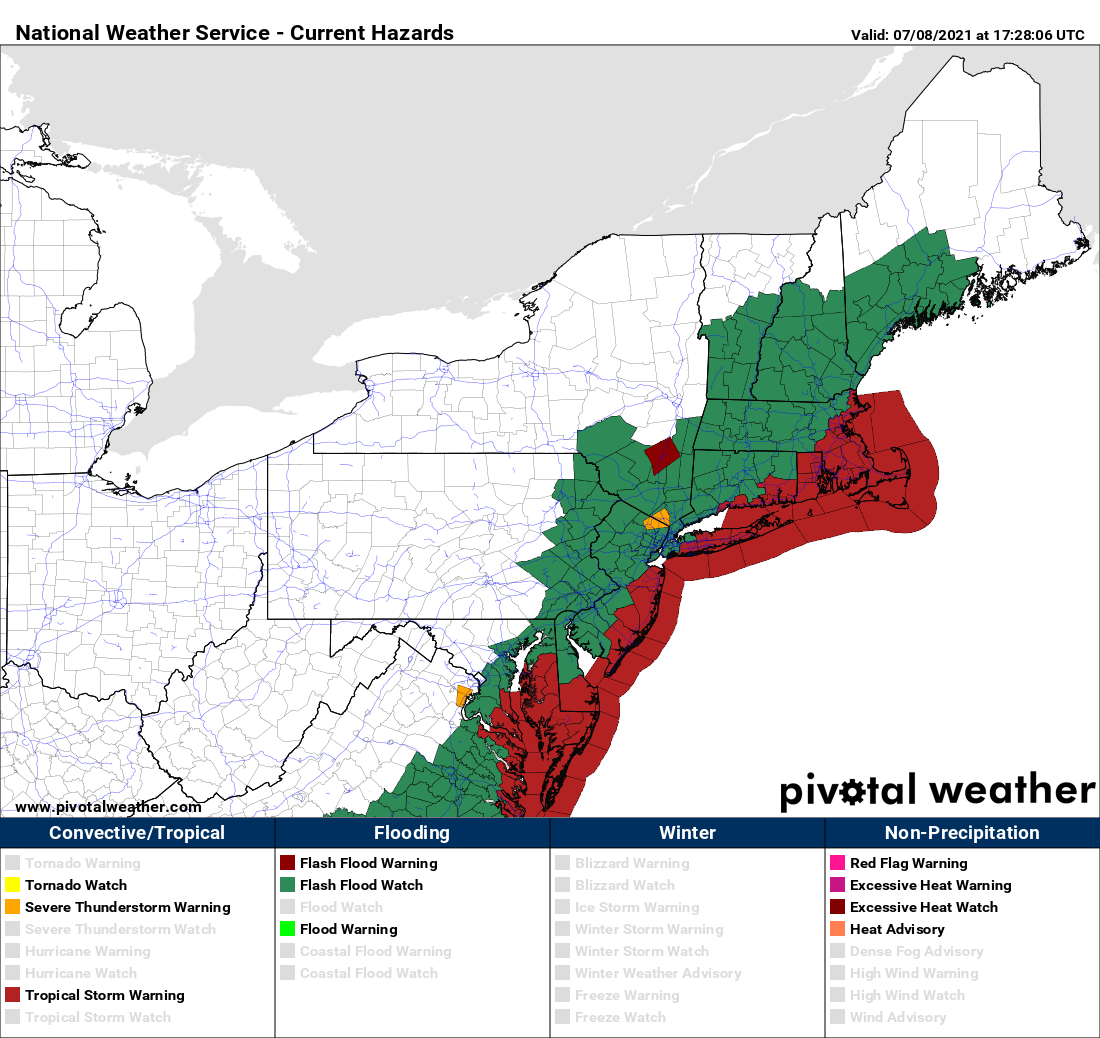
Flash Flood Watches are in effect for much of the Northeast, with Tropical Storm Warnings along the coast. Image provided by Pivotal Weather.

As of 2pm EDT, Elsa was centered about 25 miles southwest of Raleigh, NC and moving toward the northeast at 20 mph. Maximum sustained winds are down to 45 mph. A Tropical Storm Warning is in effect for the coast of Connecticut from New Haven eastward, coastal Rhode Island, and nearly all of the coast of Massachusetts from the Mouth of the Merrimack River southward (sorry Salisbury, you don’t get to play), including Cape Cod and the Islands. Elsa will continue northeastward tonight, turning more toward the east-northeast on Friday, likely passing right across southeastern Massachusetts.

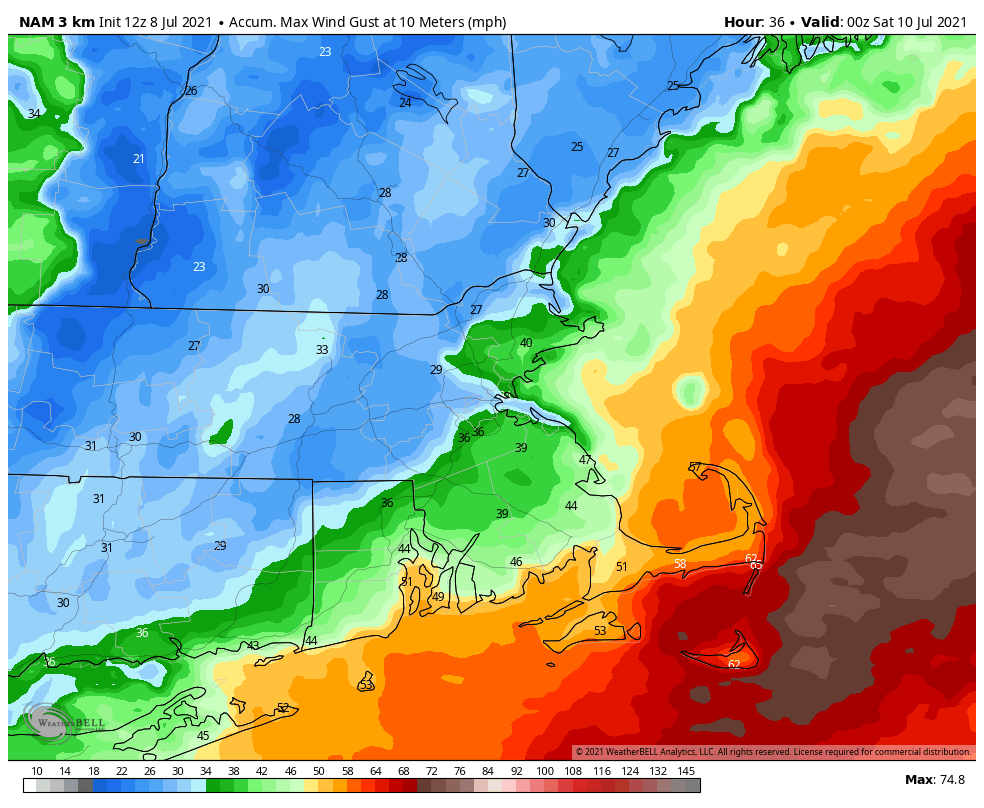
Winds may gust to 40 mph or more across parts of RI and southeastern MA on Friday. Image provided by WeatherBell.

Tropical systems have different characteristics when they get up this way, compared to how they look in the Caribbean or Gulf of Mexico. They take on a “rain to the left, wind to the right” appearance. This means that the heavy rain shifts to the left side of the storms track, while most of the strong winds are to the right of the track. In this case, that means most of the wind will be confined to parts of southern RI, southeastern MA, and the offshore waters, but much of the rest of the region can expect heavy rain. How much rain? Rainfall totals of 2-4 inches and possibly heavier, most of it falling between about 8am and 2pm on Friday. Oh, an just to add to the fun for the folks in southern RI and southeastern MA, these systems can and usually do produce some short-lived weak tornadoes, mainly in the right-front quadrant of the storm.

Elsa will produce heavy rain, especially north and west of I-95. Image provided by Weathermodels.com

Before Elsa gets here, we’ll have some showers and thunderstorms to deal with this evening and tonight, thanks to a stalled out frontal system draped across the South Coast. Once Elsa’s rain moves out late Friday, high pressure will try to build back in on Saturday, but we’ll still have plenty of moisture around, which means we could pop a few showers and thunderstorms Saturday afternoon. Warm and humid air moves back in for Sunday and Monday (and into the middle of next week), with some showers and thunderstorms possible each afternoon, especially Monday.

Thursday night: Cloudy with showers and thunderstorms during the evening. Rain and showers redevelop late at night. Low 60-67, a little warmer along the South Coast.

Friday: Windy with rain, heavy at times, tapering off in the afternoon. High 72-79. Offshore: East Coast Southeast 15-25 knots, gusts to 40 knots, becoming northwest late in the day, seas 3-6 feet. South Coast: Southeast to south winds 20-40 knots, gusts to 50 knots, seas 6-10 feet.

Friday night: Showers end in the evening, then becoming partly cloudy. Low 62-69.

Saturday: Partly sunny, chance for an afternoon shower or thunderstorm. High 73-80. Offshore: West to northwest 5-10 knots, seas 3-6 feet.

Saturday night: Clear to partly cloudy. Low 59-66.

Sunday: Intervals of clouds and sunshine, a shower or thunderstorm is possible during the afternoon. High 75-82. Offshore: East to southeast winds 5-10 knots, seas 2-4 feet.

Sunday night: Partly to mostly cloudy. Low 61-68.

Monday: Partly sunny, chance for a few afternoon showers or thunderstorms. High 77-84. Offshore: South winds 5-10 knots, seas 2-4 feet.

Elsa Makes Landfall, What’s Next?

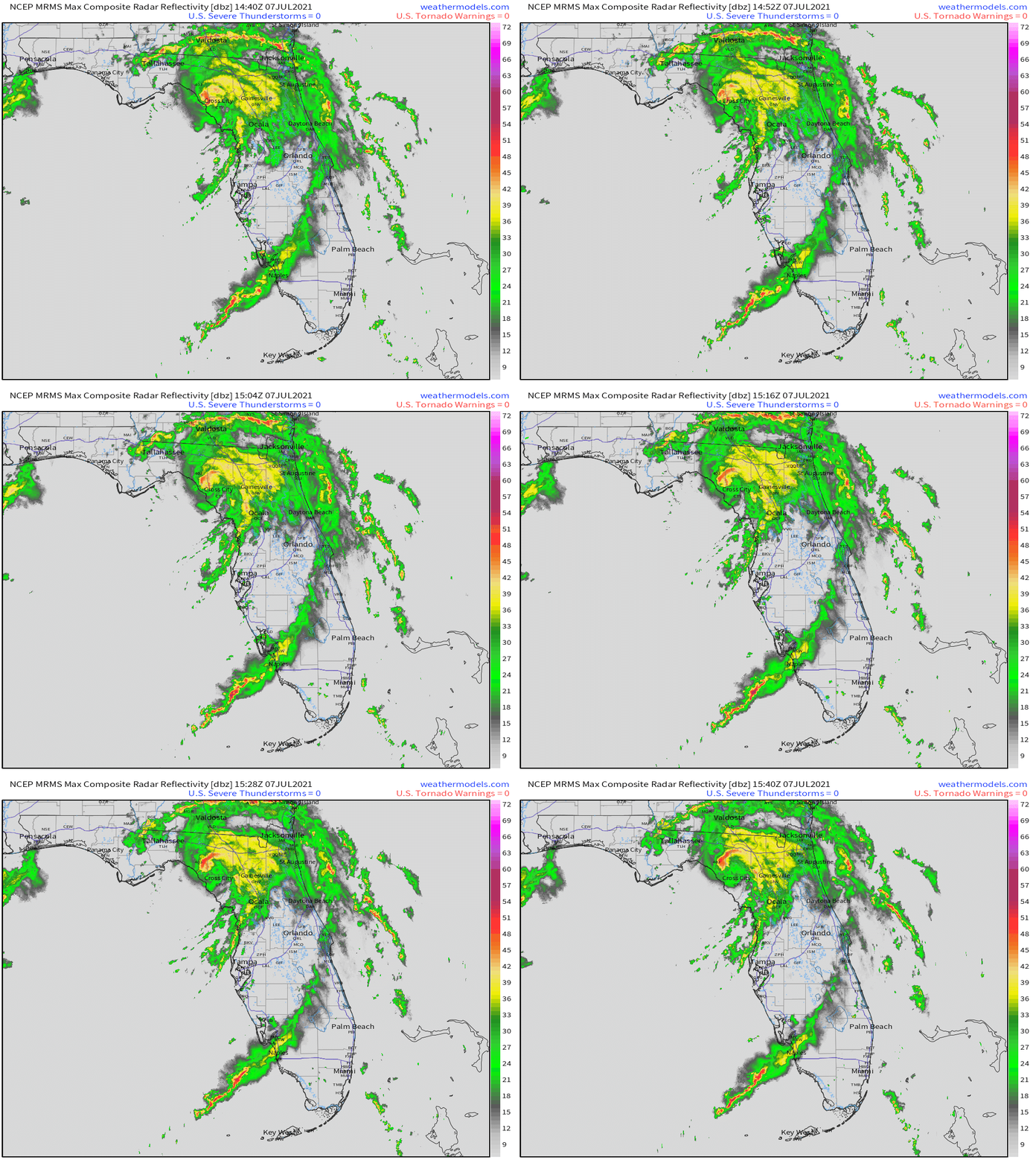
After bringing heavy rain and gusty winds to portions of the Caribbean and Florida over the past several days, Tropical Storm Elsa made landfall in northwestern Florida this morning. It’s not done yet though, not by a longshot.

Radar loop of Elsa making landfall Wednesday morning. Loop provided by Weathermodels.com

As of 2pm EDT, Tropical Storm Elsa was centered about 105 miles west of Jacksonville, Florida, moving toward the north at 14 mph. Maximum sustained winds have decreased to near 50 mph. Tropical Storm Warnings remain in effect for part of northwestern Florida, and for the Atlantic coast of Georgia and South Carolina. A Tropical Storm Watch is in effect north of there all the way up to northeastern New Jersey.

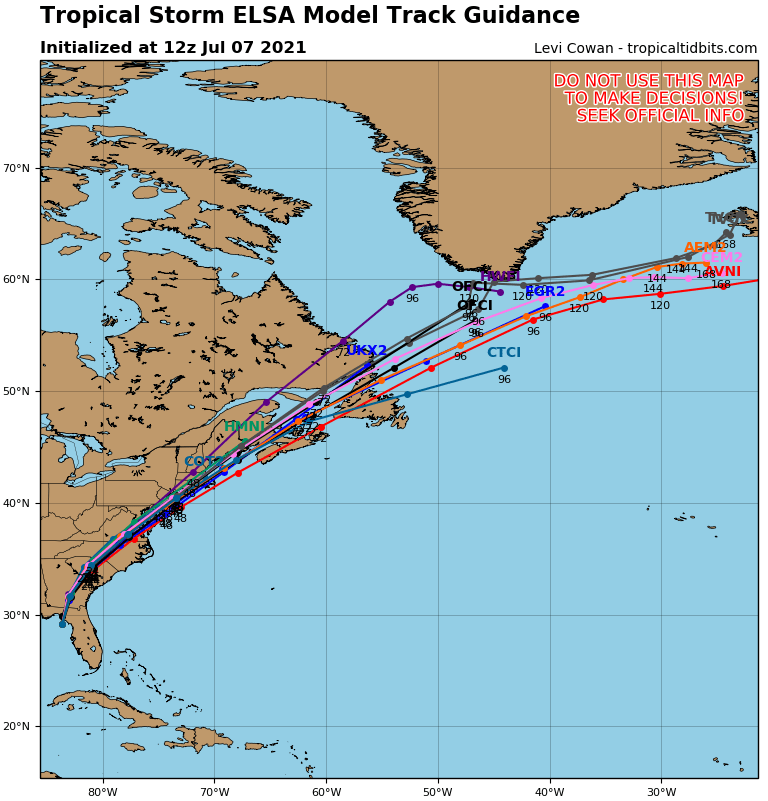
Model forecasts for the track of Elsa. Image provided by Tropical Tidbits.

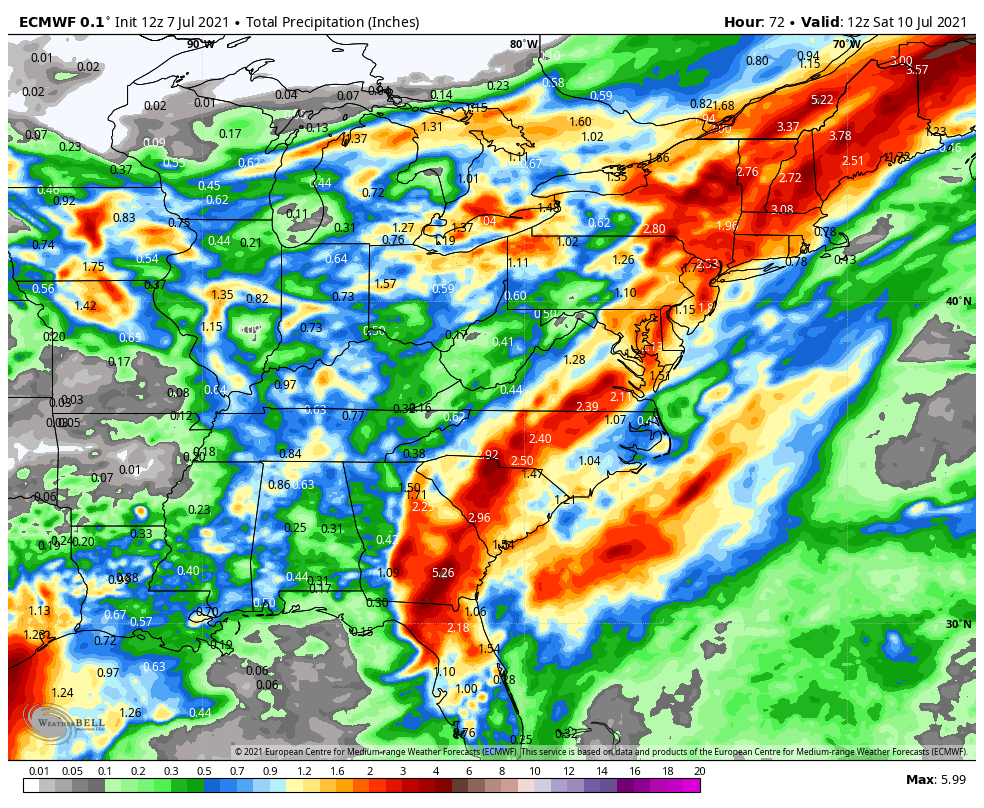
The forecast for the next 36 hours is fairly straightforward. Elsa will turn northeastward, moving across parts of Georgia, the Carolinas, and into Virginia while gradually weakening. Gusty winds, and heavy rain are likely, with rainfall totals of 3-5 inches and locally heavier likely producing flooding in many areas. In addition, to the east of the storm’s center, some tornadoes are also possible.

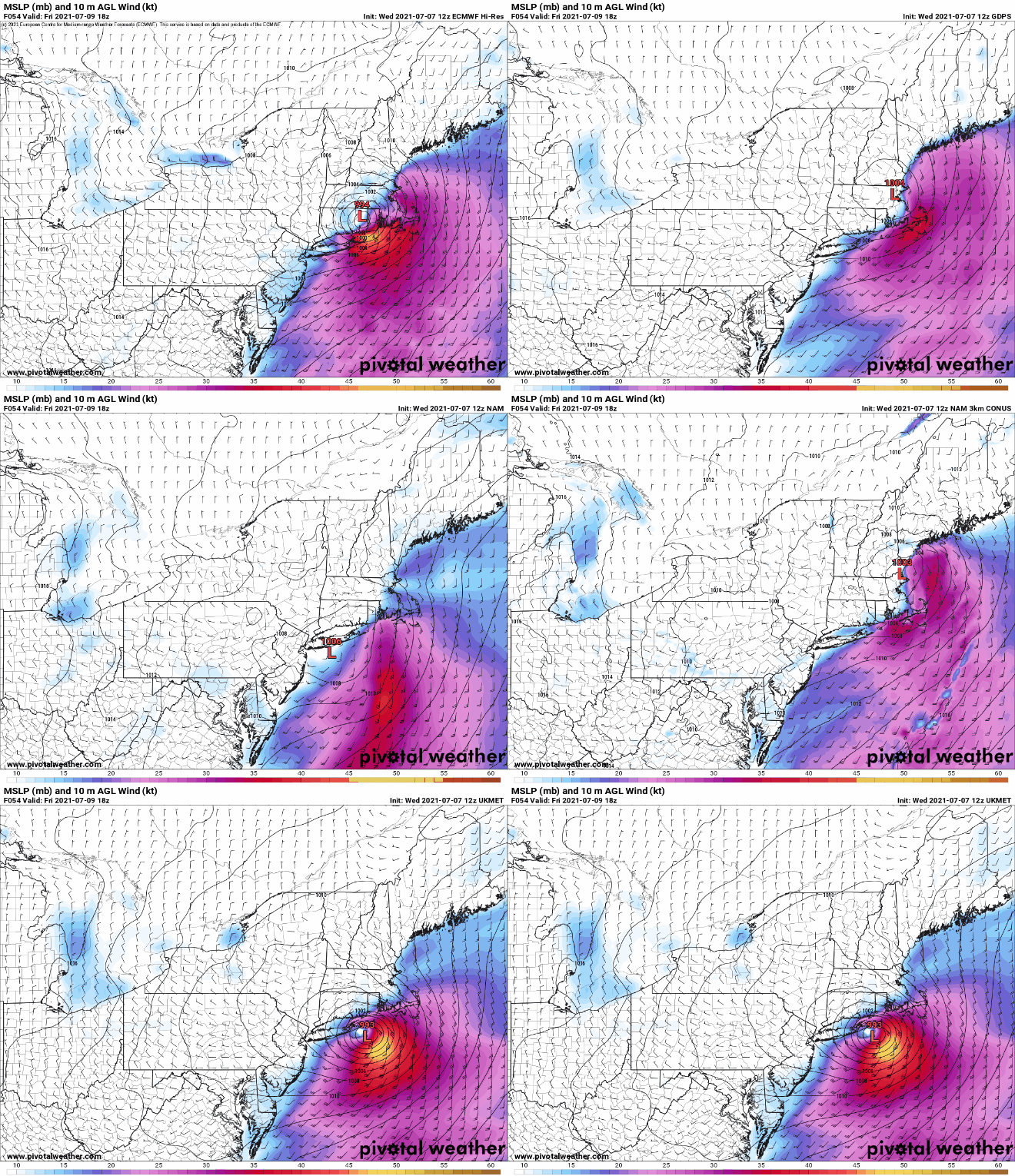
Once it gets into the Mid-Atlantic states later Thursday, we have a bit of uncertainty in the forecast. Elsa will continue northeastward, and may start to become extratropical. When this happens, the stronger winds cover a larger area, compared to tropical systems, where the strongest winds are found very close to the center. Many models show Elsa starting to strengthen a bit again. This is likely when it is starting to become extratropical. Elsa may move back over water south of Long Island, but that will depend on when it begins to turn more toward the east-northeast. This has implications for Southern New England.

Elsa will produce heavy rain up and down the East Coast over the next few days. Image provided by WeatherBell.

Elsa will continue to produce heavy rain and gusty winds across the Mid-Atlantic states and into Southern New England later Thursday into Friday. However, the strongest winds are found to the right of the center. If the storm passes near or just south of New England, that means that the strongest winds will stay offshore, possibly impacting Cape Cod and the Islands. However, if the storm stays inland, and moves across Southern New England, then a period of strong to damaging winds could impact parts of Connecticut, Rhode Island, and Southeastern Massachusetts on Friday. Sustained winds of 20-30 mph, with gusts of 50-60 mph would be possible. A track even farther to the west (which is possible), could result in those strong winds impacting the New York City, Providence, and Boston metropolitan areas on Friday.

Where will Elsa track in relation to southern New England? Images provided by Pivotal Weather.

Conditions will improve across New England on Saturday as Elsa (or what’s left of it) moves into Atlantic Canada, and beyond that, the Atlantic looks quiet for a while, which is fairly typical for early July. Plumes of Saharan Dust are making their way across the Atlantic and into the Caribbean, which suppresses tropical activity.

Weekend Outlook: April 16-19, 2021

It’s not April 1, and this isn’t a joke – there’s snow in forecast for parts of our area.

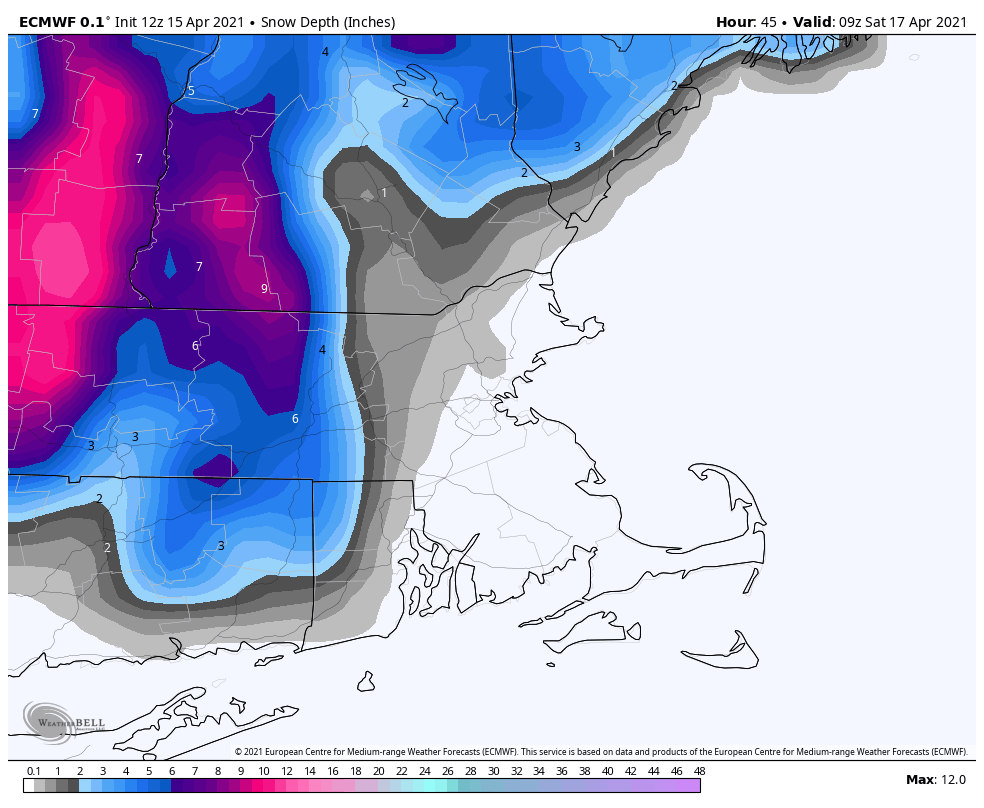
Low pressure is moving off the Mid-Atlantic coast this afternoon while an upper-level low pressure area moves in from the west. The upper-level low will draw the surface low northward towards southeastern New England while it intensifies. Rain is spreading across the region this afternoon, and it will become steadier and heavier tonight as the low moves up the coast. With the upper-level low moving in, we’ll have some very cold air aloft. As the rain becomes heavier, it will pull the cold air down from above, a process called “dynamic cooling”. As this occurs Friday morning, we’ll see the rain change over to snow across the hills from northwestern Rhode Island and central Massachusetts into southwestern New Hampshire. Some wet snow may mix in across the lower elevations of southern New Hampshire and northern Massachusetts as well but we’re not expecting much, if any, accumulation, and what does accumulate will be mainly on grassy surfaces because the pavement is too warm, and air temperatures won’t drop below freezing. It’ll be a different story across the hills from Worcester County into the Monadnocks of southwestern New Hampshire, where several inches may accumulate. Even heavier snow is possible for the Berkshires and the Green Mountains of Vermont. We should note that there are some models that are forecasting accumulating snow, and in some cases quite a bit of it, across most of eastern Massachusetts and Rhode Island. While we can’t completely rule out this scenario, we’re not expecting it to occur.

Most of us won’t see much, if any, snow from this system. Image provided by WeatherBell.

The surface low will pass near or over Cape Cod or southeastern Massachusetts Friday afternoon, allowing any mixed precipitation to change back to all rain and milder air moves in. The rain will taper off to showers in the afternoon, but the showers may not completely end until early Saturday as the system slowly starts to move away. Given the recent lack of rainfall, we’re starting to see drought conditions develop. With 1-2 inches of rain expected from this storm, we’ll help put a nice dent in that developing drought.

Much-needed rain is expected over the next 48 hours. Image provided by Weathermodels.com

Saturday won’t be quite as chilly as Friday, but we probably won’t see much sunshine either as the system only slowly moves away. High pressure starts to build in on Sunday with more clearing and milder temperatures. However, an upper-level disturbance will be moving through, so a couple of pop-up showers can’t be ruled out. Patriots Day on Monday is shaping up to be a nice Spring day with partly sunny skies and mild temperatures, but again, a pop-up shower can’t be ruled out as another weak upper-level disturbance crosses the region.

Monday looks to be a mild day. Image provided by WeatherBell.

Thursday night: Periods of rain, possibly heavy at times, changing to snow across the hills from northwestern Rhode Island and central Massachusetts into southwestern New Hampshire, breezy. Low 33-40.

Friday: Windy with rain mixed with snow at times in the morning, tapering off to showers during the afternoon. High 37-44, possibly a little warmer south of Boston.

Friday night: Cloudy and breezy with showers ending. Low 33-40.

Saturday: Plenty of clouds, possibly a few showers near the coast, some sunny breaks may develop in the afternoon. High 44-51.

Saturday night: Partly to mostly cloudy. Low 32-39.

Sunday: Intervals of clouds and sunshine, slight chance for a shower. High 49-56.

Sunday night: Clear to partly cloudy. Low 33-40.

Monday: Partly sunny, slight chance for a shower. High 56-63.

More Snow on the Way

This shouldn’t be a surprise, since it’s February, but there’s snow in the forecast.

Today’s sunshine and cool temperatures are a product of high pressure building in across the eastern Great Lakes. However, as that high slides off to the east, low pressure, currently in the western Gulf of Mexico, will slowly make its way toward the region. However, it’s not as simple as a storm system passing off to the south and bringing in some snow. This will actually be a three-part system that lasts quite a while.

Aside from a few high clouds, most of the Northeast is enjoying sunshine this afternoon. Loop provided by NOAA.

The initial low pressure system will move off the Southeast coast and head northeastward, passing south of the area late Thursday and Thursday night. This will spread some light snow in Thursday afternoon and evening, mainly south of the Mass Pike. As that system pulls away, another weak system will emerge from the Carolina coast, spreading more snow in. This will overspread most of the area. Along the South Coast, we’ll see some milder air move in, especially aloft, which will likely result in some sleet or rain mixing in. That system pulls away early Friday, but yet another weak system follows in its wake, passing south of the area during the day on Friday, with even more snow expected, even down to the South Coast, as some cooler air filters in behind the previous system. That system finally pulls away Friday night, but with an upper-level low pressure system moving across the Northeast, some more snow showers are possible on Saturday.

It’s important to note that this isn’t your classic Nor’easter with a powerful system off the coast, strong winds, and bursts of heavy snow. Instead, we’re just left with a series of weak systems that will produce off-and-on light snow for a period of 24-to-36 hours across the region. Of course, even light snow will add up if it persists for that long, but this isn’t the “blockbuster” 1-to-2 feet that we sometimes receive at this time of year.

So, how much are we expecting?

Central NH (Concord): 2-4″
Southern NH (Manchester/Nashua): 2-5″
NH Seacoast/Merrimack Valley: 3-6″
MetroWest/MetroBoston: 4-7″
Southeastern Massachusetts/RI: 5-9″
South Coast: 4-7″
Cape Cod: 3-6″ (heaviest near the Canal)

The NWS Blend of Models is probably closest to our thinking right now. Image provided by Weathermodels.com

Another system may bring in some light snow or rain on Monday. We’ll have a little more detail on that in our Weekend Outlook tomorrow.

Weekly Outlook: February 15-21, 2021

This week is going to be messy with not one but two different storms that will produce a variety of precipitation across the region.

We start off the week with plenty of clouds and some light snow and/or freezing drizzle this afternoon as a weak system passes well south of the region. However, another storm system will be moving out of the Tennessee Valley and heading our way. This is the same storm that wreaked havoc on Texas and the Southern Plains over the weekend. At one point over the weekend, all 254 counties in Texas were under a Winter Storm Warning. We’re not sure if that has ever happened before, but it’s certainly a rare event. That storm will head northeastward today, moving up the Appalachians. It will then redevelop south of Long Island tonight, and pass near or across southeastern Massachusetts Tuesday morning.

A variety of watches, warnings, and advisories are in effect across the Northeast ahead of the next storm system. Image provided by Pivotal Weather.

With the low passing to our south, cold air will remain in place for much of the region, mainly north and west of Boston. As milder air moves in aloft, we’ll see snow change over to sleet and then freezing rain this evening and tonight. Before it changes over, we’re looking at an inch or less of snow for much of Massachusetts and Rhode Island, with an inch, possibly 2 inches across southern New Hampshire. Once you get north of Concord, NH, several inches are possible before the flip to sleet/freezing rain. An extended period of freezing rain is possible in parts of the area, especially from the Merrimack Valley into Southern New Hampshire. This will obviously result in hazardous driving conditions, but also will increase the threat of power outages due to downed trees and wires from the weight of the ice. From Boston southward, we’re looking at mostly rain, with temperatures above freezing. How far inland that above-freezing air gets is still a question mark, but right now, we’re thinking that areas north and west of Interstate-95 will likely stay below freezing the entire time. Most of the models try to bring the warmer air all the way into the Merrimack Valley or even Southern New Hampshire. However, the models also tend to overestimate how quickly the cold air will erode, especially when there is snow on the ground. Plus, they have significantly underestimated the magnitude of the cold air that moved in across Texas and the Southern Plains over the last few days. For these reasons, we’re going to stay a little colder than the models. Across Cape Cod and parts of southeastern Massachusetts, cold air won’t be an issue, and in fact, temperatures could get to 50 or even warmer for a while Tuesday morning if the storm passes across southeastern Massachusetts instead of just to the south.

Everything winds down by early afternoon, then skies clear out, with colder air returning for Tuesday night and Wednesday as high pressure builds in. From Boston southward, this means that everything will quickly ice back over Tuesday evening as temperatures drop below freezing. Keep this in mind if you’ll be out an about, as many untreated surfaces will become slick. Although Wednesday will feature sunshine, it will be quite chilly, with temperatures likely staying in the 20s to lower 30s, which is as much as 10 degrees below normal.

Temperatures will be 5-10 degrees below normal on Wednesday. Image provided by Weathermodels.com

By Thursday, another system will approach the region, and this one also looks messy, but a little colder. This system will likely stay south of the region, but some milder air will move in aloft. So, once again, we’re looking at snow, changing to sleet and freezing rain, and possibly plain rain in some areas. The airmass ahead of this system will be a little colder than the one we have in place today, so we could be looking at more snow before the changeover, especially from the Merrimack Valley northward. However, this one could also feature a period of freezing rain across the interior. Details like this are nearly impossible to pin down 4-5 days in advance, so we’ll get into more detail towards midweek as things become clearer.

Thursday night and Friday are looking messy once again. Images provided by Pivotal Weather.

High pressure returns next weekend with drier and colder conditions once again. There are some signs that the colder weather we’ve been dealing with for much of the month could start to retreat in Canada next week, but that’s a long ways away, and things can still change.

Above normal temperatures next week? It’s possible, at least according to one model. Image provided by WeatherBell.

Monday: Cloudy with some light snow or snow showers, possibly mixed with a little sleet or drizzle, especially along the coast. High 27-34.

Monday night: Light snow during the evening, mainly from the Merrimack Valley into Southern New Hampshire, eventually changing to sleet and freezing rain, except precipitation falls mainly as rain south and east of Interstate 95. Low 25-32 during the evening, then temperatures may rise a few degrees overnight.

Tuesday: Freezing rain across the interior and rain in the coastal plain ending by early afternoon. High 30-37 north and west of Interstate 95, 38-45 south and east of I-95, potentially as warm as 45-55 across parts of southern Rhode Island, southeastern Massachusetts, and Cape Cod during the morning.

Tuesday night: Clearing, breezy. Low 14-21.

Wednesday: Sunshine and some late-day clouds. High 25-32.

Thursday: Cloudy, light snow is possible late in the day, possibly changing to sleet and freezing rain at night. High 26-33.

Friday: Snow, sleet, freezing rain, and rain ending in the morning, breezy. High 33-40.

Saturday: Intervals of clouds and sun, breezy, a few flurries are possible. High 25-32.

Sunday: Partly to mostly sunny. High 27-34.