Season’s Greetings! (Hurricane Season That Is)

We’re about to flip the calendar to June, which marks the start of meteorological summer. It also marks the start of Hurricane season in the Atlantic Basin (North Atlantic Ocean, Caribbean Sea, and Gulf of Mexico).

Hurricane season in the Atlantic runs from June 1 through November 30, but it got off to an extraordinarily early start again in 2017 when Tropical Storm Arlene formed back in April. Alex became the second tropical storm on record during the month of April in the Atlantic when it strengthened on April 20. Arlene stayed out in the open Atlantic without affecting any land areas, before merging with a larger extratropical storm on April 23. The next storm that forms will be given the name Bret.

FINAL 0523 Hurricane Graphic_ names-700x400
Hurricane Names for the 2017 season in the Atlantic. Image provided by NOAA.

In a normal season, the Atlantic Basin sees 12 named storms, of which 6 become hurricanes and 3 become major hurricanes (Category 3 or higher on the Saffir-Simpson Scale). While there are plenty of hurricane forecasts out there, these were pioneered by Dr. William Gray. His research team at Colorado State University continues his work, and for this season is calling for 11 named storms, of which 4 could become hurricanes, and 2 major hurricanes. They are scheduled to release an updated forecast on Thursday.

tracks-at-2016
2016 say plenty of storms form in the Atlantic, with several making landfall in the US. Image provided by the National Hurricane Center.

Of course, an active season doesn’t guarantee that a storm will make landfall in the United States though. In 2010, there were 19 named storms, 12 hurricanes, and 5 major hurricanes. Only 1 storm, Tropical Storm Bonnie, made landfall in the United States. On the flip side, 1992 was a quiet season, with just 7 named storms, 4 hurricanes, and 1 major hurricane, with the first named storm not forming until August 16. Of course, that first storm was Andrew, which slammed into South Florida on August 24 as a Category 5 hurricane, one of just 3 Category 5 storms to ever make landfall in the United States.

The peak of the season usually occurs from mid-August through late September, but an early start isn’t unusual. On average, the first named storm of the season occurs on July 9, with the first hurricane forming around August 10. In 2015, there were two tropical storms during May and June (Ana and Bill), while 2012 saw 4 named systems (Alberto, Beryl, Chris, and Debby) with 1 hurricane (Chris) forming before the end of June. Last year, 2 storms formed before the end of May (Hurricane Alex in January, Tropical Storm Bonnie in late May), then 2 more tropical storms in June (Colin and Danielle)

Here in New England, we should always pay attention when a storm is nearing the Bahamas, as those are the ones that have the potential to impact us. Using data back to 1851, a tropical storm makes landfall in Southern New England or Long Island once every 4 years, while a hurricane makes landfall once every 8 years. The last tropical storm to make landfall was Irene, which passed right over New York City in 2011, so we’re about due for another one. As for hurricanes, while we’ve been threatened several times in the past few years, the last one to make landfall was Hurricane Bob in 1991. That 26-year gap is the 2nd longest on record, second only to the 28 year gap between 1896 and 1924. In other words, we are very overdue.

p1969053694-3
Hurricane Gloria produced a lot of wind across eastern New England, with significant damage across Long Island and western New England, closer to the track. Image provided by NOAA,

The Atlantic remains fairly quiet right now, and we’re not expecting anything for form in the next few days. Even if something were to form soon and head this way, the waters off of New England are too cold to sustain a tropical system, so we’d see something more like a typical nor’easter. Only two tropical storms have ever made landfall in the Northeast before the end of June. The first was an unnamed minimal tropical storm that crossed Long Island and went into southern Connecticut on May 30, 1908. The other was Tropical Storm Agnes, which made landfall near New York City on June 22, 1972, then caused devastating flooding across parts of the Mid-Atlantic states. In terms of hurricanes, the earliest one to ever make landfall up this way was Hurricane Belle, which slammed into Long Island with 90 mph winds on August 9, 1976. We did have Hurricane Arthur pass just offshore of Nantucket on July 4 in 2014. While it did not make landfall, it made for a rather wet and cool holiday, especially across Cape Cod and southeastern Massachusetts. Statistically, the most likely time for a hurricane to hit New England is between the middle of August and late September. Of the 23 hurricanes that made landfall in New England or Long Island since 1851, 20 of them have done so between August 19 and September 27.

Some of the statistics in this post were supplied by Gary Gray and David Vallee. David is probably the local expert in Southern New England on tropical systems and their impacts on the region. He’s written several papers on them including a nice review of 20th Century storms.
Is Matthew About to Get Loopy?

“Just when they think they got the answers, I change the questions!” – Roddy Piper


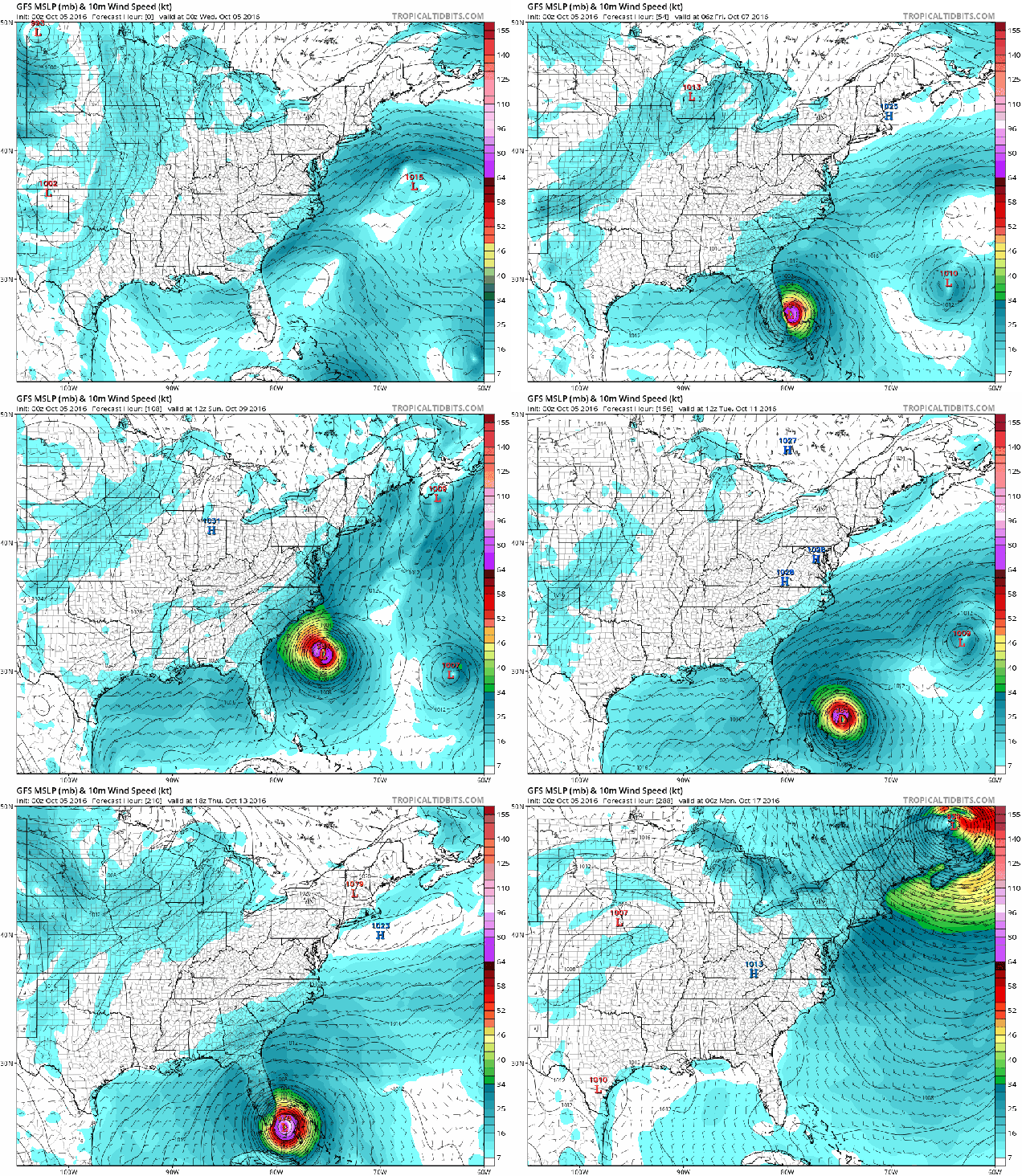
At this time yesterday, we were gaining more and more confidence in our forecast for Matthew. Then the midday models started rolling in, and we started scratching our heads. Instead of coming close to Florida and then heading up the coast, passing south and east of New England, the models started doing some wacky things. First, one of them had it menace the Southeast, then do a big loop back into the Bahamas before hitting Florida again in a much-weakened state. Then, another model did something similar. “It’s just two outliers” is what we thought, the rest still bring it up the coast. We were still fairly confident in our forecast. Then, the GFS model came out around midnight:

gfs_mslp_wind_eus_fh0-288-1
GFS model forecast loop from early Wednesday morning, October 5. Loop provided by Tropical Tidbits.

At that point, our forecast went right out the window.What seemed like an anomaly from one or two models, was quickly becoming the consensus. The GFS model, which had been very consistent with a track up the East Coast, suddenly changed gears, and had Matthew threaten Florida and the Bahamas not once, but twice. Oh, it still brought Matthew up the coast, bringing rain and gusty winds to parts of New England for the weekend, but now it was doing it NEXT weekend, not this weekend.

al142016
Model forecasts for the track of Hurricane Matthew from midday October 5. Image provided by the University of Wisconsin.

Not all of the models are showing this loop, but as you can see in the image above, there are several that do now. Before we get into what we think might happen, we’ll get into what is causing this peculiar forecast. Looking at the upper atmosphere this morning, we see a trough of low pressure across much of the West, and a ridge of high pressure in the East. There’s also a pretty strong jet stream moving into the West Coast and into the Rockies, before it makes a sharp left turn in the Mississippi Valley.

upacntr_300
Upper-air analysis for 300mb (approximately 30,000 feet) from 8am on October 5. Image provided by the National Center for Atmospheric Research.

As this trough of low pressure moves eastward, the models had been projecting that it would strengthen and sharpen up, in effect “capturing” Matthew as the trough neared the East Coast. The southerly winds ahead of the trough would drive Matthew northward or northeastward, and bring it up the coast. Instead, the models are now showing that this trough will actually weaken as it moves eastward, and flatten out. As a result, high pressure will build back in, blocking Matthew from moving northward. This would turn Matthew back towards the south and let it mill around in the Bahamas. Not all of the models are showing this scenario. Some still have the trough just strong enough to draw Matthew northward enough that the westerly winds of the jet stream are able to push it out to sea once it gets up towards the Carolinas.

This leads us to more questions, which is where the quote at the top of the post comes in.If Matthew does not get pulled north and head out to sea, then what does its future hold? Some models have it loop around, back into the Bahamas, then back towards Florida before turning northeast and heading up the coast again next week. Another one sends it back into Florida as a much weaker tropical storm, then across the state and into the Gulf of Mexico where it eventually weakens and dissipates. At this point, we’re back to “wait and see” mode.

cmwmaxw01a
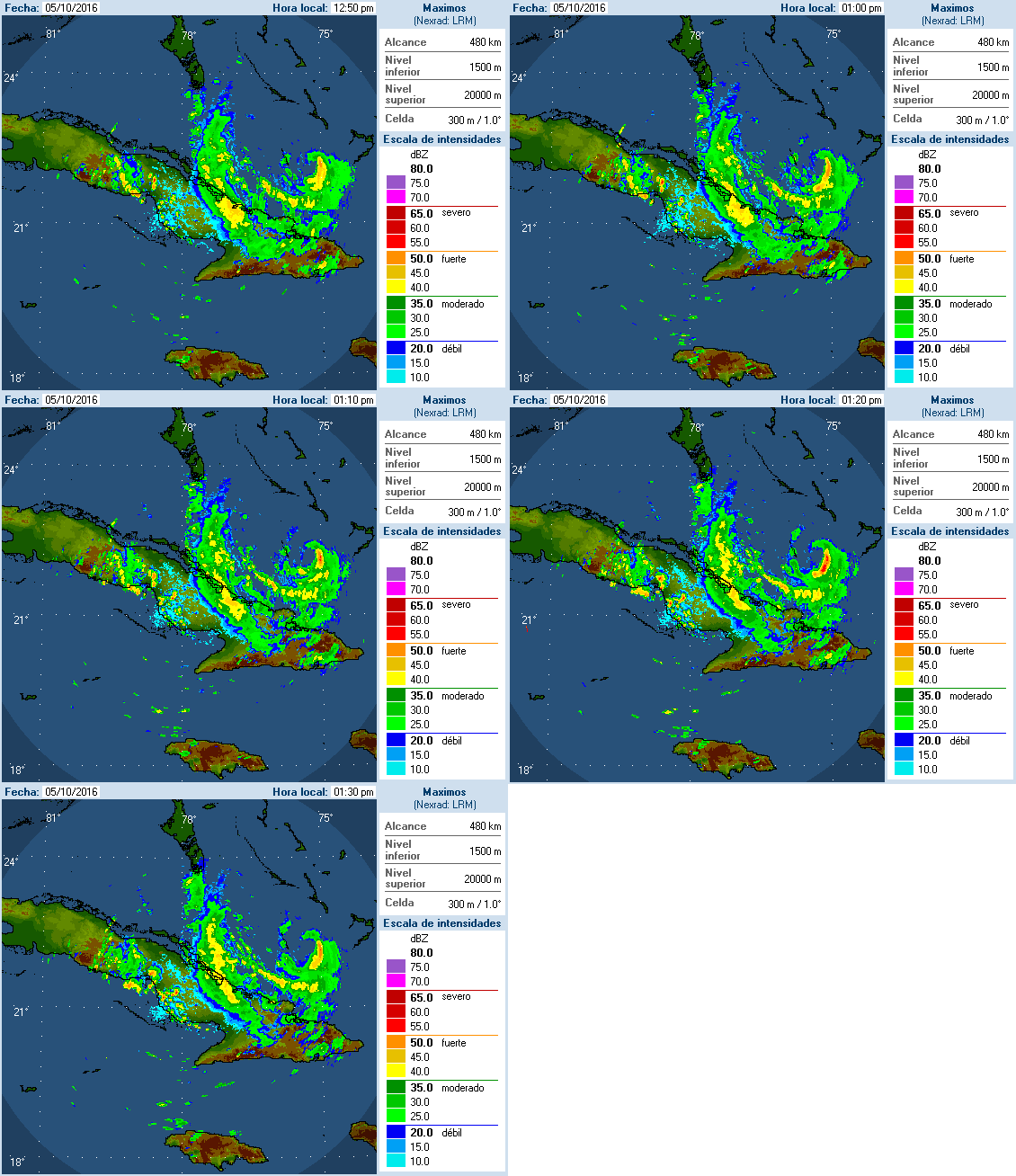
Radar loop from Camaguey, Cuba showing the eye of Hurricane Matthew. Image provided by Instituto de Meteorología de la Republica de Cuba

What we do know is this: There are hurricane warnings in effect for much of Florida and the Bahamas. Hurricane Matthew is still a Category 3 storm with top winds near 120 mph this afternoon. It is going to move through the Bahamas over the next 24 hours, and then come dangerously close to the Atlantic coast of Florida, with landfall a possibility, but not definite. It will likely head northward, bringing gusty winds and heavy rain to much of eastern Florida, southeastern Georgia, South Carolina, and southeastern North Carolina over the next few days. After that? That’s a really good question that we just can’t answer right now.


Weekly Outlook October 3-9, 2016

There’s not much going on in the weather world right now is there? OK, we’re know you’re not that naive. We’ll get to the update on Matthew in a moment. Much of the remainder of the forecast is actually pretty simple.

The gloomy pattern we’ve been in will continue for one more day before the upper-level low pressure system responsible for it finally lifts out. High pressure starts to build in on Tuesday, and we stay dry through Friday.

After that? Well, that’s the $64,000 question, isn’t it? Here’s what’s going to be happening with the atmosphere. A cold front will start to approach from the west, while an upper-level trough of low pressure moves from the Plains states into the Great Lakes. By early Saturday, Matthew should be off the North Carolina coastline.

gfs_z500_mslp_eus_23-1
GFS forecast for Saturday morning October 8. Note the trough of low pressure (green colors) moving into the Mississippi Valley, the ridge of high pressure off the East coast (red and orange colors), and Matthew just off the NC coast. Image provided by Tropical Tidbits.

How strong that trough is, as well as how strong the ridge of high pressure off the East Coast is, will determine where Matthew goes. The GFS (pictured above), sends the storm north-northeastward, as the trough pulls it in. Other models, such as the ECMWF, do not have a strong trough, and as such, it builds the ridge back in, stalling Matthew’s northward progress, and letting it mill around off the Carolina coast for a few days. Other models don’t build up the ridge to the east, and thus let Matthew head northeastward, farther out to sea, before the trough captures it and pulls it northward well east of New England. The upper-level energy that will help determine how deep that trough gets is still off the West Coast. Once it gets into the West Coast, and an area where there is a lot more data to feed into the models, they should start to converge on a solution, and thus give us a better idea, or at least a little more confidence, as to what will happen.

12_es1
GFS Ensemble forecast tracks for Hurricane Matthew. Image provided by Dr. Brian Tang, University at Albany.
12_es3
ECMWF Ensemble forecast tracks for Hurricane Matthew. Image provided by Dr. Brian Tang, University at Albany.

Before we get to what, if any, impacts Matthew may have on our area, there’s another problem. The models are picking up on this, but we don’t think they’re hitting it hard enough. We told you that a cold front would be coming in from the west. This is going to set up what is called a “Predecessor Rainfall Event” or PRE for short. This often happens up here ahead of tropical systems, and can even occur when the tropical system doesn’t even get within 500 miles of New England. This was the case with the devastating flooding we had in 1996 from Hurricane Lili and again in October of 2005. This also happened last year in South Carolina with offshore Hurricane Joaquin. In other words, even if Matthew does not come close to New England, we could be looking at extremely heavy rainfall around here on Saturday ahead of a cold front. Earlier this summer, we told you about an old rule of thumb “When in drought, leave it out”, when talking about rainfall. Well, we’ve got another rule of thumb for you “Droughts end in floods”. Just look at Texas from earlier this year to see that play out.

Monday: Partly to mostly cloudy with more showers and maybe even a rumble of thunder possible. High 64-71.

Monday night: Mostly cloudy, chance for a few more showers. Low 50-57.

Tuesday: Becoming partly sunny. High 58-65.

Tuesday night: Partly cloudy.  Low 44-51.

Wednesday: Partly to mostly sunny (yes, really, we mean it). High 60-67.

Thursday: Mostly sunny. High 65-72.

Friday: Sunshine and a few clouds. High 67-74.

Saturday: Becoming cloudy with rain developing. The rain could be heavy, especially at night. High 64-71.

Sunday: Cloudy with rain likely, possibly heavy at times. If Matthew is close enough, it will also be very windy. High 60-67.

Will Matthew Cause Mayhem?

By now you’ve probably heard, there’s a new storm in the Atlantic, and it’s named Matthew. OK, you probably knew that, because the hype machine from the media has gone into overdrive for the past few days. Why has that happened? Some of the computer forecast models have indicated that there’s a possibility that Matthew could hit the East Coast? How likely is that? We’ll delve into that shortly. First, we’ll get into what we do know.

vis_lalo-animated
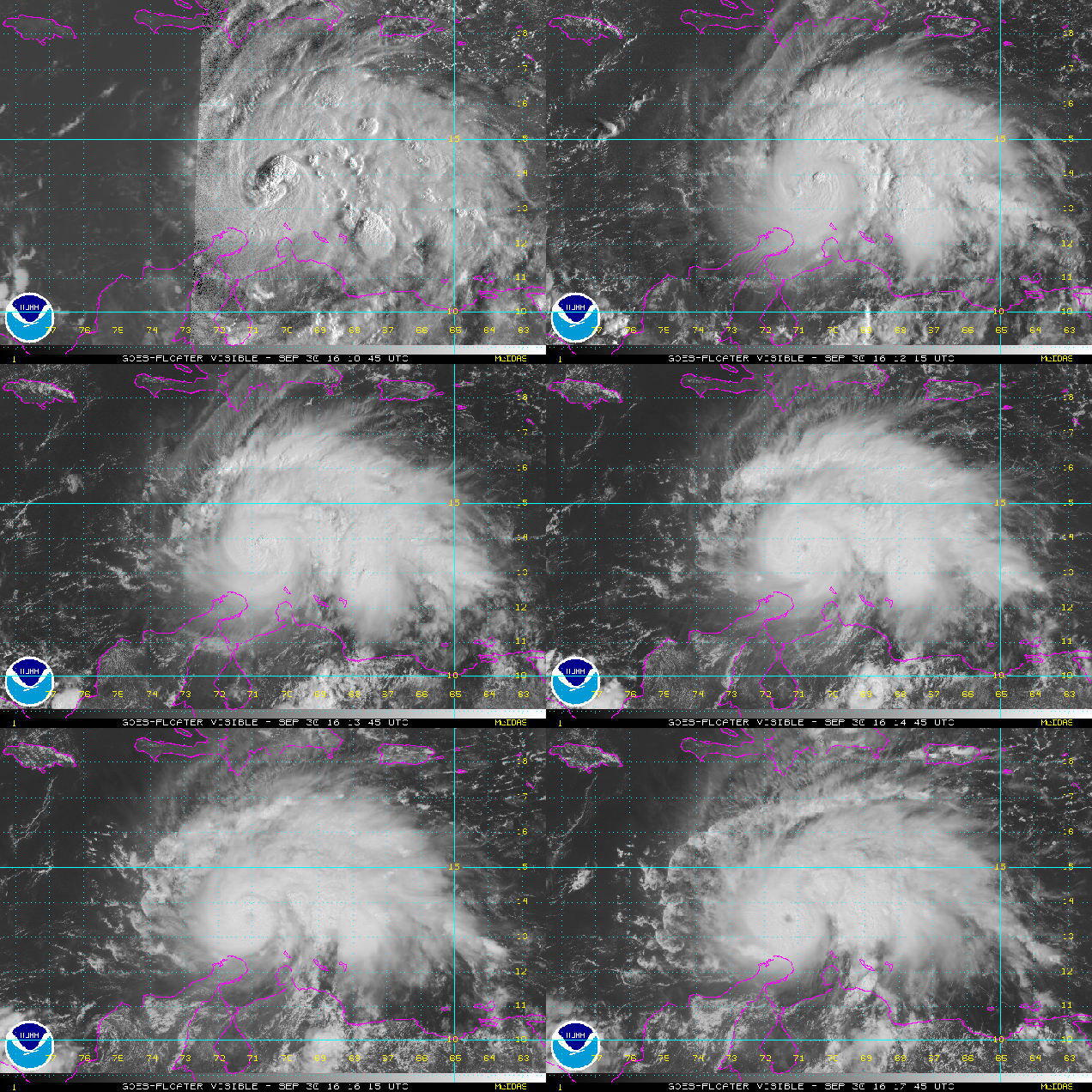
Satellite loop of Hurricane Matthew from Friday afternoon September 30. Loop provided by NOAA.

As of 2pm EDT on Friday, Matthew was a Category 3 Hurricane on the Saffir-Simpson scale, with maximum sustained winds of 120 mph.The storm was centered a little less than 100 miles off the northern coast of Colombia, and was moving off towards the west-southwest at 12 mph. A Tropical Storm Warning is in effect for the coast of Colombia from the Colombia/Venezuela border to Riohacha.

It is actually pretty rare to have a storm impact the ABC Islands (Aruba, Bonaire, Curacao) and northern South America. There have been a few wind gusts to near tropical storm force in Aruba and Bonaire today, but for the most part, it’s just been a breezy and cloudy day in an area that usually is sunny and warm. When Matthew crossed the island of Martinique a few nights ago, it produced sustained winds of 40 mph and a gust to 60 mph at the airport in St. Pierre, with reports of gusts of up to 89 mph on the island. There was several reports of damage across the island.

OK, that’s what we know. Here’s what we’re fairly sure about. Matthew should turn more towards the northwest and eventually north this weekend with some more strengthening possible. It may become a category 4 hurricane. Unfortunately, it is also going to pass very close to Jamaica late Sunday and early Monday. It may even make landfall on the island. Even a glancing blow will likely result in widespread damage across the island. After that, Matthew should continue northward, and it will pass very near or over extreme western Haiti or eastern Cuba before heading into the Bahamas. Some slight weakening is possible due to interaction with the land areas, but Matthew should still be a strong hurricane (Category 2 or 3) when it enters the Bahamas.

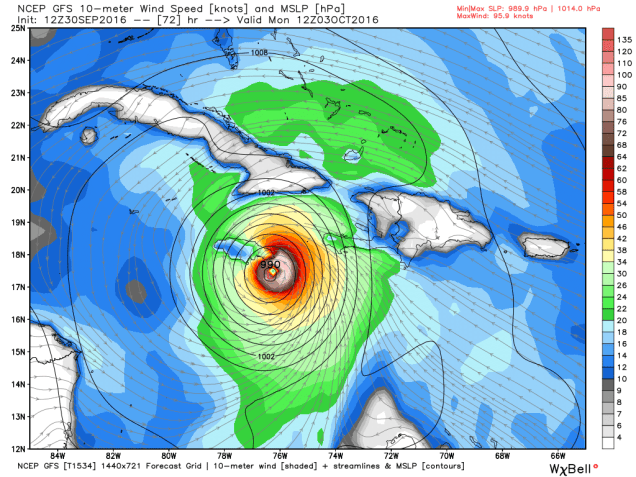
gfs_mslp_uv10m_haiti_13
GFS model forecast for sea-level pressure and wind speeds for Monday morning October 3. That wouldn’t be a good time to be in Kingston, Jamaica. Image provided by WeatherBell.

Now, the part that nobody knows with any certainty – what happens after Matthew gets into the Bahamas. This is the big question, and a lot of it has to do with what the upper-level pattern looks like. A trough of low pressure will be starting to move out of the Northeast while another one moves into the Great Plains. In between, a ridge of high pressure will be moving into the East. Exactly how quickly these features move eastward will determine which way Matthew goes.

12_es1
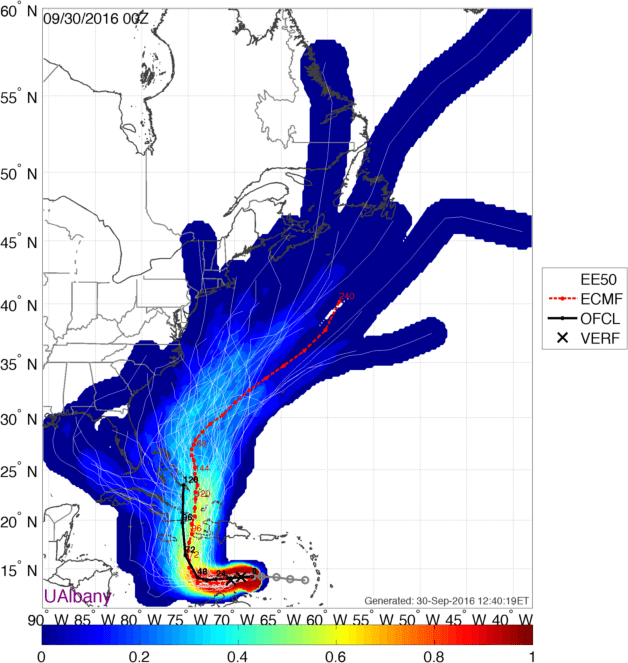
Forecast tracks for Matthew from the GFS Ensemble. Image provided by Brian Tang, University at Albany
0_es3
Forecast tracks for Matthew from the ECMWF Ensemble. Image provided by Brian Tang, University at Albany

As you can see from the images above, there are dozens of possibilities as to where Matthew can go. Based on the most recent model runs, a track through the Bahamas and then northward off the Carolinas is the most likely outcome, but there are still some models that have the storm stall in the Bahamas or even drift closer to Florida or possibly into the Gulf of Mexico. Once it gets up towards the Carolinas, there are even more possibilities to consider. The storm could continue up the coast and threaten the Northeast. It could start to turn northeastward and threaten Atlantic Canada. It could head harmlessly out to sea. At least one model shows it doing nearly all of the above! This model has it head out to sea, then hook back northwestward, and head towards eastern New England and Nova Scotia/New Brunswick.

At this point, we really have to wait and see how the pattern evolves before we’ll have a better idea as to what Matthew is going to do. If it is going to impact the Northeast, the time frame would be towards next weekend.So, keep an eye on Matthew’s progress if you have plans for that time frame.

What’s Going On With Hermine?

Labor Day Weekend is here, and the big question on everyone’s mind is “What is Hermine going to do?” We’ll try to answer that as best as we can right now.

vis_lalo-animated
Satellite loop of Hermine. Loop provided by NOAA.

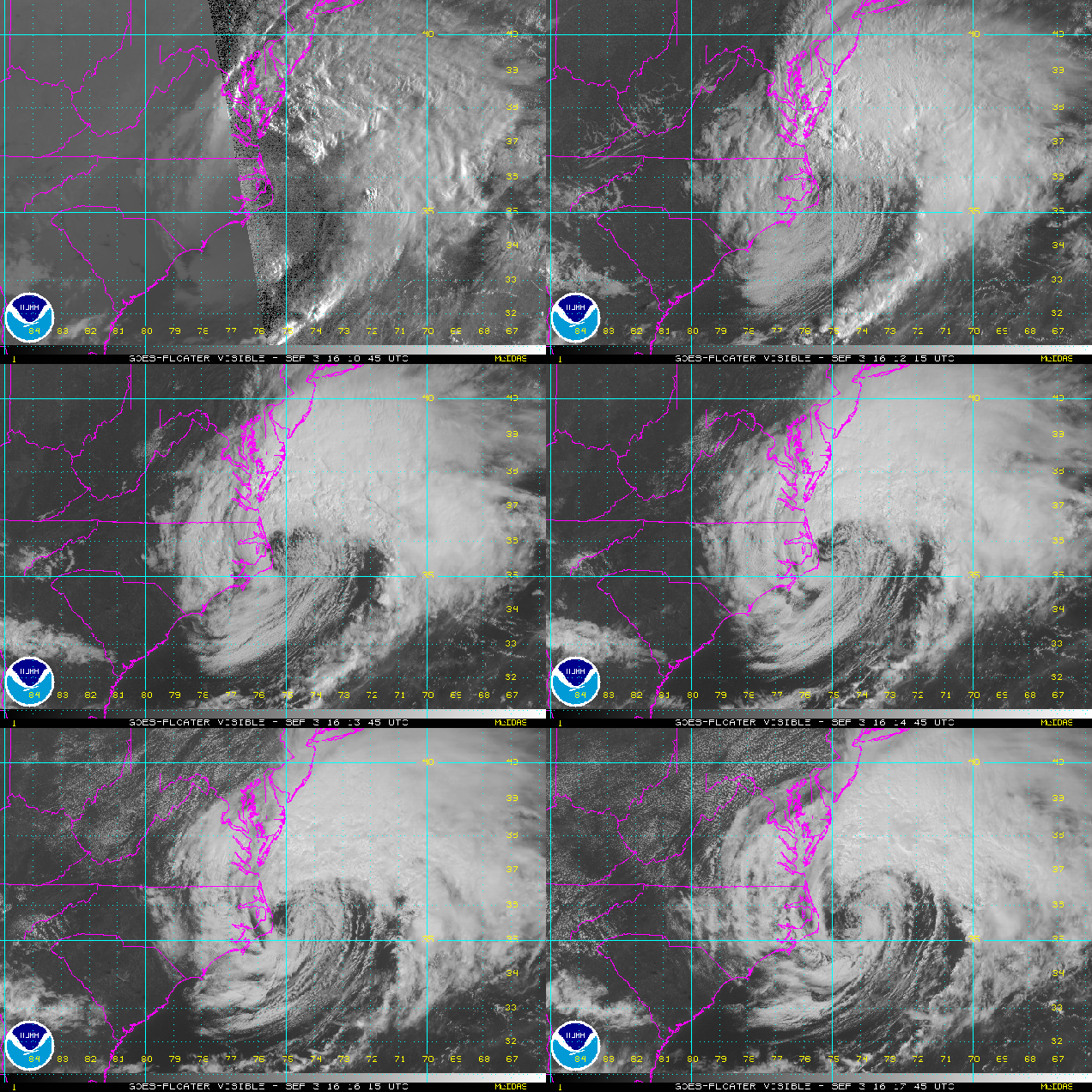
First, we’ll give you the facts. As of 2pm EDT, Hermine was centered about 90 miles east of Duck, North Carolina, moving toward the east at 10 mph. Maximum sustained winds are near 70 mph. Hermine is now a “post-tropical” storm. What does that mean? Well, to start with, it means that’s it’s no longer tropical. It’s more like a typical Nor’easter that we see throughout the fall, winter, and spring. As you can see in the satellite loop above, most of the thunderstorm activity is now well north of the center of circulation. Tropical systems contain thunderstorm activity concentrated near the center of the storm.

093728R_sm
Map showing current tropical storm watches and warnings as well as the extent of strong winds with Hermine. Image provided by the National Hurricane Center.

Despite the fact that Hermine is no longer tropical, Tropical Storm Warnings remain in effect for the East Coast from Ocracoke Inlet, North Carolina to Watch Hill, Rhode Island. A Tropical Storm Watch is in effect from Watch Hill up to Sagamore Beach, Massachusetts, which includes all of Cape Cod, the Islands, and the coast of Rhode Island.

So, if it’s no longer tropical, why are there tropical storm watches and warnings in effect? There are two reasons for this. The first, and simplest one, is the fact that there is a chance Hermine could re-acquire tropical characteristics as it sits over the warm waters of the Gulf Stream over the next few days. The other reason is related to Sandy. As you may recall, when Sandy slammed into New Jersey in 2012, there were no hurricane warnings in effect, despite the fact that Sandy was still a Category 1 hurricane while offshore. The reason there were not warnings was because Sandy was expected to become “post-tropical” before landfall, and the rules that the Hurricane Center had to abide by at the time did not allow them to issue watches/warnings if the system was not expected to impact the coast as a tropical system. (Yeah, we think it was stupid too.) So, they changed those rules, and this is the first test of them.

al092016
Computer model forecasts for the track of Hermine. Image provided by the University of Wisconsin.

So, what does the future actually hold for Hermine? Hermine will stall out east of the Delmarva Peninsula tonight and Sunday as it gets stuck under an upper-level low pressure system. It will then drift around south of Long Island for a few days. While it’s sitting over the warm water there, it could become a tropical system again (possibly even a hurricane), but that won’t last too long. Why? As it sits over the same area, it will churn up the waters, which will bring cooler water to the surface through a mechanism called “upwelling.” As this cooler water comes up, the system will lose the warm water it needs to sustain a tropical system, and then lose any tropical characteristics it may have gotten back. In other words, it’ll be “post-tropical” again.

ww3_height_dir_bermuda_17
Wave Watch model forecast for expected wave heights along the East Coast Monday morning. Image provided by WeatherBell.

In terms of sensible weather, Hermine is going to lay the smack down on the Mid-Atlantic states. Rough surf will pound the coast, especially in New Jersey, for several days, along with strong winds right along the coast. Wind gusts of 40-60 mph are expected along the Mid-Atlantic coast, along with some periods of rain, though the heaviest rain should stay off shore for the most part.

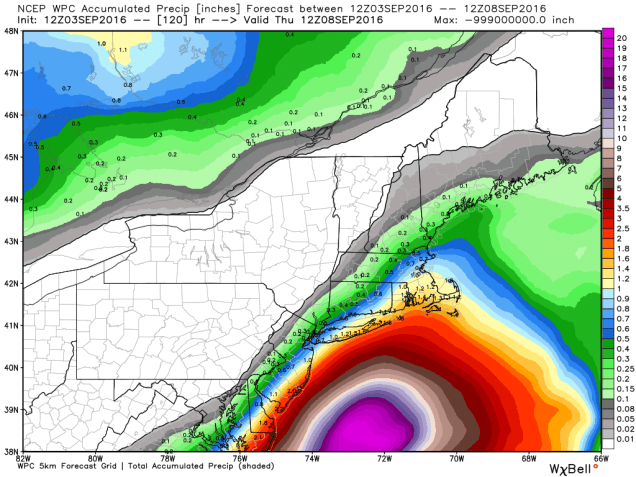
wpc_total_precip_neng_20
Expected rainfall through Thursday morning. Image provided by WeatherBell.

What about here in New England? We’re going to escape the brunt of it. There will be some very rough seas, starting on Sunday and likely continuing through at least Wednesday. It’s probably a good idea to stay out of the water if you’re heading to the beach, as the risk for rip currents will be high. Likewise, you probably don’t want to be heading out on a boat, with seas of 10-20 feet expected. If you’re taking one of the ferries to the Vineyard, Nantucket, or Block Island, there will likely be times where they have to cancel them due to rough seas. In terms of winds, the strong winds are likely right along the South Coast and across the Cape and Islands. Wind gusts of 30-40 mph or more are likely at times right through at least Tuesday. The bulk of the rain will stay to our south, but periodic showers and occasional batches of steady rain will come through at times over the next several days. The graphic above might be overdone in terms of how much rainfall we’ll get, but there will likely be some rain at times, especially the farther south you head.

Hermine likely won’t start to move out of the picture until the latter half of the week. Until then, we’ll just head to deal with clouds, periodic showers, occasionally strong winds, and rough surf for several days. In other words, it’ll feel like a typical April week, expect temperatures will be in the upper 60s and 70s instead of 40s and 50s.


Hurricane Hermine Heading Here?

(Note: This post was edited to reflect the fact that Hermine was upgraded to a hurricane at 3pm EDT)

We’re just about to start the Labor Day Weekend, traditionally summer’s last gasp around here, and the big question on everyone’s mind is “Will Hurricane Hermine ruin my plans?” The short answer is “maybe.”

rb_lalo-animated
Satellite loop of Tropical Storm Hermine. Loop provided by NOAA.

First, let’s start off with the basic facts. As of 3pm EDT, Hurricane Hermine was centered about 115 miles south-southwest of Apalachicola, Florida, and was moving towards the north-northeast at 14 mph. The storm has maximum sustained winds of 75 mph, and some more strengthening is possible before landfall just east of Apalachicola tonight.A Hurricane Warning is in effect for the coast of Florida from Mexico Beach to the mouth of the Suwanee River. Hurricane watches and Tropical Storm Warnings are also in effect for much of the remainder of the Florida Gulf Coast, as well as much of the Atlantic Coast from northeastern Florida up to North Carolina.

153730R_sm
Map showing the extent of tropical storm force winds with Hermine and all current watches and warnings. Image provided by the National Hurricane Center.

OK, now that we’ve got the facts spelled out, here’s what we’re fairly sure about: Hermine will likely make landfall a little east of Apalachicola, Florida tonight. This will be the 1st hurricane to make landfall in Florida since Hurricane Wilma on October 24, 2005, ending Florida’s record 11-year “hurricane drought.” Once it makes landfall it will move up across Georgia and into the Carolinas, slowly weakening while dropping heavy rainfall on the region. Flooding is almost a certainty in some areas. The center of Hermine should move back out into the Atlantic off the North Carolina coastline, possibly as far north as Norfolk, Virginia by late Saturday. Once off the coast, the storm will likely drift northward and then stall east of the Delmarva Peninsula on Sunday. This is where things get tricky.

wpc_total_precip_se_16
Rainfall forecast through Monday morning. Image provided by WeatherBell.

We’ve gone over what is going on currently, and what we’re fairly sure will happen over the next 2-3 days. Now, we’ll delve into the parts that we don’t have a handle on yet. Once the storm stalls east of the Delmarva Peninsula, we have a lot of questions that just can’t be answered right now. Where does it actually stall? How long does it stall? Which way does it drift once it does stall? How strong will it be? How large will the wind field be? How large will the precipitation field be? These are all important details that have a HUGE effect on the forecast. Unfortunately, we won’t have a better idea of these details for another 24 or even 48 hours.

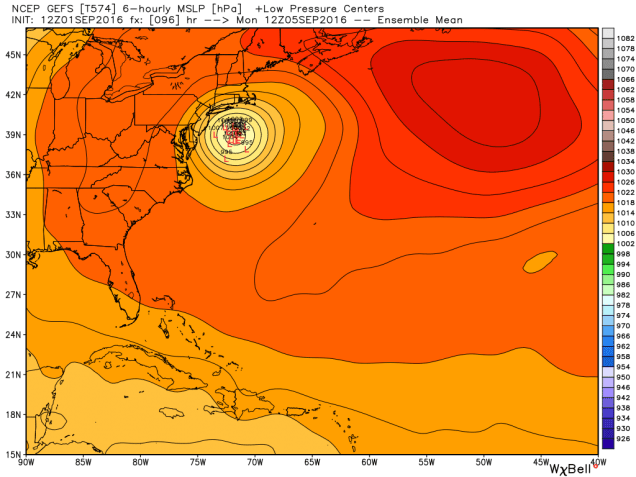
gefs_slp_lows_swatl_17
GFS Ensemble Forecast for the position of low pressure Monday morning. Note that while the different members all have the low positioned south of Long Island, there is some variation in all directions as to exactly where the storm will be centered. Image provided by WeatherBell.

While we’re not expecting Hermine to be a hurricane once its off the Delmarva Peninsula, it could still be a tropical storm once it is east of the Delmarva Peninsula. More likely, it will become extratropical. What does that mean? To put it in simple terms, it will be more like a typical Nor’easter around here.

If you’ve got Labor Day Weekend plans, don’t scrap them just yet, but have a backup plan ready. The farther north your plans are, the less likely that you’ll be impacted. However, the closer you are to the South Coast or the Cape, the greater the chance that you may be dealing with gusty winds and/or rainfall. (Rough surf is a virtual lock at this point, so staying out of the water is probably a good idea).

We should be able to provide an update this weekend, once things become a little more certain.


Tropical Trouble? Several Storms Could Threaten Land Areas

The peak of hurricane season is normally a 6-week period from late August until late September. This year is no exception. We currently have five active tropical systems that we’re tracking, and more may be on the way. Of the five that are currently out there, all of them are a threat to some land areas, four of them to parts of the United States.

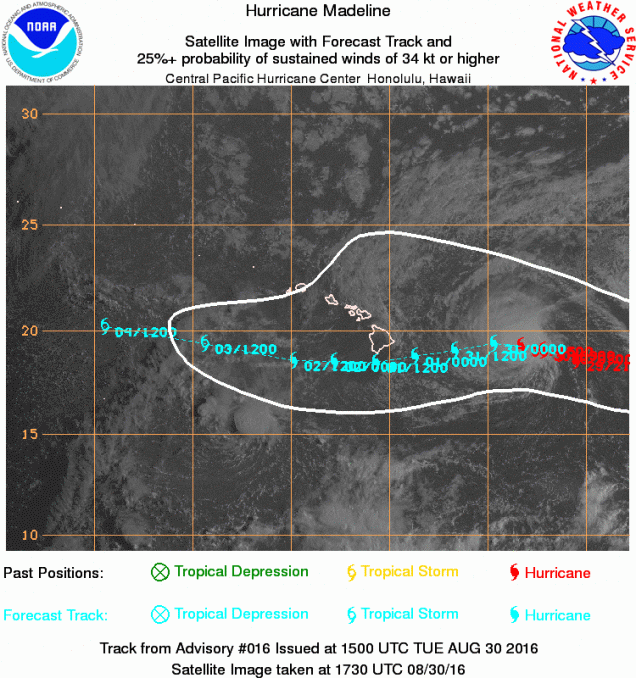
probEP142016_160830_1730_sata
Satellite photo and forecast track for Hurricane Madeline. Image provided by the Central Pacific Hurricane Center.

We’ll start in the Central Pacific where Hurricane Madeline is bearing down on parts of the Hawaiian Islands. As of 8am HST Tuesday, Hurricane Madeline was centered about 415 miles east of Hilo, Hawaii, moving towards the west at 10 mph. Maximum sustained winds are near 120 mph, making Madeline a Category 3 Hurricane on the Saffir-Simpson Scale.  A Hurricane Watch and Tropical Storm Warning have been issued for the Big Island of Hawaii, and a Tropical Storm Watch has been issued for Maui County, including the islands of Maui, Molokai, and Lanai. It is extremely rarely for a storm impact Hawaii as a hurricane when moving in from the east. The current forecast calls for Madeline to pass just south of the Big Island with some weakening expected. Most hurricanes that impact Hawaii are traveling from south to north. Madeline should pass close enough to Hawaii to bring strong winds and heavy rain to some of the southernmost islands. Rainfall totals of 5-10 inches and locally heavier are possible, especially in the windward sides of the islands. Rough surf will pound most of the islands for the next several days.

rb_lalo-animated
Satellite loop of Hurricane Lester. Loop provided by NOAA.

Next up is Hurricane Lester, which was centered about 1350 miles east of Hilo, Hawaii at midday, moving toward the west at 14 mph. Lester has top winds near 120 mph, is expected to steadily weaken over the next few days while continuing in a general westward direction. While Lester is not a threat to land for the next few days, that could change by the end of the week. The current track calls for Lester to gradually turn more towards the west-northwest and northwest by Friday and Saturday, passing a little north of the Hawaiian Islands. While this track would likely spare the islands from most of the wind and rain, if Lester makes that turn a bit later, it would pass a lot closer to the islands. Residents of Hawaii should make sure to keep tabs on Lester’s progress once Madeline moves away from the region.

07L_tracks_latest
Model forecasts for the track of Hurricane Gaston. Image provided by Tropical Tidbits.

Closer to the mainland we find Tropical Depression Eight. The storm was centered about 70 miles south of Cape Hatteras, North Carolina early Tuesday afternoon and was nearly stationary. Maximum sustained winds are near 35 mph. A slow drift toward the north is expected tonight and Wednesday, with some strengthening possible as the storm moves over the warm waters of the Gulf Stream. A Tropical Storm Warning is in effect for the coast of North Carolina from Cape Lookout to Oregon Inlet. Wins gusts to 30-40 mph and locally heavy rainfall are expected over the Outer Banks of North Carolina tonight and Wednesday. After that, the system should start to head out into the Atlantic and dissipate by later in the week.

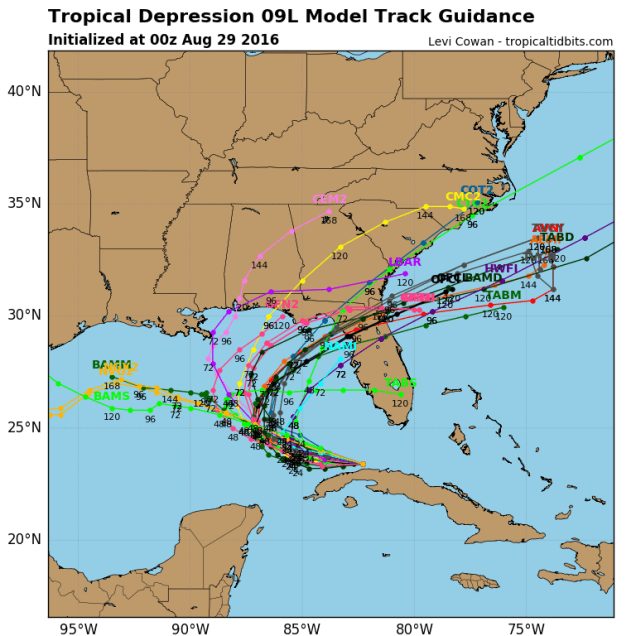
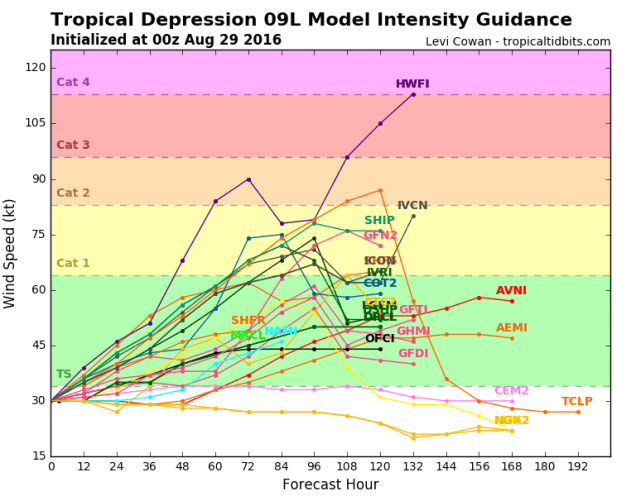
Finally, we get to Tropical Depression Nine, which was centered about 340 miles west of Key West, Florida at midday Tuesday. The storm has maximum sustained winds of 35 mph, and was moving towards the west-northwest at 7 mph. This is the same storm we’ve been watching for a week-and-a-half that was supposed to be the next “Storm of the Century”. Well, it might finally be starting to get its act together. The forecast for this system calls for a turn more towards the north and eventually northeast as an upper-level trough of low pressure starts to steer the system. Strengthening is expected, and the depression could become a tropical storm tonight or early Wednesday. Tropical Storm Watches will likely be issued for parts of the Gulf Coast later today or tonight. Some of the models show the possibility of the storm becoming a hurricane before making landfall along the Florida Gulf Coast later this week. Once it makes landfall, it should quickly cross the Southeast, then emerge into the Atlantic, where some re-strengthening is possible. The system will likely bring heavy rain and gusty winds to parts of the Carolinas, but beyond that its future is uncertain. Some models indicate that it will continue northeastward, out into the Atlantic, while others try to slow it down and head northward up the East Coast in a much-weakened state. Since this could have an adverse impact on the Labor Day Weekend up here, we need to pay close attention to it.

09L_tracks_latest
Model forecasts for the track of Tropical Depression Nine. Image provided by Tropical Tidbits.
09L_intensity_latest
Model forecasts for the intensity of Tropical Depression Nine. Image provided by Tropical Tidbits.

Finally, a new tropical wave has emerged from the coast of Africa. This wave will cross the Cape Verde Islands tonight, then head westward across the Atlantic. Conditions are favorable for further development, and many of the forecast models show the possibility of this system strengthening over the next several days. It is still at least 5 days away from impacting the eastern Caribbean, so there is plenty of time to monitor its progress before it threatens any land areas. If it does do what the models are showing, expect the hype machine to get cranked up to maximum again, as the next “Storm of the Century of the Week” could be a threat to the East Coast.

Weekly Outlook August 29-September 5, 2016

In a lot of ways, this week will be very similar to last week. That shouldn’t be a big surprise, we’ve been stuck in the same weather pattern for nearly the entire summer.

Buying-the-windshield-wipers-that-work-perfectly-for-my-car
These are called windshield wipers. You use them to clean the rain off of your windshield. Most of you probably haven’t used them much in the past few months.

Just like last week, we’ll start the week off with a cold front crossing the region early Monday. It may produce a few showers early this morning, but that’s about it. High pressure briefly builds in for Tuesday with drier conditions, then another cold front moves through on Wednesday. It may produce a few showers or thunderstorms late Wednesday. After that, high pressure builds in for the rest of the week and into the Labor Day Weekend with cooler and drier conditions. Dewpoints will likely be in the 40s again from Thursday into Saturday.

rb_lalo-animated
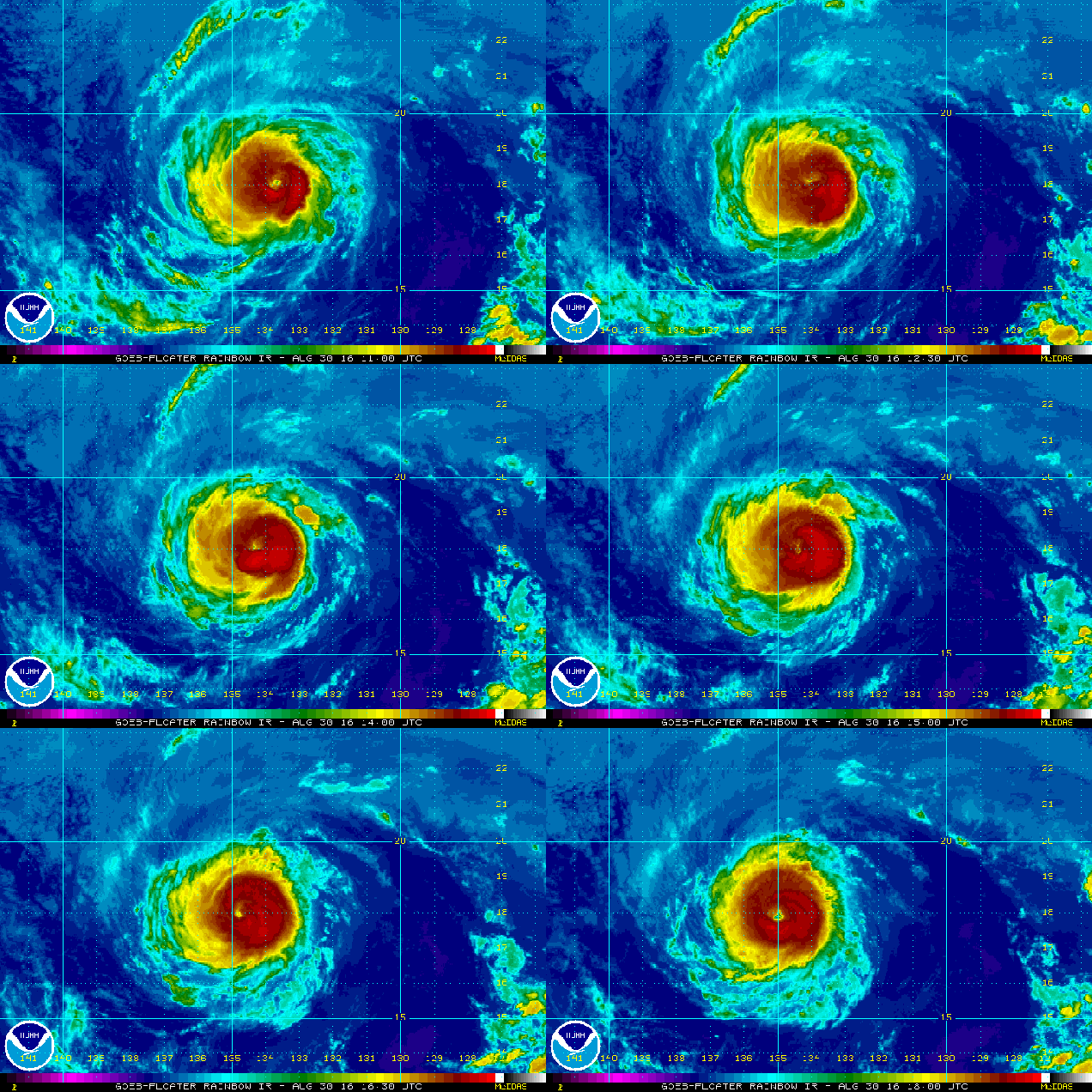
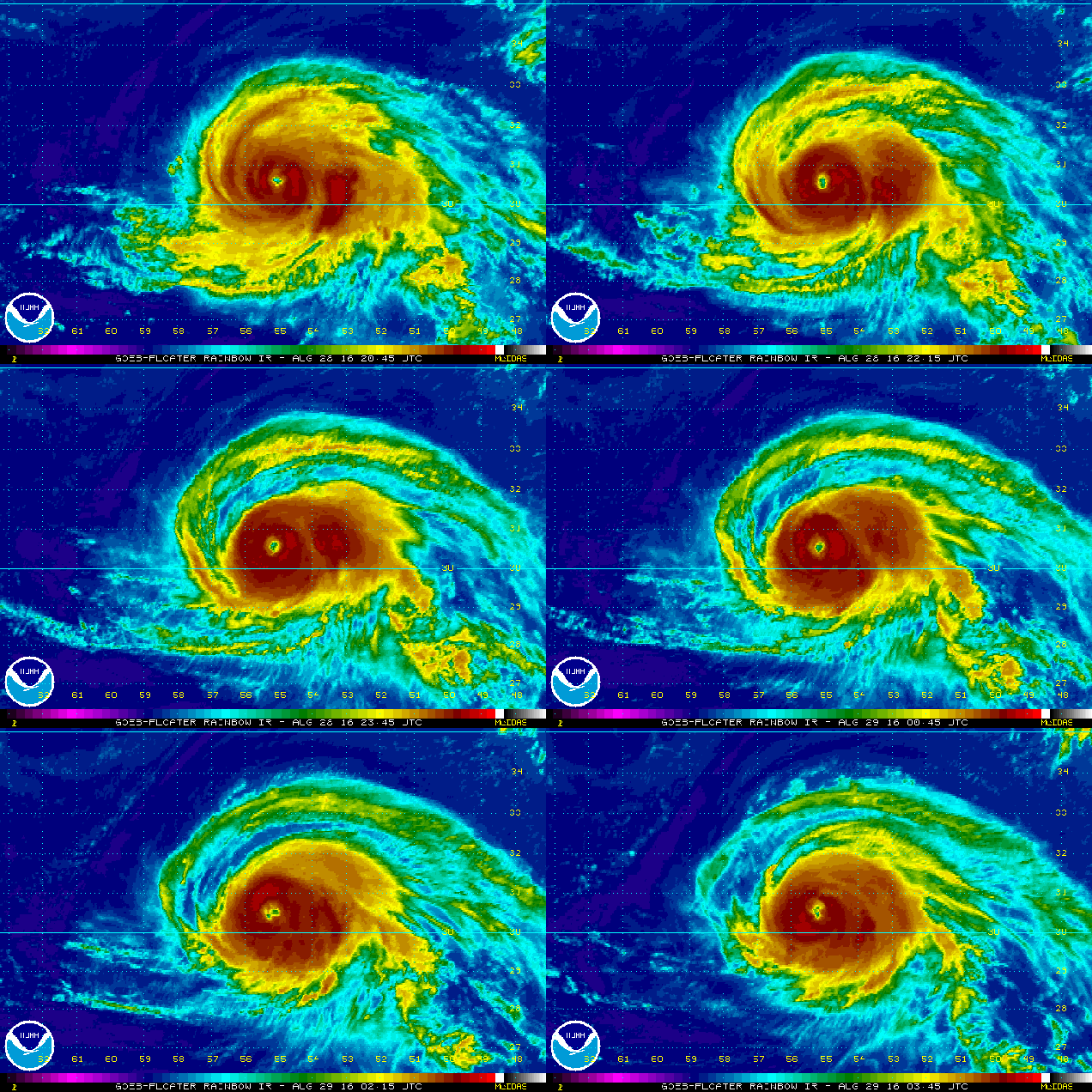
Satellite loop of Major Hurricane Gaston. To quote a friend “Now that’s an atmospheric heat engine.” Loop provided by NOAA.

That large high pressure area building in will also be a “deflector shield” of sorts. There are currently three tropical systems in the Atlantic, and two of them, are not far from the US mainland. First we have Major Hurricane Gaston. Gaston has maximum sustained winds near 120 mph, making it a Category 3 Hurricane on the Saffir-Simpson Scale. Gaston is centered about 575 miles east of Bermuda tonight. Unless you’re in the middle of a Trans-Atlantic cruise, then you don’t have to worry about Gaston, as it will be heading out over the open Atlantic, no threat to any land areas. Gaston will start to send some rough seas our way though, so if you are planning on heading to the beach this week, be alert, as there will be a higher than now risk for riptides.

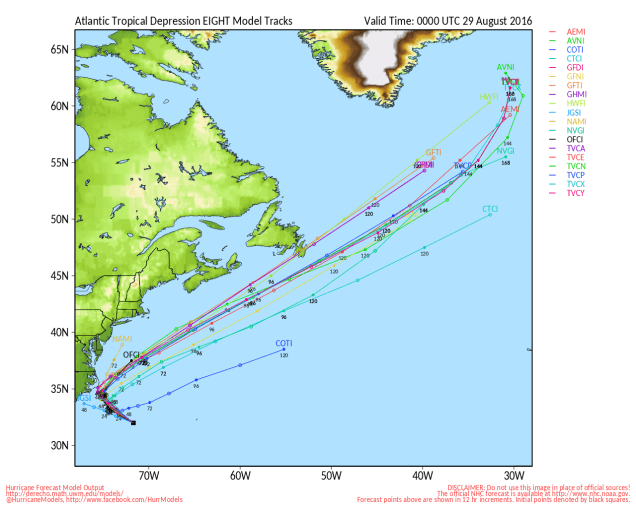
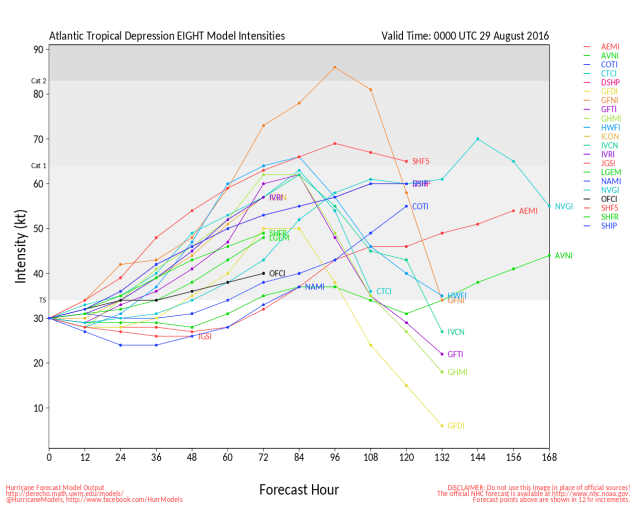
Closer to home, Tropical Depression Eight developed on Sunday. TD 8 has top winds near 35 mph, and is centered about 285 miles southeast of North Carolina. The forecast calls for TD 8 to strengthen into a tropical storm late Monday. Since it is expected to turn towards the northwest, a tropical storm watch has been issued for the Outer Banks of North Carolina from Cape Lookout to Oregon Inlet. After brushing the Outer Banks late Tuesday, it will turn more towards the north and northeast, merging with the cold front that will cross our region on Wednesday.

al082016
Model forecasts for the track of Tropical Depression Eight. Image provided by the University of Wisconsin.
al082016_inten
Model forecasts for the intensity of Tropical Depression Eight. Image provided by the University of Wisconsin.

We also have Tropical Depression Nine, centered about 100 miles southwest of Key West, Florida and just off the north coast of Cuba tonight. This is the system that has been relentlessly hyped by many in the media and on the Internet (but not this site) for the past week plus as the next “Storm of the Century”. It finally developed a circulation center Sunday afternoon, and was deemed a tropical depression. If you believed many of the computer models and “Facebook Forecasters” earlier in the week, it was supposed to hit south Florida as a hurricane yesterday. Right now, it looks like the storm should turn more to the north while strengthening into a tropical storm over the next day or two. A track towards the Big Bend of Florida seems most likely at this point, but as this storm has shown already, it will do (or not do) what it wants to. Assuming it does track towards Florida, it should cross the Southeast, then emerge off the coast of Georgia or northeastern Florida. Once there, it will move over the warm waters of the Gulf Stream and could strengthen once again. However, with a big high pressure area to the north (we told you that we’d tie that in eventually), a track up the coast is unlikely. Instead, the system will likely head out into the open Atlantic.

09L_tracks_latest (1)
Model forecasts for the track of Tropical Depression Nine. Image provided by Tropical Tidbits.
09L_intensity_latest (1)
Model forecasts for the intensity of Tropical Depression Nine. Image provided by Tropical Tidbits.

So, here’s what we can expect around here right through and including Labor Day:

Monday: Chance for a few showers early, then becoming partly to mostly sunny. High 84-91.

Monday night: Clear skies. Low 56-63.

Tuesday: Partly to mostly sunny. High 78-85.

Tuesday night: Clear to partly cloudy. Low 60-67.

Wednesday: A mix of sun and clouds, chance for showers and thunderstorms during the late afternoon and evening hours.High 83-90.

Thursday: Partly sunny. High 75-82.

Friday: Intervals of sunshine and clouds.High 71-78.

Saturday: Sunshine and a few pop-up clouds.High 72-79.

Sunday: Mostly sunny. High 75-82.

Labor Day: Plenty of sunshine.High 77-84.


A Little Sizzle, a Lot of Fizzle (and Probably Some Drizzle) in the Tropics

As we get into the end of August, we are moving into the peak of hurricane season. As expected, the tropics have awakened, with plenty of activity to watch, but thus far, much of it remains disorganized.

two_atl_2d0
In addition to Tropical Storm Gaston, there are 3 disturbances being watched in the Atlantic. Image provided by the National Hurricane Center.

Starting in the Atlantic, we have Tropical Storm Gaston. Gaston was centered about 900 miles east-southeast of Bermuda Friday evening, moving towards the northwest at 15 mph. While Gaston was briefly upgraded to a hurricane earlier in the week, it currently has maximum sustained winds of 65 mph. Conditions are favorable for Gaston to strengthen this weekend and become a hurricane once again. The storm should turn more toward the north and eventually northeast, remaining over open waters into the start of the upcoming week.

gulf_cdas1
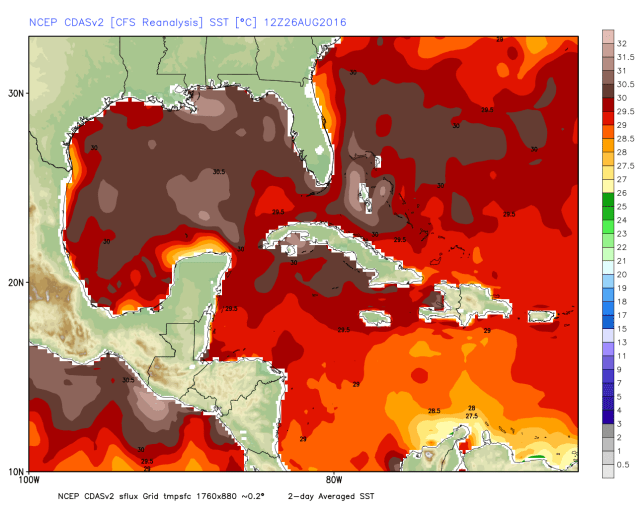
Current water temperatures across the Gulf of Mexico, Caribbean Sea, and Southwest Atlantic Ocean. A storm moving into this bath water could strengthen quickly. Image provided by WeatherBell.

A disorganized area of showers and thunderstorms is moving across the Central Bahamas this evening. This is the same storm that everyone on the Internet has been hyping up as next “Storm of the Century” for the past week. As you can see, it still hasn’t done anything, but that hasn’t stopped the hype at all. Conditions will be unfavorable into the weekend for any development of this system. Several models are still showing the potential for the system to develop once it gets into the Gulf of Mexico. Water temperatures are very warm across the Gulf, which would help to fuel any developing system. Will it ever develop? We’ll find out one way or the other in the next few days. Anyone with interests in and around the Gulf Coast should still keep an eye on the progress of this system, just in case it finally gets its act together.

wpc_total_precip_tx_12
Expected rainfall through Monday evening. Image provided by WeatherBell.

Meanwhile, there is a weak trough of low pressure already located in the northern Gulf of Mexico this is being watched. Upper-level conditions are not favorable for development of this system, but it will bring heavy rainfall to portions of Louisiana and Texas this weekend. This is not good news for areas that were hit hard by flooding just a few weeks ago.

Another disturbance has developed just south of Bermuda this evening. This system is expected to remain weak for the next few days while moving very little. Eventually it should start drifting westward, and some slow development is possible. This system may bring some showers and thunderstorms to Bermuda this weekend and parts of eastern North Carolina during the early part of the upcoming week, but otherwise should not have much of an impact on any land areas.

aal91_2016082700_track_early
Model forecasts for the track of a disturbance south of Bermuda. Image provided by NCAR.
aal91_2016082700_intensity_early
Model forecasts for the intensity of a disturbance south of Bermuda. Image provided by NCAR.

While the Atlantic is filled with potential tropical systems, the Pacific has a couple of named systems, one of which could be a threat to land.

vis_lalo-animated (1)
Satellite loop of Hurricane Lester. Loop provided by NOAA.

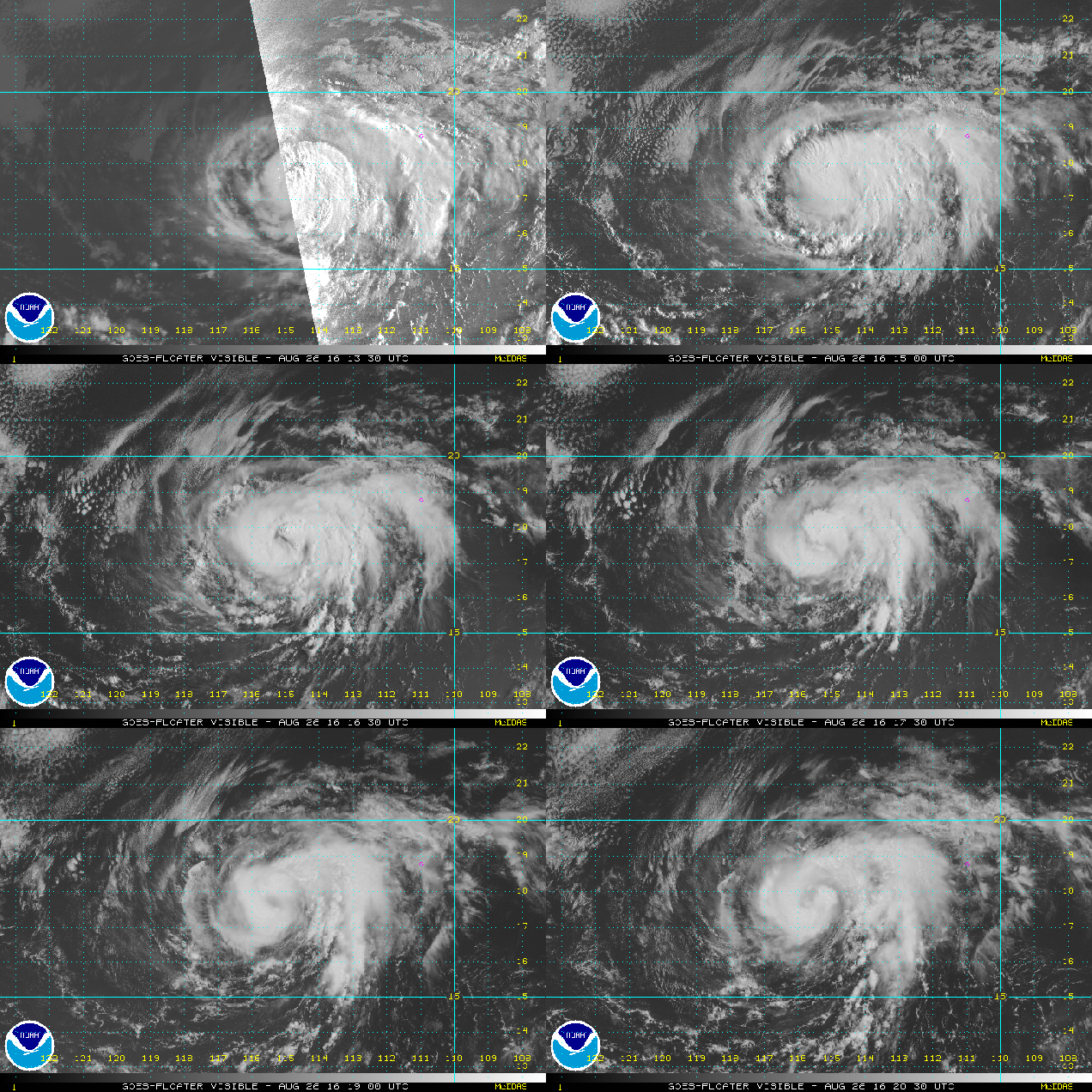
Hurricane Lester was centered about 550 miles southwest of Cabo San Lucas, Mexico Friday evening. Lester has maximum sustained winds near 75 mph, and additional strengthening is expected. Lester is currently moving toward the west at 9 mph, and a general westerly track is expected to continue through the weekend. Lester is not a threat to land for the next several days, however, some models are showing that it could have some impacts of Hawaii towards next weekend.

ep142016
Model forecasts for the track of Tropical Storm Madeline. Image provided by the University of Wisconsin.
ep142016_inten
Model forecasts for the intensity of Tropical Storm Madeline. Image provided by the University of Wisconsin.

Tropical Storm Madeline could be a more immediate threat to Hawaii. Tropical Depression 14-E developed earlier on Friday about 1250 miles east-southeast of Hilo, Hawaii, and was upgraded to Tropical Storm Madeline Friday evening. Madeline has maximum sustained winds near 40 mph, and additional strengthening is expected. Madeline could become a hurricane by the end of the weekend or beginning of next week. The storm is expected to track towards the northwest this weekend before turning more towards the west. On this track, Madeline could approach the Hawaiian Islands towards midweek. Residents of the region should keep an eye on Madeline’s progress during the next few days.

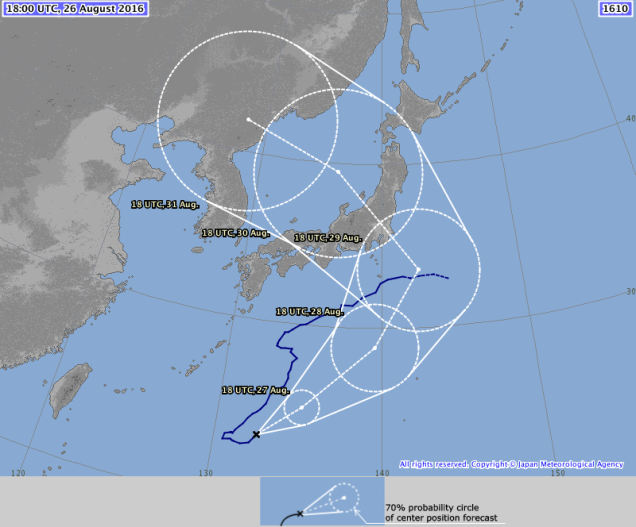
1610-00
Forecast track for Typhoon 12W (Lionrock). Image provided by the Japan Meteorological Agency.

In the Western Pacific, Typhoon 12W Lionrock (Is that not the coolest name you’ve seen in a while for a tropical system?) has been slowly meandering around south of Japan for much of the past week, but that looks like it is about to change. As of Friday evening, the storm has maximum sustained winds near 110 mph, and some additional strengthening is possible this weekend. A track toward the northeast is expected this weekend, but a turn more toward the north and eventually northwest is likely by Sunday or Monday. On this track, the typhoon would make landfall in southeastern or eastern Japan on Monday.

Weekly Outlook August 22-28, 2016

As we start off the last full week of meteorological summer, some things will remain the same as they have for months – there will be very little rainfall, worsening an already severe drought across the region. Some things will change though – humidity levels will drop at least for a few days and so will temperatures.

20160816_northeast_trd
The only place in Southern New England not currently classified as being in drought is Nantucket Island. Image provided by the US Drought Monitor.

The week will start off with a little rain. However, by the time most of you read this, the rain will already have ended. A cold front will cross the region early Monday morning with showers and possibly thunderstorms. The rain should end towards daybreak, then skies will quickly clear out as the front pushes offshore. After that, high pressure builds in, with much drier air for Monday and Tuesday. How dry? How does dewponts in the 40s sound?  Temperatures will actually be near or a little below normal as well. By Wednesday, the high moves offshore, winds become southwesterly, and both the temperature and humidity start to rise again. On Friday, another cold front sweeps across the region, with a few showers and thunderstorms expected. Cooler and drier air returns next weekend.
Umbrella-PNG-Pic
Just in case you forgot, this is called an umbrella. You use it to keep yourself dry when it rains. Most of you probably haven’t seen one for months.

Monday: Showers ending around daybreak, then becoming partly to mostly sunny, breezy, and less humid. High 76-83.

Monday night: Clear skies. Low 53-60.

Tuesday: Wall-to-wall sunshine. High 75-82.

Tuesday night: Clear skies. Low 54-61.

Wednesday: Sunshine and a few clouds. High 83-90.

Thursday: Partly to mostly sunny. High 82-89.

Friday: A mix of sun and clouds with afternoon showers and thunderstorms possible. High 83-90.

Saturday: Mostly sunny. High 79-86.

Sunday: Partly to mostly sunny. High 77-84.

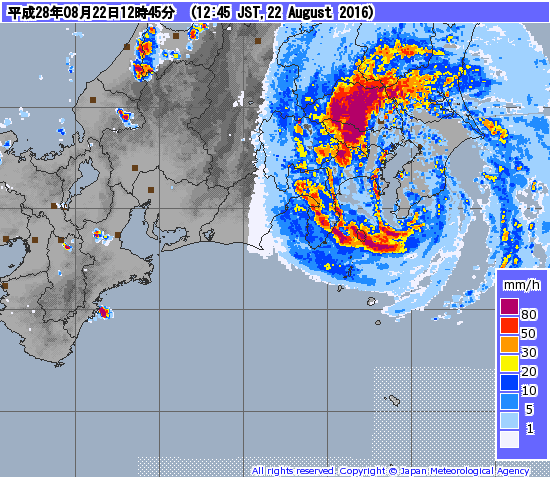
As this post is being written, Typhoon 10W (Mindulle) is making landfall very close to Tokyo. That’s probably not good. If you’re looking for an update on the massive hurricane that’s supposed to wipe out the East Coast just before Labor Day, then you’re out of luck. because it’s a fantasy that will not likely happen. Oh, we’ve got plenty of activity – Tropical Depression Fiona is dying southeast of Bermuda. There are two other areas we’re watching, one of which could become a tropical depression on Monday. The odds of either of those impacting the East Coast are still fairly small though. If there is a potential threat, we’ll let you know all about it.

201608221245-00
Radar image of Typhoon 10W (Mindulle) making landfall near Tokyo. Image provided by the Japan Meteorological Agency.