A Little Bit of Everything – October in the Northeast

October can be a time of change in the Northeast. While the first thing that comes to mind is the changing colors of the foliage across the region, the weather also changes, sometimes quite frequently. That’s what we’re going to be dealing with for the next few days.

rtma_t2m_neng
Current temperatures across the Northeast as of 1pm on October 19. Image provided by WeatherBell.


It’s an unseasonably warm afternoon across much of the Northeast, with temperatures generally in the 60s and 70s, with 80s from southern Connecticut into the Mid-Atlantic states. Dozens of record highs have been set over the past few days, and more are falling today. However, some changes are coming, and the warm weather will be a distant memory within the next 24-48 hours.

A cold front is moving across the region this afternoon, though you really couldn’t tell, as there’s only scattered cloud cover and little precipitation with the front. That front will stall out to the south of New England tonight. On Thursday, a wave of low pressure will start to approach from the west. This will spread rain and showers into the region. Some of the rain will be heavy, especially from New York into Pennsylvania late Thursday into Friday. With rainfall totals of 1-3 inches and locally up to 5 inches expected, some flooding is likely. Across New England, where a serious drought is ongoing, rainfall will be much lighter, with most locations likely receiving under half an inch of rain.

qpf_acc-us_ne
Expected rainfall through Friday evening across the Northeast. Image provided by Pivotal Weather.


As that wave of low pressure moves into Upstate New York on Friday, it will lift that cold front back across New England as a warm front. While Friday won’t be as warm as today, temperatures will still get into the 60s and lower 70s across much of New England. With dewpoints also in the 60s, it will be a rather muggy day for mid-October.

99l_tracks_latest
Computer model forecasts for the track of a tropical disturbance in the Bahamas. Image provided by Tropical Tidbits.


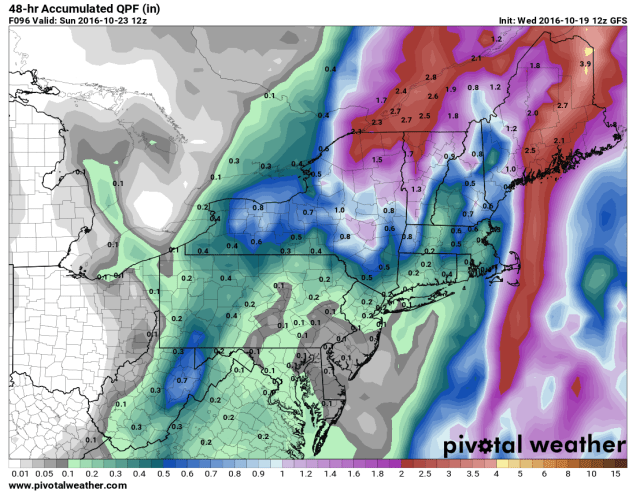
Meanwhile, there is a tropical disturbance brewing in the Bahamas right now. While conditions are favorable for development, we’re not looking at another monster like Matthew, it could become a tropical depression or subtropical storm over the next few days. The system will likely head northward, moving towards the Gulf of Maine as we head into the weekend. This will bring another round of heavy rainfall into Maine and Atlantic Canada, again missing most of Southern New England, where the rain is most needed.
qpf_048h-us_ne
Expected rainfall between Friday morning and Sunday morning across the Northeast. Image provided by Pivotal Weather.


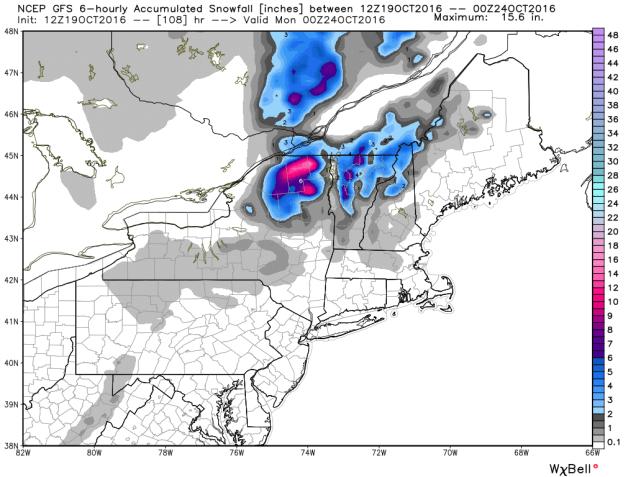
Once the system moves into southeastern Canada, it is expected to stall out under an upper-level low pressure area and become a strong extratropical system. It will drag a cold front across the Northeast, bringing much colder air into the region. With strong low pressure nearby and much colder air filtering in, rain will change over to snow across portions of Upstate New York and Northern New England. While the snow will be confined mainly to the higher elevations, this is the first accumulating snow of the season across the area. Several inches may accumulate across parts of the Adirondacks and the Green Mountains.
gfs_6hr_snow_acc_neng_19
Expected snowfall through Sunday evening across the Northeast. Image provided by WeatherBell.


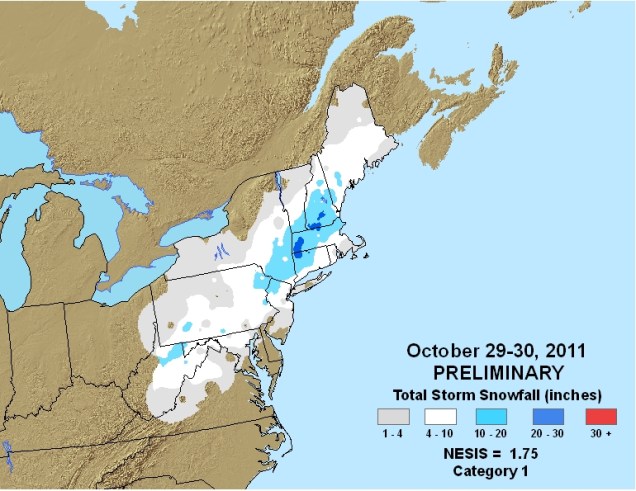
While there could be a few wet flakes mixed in with some of the rain across lower elevations of Central New England, accumulating snow is not expected.Sunday will be a chilly day, with highs only in the 40s and 50s across much of the Northeast. These readings are 10-20 degrees below normal. Of course, any mention of snow in October across the Northeast will make residents think back just a few years to the pre-Halloween snowstorm that dropped 1-2 feet of snow across parts of the region, setting numerous records. While this system won’t come anywhere close to that, it should make for some spectacular photos of snow-capped mountains and valleys filled with colorful foliage early next week.
20111029-20111030-1-75
Snowfall from the Halloween snowstorm of 2011. Image provided by NOAA.


Weekly Outlook October 3-9, 2016

There’s not much going on in the weather world right now is there? OK, we’re know you’re not that naive. We’ll get to the update on Matthew in a moment. Much of the remainder of the forecast is actually pretty simple.

The gloomy pattern we’ve been in will continue for one more day before the upper-level low pressure system responsible for it finally lifts out. High pressure starts to build in on Tuesday, and we stay dry through Friday.

After that? Well, that’s the $64,000 question, isn’t it? Here’s what’s going to be happening with the atmosphere. A cold front will start to approach from the west, while an upper-level trough of low pressure moves from the Plains states into the Great Lakes. By early Saturday, Matthew should be off the North Carolina coastline.

gfs_z500_mslp_eus_23-1
GFS forecast for Saturday morning October 8. Note the trough of low pressure (green colors) moving into the Mississippi Valley, the ridge of high pressure off the East coast (red and orange colors), and Matthew just off the NC coast. Image provided by Tropical Tidbits.

How strong that trough is, as well as how strong the ridge of high pressure off the East Coast is, will determine where Matthew goes. The GFS (pictured above), sends the storm north-northeastward, as the trough pulls it in. Other models, such as the ECMWF, do not have a strong trough, and as such, it builds the ridge back in, stalling Matthew’s northward progress, and letting it mill around off the Carolina coast for a few days. Other models don’t build up the ridge to the east, and thus let Matthew head northeastward, farther out to sea, before the trough captures it and pulls it northward well east of New England. The upper-level energy that will help determine how deep that trough gets is still off the West Coast. Once it gets into the West Coast, and an area where there is a lot more data to feed into the models, they should start to converge on a solution, and thus give us a better idea, or at least a little more confidence, as to what will happen.

12_es1
GFS Ensemble forecast tracks for Hurricane Matthew. Image provided by Dr. Brian Tang, University at Albany.
12_es3
ECMWF Ensemble forecast tracks for Hurricane Matthew. Image provided by Dr. Brian Tang, University at Albany.

Before we get to what, if any, impacts Matthew may have on our area, there’s another problem. The models are picking up on this, but we don’t think they’re hitting it hard enough. We told you that a cold front would be coming in from the west. This is going to set up what is called a “Predecessor Rainfall Event” or PRE for short. This often happens up here ahead of tropical systems, and can even occur when the tropical system doesn’t even get within 500 miles of New England. This was the case with the devastating flooding we had in 1996 from Hurricane Lili and again in October of 2005. This also happened last year in South Carolina with offshore Hurricane Joaquin. In other words, even if Matthew does not come close to New England, we could be looking at extremely heavy rainfall around here on Saturday ahead of a cold front. Earlier this summer, we told you about an old rule of thumb “When in drought, leave it out”, when talking about rainfall. Well, we’ve got another rule of thumb for you “Droughts end in floods”. Just look at Texas from earlier this year to see that play out.

Monday: Partly to mostly cloudy with more showers and maybe even a rumble of thunder possible. High 64-71.

Monday night: Mostly cloudy, chance for a few more showers. Low 50-57.

Tuesday: Becoming partly sunny. High 58-65.

Tuesday night: Partly cloudy.  Low 44-51.

Wednesday: Partly to mostly sunny (yes, really, we mean it). High 60-67.

Thursday: Mostly sunny. High 65-72.

Friday: Sunshine and a few clouds. High 67-74.

Saturday: Becoming cloudy with rain developing. The rain could be heavy, especially at night. High 64-71.

Sunday: Cloudy with rain likely, possibly heavy at times. If Matthew is close enough, it will also be very windy. High 60-67.

Beneficial Rain Is On The Way….Or Is It?

If you’ve lived around here long enough, at some point you start to think to yourself that winter won’t ever end. You start to dream about vacations in tropical locations, or better yet, sitting in your own backyard on a sunny summer afternoon. This past summer, you probably didn’t have many complaints, as there were plenty of those sunny, warm afternoons to go around. However, because it was so sunny and warm, much of the region is now in the midst of a very serious drought.

20160920_northeast_trd
Yup, it’s been really dry for a while now. Image provided by the National Drought Monitor.

A persistent ridge of high pressure kept the Northeast dry and warm through much of the Spring and Summer. Most of the cold fronts that tried to move through the region were starved for moisture, thus their main effects were to cool temperatures and lower humidity for a day or two. Thunderstorm activity was common, but aside from localized downpours, there really hasn’t been a widespread heavy rain event across much of the region for several months. That could be changing this week.

500wh-conus
GFS forecast showing an upper-level low pressure area sitting over the Appalachians Friday morning. Image provided by Pivotal Weather.

A slow-moving cold front will move across the region on Tuesday, bringing showers with it. While the rain likely won’t be too heavy, it should be widespread, which is good news for an area that needs all the rain it can get. The front will likely stall out right along the coastal plain, which may keep the shower activity going into Wednesday right along the coast. However, changes in the weather pattern are coming that promise to bring even more rain to the area.

An upper-level low pressure system will drop southward from the Great Lakes and take up residence across portions of the Ohio Valley and Appalachians. It will likely stay there for several days, before lifting out to the northeast this weekend. However, with the upper-level low pressure area just sitting there, low pressure will essentially remain in place at the surface as well across the same area. This will result in periods of rain and showers across much of the area right through the week. While the rain may be briefly heavy at times, persistent rainfall over several days can add up, with some areas possibly receiving 1-3 inches of rain between Tuesday and Friday, with some heavier amounts possible. Rainfall deficits in this area are on the order of 5-10 inches, so much more is needed, but this is definitely a good start.

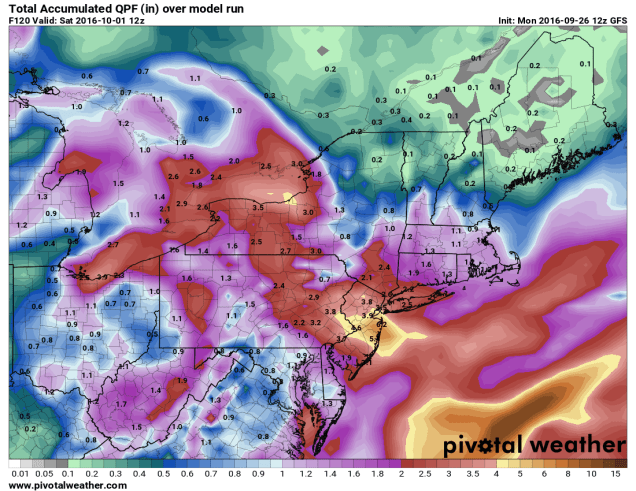
qpf_acc-us_ne
GFS model forecast for rainfall through Saturday morning. Doesn’t look good for Northern New England. Around here? We’ll see. Image provided by Pivotal Weather.

So, if you’re in places like Pittsburgh, Syracuse, or Atlantic City, it’s going to be a pretty dismal week. Around here? Well, that’s not an easy question to answer. With the low setting up well to the southwest of the area, high pressure will try to build in from the north. This will bring cool and dry conditions into much of northern New England this week. As for southern New England, where the effects of the drought are the most pronounced, the forecast depends entirely on where the low and high set themselves up. If the high is the dominant feature, much of southern New England can expect dry and cool conditions, with gusty east to northeasterly winds bringing some clouds and drizzle in off the Atlantic at times. If the low sets up a bit closer to the region, then the forecast will trend more towards a damp scenario with periods of showers for the next several days. At this point, it’s still a little too early to tell which scenario will be the correct one. The pattern for the past several months would suggest that we stay drier. However, given what normally happens this time of year, and how the forecasts related to upper-level low pressure areas never go as planned, we wouldn’t be surprised at all if it ends up being a gray, damp week around here too. However, that’s by no means a certainty, so keep an eye on the forecast before you make any plans.

Drought Continues in the Northeast, Is There Relief in Sight?

A persistent pattern over the last several months has left much of Northeast in a drought. According to the most recent update from the National Drought Monitor, portions of Western New York and also Central New England are experiencing severe drought.

20160802_northeast_trd (1)
Update from August 2 on drought conditions across the Northeast, Image provided by NOAA.

Heavy showers and thunderstorms have been common across the Mid-Atlantic states recently, eliminating any drought concerns, but the bulk of the rainfall has remained well south or well north of areas that need it the most.

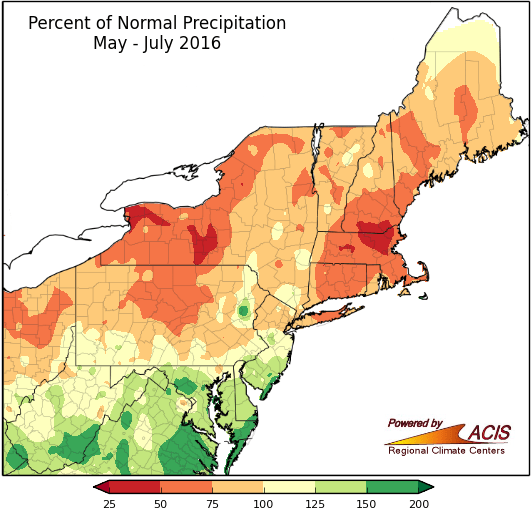
m3ppct_northeast_jul16
Map showing percent of normal rainfall from May 1 through July 31 across the Northeast. Image provided by the Northeast Regional Climate Center

According to data from the Northeast Regional Climate Center, the period between Marc 1 and August 2 is the driest on record for several locations across New York and New England, including cities such as Lawrence, MA, and Elmira and Batavia, NY. Other locations, such as Hartford, CT and Hingham, MA, are in the Top 5 driest March 1-August 2 on record. Many rivers and streams across the region are at near record low levels. Water restrictions and/or bans are in effect for hundreds of cities and towns across the region.

A cold front will cross the region on Saturday, producing scattered showers and thunderstorms. While some of these storms could be locally heavy, most places will receive just light rainfall, which will barely put a dent in the drought. The bigger concern on Saturday is for severe weather across the Northeast. While the timing of the front won’t be optimal for a severe weather outbreak, conditions will be favorable for some strong to severe thunderstorms, especially across Southern New England and southeastern New York during the afternoon hours. Some storms may produce strong winds along with hail and brief downpours.

gfs_tprecip_neng_7
GFS model forecast for rainfall through Saturday night. Image provided by WeatherBell.

Once the front moves through, high pressure builds back in with sunshine and dry conditions for the first half of the upcoming week. Another front will move through on Wednesday with a chance for some additional showers and thunderstorms before stalling out across the region. Exactly where that front stalls out will be critical, as waves of low pressure are expected to ride along it, bringing chances for some much-needed rainfall. If the front stalls along the southern New England coast, then some significant rainfall could fall across much of New York and Southern New England. If the front stalls out across the Mid-Atlantic states, then the heaviest rain would be focused there, and not where it is needed most. The forecast models are split on where the front will stall out, so it’s too early to get a good idea of which idea might be correct. However, if history is any indication, then expect the front to stall out to the south. Droughts feed on themselves, which leads to an old forecasting rule of thumb – “When in drought, leave it out“.

rb-animated.gif

Normally, when the Northeast experiences a drought in the summer, it ends with heavy rainfall from a tropical system, or the remains of a tropical system that made landfall elsewhere. Tropical Storm Earl is moving into eastern Mexico this evening, but it is not expected to have any impacts on the US. However, there is a cluster of thunderstorms in the northeastern Gulf of Mexico that needs to be watched. While development of a tropical cyclone is not expected over the next few days, the system could slowly organize. The main impact from this system will be heavy rainfall across the Gulf Coast, especially in portions of Florida and southern Georgia. Some models are showing the potential for 5-10 inches of rain over the next few days. This will almost certainly lead to flooding in parts of the region.

gfs_tprecip_florida_18
GFS model forecast for rainfall across the Gulf Coast through Tuesday. Image provided by WeatherBell.

The ideal situation would be for some of this moisture to be drawn northward and ride along the front into the Northeast, finally bringing significant rainfall to the area. While this is a possibility, it does not seem like a likely scenario at this point. In fact, some of the models show the moisture remaining in place across the Northern Gulf of Mexico right through the week, with heavy rain and thunderstorms continuing across the region.

Beneficial Rain? Not For Most of Us

Last night, we told you about the old adage “When in Drought, Leave It Out.” Well, a lot of meteorologists around here decided to ignore that because many of the computer models were forecasting heavy rain across Southern New England on Friday. If you checked out a forecast anywhere on TV, Radio, or the Internet, all you heard was that heavy rain was expected on Friday. However, our forecast, along with the one from our comrades at Woods Hill Weather, was for most of the heavy rain to remain to our south. Well, most of the computer models started leaning that way today as well, and all of the other forecasts started to backpedal off of their “heavy rain” forecasts.

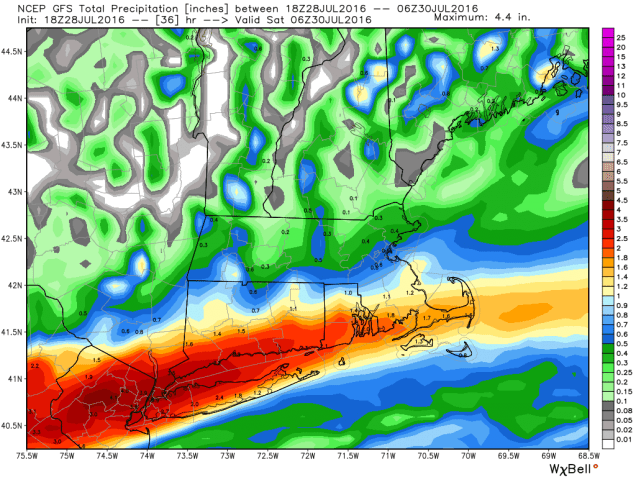
gfs_tprecip_boston_7
GFS model forecast for rainfall through early Saturday morning. Image provided by WeatherBell.
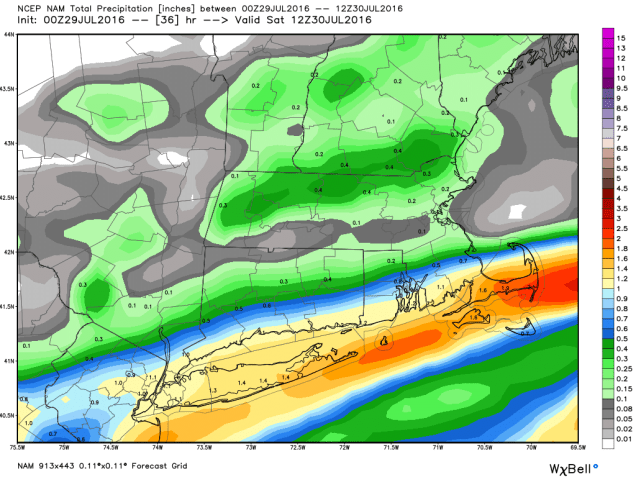
nam_total_precip_boston_13
NAM model forecast for rainfall through early Saturday morning. Image provided by WeatherBell.

As you can see in the maps above there will be a sharp cutoff from heavy rain to very little rain across the region. We’re confident that heavy rain will fall along the south coast on Friday, and we’re fairly confident that the heavy rain shouldn’t make it as far north as Boston. Areas in between Boston and Providence? That’s a toss-up. A Flash Flood Watch is in effect for most of Southeastern Massachusetts, Rhode Island, and Connecticut through Friday evening. Some flooding is likely with some of the heavier downpours, especially in some of the places that usually experience flooding in heavy rain. Unfortunately, not much rain is expected in the areas that really need it, especially the Merrimack Valley.

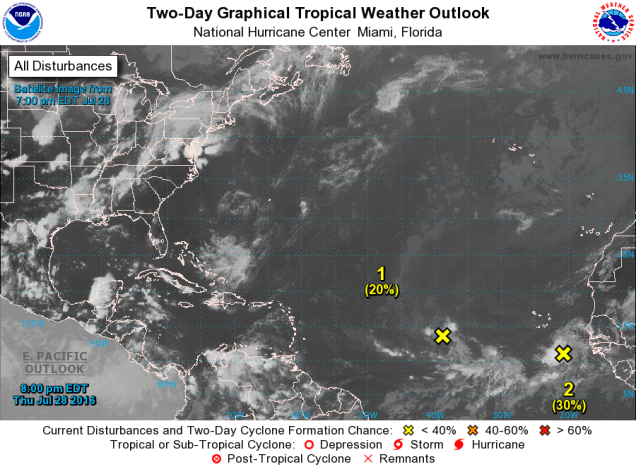
In yesterday’s post, we also mentioned the possibility of the tropics heating up. We told you about the tropical disturbance that was being watched in the eastern Atlantic. Well, we’re still watching it today, but we also have our eyes on a second area of disturbed weather out there.

two_atl_2d0
We have not one, but two disturbances to keep an eye on now. Image provided by the National Hurricane Center.

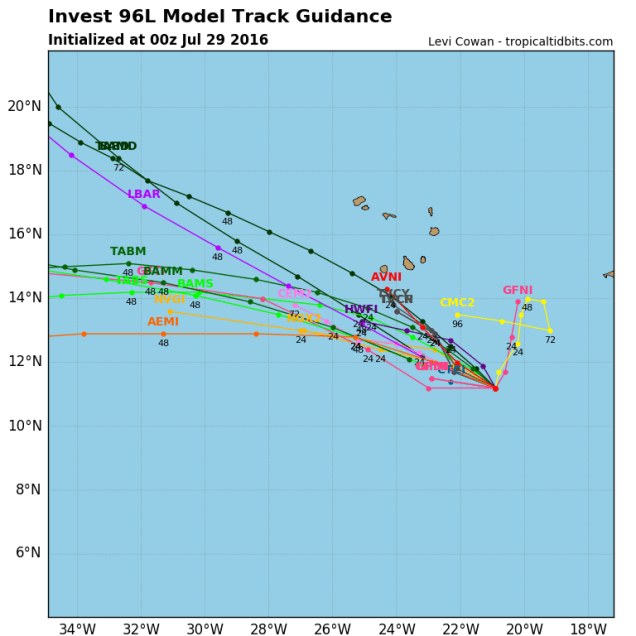
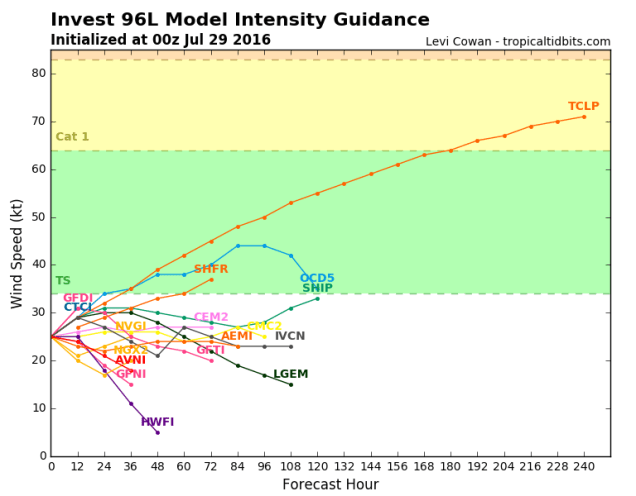
The first disturbance is passing south of the Cape Verde Islands this evening. It remains weak, but conditions are favorable for some development over the next few days. However, that window of opportunity will likely start to close as the system gets into the central Atlantic by the end of the weekend. Most of the forecast models don’t expect much development of this system, and frankly, neither do we. It’s something to keep an eye on through the weekend, but we’re not expecting much.

96L_tracks_latest
Model forecasts for the track of a tropical disturbance south of the Cape Verde Islands. Image provided by Tropical Tidbits.
96L_intensity_latest
Model forecasts for the intensity of a tropical disturbance south of the Cape Verde Islands. Image provided by Tropical Tidbits.

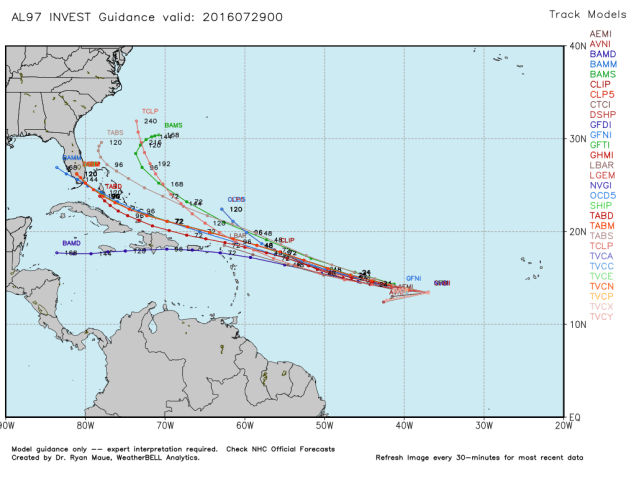
Meanwhile, farther to the west, another disturbance is about halfway between Africa and the Caribbean, and quickly heading westward this evening. The fast movement will likely preclude much development for now, but it should bring some gusty winds to the Lesser Antilles this weekend. Assuming it survives that long, we will need to keep an eye on it. As you can see below, many of the tropical models bring in just north of the Islands and into the Bahamas. There are other models that bring the system into the Caribbean and possibly the Gulf of Mexico well down the line. There are others that don’t expect the system to survive more than a few days.As the system gets closer to the Caribbean, we should start to get a better idea of what it might do and where it might go. Until then, it’s just something to keep an eye on.

AL97_current
Model forecasts for the track of a tropical disturbance in the Central Atlantic. Image provided by WeatherBell.
97L_intensity_latest
Model forecasts for the intensity of a tropical disturbance in the Central Atlantic. Image provided by Tropical Tidbits.


“When in Drought, Leave it Out”

“When in Drought, Leave it Out”

We don’t know who first coined that phrase, but like most meteorological rules of thumb, it tends to hold true most of the time. Here in New England, especially Southern New England, we are definitely in a drought.

20160719_northeast_trd
Latest update from the U.S. Drought Monitor.

A persistent pattern has led to warm and dry conditions across the Northeast for the past several months.While scattered showers and thunderstorms have produced locally heavy rainfall in some areas recently, widespread rainfall has been lacking. Many cold fronts have come across the region with little rainfall and coastal storms are rare in the summer to begin with. Even waves of low pressure passing south of New England along stalled out cold fronts have been too far south to produce much rain across our area.

m3ppct_northeast_jun16
Rainfall since the start of April has been well below normal across the region, especially in the Merrimack Valley. Image provided by the Northeast Regional Climate Center.


The dryness has been most noticeable since the beginning of June. Since June 1, Boston’s Logan Airport has recorded just 1.99″ of rain. This is the driest June/July on record in the city. The current record is 2.03″ from 1949. If Boston does not receive more than 0.04″ before Sunday night, a new record will be set (more on that later). In Worcester, the 3.18″ during the same timeframe is the 4th lowest total on record. In Lowell, 3.12″ of rain has been reported since June 1. This is the 8th lowest total on record.

So, is there any relief on the way? Maybe, though we wouldn’t count on it. A cold front will move across the region late Thursday and early Friday, then stall out south of New England. A wave of low pressure will ride along the wave, passing south of us on Friday. This wave will produce locally heavy rain and thunderstorms across the Ohio and Tennessee Valleys on Thursday, before it heads for the Mid-Atlantic states Thursday night. The question then is, how far north does the low and its associated rain shield get? This is the same situation we often see in the winter when trying to determine if a storm will miss us completely, bury us with heavy snow, or come too close and give us rain instead of snow. Thankfully, we don’t have to worry about snow for another 3-4 months at least.

Right now, there are several different solutions among the models, which have a rather large impact on the forecast.

gfs_tprecip_boston_15
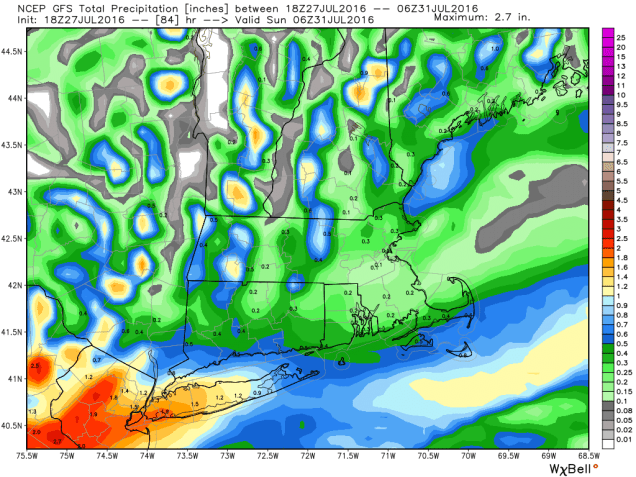
GFS model forecast for total rainfall through Saturday night. Image provided by WeatherBell.
cmc_total_precip_boston_15
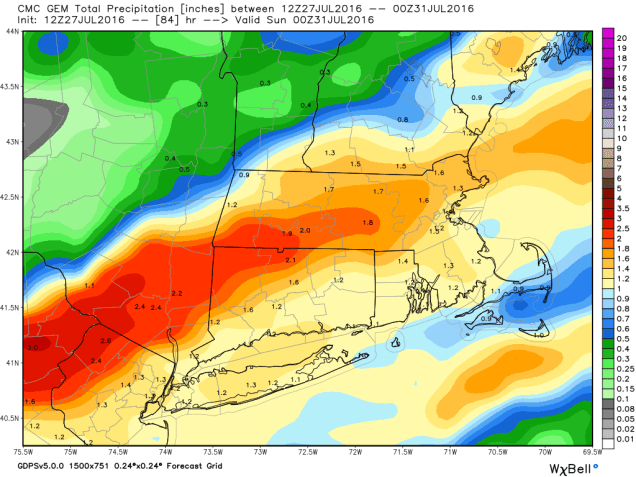
GEM (Canadian) model forecast for total rainfall through Saturday night. Image provided by WeatherBell.
nam_total_precip_boston_29
NAM model forecast for total rainfall through Saturday night. Image provided by WeatherBell.

For the past few months, as we’ve mentioned previously, most of these storms have passed too far south to have much of an impact on us. For this reason, we’re inclined to lean that way with the forecast for Friday as well. That means we’re going with the GFS model above. Is there a possibility that one of the other models is right and we do get heavy rain? Sure, they could very well be right, but we’re not betting on it.

Droughts feed on themselves, which is how the expression at the top of the page came into existence. When the ground is dry, there is even less moisture available for approaching systems. When there’s less moisture available, less rain falls. When less rain falls, the drought gets worse. So how do we break the drought? When we have one in the summer, usually, the answer is with a tropical system. Either a tropical storm/hurricane comes up the coast and slams into New England dumping copious amounts of rain on us, or one hits farther down the coast (North Carolina or the Gulf) and weakens inland and the remains of it move this way with heavy rainfall. The Summer of 1955 was hot and dry like this one has been. Then, in the span of a week in August, two Tropical Storms (Connie and Diane) brought record rainfall to the region, with widespread flooding. Of course, that’s not the scenario we prefer. A more gradual transition to a wetter pattern is the best case scenario, but that isn’t how is usually works.

So, right now, you’re probably asking “is there a tropical system heading our way?” No, there isn’t, not yet. Since our record-setting June, there hasn’t been any activity at all in the Atlantic in July, but that could be changing. A tropical wave moved off the coast of Africa on Tuesday, producing plenty of shower and thunderstorm activity. Although some of that activity diminished today, conditions are still favorable for some development over the next few days. The odds of the system becoming a tropical depression are still fairly low, and the odds of it impacting any land, let alone New England, are still fairly remote.

al962016
Model forecasts for the track of a tropical disturbance in the Eastern Atlantic. Image provided by the University of Wisconsin.
al962016_inten
Model forecasts for the intensity of a tropical disturbance in the Eastern Atlantic. Image provided by the University of Wisconsin.

Now that we’re approaching the beginning of August, these waves should start to move off the coast of Africa every few days. At least a few of these will eventually become tropical systems as we approach the peak of hurricane season, which is late August into late September. Another area to watch is down near the Bahamas. Sometimes tropical systems form in this region, and they can quickly strengthen and head up the coast within a couple of days, which is exactly what Hurricane Bob did in August of 1991.

For now, do your rain dance and pray for rain to save your garden or lawn. It doesn’t look like any beneficial rain is coming anytime soon (unless the NAM is right on Friday).