Boston May Need an Ark, Bismarck Needs a Plow

Two developing storm systems – one off the East Coast and one in Plains, will both wreak havoc in the next few days, but for very different reasons.

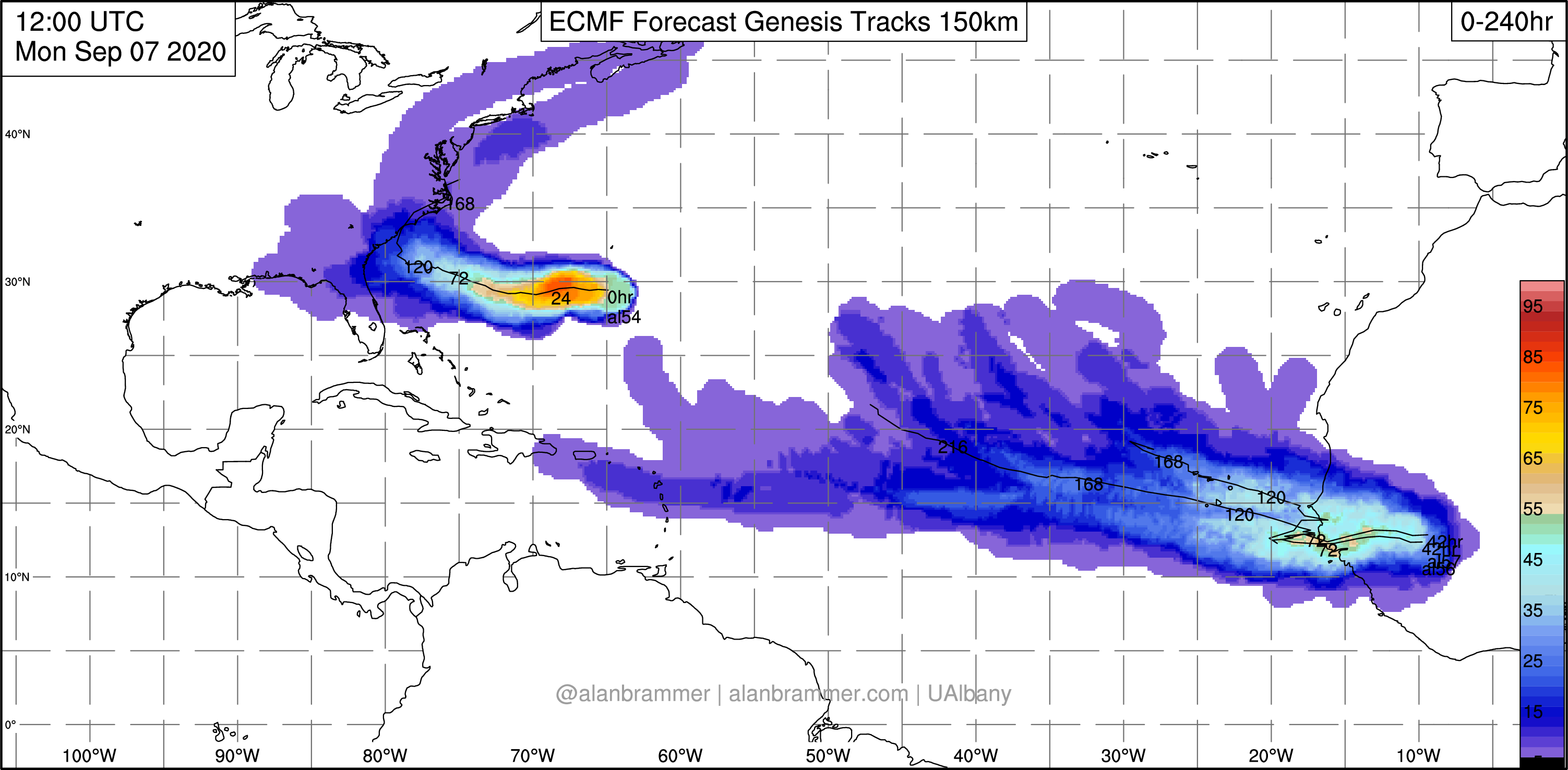
Two low pressure areas are developing off the East Coast early this morning. The northern system is the stronger of the two, but the southern one is being monitored by the National Hurricane Center. It has the potential to develop into a tropical depression or subtropical storm later today. Whether it does or not, these two low pressure areas will eventually merge and become a rather strong non-tropical system over the next 24 hours. There is very little in the way of steering currents right now, so the system will just meander around off the coast until Saturday.

Low pressure won’t be in a hurry to go anywhere off the East Coast for the next few days. Loop provided by Tropical Tidbits.

As the system drifts northward, it will produce gusty winds along the coast, especially in New England. Tides are astronomically low at the moment, but will be rising later this week, so coastal flooding, while not a major concern, will still be possible in some locations. A coastal flood watch has been issued for parts of Plymouth County, Cape Cod, and Martha’s Vineyard. Rough seas will also be a large concern for marine interests, with Storm Warnings now in effect offshore. However, the biggest concern and also the biggest question mark right now is heavy rainfall.

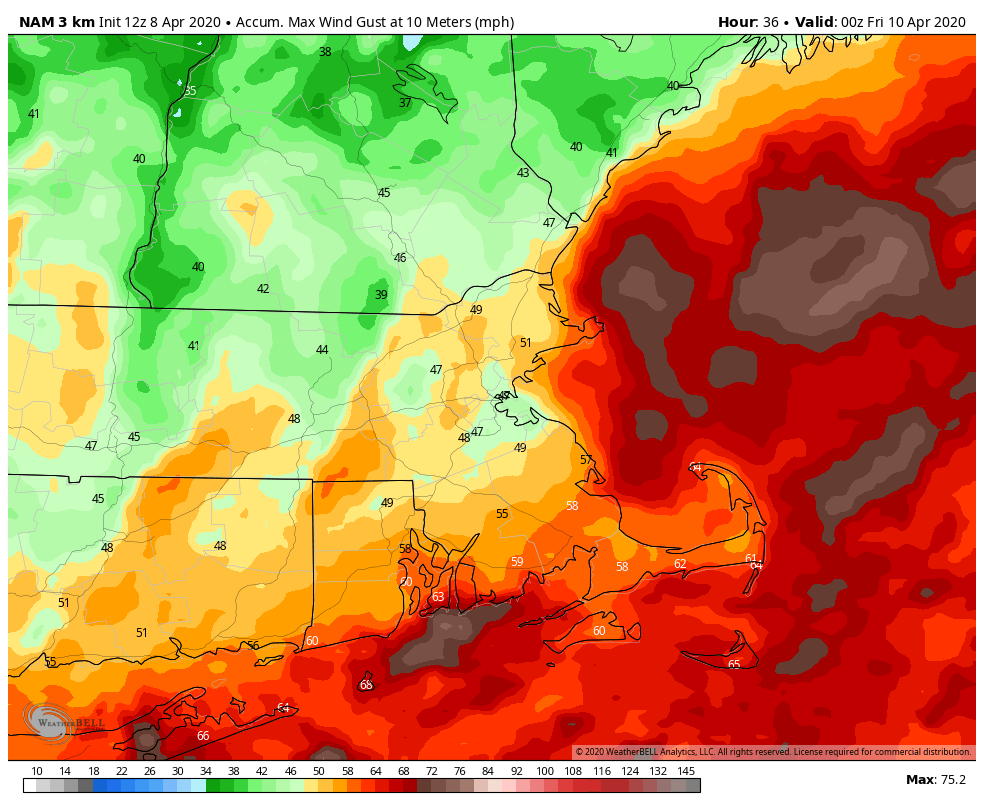
Wind gusts in excess of 50 mph are possible across much of Southern New England. Yeah, that blows. Image provided by WeatherBell.

While the storm will likely spread some heavy rainfall into New England, there is still plenty of uncertainty as to how far north the heavy rain gets, as well as how much rain actually falls. Some of the models are producing extremely heavy rainfall, with totals in excess of 10″ in southeastern Massachusetts! While we aren’t buying the extreme totals, the fact that most of the models are showing this potential means that some very heavy rain is likely, especially south of Boston, where a Flood Watch has been issued.

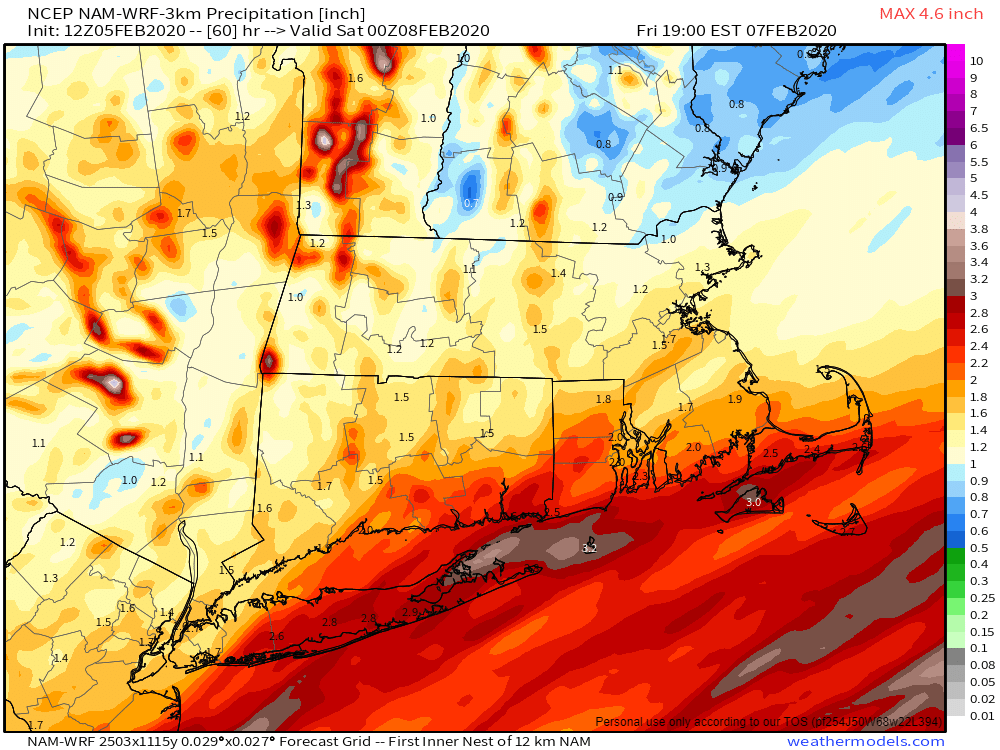
That’s a lot of water coming out of the sky over the next 3 days. Some models have even more than this! Image provided by WeatherBell.

Thanks to some dry weather over the past couple of months, we shouldn’t have to worry about any flash flooding, though downpours will result in ponding of water on roadways, and some locations normally prone to flooding in heavy rain will also have problems. However, since we’re expecting a prolonged period of heavy rain, flooding is still a possibility in some locations, other than the ones we just mentioned, especially some of the smaller streams and rivers. Strong winds will also start to take some of the leaves off of trees, which may clog up storm drains, resulting in some flooding as well.

Recent dryness means that flash flooding is not likely in New England with this storm. Image provided the the Northeast River Forecast Center.

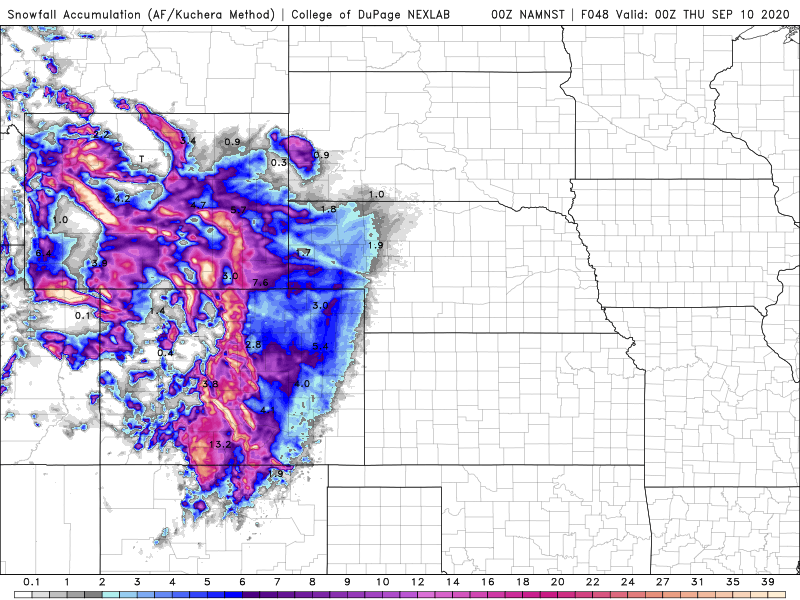
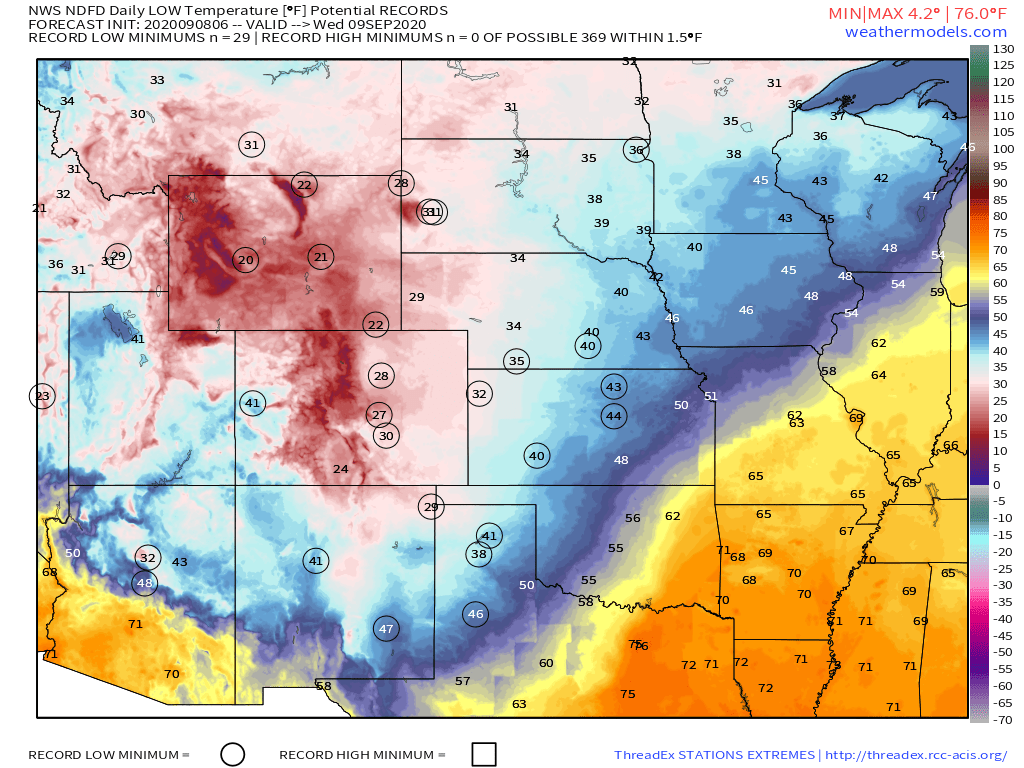
While all this is taking place off the East Coast, some very cold air will settle into the Rockies and Plains states as low pressure starts to develop across the Central Plains. Record lows are likely to be set in numerous locations over the next few mornings across the region. This system will head north-northeastward while strengthening. The system isn’t expected to become that strong, but with a large high pressure area building in behind it, it will produce some strong winds. It will also draw warm and moist air northward from the Gulf of Mexico. As this air runs into the much colder air on the backside of the storm, the first significant snowstorm of the season is expected to develop across the Northern Plains.

Winter Storm Watches and warnings have been posted from parts of Idaho Montana, and Wyoming into parts of northern Nebraska and the Dakotas as well as northwestern Minnesota. across Idaho, Montana, and Wyoming, snowfall totals of 6-12 inches are possible, with some heavier amounts in the higher elevations. The biggest issues are expected across the Dakotas and northwestern Minnesota.

Wind gusts of 40-50 mph or more are expected across the Northern Plains. Image provided by WeatherBell.

The precipitation will start as rain across this area later today, but strong northerly winds will usher much colder weather in, changing the rain to snow from west to east on Thursday. Like its East Coast counterpart, this storm won’t move at a rapid pace, so snow, possibly heavy at times will continue across this area into early Saturday, with snow showers lingering into Sunday.

This storm also has some questions with it’s precipitation shield. While heavy snow is likely across a large area, how much falls and where the heaviest snow will fall is still a question. Right now, it looks like the heaviest snow will fall from central South Dakota into central and eastern North Dakota, but that still could change. As for amounts, many areas could see more than a foot, with totals in excess of 2 feet possible in some areas. The snow will be accompanied by winds gusting to 40-50 mph, resulting in blizzard conditions, especially late Thursday into Friday.

Welcome to winter! Snowfall totals of 1-2 feet or more are possible across the Dakotas. Image provided by Pivotal Weather.

While snow in October is not unusual across this region, snowfall amounts of this magnitude this early in the year are extraordinarily rare. In Grand Forks, ND, the largest October snowstorm on record occurred October 24-26, 2001, and it dropped 10.9″ on the city. In Fargo, ND, the largest October snowstorm on record is only 8.1″ on October 30-31, 1951. For Pierre, SD, the October snowstorm of record occurred October 30-31, 1943, and it only produce 7.2″ of snow. Current model forecasts are forecasting amounts that are 3-4 times the records. These model forecasts are likely too high, but it seems likely that many of these October records are going to be obliterated in the next few days. Hopefully, this is not a sign of what’s to come this winter.

Weekly Outlook: March 4-10, 2019

The first full week of March is shaping up to be a wintry one, mainly in the temperature department, but a little in the precipitation department as well.

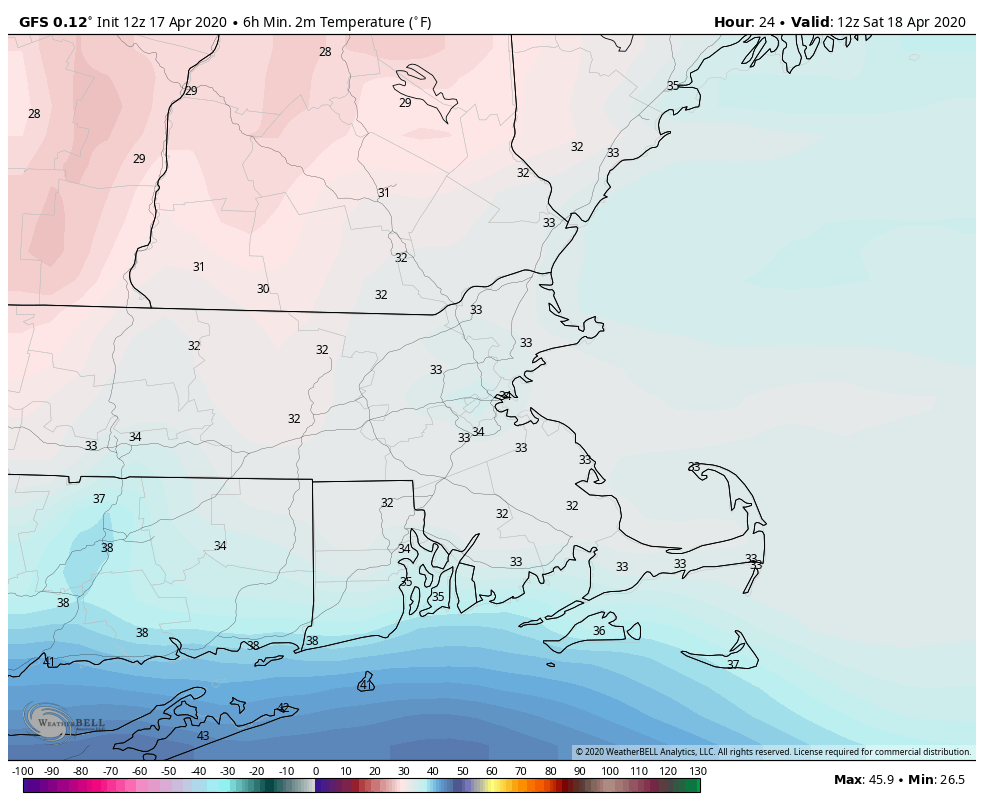
The snow will be ending across the region this morning as our storm system pulls away, with some clearing this afternoon. Temperatures may even get a tad mild, allowing for some melting to take place. However, we’re going to drop back below freezing tonight, so anything that melted with ice back up. If you’re heading out this evening, watch out for slippery conditions on untreated surfaces.

Temperatures could get into the middle to upper 30s this afternoon, allowing some of the fresh snow to melt. Image provided by WeatherBell.

After that, a rather cold airmass will settle into the region for Tuesday through Thursday. While temperatures won’t be as extreme as in the Plains states, we’re still looking at temperatures that are 10-20 degrees below normal, especially Wednesday and Thursday. A couple of upper-level disturbances will also be moving through the region, which may produce a few snow showers at times, especially Wednesday and Thursday.

Temperatures will be 10-20 degrees below normal during the middle of the week. Image provided by Weathermodels.com

By Friday, high pressure will move offshore and temperatures will start to moderate. That just means it won’t be quite as cold, but temperatures will still be below normal. The weekend is where things get complicated.

It looks like we’re going to have 2 systems impact the area, a weak one on Saturday, and a stronger one on Saturday. Given that these are both several days away, nothing is set in stone at this point. The first system passes south of New England on Saturday. There is at least one model that has it pass too far south to have any impact on us, but most bring it close enough to spread in some light precipitation. Right now, it looks likely mainly some light snow, but it could be some rain as well, especially along the south coast.

The stronger storm comes in on Sunday. This one looks like it will produce some rain across the area. However, some models are showing temperatures below freezing at the start, which means we’d be looking at yet another situation where we have snow to sleet or freezing rain inland and rain along the coast. Again, this is a week away, so trying to nail down details at this point is a futile exercise. Just be aware that next Sunday could be messy, especially north and west of Boston.

Daylight Saving Time starts at 2am Sunday. Sunset next Sunday evening will be at approximately 6:45pm. Image provided by the National Weather Service.

Monday: Snow (rain on the Cape) ending early, some sunny breaks develop in the afternoon. High 33-40.

Monday night: Becoming mostly clear. Low 9-16.

Tuesday: Morning sunshine, afternoon clouds, slight chance for a snow flurry. High 24-31.

Tuesday night: Clear to partly cloudy. Low 10-17.

Wednesday: A sunny start, then clouding up again, breezy. A snow shower is possible. High 19-26.

Thursday: Intervals of clouds and sunshine, with a few afternoon snow showers possible. High 20-27.

Friday: Plenty of clouds. Light snow or rain developing at night. High 28-35.

Saturday: Cloudy with some snow or rain showers possible in the morning. High 31-38.

Sunday: Cloudy with a chance of rain, possibly some snow or a wintry mix across the interior. High 34-41.

Sunday Night Special or Monday Morning Madness?

As promised, the second storm in our one-two punch is heading this way. While most of the snow is expected while you’re asleep Sunday night, it could have a big impact on your Monday morning commute.

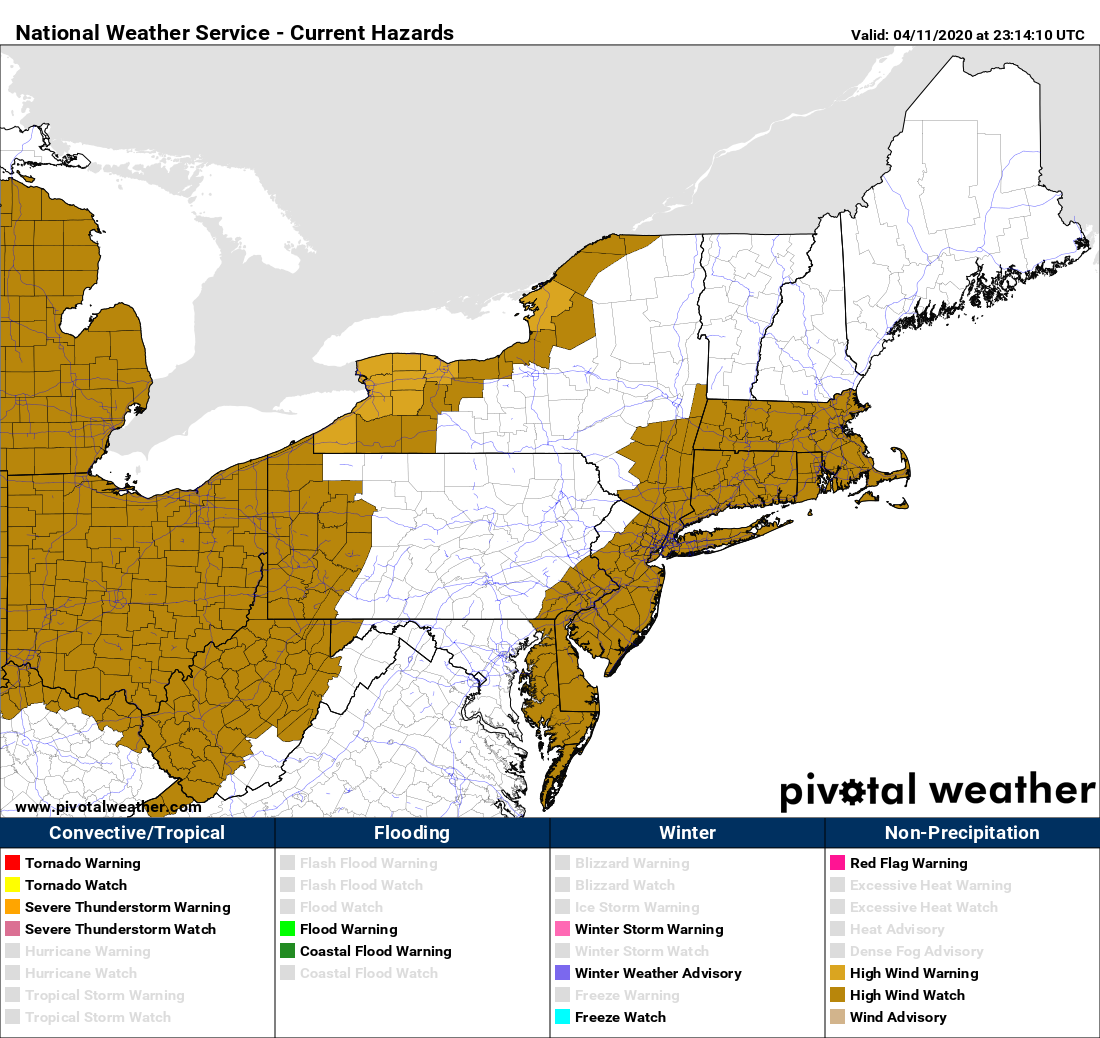
Winter Storm Warnings and Winter Weather Advisories are in effect for most of the Northeast as of Sunday morning. Image provided by Pivotal Weather.

High pressure is hanging on this morning, providing us with sunshine, but clouds will quickly move in this afternoon as low pressure starts to move towards the Mid-Atlantic coastline, passing south of New England Monday morning. This storm will be a bit stronger than the one we had yesterday, and also have a little more moisture to work with, but will be moving fairly quickly, limiting the amount of time it spends in the region. One thing working in its favor is that most of the snow will fall at night. We’re at the time of year where the sun angle is high enough that snowfall during the daytime has a hard time sticking on pavement. At night, that’s not an issue.

The high-resolution NAM model shows the snow moving in this evening, becoming heavy overnight, and ending in the morning, with any rain confined to the south coast. Loop provided by Tropical Tidbits.

Snow will move in this evening, likely in the 7-10pm time frame, and will continue through the overnight hours. It may be heavy at times, especially between about 1 and 5am. A change to rain is expected for Cape Cod and the South Coast, but likely won’t advance past Route 44. Everything should wind down and end around 6-8am. That’s also the time of the morning commute. Road crews should have plenty of time to work on getting the roads cleared, but given past experience, and that people will likely leave early since it’ll still be snowing, we expect many roads to still be in awful shape. Give your self a lot of extra time in the morning. We also expect many school districts to cancel classes for Monday.

Snowfall is running about 10-20 inches below normal across the area this winter. Image provided by the Northeast Regional Climate Center.

It’s been a down year for snowfall, running 10-20 inches below normal across the area, but this storm will put a dent in those departure numbers. How much are we looking at?

Cape Cod/South Coast/Southern RI: 2-5″
The rest of the region: 4-8″ with isolated 10″ totals possible, especially from northern RI into the South Shore.

The high-resolution NAM has had a great winter for snowfall predictions, and we’re not straying from it again. Image provided by WeatherBell.

Things look to quiet down and get colder behind this storm, but a pattern change to milder weather could be coming as we head towards mid-March. We’ll have more details on at least the next week in our Weekly Outlook early Monday morning.

Not One, But Two Storms on the Way

Back in our Weekly Outlook on Monday, we warned you that even though Meteorological Winter ends on February 28, that March can still be a wintry month. Well, today is March 1, and we’re looking at two snowstorms in the first four days of the month.

You can see that this is a fairly fast-moving storm. In by daybreak Saturday, out before dinnertime. Loop provided by Tropical Tidbits.

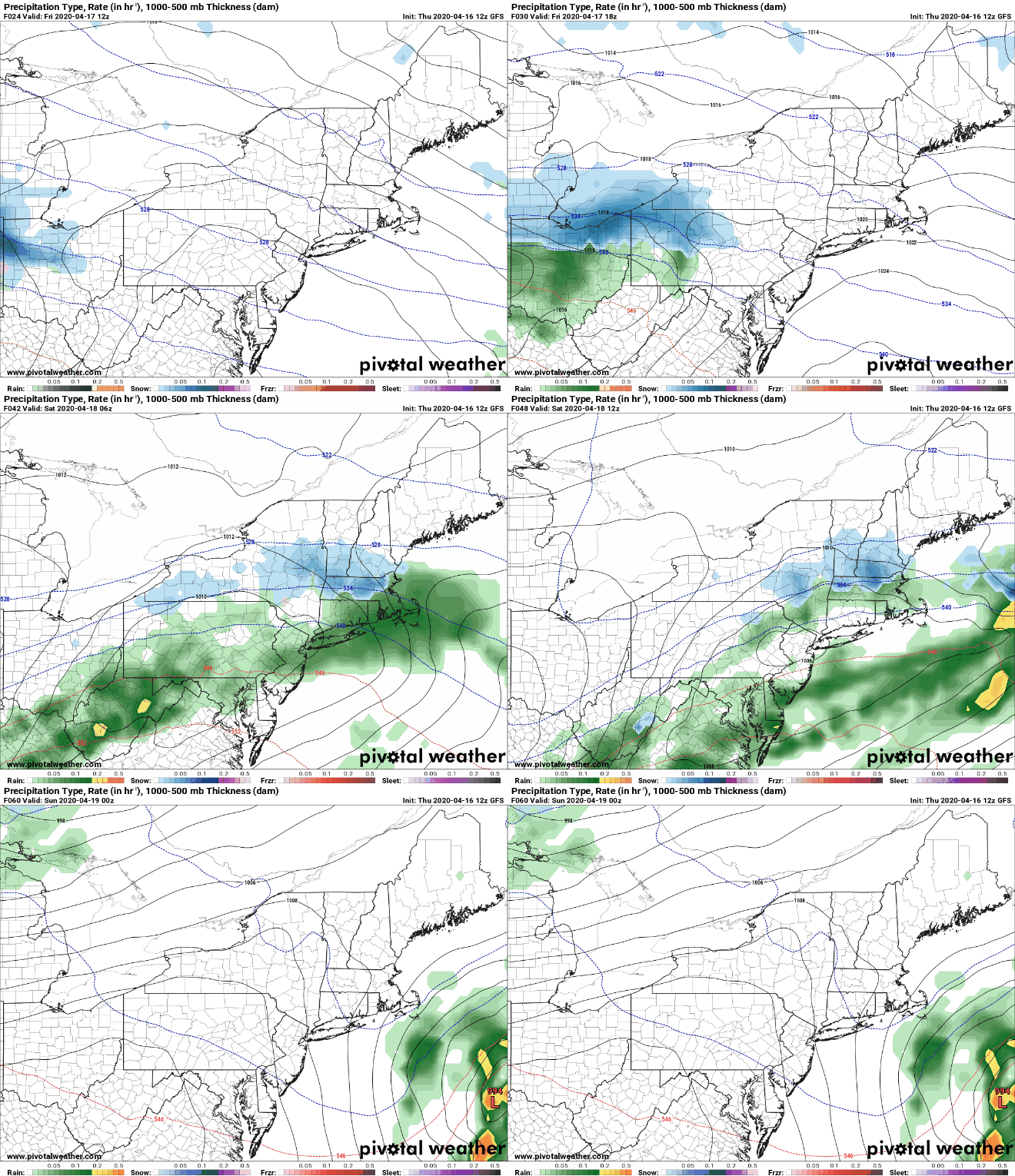
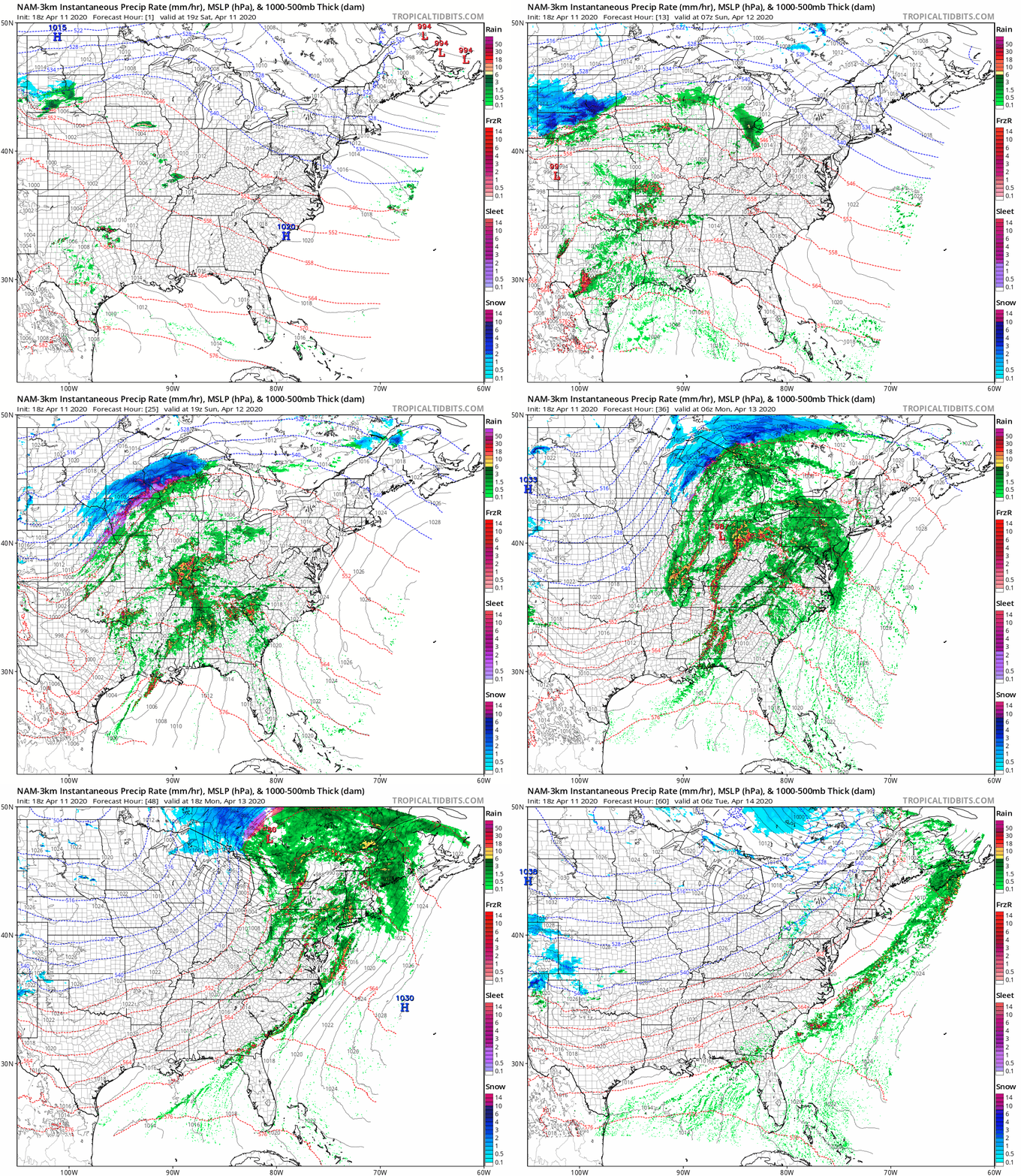
Technically, there’s actually 3 storms, as the first one is passing south of the region this morning. It brought in some clouds, and a few stray flakes across southeastern Massachusetts, but otherwise, had little impact on us. The first storm we need to pay attention to is moving across the central Appalachians this afternoon. It will move off the Mid-Atlantic coast tonight, then pass south of New England on Saturday. A few days ago, it looked like this storm would pass harmlessly to our south while a a system to the north brought in some snow or rain later on Saturday. Well, this storm became the more dominant of the two, and will pass closer to us than originally thought.

Snow will develop Saturday morning, maybe before daybreak south of Boston. It may even start as some sleet or rain across Cape Cod before changing to snow It will snow steadily during the morning hours, and then taper off and end during the afternoon, possibly lingering along the coast until evening. Despite the hype from some of the media, this will not be a big storm. Oh sure, it’ll be disruptive to your Saturday morning/afternoon plans, but it’s not a major storm.

So, the big question – how much?

Central NH/Southern ME (Concord/Portland) – Less than 1″
Southern NH/Seacoast/Cape Cod (Manchester/Nashua/Portsmouth) – 1-2″
Merrimack Valley – 2-4″
Metro Boston/MetroWest/Southeastern MA/ Rhode Island – 3-6″

Would be we shocked if a few spots, especially south of Boston, pick up 7 or 8 inches? Nope, not at all. This won’t be the fluffy snow we had a few days ago, so it won’t pile up as quickly.

We’ve stuck with the high-resolution NAM for most of the winter and it’s served us well, so we’re going to do it again. Image provided by Weathermodels.com

OK, so the snow ends Saturday afternoon/evening, and we’re all set, right? Nope – the next storm, follows fairly quickly for Sunday night and Monday. This one looks a little strong, and will pass a little closer. This will allow for the rain/snow line to penetrate a little farther into southeastern Massachusetts. However, with it being a stronger storm, it will have more moisture to work with, and that means more snow. There’s still many details that need to be worked out, and some things will depend on what the first storm does, so we’re not going to go into too much detail yet. We’ll have another blog post Sunday morning focused on that storm. But, there are several models showing the potential for up to, or even more than a foot of snow in spots from that storm.

The NAM model indicates that we could get a pretty good wallop early Monday. We’ll see if things stay that way over the next day or two. Image provided by Pivotal Weather.

After that storm goes by, it looks cold and dry for a few days. But let’s take it one storm at a time for now. Look for an update from us Sunday morning.

A Little Snow to End February

As the headline implies, we’ve got some of the flaky white stuff on the way. This storm is going to be unlike any storm we’ve had all winter. It’s going to be all snow, and the fluffy type at that. It also, may cause problems for your Thursday morning drive to work or school.

High pressure is in place right now, with a cold and dry airmass settled into New England. Temperatures dropped into the single numbers and teens this morning, and at midday, dewpoints were still well below zero. As the high moves off the east, an Alberta Clipper will move in from the west. As it starts to spread precipitation into the region, it will run into this dry air this evening. So, even though the radar may show snow falling, it will evaporate before it hits the ground.

Very dry air remains in place at midday. This will help delay the snow’s arrival a little this evening. Image provided by WeatherBell.

Eventually, the atmosphere will moisten up enough so that the snow will make it down to the ground, and we’ll have some light fluffy snow falling through the overnight hours. It should taper off and end from the west to east right around the time most people head out to work or school in the morning. Road crews should have plenty of time to work on the getting everything cleared before the morning rush hour, but this being New England, where plenty of people completely forget how to drive as soon as they see a single raindrop, well, the snow will probably impact your morning drive, so leave a little extra time.

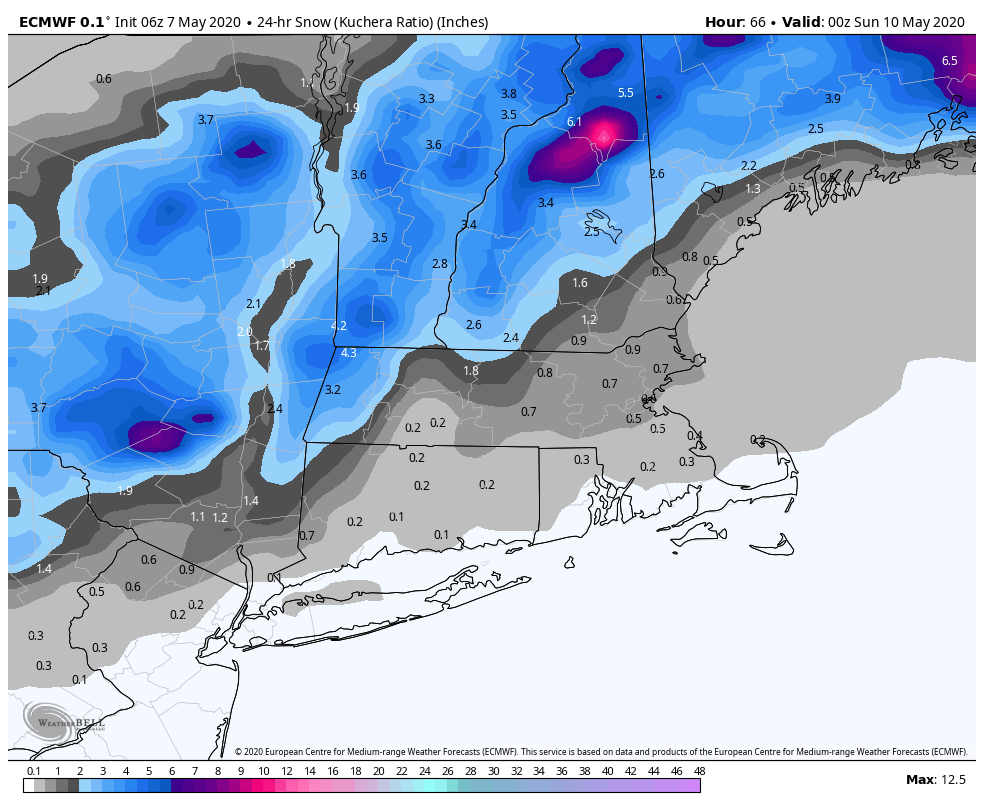
As for how much will fall, this won’t be a big deal, at least by New England standards. Most of the snow maps you see people post online (like the one below) assume a 10:1 ratio for snow to liquid. In many cases, this will work – 1 inch of rain equates to 10 inches of snow. However, the colder you get, the more the ratio changes. With temperatures in the teens, the ratio could be 20:1. For tonight’s storm, the ratio will probably end up somewhere around 15:1, so, you might expect a little more than the map below is showing. Remember – I also said that the initial burst of snow will likely evaporate before reaching the ground. The model assumes that anything showing up as precipitation does reach the ground, so it will assume we’ve got more precipitation than we actually will get. Plus, nearly every storm this winter has underperformed in the snow department, compared to what the models have forecast. So, factoring all that in, the 10:1 map may actually not be that bad after all.

OK, enough of the caveats and explanations, all you want to know is how much you’ll be cleaning off of your car or driveway in the morning.

Southern New Hampshire: 1-2″
Merrimack Valley/North Shore/Cape Cod/South Coast/Rhode Island: 1-3″
Metro Boston/MetroWest/South Shore: 2-4″

Given the fluffy nature of the snow, if a few places picked up 5″, especially from Worcester County into the South Shore, we wouldn’t be completely shocked.

We’ve been going with the High-resolution NAM all year, no reason not too once again. Image provided by Weathermodels.com

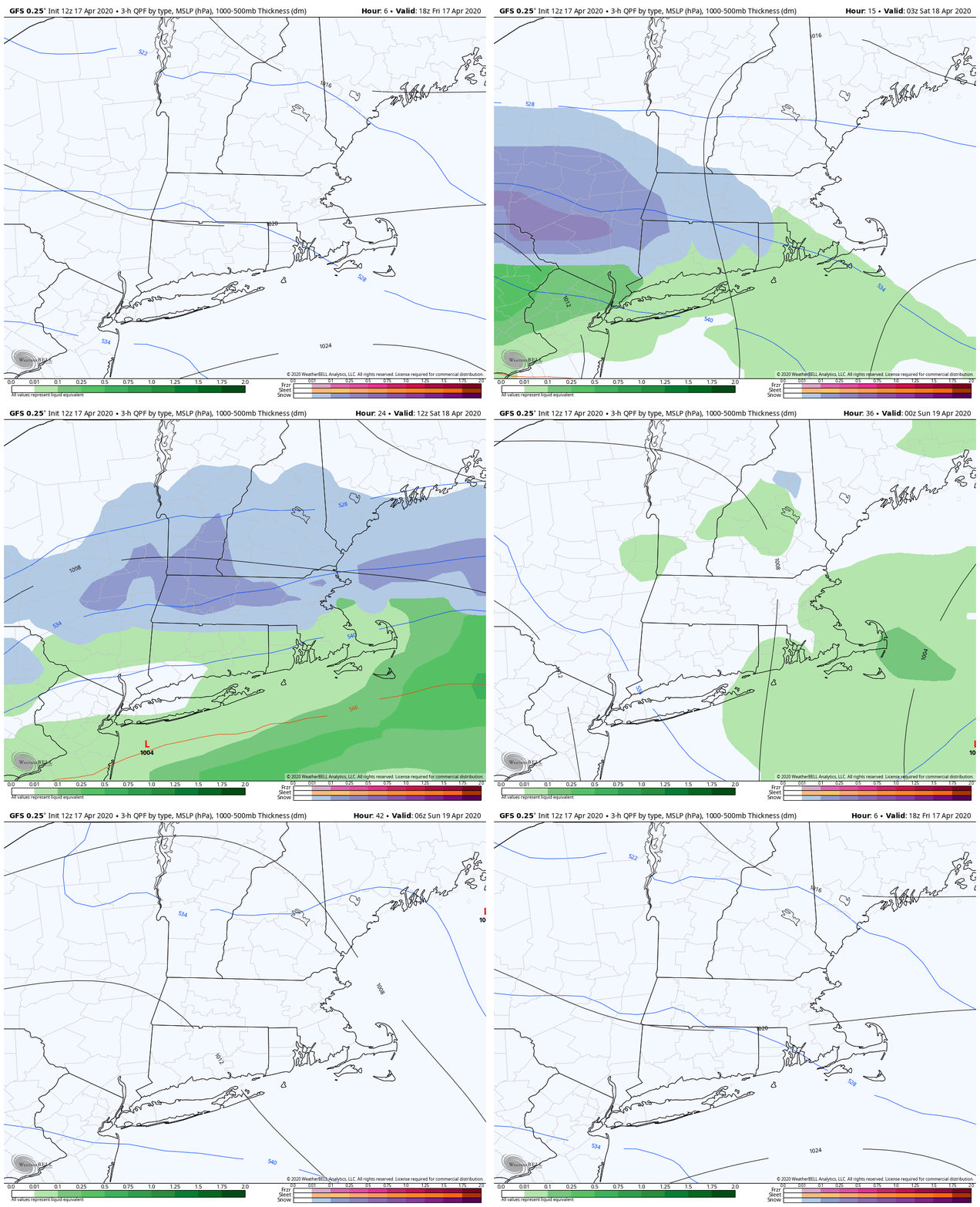
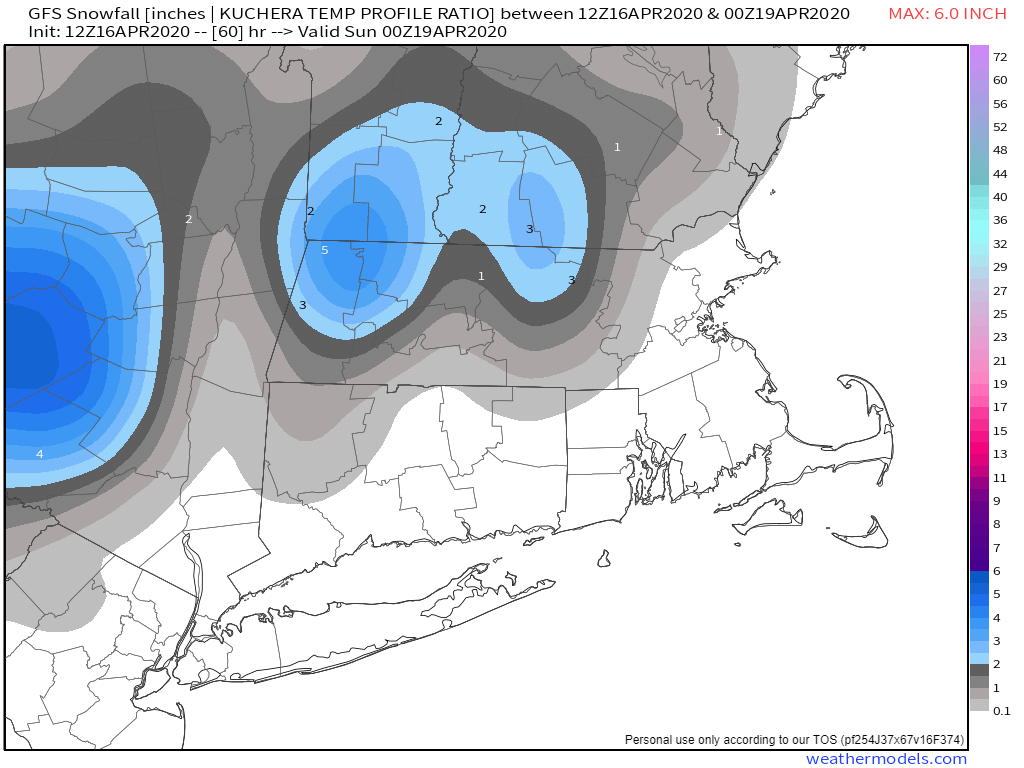
Another weak system will pass to our south Thursday night into Friday morning, with some light snow possible across the South Coast and Cape Cod, but the storm may end up too far south to impact us at all. Another system passes to the north late Saturday into early Sunday, and this one will be more typical of what we’ve seen this winter, with some light snow changing to sleet, freezing rain and eventually rain. What we’ve actually got our eyes on in the future is Sunday night and Monday. The models have been signalling for a few days the potential for a system to impact us then, but the details have been all over the place. The various models have shown solutions that range from a complete miss to snow to rain, to a heavy snowstorm. There’s still plenty of time for that to come into focus, and we’ll worry about it more as the weekend arrives. For now, we’ll just deal with the light snow tonight.

Weekly Outlook: February 18-24, 2019

You’re waking up to snow this morning, but that might not be the only snow for the week, at least for most of us. It is still February, so this should be expected.

The week is starting off with some snow, but since we discussed that in detail yesterday, and the bulk of the snow will be over by the time most of you read this, we won’t dwell on it much longer. Snow showers will continue into the afternoon, but little additional accumulation is expected. High pressure then builds in for tonight, Tuesday and part of Wednesday. This will give us drier but colder conditions. Again, it is February, this should be expected.

It’s still winter, so it shouldn’t be that warm. Average high temperatures for mid-February are in the upper 30s to lower 40s. Image provided by Weathermodels.com

By late Wednesday, another low pressure system will head towards the Great Lakes, just like a lot of them have already done so far this winter. As a result, we’ll see the same thing we have already seen plenty of times. Snow will develop Wednesday night, then warmer air will move in aloft, with a change to sleet and/or freezing rain early Thursday, and an eventual change to all rain as warmer air finally moves in at the surface. This doesn’t look like a big deal, with an inch or two of accumulation possible Wednesday night from the Merrimack Valley into southern New Hampshire.

A little bit of snow is expected early Thursday morning, mainly north of Boston. Image provided by Pivotal Weather.

The rain ends Thursday morning, then high pressure returns for later Thursday into Friday and Saturday. Then on Sunday, we do it all over again. Low pressure heads towards the Great Lakes again, and we get some snow, changing to sleet and/or freezing rain, then plain rain. Wash, rinse, repeat.

Monday: Cloudy with occasional snow showers tapering off and ending. High 27-34.

Monday night: Clearing. Low 9-16.

Tuesday: Partly to mostly sunny. High 24-31.

Tuesday night: Becoming partly to mostly cloudy. Low 9-16.

Wednesday: Cloudy with snow developing in the evening, changing to sleet, freezing rain, and rain from south to north overnight. High 25-32.

Thursday: Rain ending in the morning, then becoming partly sunny and breezy in the afternoon. High 42-49.
Friday: Intervals of clouds and sunshine. High 36-43.

Saturday: Some early sun, then becoming mostly cloudy. High 37-44.

Sunday: Cloudy, snow developing, quickly changing to sleet or freezing rain, then plain rain in the afternoon. High 40-47.

Monday Morning Mess?

While you’re enjoying a sunny Sunday, we’ve got some snow on the way tonight into Monday. It won’t be a lot, but it’ll probably make your morning drive to work into a large headache, especially south of Boston.

Low pressure will move out of the Ohio and Tennessee Valleys today and head east-northeastward, passing south of New England Monday morning. For once this season, we have enough cold air in place and a favorable storm track that we’ll be talking about all snow with this system, except possibly across parts of Cape Cod and the Islands. Since this is a fairly weak storm, we’re not talking about a lot of snow to begin with, and with it passing well to the south, the amounts will taper off quickly, the farther north you go.

The high resolution NAM model has a pretty good handle on how this storm will go, on our opinion. Loop provided by Tropical Tidbits.

The snow will develop late this evening from west to east, roughly in the 10pm-midnight time frame. It will continue through the overnight hours, and may even be briefly moderate to heavy south of Boston. While the steadiest snow looks to end during the morning hours on Monday, occasional light snow and snow showers will continue off an on during the afternoon, especially along the coastline. Everything should be done by evening.

So, how much are we looking at?
Southern NH/Southern ME: 1″ or less
Merrimack Valley: 1-2″
North Shore/Metro West: 1-3″
I-95 Corridor (Boston/Providence): 2-4″
Southeastern Mass/Southern RI: 3-6″, possibly a little more across Cape Cod

We’ve stuck with the high-resolution NAM for much of the winter, and it’s done pretty good, so we see no reason to go against it now. Image provided by WeatherBell.

Another storm may bring in more snow towards Wednesday, but we’ll have more details on that in our Weekly Outlook early Monday.

Weekly Outlook: February 11-17, 2019

Remember a few years ago when every single storm turned into a major snowstorm around here? In many ways, that was preferable to the winter we’ve had this year. Forecasting was a lot easier. Just forecast snow, and lots of it. Chances are, that’s what ended up happening. Not this year. This year, we get rain/snow lines, sleet, freezing rain, and a general mess with just about every storm. Well, there’s another one on the way.

The week actually starts out on a quiet note with high pressure to the north and a weak low pressure area passing well to the south. This will provided us with dry and seasonably cold conditions today. This is the proverbial “calm before the storm.” On Tuesday, low pressure will start to head towards the Great Lakes, sending clouds and precipitation into New England. It should be cold enough for it to start as snow across the region Tuesday afternoon. In fact, the snow may be quite heavy for a while Tuesday afternoon, which may result in the afternoon rush hour becoming utter chaos (not that it isn’t already). Eventually, warmer air will start to move in aloft, and then at the surface, which will result in a change to sleet and then freezing rain or rain from south to north during the evening hours. The questions are: 1. When does the change to sleet occur? 2. How long does it stay as sleet before changing to freezing rain? 3. When do temperatures get above freezing to end the icing threat? The answers to these questions will play an important role in how much of a mess things become.

The NAM may be a little quick to bring in the sleet, and it has a lot of sleet, but it’s done fairly well this winter, so far. We’ll see how it does with this storm. Loop provided by Tropical Tidbits.

Eventually, a secondary area of low pressure will develop, and move across southeastern New England early Wednesday. This should allow most of the region to get above freezing and change to plain rain before everything winds down around daybreak Wednesday. So, how much snow are we expecting before the changeover?

Cape Cod/Southeast Massachusetts, Southern Rhode Island: 1-2″
I-95 Corridor (Boston/Providence): 1-3″
MetroWest/North Shore: 2-4″
Merrimack Valley/Southern NH/ NH Seacoast: 3-6″
Central NH/Southern ME (Concord/Portland): 4-8″

The FV3 model is probably closest to our thinking for snowfall amounts. Image provided by Pivotal Weather.

High pressure builds in behind the storm for late Wednesday and Thursday with dry and cooler conditions. However, another storm follows for Friday. This one looks to be milder, with mainly rain. However, it’s still 5 days away, and the models have been, well, not good, beyond about 3 days this winter, so we’ll obviously have to keep an eye on that one too. But for now at least, it looks like rain. High pressure builds in behind that storm next weekend with dry and colder weather.

Tuesday might suck weather-wise, but cheer up – pitchers and catchers report to Fort Myers for Spring Training on Wednesday! There will be actual games a week from Friday! Oh, and in case you forgot, the Patriots won the Super Bowl last week! Image provided by NESN.

Monday: Morning clouds, then becoming partly sunny. High 31-38.

Monday night: Clouds return. Low 13-20.

Tuesday: Cloudy with snow developing in the afternoon, possibly heavy at times. Snow will change to sleet along the South Coast towards evening. High 25-32.

Tuesday night: Snow changing to sleet, freezing rain, and eventually plain rain from south to north before ending by daybreak. Breezy. Temperatures slowly rise at night.

Wednesday: A lingering snow or rain shower is possible, otherwise skies will become partly sunny, breezy. High 39-46, possibly warmer across parts of southeastern Massachusetts and Cape Cod in the morning.

Thursday: Sunshine and a few clouds, still breezy. High 34-41.

Friday: Becoming partly to mostly cloudy with a few rain showers possible. High 43-50.

Saturday: Cloudy and breezy with a chance of rain. High 43-50.

Sunday: Partly to mostly sunny, breezy, and colder. High 29-36.

Weekly Outlook: January 28 – February 3, 2019

The winter of little snow rolls on this week, with just a little bit of snow and more cold weather. Don’t worry, it won’t last too long, and it could be a LOT worse.

The week starts off with high pressure building in, giving us sunshine and seasonably cold conditions. Clouds will start to move in during the evening as low pressure heads towards the Midwest. As this system moves across the Great Lakes on Tuesday, snow will develop across the region Tuesday afternoon. A secondary area of low pressure will develop across the Mid-Atlantic states during the afternoon. This will help bring milder air into the region, changing to snow to rain during the afternoon and evening hours. Whether or not this changeover makes it into southern and central NH is still a question mark. Either way, this doesn’t look like a big snow producer, with a few inches across central and southern NH, and an inch or less elsewhere.

This storm is not expected to be a big snow-producer across the area. Image provided by Pivotal Weather.

Once that secondary low pressure area moves past the area, colder air will quickly move back in, changing any rain back to snow before it ends towards daybreak. That’s not the end of the story though. We could see some sunshine develop in the afternoon, but an arctic front will move through late in the day. This front may produce some snow showers or squalls, which could impact the Wednesday evening commute, but they may hold off until a little later. These squalls may briefly lower visibility, and could drop a quick half inch or so, but the bigger story is what comes in behind the front.

Wind chills will be well below zero when most of you are heading out to work or school Thursday morning. Image provided by Weathermodels.com

Skies clear out Wednesday night as high pressure builds in, ushering in much colder air. While it won’t be quite as cold as last Monday when most of the area had high temperatures around 5 degrees, we’ll have more wind this time, so wind chills will be well below zero on Thursday. So, how could it be worse? When this airmass moves into the Northern Plains and Upper Midwest later Tuesday into Wednesday, temperatures will be a LOT colder. Across parts of the Dakotas and Minnesota, low temperatures will drop near or below -40 Thursday morning, with afternoon highs not reaching -30 in some areas. This is actual air temperature, not wind chill. So what will the wind chills be? How does -60 to -65 sound? We’re not quite sure why people voluntarily live in this area, but they do.

Yes, wind chills could be lower than -60 in parts of the Upper Midwest and Northern Plains Wednesday morning. That is beyond ridiculously cold to us. Image provided by Weathermodels.com

Getting back to our weather, Thursday night will be chilly, but we’ll start to moderate on Friday as high pressure shifts to the east. Oh, it’ll still be cold, just not as cold as Thursday. The gradual warmup will continue on Saturday as high pressure moves offshore and then a warm front moves through on Sunday with milder weather moving in.

Monday: Mostly sunny and chilly. High 24-31.

Monday night: Increasing clouds. Low 15-22.

Tuesday: Cloudy with light snow developing in the afternoon, quickly changing to rain south of Boston. High 30-37.

Tuesday night: Light snow likely across central and southern NH, changing to rain from the MA/NH border southward during the evening. Rain changes back to snow everywhere after midnight, ending towards daybreak. Temperatures may rise a bit through midnight, then drop back to 22-29 by daybreak.

Wednesday: Breezy with any snow showers ending early, then skies become partly to mostly sunny. Snow showers or squalls are possible in the evening. High 26-33, but temperatures will quickly plunge at night.

Thursday: Partly to mostly sunny, breezy, and much colder. High 7-14.

Friday: Sunshine and afternoon clouds, still cold. High 17-24.

Saturday: A mix of sun and clouds, still chilly. High 22-29.

Sunday: Partly sunny and milder. High 34-41.

Storm Update – Less Snow, More Problems

In our forecast yesterday, we told you that some of the biggest questions were the track of the storm system and related to that, how far north the change to sleet/freezing rain would take place. Well, we’ve got some more clarity on that now.

Some of you are already seeing some snow falling this afternoon, but this is not related to the storm. Some ocean-effect snow has pushed into Cape Cod and Plymouth County, and will continue to push inland this afternoon. This will be light, with less than an inch in most spots. The steadier snow will move in late this afternoon and evening from the west, reaching southern NH and the Merrimack Valley first, then the rest of Eastern Massachusetts and Rhode Island. It’s after midnight where the changes start to take place.

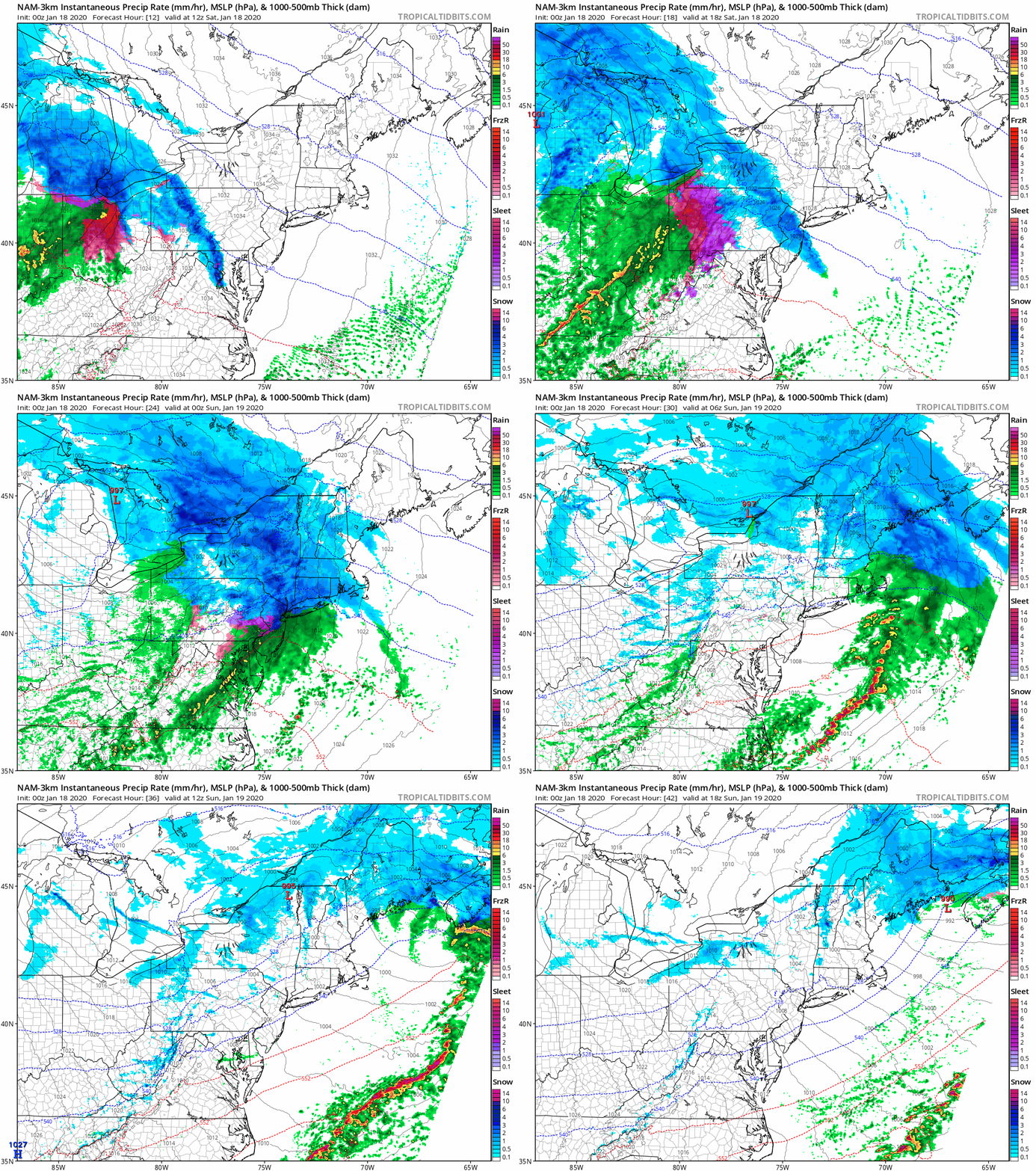
The NAM model shows the progression of the storm with the changeover to sleet. freezing rain, and plain rain gradually spreading northward early Sunday. Loop provided by Tropical Tidbits.

The storm system looks like it will track a bit farther north, passing very close to Boston on Sunday. This will not only allow milder air to move into most of southeastern Massachusetts, but the milder air aloft will also move much farther north than we had anticipated yesterday. Snow will fall heavy at times overnight, especially north of the Mass Pike, but as the warmer air starts to move in, we’ll see a change to sleet and eventually freezing rain move into the South Coast towards Midnight. A change to plain rain is likely before daybreak across southern Rhode Island and southeastern Massachusetts, as temperatures may break into the 40s Sunday morning. Some of the rain could be heavy, which may wash away most of the snow that does fall. Farther north, snow will gradually change to sleet and freezing rain north and west of Boston towards daybreak, with the changeover likely getting into southern NH as well. This will significantly cut down on snow amounts, but could make travel quite hazardous if there’s enough freezing rain.

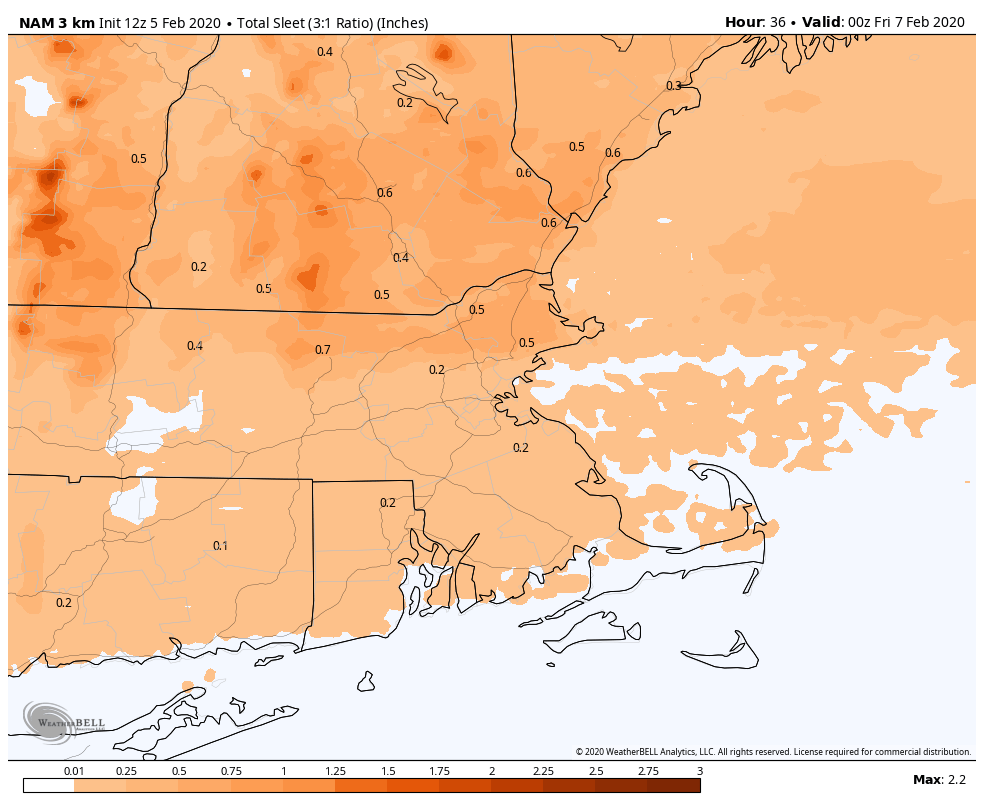
The NAM model is forecasting up to 1/4 inch of freezing rain in parts of southern NH and the Merrimack Valley. Image provided by Pivotal Weather.

By midday, the storm passes by and moves offshore, with winds shifting into the north. This will bring much colder air back in, and rather quickly. Temperatures may get close to or a little above freezing during the morning from southern NH into the Merrimack Valley and the northern and western suburbs of Boston, but by afternoon they’ll quickly drop into the 20s during the afternoon and teens by evening. That will result in a flash freeze, and any untreated surfaces will quickly freeze up, resulting in very hazardous travel. It will also mean that anything you haven’t cleaned off of your car, driveway, sidewalk, etc. will quickly turn into cement. The bitterly cold air will continue to flow in, and temperatures on Monday may struggle to reach the lower teens, with wind chills below zero thanks to gusty northwest winds. These gusty winds may also produce some ocean effect snow across parts of Cape Cod, especially the Outer Cape.

The High Resolution NAM model shows the rollercaster that our temperatures will be on over the next couple of days. Loop provided by Weathermodels.com

So, how much snow are we expecting now? Here’s our current thinking:

Cape Cod/South Coast: 1-3 inches
Southeastern Massachusetts/I-95 corridor: 2-4 inches
MetroWest/North Shore: 3-5 inches
Merrimack Valley/NH Seacoast: 3-6 inches
Southern NH: 4-7 inches
Central NH/Southern Maine: 8-14 inches, with higher amounts the farther north you go.

While there isn’t any one model that matches our current thoughts on accumulations, the High Resolution NAM model is closest to our current thinking. Image provided by the College of DuPage.

Temperatures will slowly start to moderate on Tuesday, then another system may move in on Wednesday, but this one, believe it or not, may be mostly rain. We’ll see how that evolves over the next few days.